


Why Understanding Income Tax Rules for Retirement Benefits Can Save You Thousands
The income tax rules for retirement benefits catch many retirees off guard — often at the worst possible time.
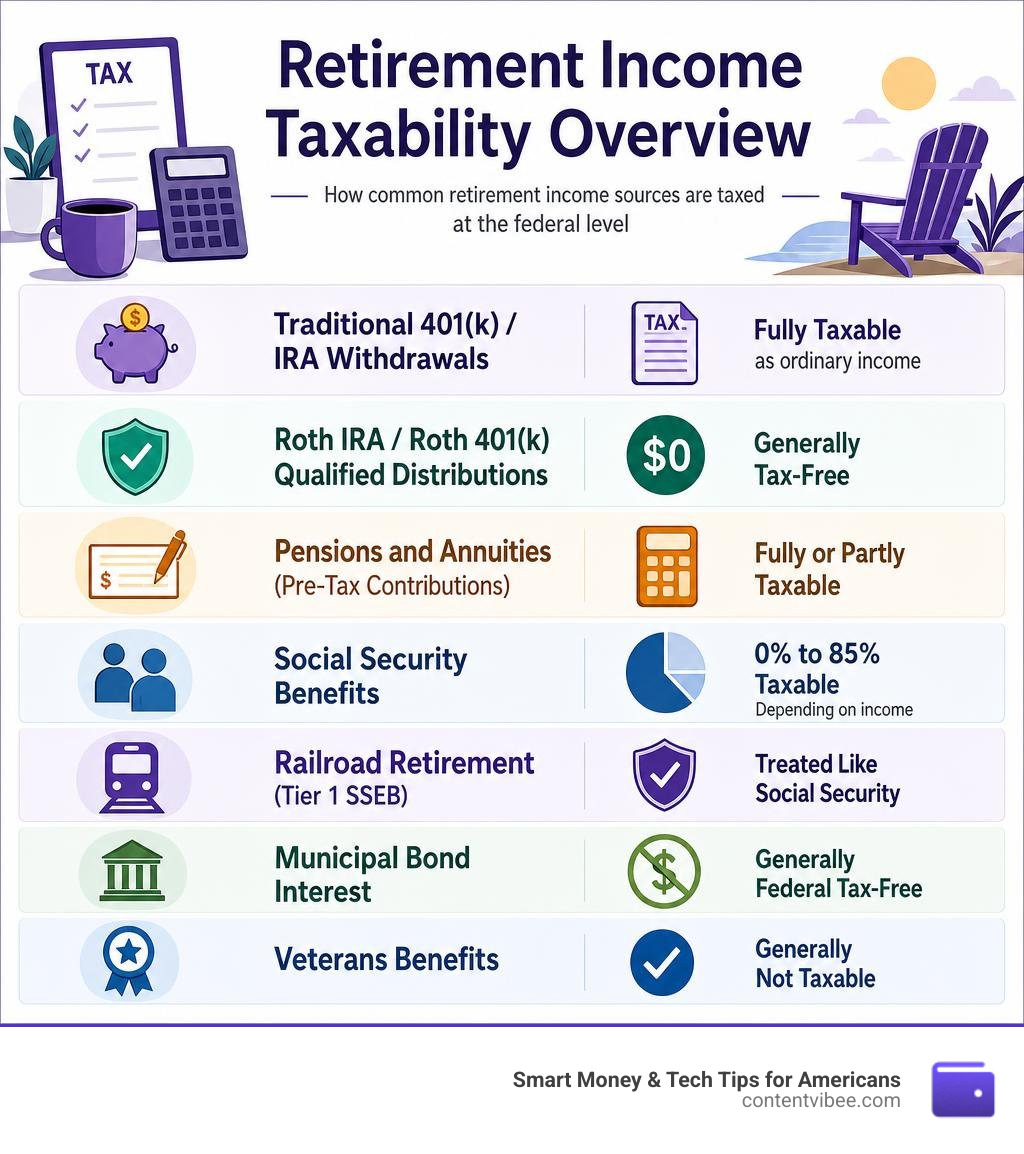
Here’s a quick summary of how different retirement income sources are taxed at the federal level:
| Retirement Income Type | Federal Tax Treatment |
|---|---|
| Traditional 401(k) / IRA withdrawals | Fully taxable as ordinary income |
| Roth IRA / Roth 401(k) qualified distributions | Generally tax-free |
| Pensions and annuities (pre-tax contributions) | Fully or partly taxable |
| Social Security benefits | 0% to 85% taxable depending on income |
| Railroad Retirement (Tier 1 SSEB) | Treated like Social Security |
| Municipal bond interest | Generally federal tax-free |
| Veterans benefits | Generally not taxable |
A persistent misunderstanding among retirees is that retirement income is largely tax-free. In reality, about 50% of Americans who receive Social Security retirement benefits pay taxes on them — and that’s just one piece of the puzzle.
Pensions, annuities, IRA withdrawals, and even some lump-sum distributions all come with their own rules. Miss them, and you risk underpaying taxes, triggering IRS penalties, or leaving money on the table.
The rules aren’t simple. There are two separate IRS methods — the General Rule and the Simplified Method — for calculating how much of your pension or annuity is taxable. The method you must use depends on your plan type and when your payments began. Layer in state taxes, new legislation like the temporary over-65 deduction, and SECURE Act 2.0 changes, and the picture gets complex fast.
This guide breaks it all down in plain language — so you know exactly what to expect and how to plan.
Understanding the Income Tax Rules for Retirement Benefits: General Rule vs. Simplified Method

When you receive periodic payments from a pension or annuity, the IRS doesn’t always tax the entire amount. If you made after-tax contributions to your retirement plan during your working years, those contributions represent your “cost” (also known as your “investment in the contract”).
Because you already paid income tax on that money, the IRS allows you to recover it tax-free over your retirement. The big question is: How do you calculate the tax-free portion of each payment?
The IRS provides two primary methods for cost recovery: the Simplified Method and the General Rule.
- The Simplified Method: This is the most common method. It uses a straightforward calculation based on your age at the annuity starting date to determine a fixed number of monthly tax-free payments. You divide your total investment in the contract by a set number of monthly payments (prescribed by IRS tables) to find the exact tax-free dollar amount for each check.
- The General Rule: This method is more complex and relies on actuarial tables (based on life expectancy multiples) to determine the tax-free portion. Instead of a fixed monthly dollar amount, the General Rule establishes an “exclusion percentage” (or ratio) that you apply to every payment.
For a comprehensive look at how these calculations are structured on federal tax filings, you can refer to the official 2025 Publication 575. If you are looking to get a broader grasp on how these frameworks fit into your overall retirement roadmap, check out The Ultimate Guide to New Retirement Tax Rules.
How the Income Tax Rules for Retirement Benefits Apply to Qualified vs. Nonqualified Plans
Which method are you legally required to use? It depends entirely on whether your retirement plan is qualified or nonqualified.
- Qualified Plans: These are employer-sponsored plans that meet specific Internal Revenue Code requirements (such as traditional pension plans, 401(k)s, 403(b)s, and Keogh plans). For almost all qualified plans with an annuity starting date after November 18, 1996, you must use the Simplified Method. The only exceptions are if you were age 75 or older when payments began and your annuity guarantees five or more years of payments.
- Nonqualified Plans: These are commercial annuity contracts purchased individually from insurance companies using after-tax funds. For nonqualified plans, you must use the General Rule to calculate your tax-free cost recovery.
When you receive distributions, your plan administrator will issue a Form 1099-R. Understanding how to read this form is critical to ensuring your cost recovery is reported correctly. For a step-by-step breakdown of how these forms report your taxable and non-taxable distributions, read our guide on Demystifying Form 1099-R and Your Retirement Distributions.
Calculating Investment in the Contract and Expected Return

To use the General Rule, you have to roll up your sleeves and do some math. Specifically, you need to calculate two primary figures: your investment in the contract and your expected return.
- Investment in the Contract: This is your net cost. Start with the total premiums or contributions you paid into the plan. From that number, subtract any tax-free distributions, refunds, rebates, or dividend payments you received before your annuity starting date.
- Expected Return: This is the total amount you are actuarially expected to receive under the contract. If your annuity is for a fixed term (e.g., $1,000 a month for 10 years), the calculation is simple: multiply the annual payment by the number of years. However, if your annuity is paid for life, you must multiply your annual payment by a life expectancy multiple found in the IRS actuarial tables.
To find these exact actuarial tables and see detailed worksheets, you should consult Publication 939 (12/2025), General Rule for Pensions and Annuities | Internal Revenue Service.
Adjusting the Cost Basis for Refund Features and Exclusions
Before you finalize your investment in the contract, you may need to make a few adjustments to your cost basis:
- Refund Features: If your annuity contract contains a “refund feature” — meaning it promises to pay a beneficiary if you pass away before receiving a guaranteed minimum amount — you must reduce your investment in the contract. You calculate this reduction using IRS Table III or Table VII in Publication 939, based on your age and the duration of the guaranteed payments.
- Death Benefit Exclusions: If you are a beneficiary inheriting an annuity from an employee who passed away before August 21, 1996, you may be eligible to add a death benefit exclusion of up to $5,000 to the cost basis, reducing your overall taxable portion.
- Foreign Employment: If you worked abroad and your employer made contributions to your retirement plan that were exempt from U.S. tax under foreign tax treaties at the time, those contributions can sometimes be added to your investment in the contract, increasing your tax-free recovery.
Determining the Exclusion Percentage for Periodic Payments
Once you have calculated your adjusted investment in the contract and your expected return, you can determine your exclusion percentage:
$$\text{Exclusion Percentage} = \frac{\text{Adjusted Investment in the Contract}}{\text{Expected Return}}$$
Multiply this percentage by your periodic annuity payment to find the tax-free portion. The remainder of each payment is fully taxable.
- Part-Year Payments: If you retire mid-year, apply the exclusion percentage only to the payments you actually received during that calendar year.
- Annuity Increases: If you receive a cost-of-living adjustment (COLA) or another increase in your pension amount, the tax-free dollar amount remains fixed based on your original calculation. The entire amount of the increase is treated as taxable income.
- Variable Annuities: If you have a variable annuity where payments fluctuate based on investment performance, you do not use a percentage. Instead, you divide your investment in the contract by the number of expected payments to find a fixed, tax-free dollar amount per payment.
Federal and State Tax Rules for Social Security and Pensions
Managing your taxes in retirement requires looking at your entire income portfolio. Many retirees are shocked to discover that federal and state governments can tax both their pensions and their Social Security benefits.
At the federal level, up to 85% of your Social Security benefits can be taxed depending on your provisional income (also called “combined income”). The IRS calculates provisional income using this formula:
$$\text{Provisional Income} = \text{Adjusted Gross Income (AGI)} + \text{Tax-Exempt Interest} + 50\% \text{ of Social Security Benefits}$$
The federal tax thresholds for Social Security are structured as follows:
- Single Filers:
- Provisional income under $25,000: 0% of benefits are taxable.
- Provisional income between $25,000 and $34,000: Up to 50% of benefits may be taxable.
- Provisional income above $34,000: Up to 85% of benefits may be taxable.
- Married Filing Jointly:
- Provisional income under $32,000: 0% of benefits are taxable.
- Provisional income between $32,000 and $44,000: Up to 50% of benefits may be taxable.
- Provisional income above $44,000: Up to 85% of benefits may be taxable.
To avoid a surprise tax bill at the end of the year, you can submit Form W-4V to the Social Security Administration to request voluntary federal income tax withholding at a rate of 7%, 10%, 12%, or 22%.
For a deeper dive into these calculations, check out the resources on Do you pay taxes on Social Security? and read our comprehensive Social Security Taxable Income Guide 2026.
Navigating State-Specific Income Tax Rules for Retirement Benefits
State-level taxation is a completely different ballgame. While some states are highly tax-friendly for retirees, others tax retirement benefits aggressively.
- Social Security State Taxes: Currently, eight states tax Social Security benefits based on your income: Colorado, Connecticut, Minnesota, Montana, New Mexico, Rhode Island, Utah, and Vermont.
- State Pension Exclusions: Many states offer specific exclusions for pension and annuity income. For example, New York allows an annual pension and annuity income exclusion of up to $20,000 for residents who are age 59½ or older.
- Colorado Pension Subtraction: Colorado offers a pension and annuity subtraction of up to $24,000 for taxpayers age 65 and older. For retired military servicemembers under age 55, Colorado allows a military retirement subtraction of up to $15,000.
For a broader look at how different states handle retirement income, sales taxes, and property taxes, read the analysis on What taxes do I pay in retirement?.
Recent Tax Law Changes, NIIT, and the Over-65 Deduction
As of July 2026, several key legislative pieces impact retirement planning:
- The Temporary Over-65 Deduction: Introduced in recent federal legislation, this temporary tax benefit provides a $6,000 deduction for taxpayers over age 65 with a Modified Adjusted Gross Income (MAGI) up to $75,000 (single) or $150,000 (married filing jointly). It phases out completely at MAGI levels of $175,000 for single filers and $250,000 for joint filers, and is set to expire after 2028.
- Net Investment Income Tax (NIIT): The 3.8% NIIT surtax applies to net investment income for high-income earners (with MAGI above $200,000 for single filers and $250,000 for joint filers). While distributions from qualified retirement plans (like 401ks and traditional IRAs) are exempt from NIIT, distributions from nonqualified annuity plans are considered net investment income and are subject to the 3.8% surtax.
- SECURE Act 2.0: This legislation continues to shape the retirement landscape by raising the Required Minimum Distribution (RMD) age to 73 (and eventually to age 75 for those reaching age 74 after December 31, 2032).
Our team at ContentVibee specializes in delivering clear, actionable guidance on complex financial regulations like the SECURE Act 2.0 RMD changes. To protect your assets from shifting tax policies, read up on TCJA Expiration Strategies to Protect Your Wealth.
Special Rules for Beneficiaries and Deceased Retirees
When a retiree passes away, the tax rules governing their remaining pension or annuity benefits transition to their beneficiaries:
- Proportional Allocation of Exclusions: In states like New York, the $20,000 maximum pension and annuity income exclusion must be allocated among multiple beneficiaries based on the proportional value of the inherited pensions and annuities. For example, if two beneficiaries inherit an estate’s remaining $500,000 pension split as $350,000 (70%) and $150,000 (30%), their respective inherited exclusions would be $14,000 and $6,000.
- Cost Recovery for Beneficiaries: If a retiree dies before fully recovering their investment in a contract, the surviving beneficiary can continue to exclude the tax-free portion of the payments using the deceased retiree’s original exclusion ratio until the cost basis is fully recovered.
Strategic Withdrawal Ordering and Minimizing Retirement Taxes
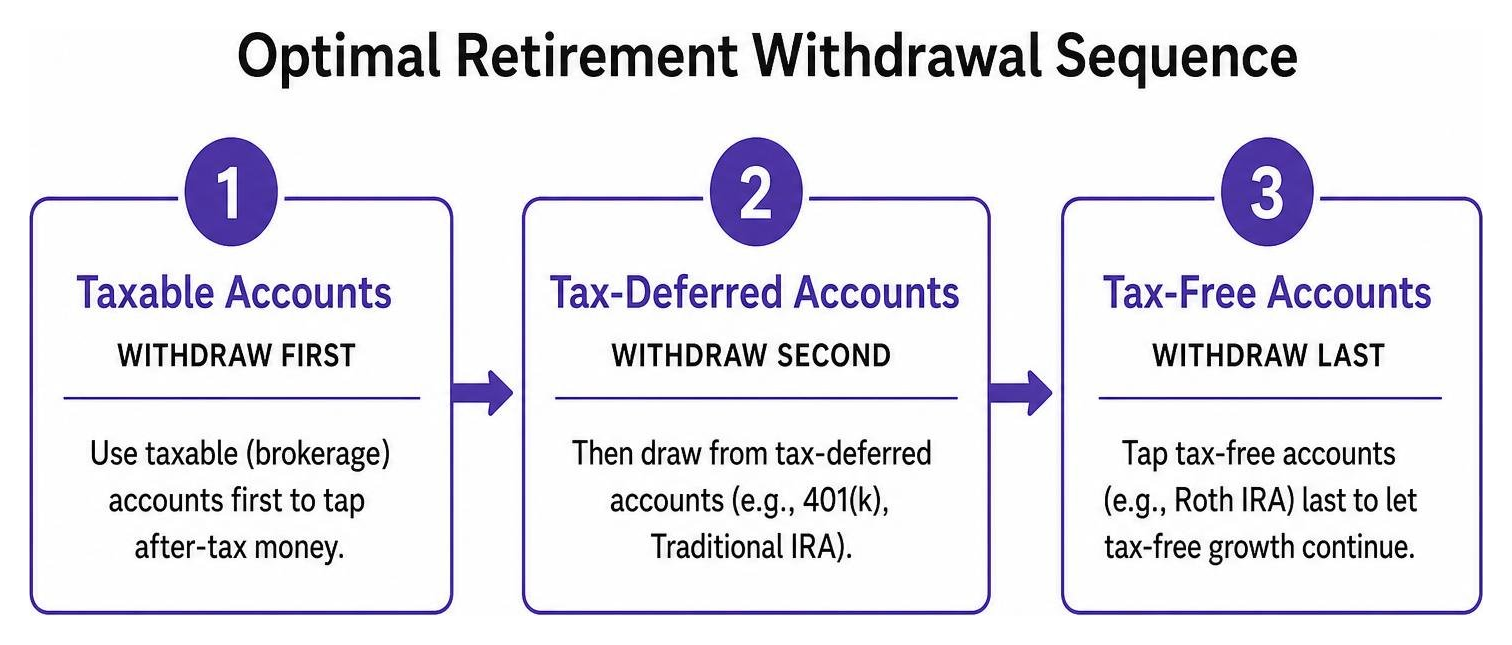
Minimizing taxes in retirement is all about controlling your taxable income from year to year. By strategically choosing which accounts to tap first, you can keep yourself in a lower tax bracket and prevent your Social Security benefits from being taxed.
Here is a comparison of how different accounts are treated under federal tax rules:
| Account Type | Contribution Tax Treatment | Distribution Tax Treatment | RMD Requirements |
|---|---|---|---|
| Traditional IRA / 401(k) | Pre-tax (deductible) | Fully taxable (ordinary income) | Yes (starts at age 73) |
| Roth IRA / 401(k) | After-tax (non-deductible) | 100% Tax-free (qualified) | No (for original owner) |
| Taxable Brokerage | After-tax | Capital gains rates (on growth) | No |
| Health Savings Account (HSA) | Pre-tax | 100% Tax-free (for medical expenses) | No |
Smart Strategies to Lower Your Tax Bill
- Strategic Withdrawal Sequencing: A classic withdrawal strategy is to tap your taxable accounts first. This allows your tax-deferred (Traditional) and tax-free (Roth) accounts to continue growing. Once taxable accounts are depleted, draw from tax-deferred accounts up to the top of your current tax bracket, and use tax-free Roth accounts to cover any additional spending needs.
- Roth Conversions: If you have a year where your income is unusually low, consider converting a portion of your traditional IRA into a Roth IRA. You will pay ordinary income tax on the converted amount now, but the funds will grow tax-free and will not be subject to future RMDs.
- Municipal Bonds: Investing in municipal bonds can provide a steady stream of interest income that is completely exempt from federal income taxes (and often state and local taxes, too).
- Health Savings Accounts (HSAs): If you saved in an HSA during your working years, you can withdraw those funds tax-free in retirement to pay for qualified medical expenses, including Medicare premiums.
To help model these choices, check out The Great Retirement Debate: Roth vs Traditional 401k Calculator Guide.
Frequently Asked Questions About Retirement Benefit Taxes
What is the 10-year tax option for lump-sum distributions?
The 10-year tax option is a special formula used to calculate the tax on a lump-sum distribution from a qualified retirement plan. It allows you to treat the distribution as if it were paid to you over a 10-year period, using 1986 federal income tax rates.
To qualify for this option, the plan participant must have been born before January 2, 1936. If eligible, you must file Form 4972 with your tax return to elect this treatment.
How do I set up tax withholding on my retirement benefits?
You can manage withholding on your retirement income using specific IRS forms:
- Periodic Pension/Annuity Payments: Submit Form W-4P to your plan administrator to set up or change your federal income tax withholding.
- Nonperiodic Distributions (e.g., lump sums): Submit Form W-4R to request a specific withholding rate.
- Social Security: Submit Form W-4V to the Social Security Administration.
If you choose not to have taxes withheld, or if your withholding is insufficient, you must make quarterly estimated tax payments using Form 1040-ES to avoid underpayment penalties.
Are joint and survivor annuities taxed differently?
Under the General Rule, joint and survivor annuities are calculated using Table VI (for two lives) in Publication 939 to determine the expected return. This multiple accounts for the joint life expectancy of both the primary annuitant and the survivor.
The resulting exclusion percentage applies to the payments received while both are living, as well as the payments continued to the survivor after the primary annuitant passes away.
Conclusion
Navigating the income tax rules for retirement benefits requires careful, proactive planning. From choosing between the General Rule and the Simplified Method to managing state-specific pension exclusions and Social Security tax thresholds, the choices you make today will directly impact your retirement lifestyle.
At ContentVibee, we are dedicated to helping you make sense of these complex rules so you can keep more of your hard-earned savings. For a detailed breakdown of which states offer the most favorable tax environments for retirees, take a look at our comprehensive rankings in Best States for Taxes in Retirement Ranked.