


Why TCJA Expiration Planning Could Be the Most Important Financial Move You Make This Year
TCJA expiration planning is no longer something you can put off — the One Big Beautiful Bill Act, signed into law on July 4, 2025, permanently extended many TCJA provisions, but several others remain temporary or modified, and the tax landscape has shifted significantly for individuals, families, and business owners alike.
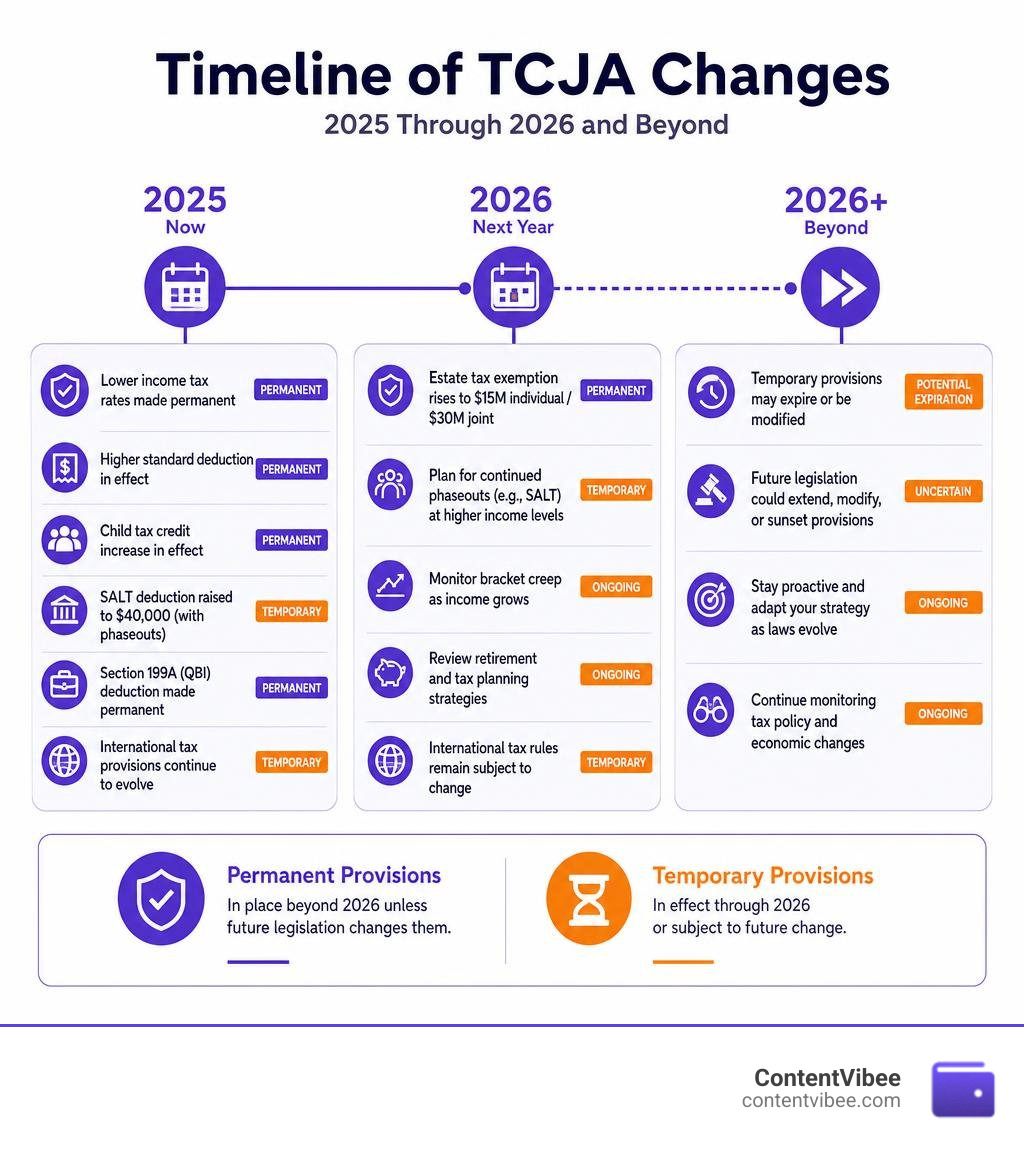
Here is a quick snapshot of what changed and what still matters for your planning:
| Area | What Happened | Action Needed? |
|---|---|---|
| Income tax rates | Lower TCJA brackets made permanent | Monitor bracket creep |
| Standard deduction | Increased to $15,750 single / $31,500 joint for 2025 | Review itemizing vs. standard |
| Child tax credit | Increased to $2,200 per qualifying child | Update withholding |
| SALT deduction | Raised to $40,000 joint (with phaseouts above $500K) | Re-evaluate itemized deductions |
| Estate tax exemption | Rising to $15M individual / $30M joint in 2026 | Review gifting strategies |
| QBI deduction (Section 199A) | Made permanent for pass-through businesses | Reassess entity structure |
| GILTI / FDII / BEAT | International rates still shifting | Revisit global tax positioning |
Even with many provisions now permanent, the rules are not the same as before. Phaseouts, modified thresholds, new savings vehicles, and international tax changes mean the strategy that worked in 2024 may not be the right one today.
For mid-career professionals — especially those approaching retirement and weighing decisions like Roth conversions or 403(b) rollovers — understanding exactly how these changes affect your tax picture is critical. Getting it wrong could cost tens of thousands of dollars over a decade.
This guide walks you through every major area: income taxes, family benefits, business impacts, estate planning, and retirement strategies — so you can make confident, informed decisions right now.
TCJA expiration planning word list:
The 2026 Tax Cliff: How the Sunset Reshapes Individual Income Taxes
While the 2025 legislative updates under the One Big Beautiful Bill Act (OBBBA) made the lower marginal income tax brackets permanent, the overall individual tax landscape remains highly dynamic. As we navigate July 2026, many taxpayers are realizing that “permanent tax brackets” do not mean their tax bills are set in stone. The interplay of standard deductions, the return of older structural limitations, and shifting exemptions means that your effective tax rate could still creep upward if you do not adapt.
Prior to the recent legislative revisions, a full sunset would have reverted the top marginal tax rate back to 39.6% from 37%. While the lower rates have been stabilized, the standard deduction amounts are under constant pressure. For 2025, the standard deduction was elevated to $15,750 for single filers and $31,500 for joint filers. However, the suspension of personal exemptions remains a core talking point. Before the 2017 reform, personal exemptions allowed taxpayers to deduct a set amount (such as $4,050 in 2017) for themselves, their spouses, and each dependent.

Without a proactive approach, the loss of certain itemized deductions and structural shifts can still result in a higher overall tax burden. To protect your hard-earned cash, you must look beyond the headline marginal rates and analyze how your adjusted gross income (AGI) interacts with the evolving rules. Learn more about the TCJA expiration date and your wallet to see how these shifting dynamics directly impact your monthly cash flow.
Proactive TCJA Expiration Planning for Bracket Creep
Even with stabilized tax brackets, inflation remains the silent pickpocket of the financial world. Tax bracket creep occurs when inflation pushes your nominal income into higher tax brackets, or when cost-of-living salary adjustments outpace the adjustments made to tax thresholds. In an era of economic fluctuation, managing this creep is essential.
When you experience bracket compression, the gap between brackets narrows in real terms, meaning a larger portion of your income is taxed at your highest marginal rate. Proactive wealth management requires a suite of defensive tactics. We recommend maximizing your contributions to tax-deferred accounts, such as traditional 401(k)s or 403(b)s, to lower your current-year AGI. Additionally, timing your capital gains and losses can prevent you from crossing into higher tax tiers.
To help you stay ahead of these subtle shifts, we have compiled the best industry secrets. Check out our comprehensive tips to avoid moving into a higher tax bracket to keep your income where it belongs. For a deeper dive into the mechanics of inflation and its relationship with the IRS, read about how inflation shifts your tax bracket.
Reverting Family Tax Benefits and Itemized Deductions
For families, the sunset of temporary provisions introduces significant changes. Under the modified rules, the Child Tax Credit (CTC) has adjusted to $2,200 per qualifying child. However, the phaseout thresholds are highly sensitive to income fluctuations. If these provisions revert to pre-TCJA levels in future budget negotiations, the credit could drop back to $1,000, with phaseouts starting at just $75,000 for single taxpayers and $110,000 for married couples.
Itemized deductions are also seeing a major overhaul:
- The SALT Deduction: The state and local tax (SALT) deduction cap, which was famously limited to $10,000 under the original TCJA, was raised to $40,000 for joint filers (with phaseouts starting above $500,000 MAGI). For high-income earners in states like New York or California, this change is a massive relief, but navigating the phaseouts requires careful timing of state tax payments.
- Mortgage Interest Deduction: Under the original TCJA, the deduction was limited to interest on the first $750,000 of new qualifying mortgage debt. If the sunset provisions take full effect, this limit could revert to $1 million, and interest on Home Equity Lines of Credit (HELOCs) used for non-home-improvement purposes may become deductible again.
- The Pease Limitation: This historical rule, which reduces the value of itemized deductions for high-income earners once their AGI exceeds a certain threshold, is scheduled to return if older rules are restored.
To see a side-by-side comparison of how these complex rules shift before and after expiration, you can consult the Official CRS Reference Table on Expiring Provisions.
Business and Investment Impacts: QBI, Depreciation, and International Provisions
For business owners, the tax landscape requires constant monitoring. While the flat 21% corporate tax rate remains a permanent fixture of the tax code, pass-through entities (such as S-corporations, partnerships, and sole proprietorships) have faced intense scrutiny. The Section 199A Qualified Business Income (QBI) deduction, which allowed eligible business owners to deduct up to 20% of their business income, was made permanent under the OBBBA, providing much-needed stability for local enterprises.
However, depreciation rules are still phasing out. The highly popular 100% bonus depreciation, which allowed businesses to immediately write off the full cost of qualifying capital purchases, has been phasing down (80% in 2023, 60% in 2024, 40% in 2025, and dropping further unless Congress intervenes).

For a detailed breakdown of how these changing depreciation rules affect your capital expenditure strategy, read the Analysis of TCJA Expiration and Bonus Depreciation Rules.
Entity Restructuring and TCJA Expiration Planning
With the QBI deduction stabilized but other corporate tax structures shifting, many business owners are asking: Is my current entity structure still optimal?
Choosing between an S-corporation and a C-corporation requires a careful calculation of your tax rate arbitrage. While S-corporation income passes through directly to your personal tax return, C-corporations benefit from the flat 21% rate but face the risk of double taxation on dividends.
If you decide that transitioning to an S-corporation is the best path to reduce self-employment taxes, you must file Form 2553 with the IRS. Typically, this election must be made no later than two months and 15 days after the beginning of the tax year for which the election is to take effect. Timing these entity elections before the end of the fiscal year is a critical step in TCJA expiration planning.
International Tax Adjustments: GILTI, FDII, and BEAT
If your business operates internationally, the sunset of the TCJA’s global provisions could significantly increase your tax liability. The three main pillars of international tax reform are scheduled for rate increases:
- GILTI (Global Intangible Low-Taxed Income): The deduction for GILTI is scheduled to reduce from 50% to 37.5%, effectively increasing the U.S. tax rate on these foreign earnings from 10.5% to 13.125%.
- FDII (Foreign-Derived Intangible Income): The deduction for domestic companies serving foreign markets will decrease from 37.5% to 21.875%, raising the effective tax rate on export-related intangible income.
- BEAT (Base Erosion and Anti-Abuse Tax): The BEAT rate, designed to prevent multinational corporations from shifting profits out of the U.S. through payments to foreign affiliates, is set to rise from 10% to 12.5%, and certain tax credits will no longer be allowed to offset it.
Proactive global tax positioning is essential to mitigate these rate hikes. Multinational businesses should review their supply chains, intellectual property holding structures, and transfer pricing agreements to ensure they are fully optimized for the post-sunset environment.
Advanced TCJA Expiration Planning for Estates and High-Net-Worth Individuals
High-net-worth individuals are facing a genuine “use it or lose it” scenario. Under the OBBBA, the federal estate and gift tax exemption was elevated to a staggering $15 million per individual ($30 million for married couples) for 2026. However, if future political administrations allow these high exemptions to sunset, the lifetime exemption is projected to drop by roughly half, reverting to approximately $7 million to $8 million per individual.
At a 40% top federal estate tax rate, failing to plan for this drop could cost a wealthy family millions of dollars in unnecessary taxes. To help you navigate these high-stakes decisions, we recommend reading the Comprehensive Guide on Planning for the Sunset.
Wealth Transfer and Trust Strategies
To lock in the benefits of the historically high exemption before any future reductions, wealthy families are utilizing advanced trust structures:
- Spousal Lifetime Access Trusts (SLATs): A SLAT allows one spouse to fund an irrevocable trust for the benefit of the other spouse (and children). This removes the assets from the taxable estate while still allowing indirect access to the funds through the beneficiary spouse.
- Dynasty Trusts: These trusts are established in states with favorable trust laws to hold wealth across multiple generations without triggering estate or generation-skipping transfer (GST) taxes.
- Irrevocable Life Insurance Trusts (ILITs): An ILIT can hold life insurance policies, ensuring the death benefit is not included in your gross estate and providing liquidity to pay estate taxes without forcing the sale of family assets.
Crucially, the IRS has issued anti-clawback regulations, confirming that individuals who make large lifetime gifts during the high-exemption period will not be penalized if the exemption amount is later reduced. This makes aggressive lifetime gifting one of the most effective strategies available today.
Retirement and Charitable Giving Optimization
For retirement savers, the current tax window presents a unique opportunity for tax rate arbitrage. Executing a Roth IRA conversion allows you to pay taxes on your retirement funds at today’s known rates, allowing the assets to grow and be withdrawn completely tax-free in retirement.
Additionally, charitable giving can be optimized through the use of Donor-Advised Funds (DAFs). By “bunching” multiple years of charitable contributions into a single tax year and contributing them to a DAF, you can surpass the standard deduction threshold to claim a massive itemized deduction, while distributing the funds to your favorite charities over time.
For more actionable retirement advice, explore our strategies to defer taxes and boost retirement savings to secure your financial future.
Frequently Asked Questions about the Sunset
As the landscape continues to evolve, taxpayers frequently ask about the long-term outlook of these policies and how they interact with state and federal budgets.
Which TCJA provisions are permanent and will not expire?
Several provisions of the original TCJA and subsequent legislation are permanent and do not have a sunset date:
- The Flat 21% Corporate Tax Rate: Unlike individual provisions, the corporate rate reduction was made permanent.
- Chained CPI: The transition to Chained CPI for indexing tax brackets and inflation adjustments remains permanent. This slower measure of inflation gradually pushes taxpayers into higher brackets over time.
- The Elimination of the Alimony Deduction: For divorce agreements executed after 2018, alimony payments are no longer deductible by the payer, nor are they taxable income for the recipient.
How does the TCJA sunset affect state-level taxes?
State income tax systems are highly dependent on federal rules, a concept known as state tax conformity. When federal definitions of adjusted gross income (AGI) or itemized deductions change, state tax liabilities often shift automatically.
For retirees, choosing the right state to call home can make a massive difference in their overall tax burden. To compare your options, check out our guide to state pension tax breaks and our definitive ranking of the best states for taxes in retirement.
What is the cost of making the TCJA provisions permanent?
The debate over extending temporary tax cuts is heavily driven by their impact on the federal deficit. According to the Congressional Budget Office (CBO) and the Joint Committee on Taxation (JCT), making all of the expiring individual and business provisions permanent would cost an estimated $4.0 trillion to $4.6 trillion over a decade.
If you are interested in the historical context of these massive legislative shifts, you can read the Analysis of the Tax Cuts and Jobs Act Enactment and Long-Term Fiscal Impact to understand how we arrived at this fiscal crossroads.
Conclusion
At ContentVibee, we believe that proactive financial planning is the key to building and preserving long-term wealth. The shifting sands of TCJA expiration planning require a vigilant, step-by-step approach. By understanding how these changes affect your individual brackets, family deductions, business entities, and estate plans, you can make strategic moves today that protect your hard-earned assets for decades to come.
Do not let tax changes catch you off guard as you prepare for your golden years. Prepare for retirement taxes with our guide to Social Security tax on benefits and take control of your financial destiny today.