


How Much Your State Taxes Can Cost You in Retirement
Finding the best states for taxes in retirement can save you thousands of dollars every single year. And over a 20-year retirement, those savings can compound into a life-changing amount.
Here are the top tax-friendly states for retirees at a glance:
| Rank | State | Income Tax | Social Security Tax | Sales Tax | Property Tax Rate |
|---|---|---|---|---|---|
| 1 | Wyoming | None | None | 5.36% | ~0.58% |
| 2 | Alaska | None | None | 1.82% | Varies |
| 3 | Florida | None | None | ~7% | ~0.83% |
| 4 | South Dakota | None | None | ~6.4% | ~0.99% |
| 5 | Nevada | None | None | ~8.2% | ~0.49% |
| 6 | Tennessee | None | None | 9.62% | ~0.49% |
| 7 | Texas | None | None | ~8.2% | ~1.40% |
| 8 | Mississippi | 4% flat | None | ~7.1% | Low |
| 9 | Pennsylvania | 3.07% flat | None | 6% | Varies |
| 10 | Iowa | Varies | None | ~6.9% | ~1.5% |
The core idea is simple: some states take a big cut of your retirement income, and others take almost nothing.
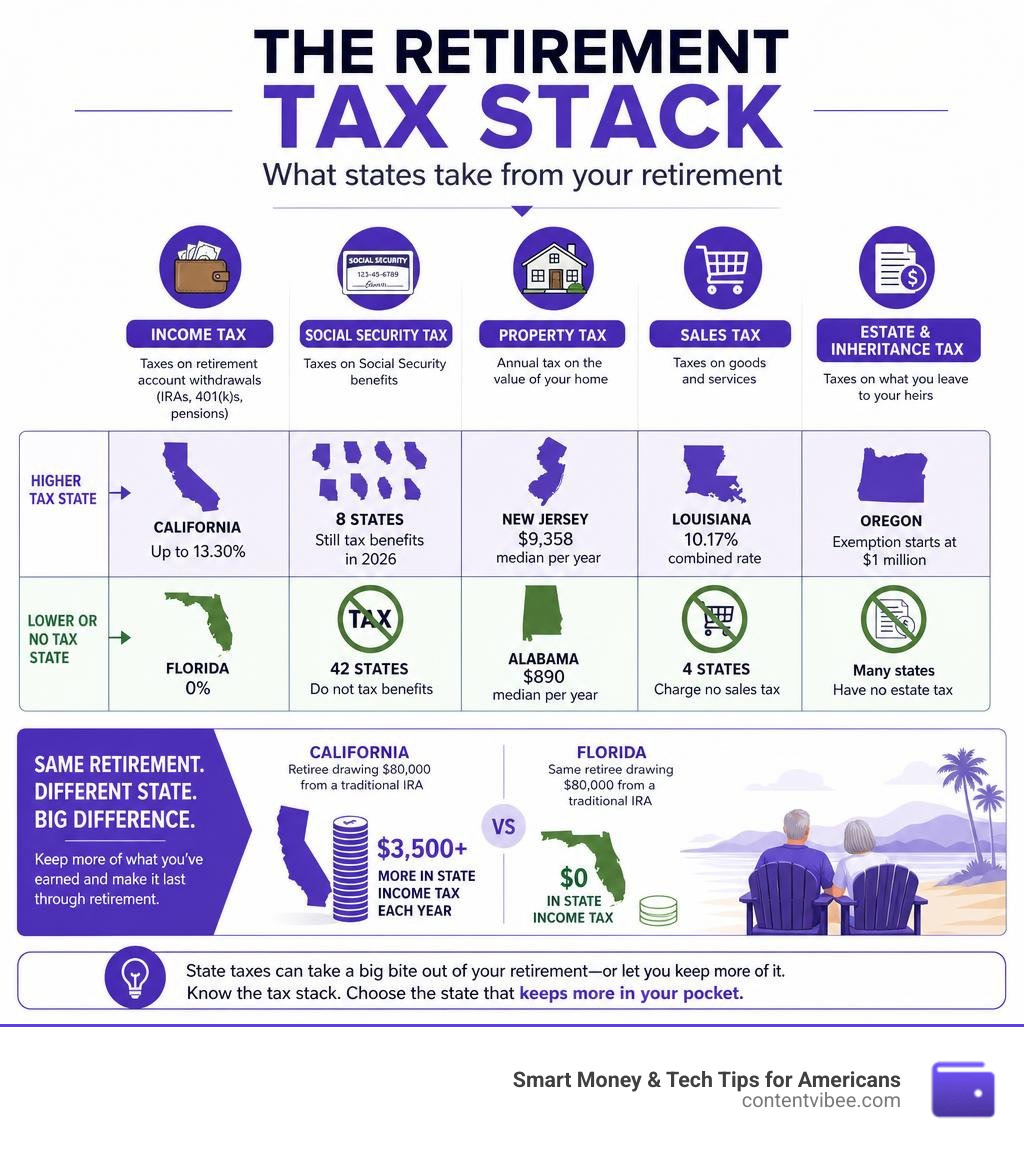
A retiree drawing $80,000 a year from a traditional IRA in California pays roughly $3,500 more in state income tax than the same retiree in Florida — who pays zero. Move that annual gap to a state like Oregon, and a married couple could be paying an effective state tax rate of nearly 13% on their IRA withdrawals.
That’s money that could stay in your pocket — or keep compounding in your portfolio.
State taxes in retirement aren’t just about income tax rates. You also need to think about:
- Social Security taxes — only 8 states still tax benefits in 2026
- Retirement account withdrawals — IRAs, 401(k)s, and pensions are treated very differently by state
- Property taxes — the median New Jersey homeowner pays $9,358 per year; in Alabama, it’s just $890
- Sales taxes — Louisiana’s combined rate hits 10.17%, while four states charge none at all
- Estate and inheritance taxes — Oregon’s exemption starts at just $1 million
The right state depends on your income mix, your assets, and your lifestyle. This guide breaks it all down clearly so you can make a smart, informed decision.
Key terms for best states for taxes in retirement:
Why Your Tax Map Changes in 2026
The tax landscape for retirees is never static. Over the last few years, several states have passed sweeping legislation to make themselves more attractive to retirees. If you are planning your golden years based on tax laws from five years ago, your map is officially outdated.
As we look at the tax landscape in July 2026, several massive state-level shifts have fully taken effect:
- West Virginia’s Social Security Phase-Out: West Virginia has officially completed its three-year phase-out of the state income tax on Social Security benefits. As of 2026, all Social Security benefits are 100% tax-exempt in the Mountain State.
- Michigan’s Retirement Income Exemption: Michigan has completed its phase-out of state income tax on most retirement and pension benefits. This means defined-benefit pensions, IRA distributions, 401(k) withdrawals, and annuity income are now largely exempt from state taxation for Michigan retirees.
- Ohio’s Flat Tax Transition: Ohio has simplified its tax structure, moving to a flat 2.75% income tax rate with a generous zero-tax bracket for anyone earning up to $26,050.
- Federal Estate Tax Exemption: On the federal level, the estate tax exemption has risen to a historic $15 million per person in 2026 (up from $13.99 million in 2025). This keeps federal estate taxes out of reach for the vast majority of Americans, but state-level estate taxes remain a key concern.
Keeping up with these changes is essential to protecting your nest egg. If you are looking for ways to structure your accounts before making a big move, check out our guide on Smart Strategies To Defer Taxes And Boost Your Retirement Savings to optimize your withdrawals.
The Best States for Taxes in Retirement Ranked
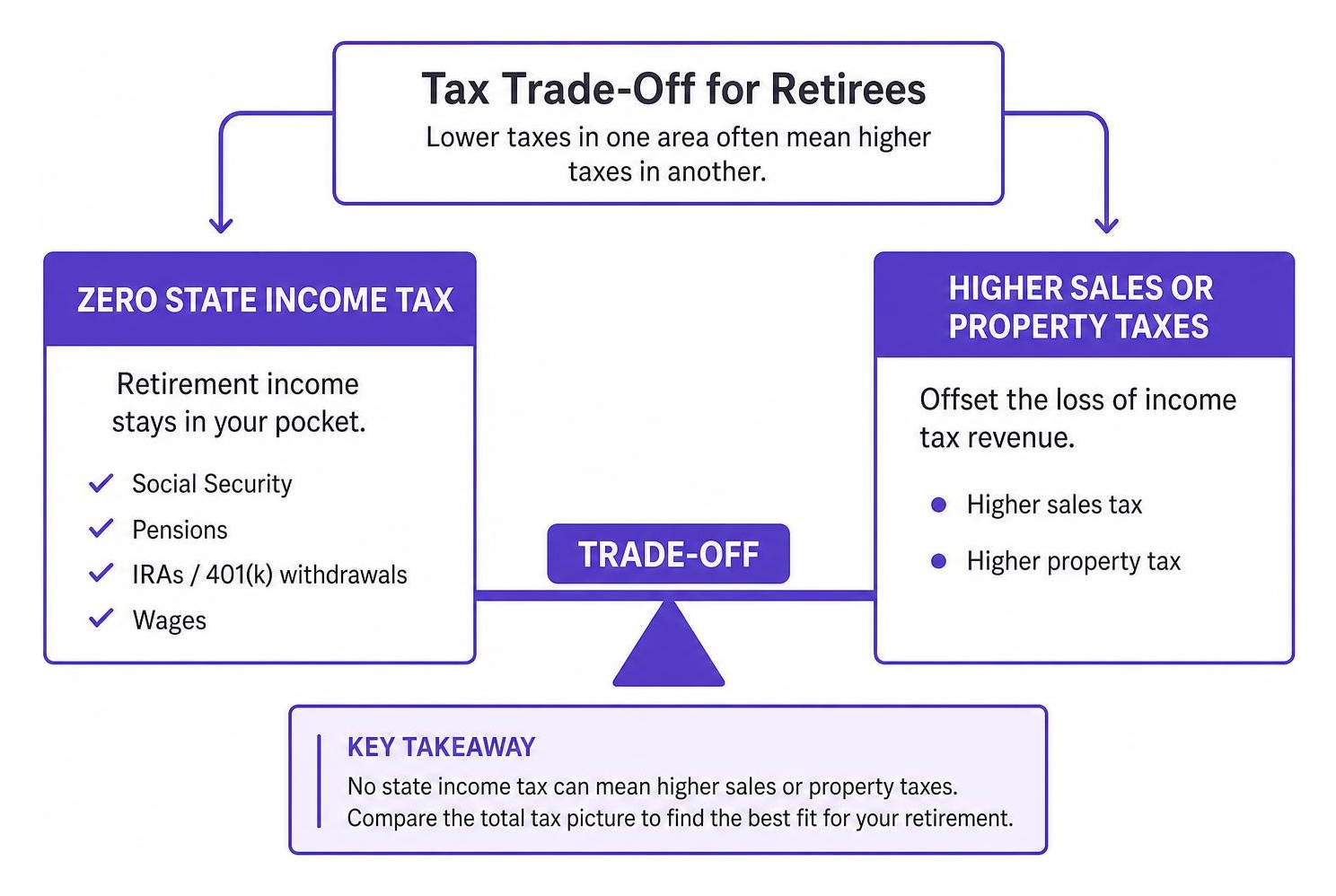
When we rank the best states for taxes in retirement, we look at the total tax picture. Many people make the mistake of moving to a state with zero income tax, only to get slammed by double-digit sales taxes or sky-high property tax assessments.
Here is our detailed breakdown of the top-ranked tax-friendly states for retirees.
1. Wyoming
Wyoming is arguably the single most tax-friendly state in the country. It has no state income tax, meaning your Social Security, pensions, IRAs, and 401(k) withdrawals are completely untouched. Additionally, Wyoming boasts an exceptionally low effective property tax rate of roughly 0.58%, and property is assessed at just 9.5% of its market value. With a combined state and local sales tax of only 5.36% and no state estate or inheritance tax, Wyoming lets you keep almost every penny you earn.
2. Alaska
Alaska has no state income tax and no state-level sales tax (though some local municipalities levy small sales taxes, averaging a combined rate of just 1.82%). For senior homeowners, Alaska offers a generous property tax exemption on the first $150,000 of assessed value for residents aged 65 and older. The trade-off? Alaska has a high overall cost of living due to its remote location, but from a pure tax perspective, it is incredibly tough to beat.
3. Florida
The classic retirement haven remains highly competitive. Florida has no state income tax, no estate tax, and no inheritance tax. Its property tax rates are moderate (effective rate of around 0.83%), and the state’s Homestead Exemption program helps protect primary residences from rapid valuation increases. Sales taxes hover around 7% depending on the county, making it a highly balanced and tax-efficient destination.
4. South Dakota
South Dakota is another zero-income-tax state that treats retirees wonderfully. It does not tax any form of retirement income, has no estate or inheritance taxes, and maintains a moderate combined sales tax rate of about 6.4%. Its effective property tax rate is slightly higher than Wyoming’s at around 0.99%, but it remains an incredibly affordable place to live.
5. Nevada
Nevada levies no state income tax, which means zero state taxes on your pension, IRA, or Social Security benefits. Property taxes are also highly favorable, with an average effective rate of just 0.49%. The state offsets this by charging higher sales taxes (averaging around 8.2% combined), but for retirees with large retirement account balances, this trade-off is usually highly beneficial.
6. Tennessee
Tennessee has no state income tax, having fully phased out its tax on interest and dividends. While this makes retirement withdrawals completely tax-free, Tennessee has the second-highest combined sales tax rate in the nation at 9.619%. If you plan to spend heavily on taxable goods in retirement, Tennessee’s sales tax can eat into your income tax savings.
7. Texas
Texas has no state income tax, which is highly appealing to retirees with large 401(k) and pension distributions. However, Texas makes up for this zero-income-tax status with some of the highest property taxes in the country. The state’s average effective property tax rate is 1.40%, meaning a $400,000 home could easily cost you $5,600 or more in annual property taxes.
8. Washington
Washington has no personal income tax, making it great for standard retirement withdrawals. However, Washington does impose a 7% tax on long-term capital gains exceeding $278,000, and it has a relatively low estate tax exemption threshold of $3.076 million. Combine that with a high average sales tax of 9.51%, and wealthier retirees need to plan carefully.
9. New Hampshire
New Hampshire has no state income tax and officially eliminated its tax on dividend and interest income. It also has no state or local sales tax. However, New Hampshire has some of the highest property taxes in the nation, with an average effective rate of around 1.50%.
Before packing your bags for any of these states, it is crucial to understand how much you actually need to save to support your lifestyle. Use our Retirement Calculator Estimate Savings Needed to run your personal numbers.
How States Tax Social Security and Pension Income
If you do not retire in one of the nine states with no income tax, you are subject to state-specific rules on how your retirement distributions are taxed. Some states that do have a state income tax actually fully exempt retirement withdrawals, making them just as tax-friendly as states with no income tax at all. You can find detailed tax rules and updates directly on official state department of revenue websites or check federal guidelines via the Social Security Administration.
States That Fully Exempt Retirement Withdrawals
There are four unique states that impose a standard state income tax on wages but completely exempt retirement income like pensions, traditional IRAs, and 401(k) distributions:
- Iowa: Iowa made all retirement income completely tax-exempt for residents aged 55 and older. If you are retired in Iowa, your 401(k), IRA, and pension distributions face a 0% state tax rate.
- Illinois: Despite its reputation as a high-tax state, Illinois does not tax qualified retirement income. All distributions from IRAs, 401(k) plans, and public/private pensions are exempt from state income tax.
- Mississippi: Mississippi does not tax Social Security, qualified pension income, or distributions from 401(k)s and IRAs. The state’s flat income tax rate is also scheduled to drop to 3% by 2030.
- Pennsylvania: Pennsylvania has a flat 3.07% income tax rate, but it fully exempts all qualifying retirement income, including pensions, IRAs, and 401(k)s, once you reach retirement age.
If you are looking for alternative methods to build up these tax-exempt accounts, check out our guide on Alternative Ways To Save For Retirement That Actually Work.
States That Tax Social Security Benefits in 2026
While federal taxes can claim up to 85% of your Social Security benefits depending on your provisional income, most states choose not to tax Social Security at all.
As of 2026, only eight states still tax Social Security benefits to some degree:
- Colorado
- Connecticut
- Minnesota
- Montana
- New Mexico
- Rhode Island
- Utah
- Vermont
Most of these states offer deductions, exemptions, or tax credits that phase out as your income rises, meaning lower- and middle-income retirees often still pay nothing. However, if you have a substantial retirement income, these states will take a bite out of your monthly check.
For a complete breakdown of how these rules work, check out our comprehensive resource on Taxing Your Golden Years A Guide To Social Security Tax On Benefits.
Property, Sales, and Estate Taxes: The Hidden Retirement Costs
Many retirees focus so heavily on income taxes that they completely ignore the “stealth taxes” that can quickly drain a fixed income.
Let’s look at how these three tax types vary wildly across the country:
- Property Taxes: The median New Jersey homeowner pays a staggering $9,358 annually in property taxes. In sharp contrast, the median Alabama homeowner pays just $890 a year.
- Sales Taxes: Louisiana has the highest combined state and local sales tax in the nation at 10.17%, closely followed by Tennessee at 9.619%. If you live in a state with high sales taxes, everyday purchases, groceries, and services will cost you significantly more. Meanwhile, Delaware, Montana, New Hampshire, and Oregon have no state or local sales taxes at all.
- Estate and Inheritance Taxes: While the federal estate tax exemption is a generous $15 million in 2026, twelve states and Washington D.C. impose their own estate taxes with much lower thresholds. Oregon has the lowest estate tax exemption in the country at just $1 million.
Property Tax Relief and Senior Exemptions
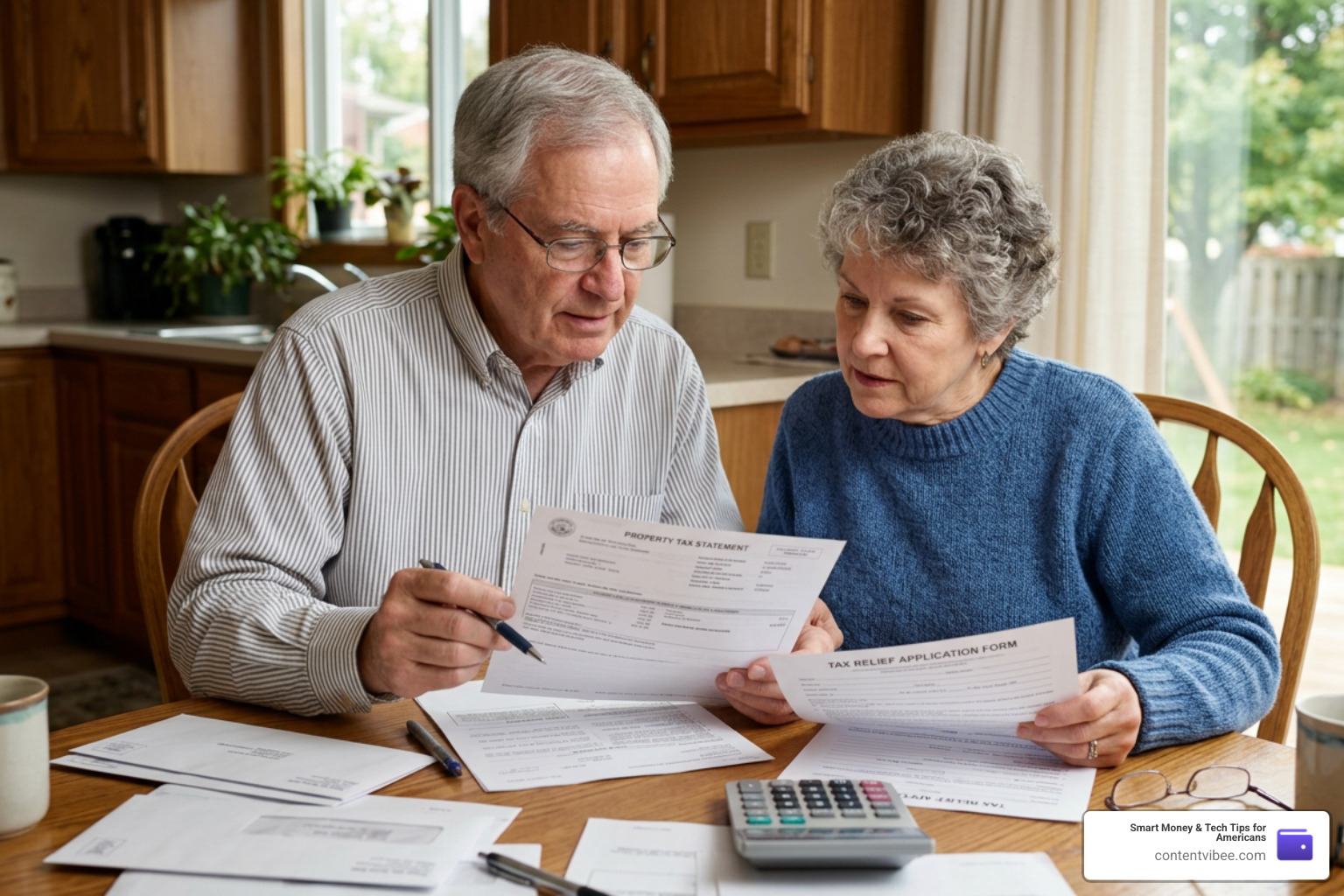
To prevent seniors from being priced out of their homes by rising property values, many states offer senior property tax relief programs, homestead exemptions, or “circuit breakers.”
- Alabama: Homeowners aged 65 and older are completely exempt from the state portion of property taxes (though local county and city taxes may still apply).
- Hawaii: Hawaii has the lowest median effective property tax rate in the country at roughly 0.27% to 0.29%, making it highly attractive for homeowners, even though its general cost of living is exceptionally high.
- Texas: Texas allows seniors aged 65 and older to “freeze” their school district property taxes, ensuring that this large portion of their tax bill will never increase as long as they own the home.
To see how other states adjust their taxes and cost-of-living metrics for retirees, check out The Golden State Guide Deciphering Calpers Cola And California Tax Adjustments.
Estate and Inheritance Tax Traps
An estate tax is levied on the value of a deceased person’s estate before it is distributed to heirs. An inheritance tax is paid by the person receiving the money.
- Maryland: Maryland is the only state in the country that imposes both an estate tax and an inheritance tax.
- Inheritance Tax States: Only five states still levy an inheritance tax: Maryland, Nebraska, Kentucky, New Jersey, and Pennsylvania. (Spouses are generally exempt from inheritance taxes, but siblings, children, and friends can face tax rates ranging from 4.5% to 16%).
For a full breakdown of how to protect your heirs from these state-level tax traps, read our Retirement Benefits Complete Guide 2026.
Frequently Asked Questions About Retirement Taxes
Which are the best states for taxes in retirement for single filers?
Single filers face a distinct “marriage penalty” when it comes to retirement taxes. Across almost all states, a single filer with a $100,000 traditional IRA withdrawal will pay about 6 percentage points more in combined federal and state taxes than a married couple filing jointly with the same income.
The best states for single filers are those with zero income tax (like Wyoming, Florida, and Nevada) or those that fully exempt IRA withdrawals (like Pennsylvania, Mississippi, Illinois, and Iowa). The worst state for single filers is Oregon, which hits single retirees with an effective tax rate of 20.41% on $100,000 IRA withdrawals, compared to 12.98% for married filers.
What are the best states for taxes in retirement with no income tax?
There are nine states with no broad-based state income tax: Alaska, Florida, Nevada, New Hampshire, South Dakota, Tennessee, Texas, Washington, and Wyoming.
While these states guarantee you will pay 0% state tax on your retirement account withdrawals and pensions, you must watch out for high property taxes in Texas and New Hampshire, and high sales taxes in Tennessee and Washington.
How many states tax Social Security benefits in 2026?
Only eight states tax Social Security benefits in 2026: Colorado, Connecticut, Minnesota, Montana, New Mexico, Rhode Island, Utah, and Vermont. All other 42 states and Washington D.C. either have no income tax or explicitly exempt Social Security benefits from state taxation.
Conclusion
At ContentVibee, we believe that smart money decisions are the foundation of a stress-free retirement. Choosing where to live in your golden years is one of the highest-leverage financial decisions you will ever make.
By comparing the combined impact of income, property, sales, and estate taxes, you can find a state that fits your lifestyle while keeping more of your hard-earned savings in your pocket. Whether you choose a zero-income-tax state like Wyoming or a retirement-exempt state like Pennsylvania, proper planning is key.
To make sure you are fully prepared for federal tax rules on your benefits, take a look at our guide on Uncle Sams Cut Understanding Taxes On Social Security to keep your tax bill as low as possible.


