


Why Your Social Security Claiming Age Could Be the Most Important Retirement Decision You Make
Your social security claiming age — the moment you first collect benefits — permanently shapes how much you receive every month for the rest of your life. Get it right, and you could collect tens of thousands of dollars more over your lifetime. Get it wrong, and that reduction is locked in forever.
Quick Answer: Social Security Claiming Age at a Glance
| Claiming Age | Benefit You Receive | Best If You… |
|---|---|---|
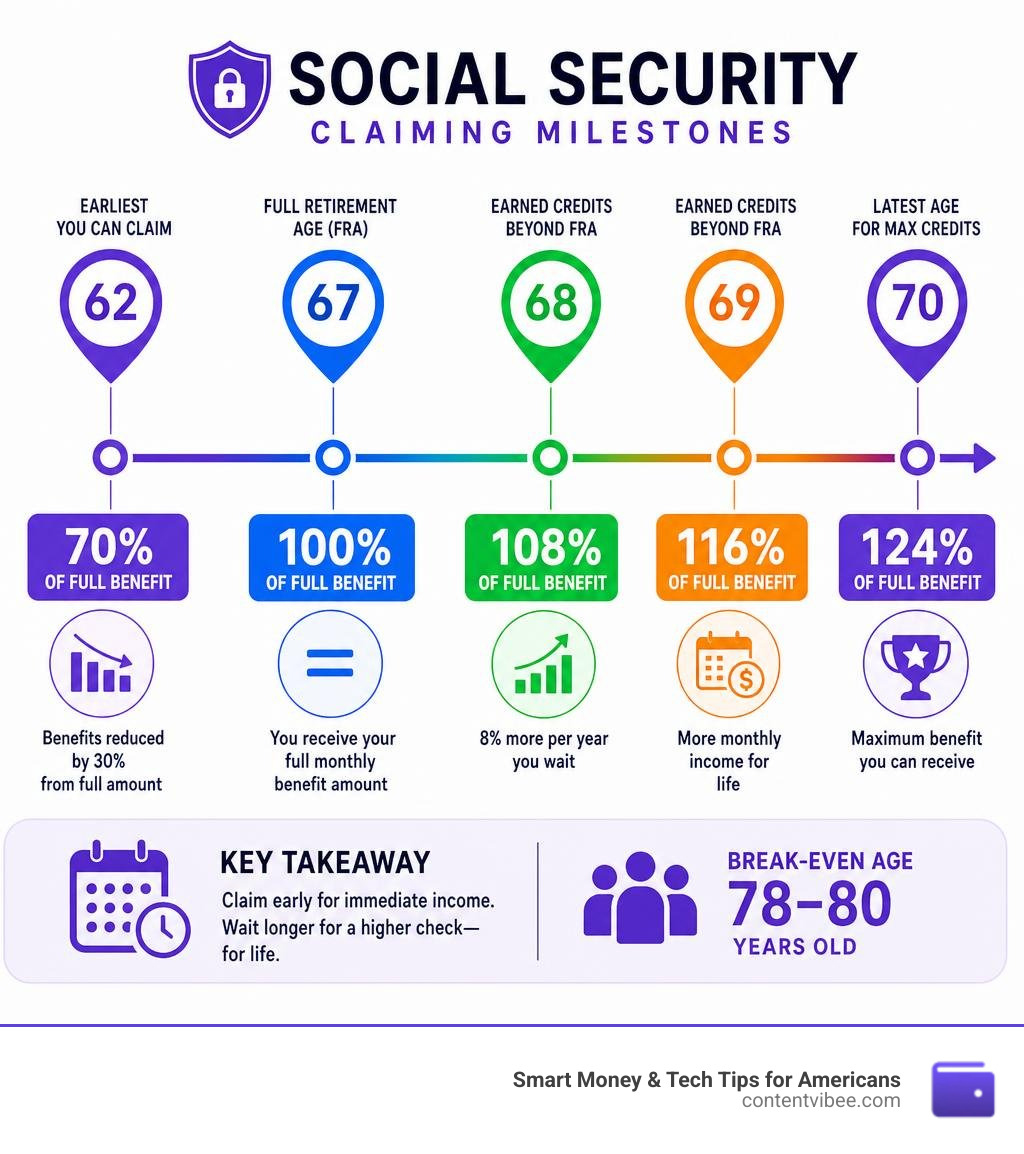
| 62 (earliest) | 70% of full benefit | Have health issues or urgent income needs |
| 67 (Full Retirement Age for 1960+) | 100% of full benefit | Want the baseline guaranteed amount |
| 70 (latest for credits) | 124% of full benefit | Are healthy and can afford to wait |
Key facts to know right now:
- You can claim as early as age 62 or as late as age 70
- Claiming at 62 (if your FRA is 67) cuts your monthly check by 30% — permanently
- Delaying past your Full Retirement Age earns you 8% more per year
- The typical break-even age is around 78-80 years old
Most people don’t realize how much this one decision matters. Social Security is the single biggest source of retirement income for roughly half of American households age 65 and older.
And yet, for decades, the majority of Americans claimed at 62 — the earliest possible moment. That’s changing. The share of people claiming at 62 has dropped from around 60% to less than 30% over the past two decades. More retirees are waking up to the math.
Whether you’re five years out or five months from retirement, understanding the tradeoffs between claiming early, at your Full Retirement Age, or delaying to 70 is essential. This guide walks you through every factor — from break-even calculations and spousal strategies to Medicare rules and the earnings test — so you can make the decision with confidence.
Social security claiming age terms simplified:
- Social Security age 70 benefits
- Social Security tax on benefits
- Social Security windfall elimination provision
Understanding Your Full Retirement Age (FRA)
Before you can decide on the perfect social security claiming age, you need to know your baseline. This baseline is your Full Retirement Age (FRA)—the age at which you are eligible to receive 100% of your monthly retirement benefit, also known as your Primary Insurance Amount (PIA).
Your FRA is not a one-size-fits-all number. It is determined entirely by the year you were born. Congress gradually raised the retirement age in 1983 because Americans are living longer, healthier lives than they did when the program was created.
If you were born in 1958 or earlier, you are already eligible for your full, unreduced Social Security benefit. For those born between 1943 and 1954, the FRA was exactly 66. For birth years from 1955 to 1960, the FRA increases gradually by two-month increments:
- 1955: 66 years and 2 months
- 1956: 66 years and 4 months
- 1957: 66 years and 6 months
- 1958: 66 years and 8 months
- 1959: 66 years and 10 months
- 1960 and later: Exactly 67 years
If you belong to the 1960 cohort or were born any year after, your FRA is exactly 67. To find your exact milestones without doing the mental gymnastics, you can use the official Official Retirement Age Calculator.
Additionally, if you are coordinating benefits with a partner, it is crucial to understand how your spouse’s age impacts your joint plan. You can map this out using our guide to Calculate Your Spousal Retirement Age Easily.
The Financial Impact of Your Social Security Claiming Age
Your monthly benefit is permanently adjusted depending on how far before or after your FRA you decide to claim. Think of your FRA as the “zero point” on a financial scale. Claiming early incurs a permanent monthly penalty, while delaying past your FRA awards you a permanent bonus.

To explore these options in detail, the Social Security Administration provides an Official Guide on Retirement Age and Benefit Reduction. For many, seeing the compounding effect of these adjustments makes it clear why waiting is highly incentivized. If you want to dive deeper into the mathematics of patience, check out our breakdown of Why Waiting for Social Security Age 70 Benefits Might Be Your Best Move.
How Early Claiming Reduces Your Monthly Payout
If you decide to claim your benefits at the earliest possible age of 62, you must accept a permanent monthly reduction. Under the rules for 2026, if your FRA is 67 and you claim at 62, your monthly check will be reduced by exactly 30%.
This reduction is calculated using a strict, non-negotiable formula:
- For the first 36 months before your FRA, your benefit is reduced by 5/9 of 1% per month (amounting to a 20% reduction).
- For any additional months beyond 36 (up to 24 months), your benefit is reduced by an additional 5/12 of 1% per month (adding another 10% reduction).
This means if your Primary Insurance Amount is $2,000 at age 67, claiming at age 62 reduces your monthly check to just $1,400. This reduction is locked in for life, aside from annual cost-of-living adjustments. For a complete look at how these reductions are applied across different birth years, refer to the Official Retirement Benefits Guide.
How Delaying Past FRA Maximizes Your Social Security Claiming Age
On the flip side, patience pays off handsomely. For every month you delay claiming past your FRA up until age 70, the Social Security Administration adds a “delayed retirement credit” to your future check.
This credit is equal to 8% per year (or 2/3 of 1% for each month you wait). If your FRA is 67 and you delay claiming until age 70, you will earn three full years of credits. This boosts your monthly check to 124% of your original Primary Insurance Amount.
Using our previous example of a $2,000 PIA at age 67, delaying until age 70 increases your monthly check to $2,480. That is an extra $1,080 every single month compared to claiming at age 62! For many retirees, this guaranteed, inflation-adjusted increase makes age 70 the Best Age to Collect SS.
The Break-Even Math: 62 vs. 67 vs. 70
Deciding on your social security claiming age ultimately comes down to a mathematical race. Will you collect more money by receiving smaller checks for a longer period, or by receiving larger checks for a shorter period? This is known as break-even analysis.
Assuming a baseline Primary Insurance Amount (PIA) of $1,000 at an FRA of 67, let’s look at how cumulative lifetime benefits stack up over time.
| Age | Claiming at 62 ($700/mo) | Claiming at 67 ($1,000/mo) | Claiming at 70 ($1,240/mo) |
|---|---|---|---|
| 65 | $25,200 | $0 | $0 |
| 70 | $67,200 | $36,000 | $0 |
| 75 | $109,200 | $96,000 | $74,400 |
| 78y 8m | $140,000 | $140,000 | $128,960 |
| 80 | $151,200 | $156,000 | $148,800 |
| 82y 6m | $172,200 | $186,000 | $186,000 |
| 85 | $193,200 | $216,000 | $223,200 |
| 90 | $235,200 | $276,000 | $297,600 |
As the table shows:
- The 62 vs. 67 Break-Even Point: If you live past 78 years and 8 months, waiting until your Full Retirement Age of 67 results in a higher lifetime payout than claiming at 62.
- The 67 vs. 70 Break-Even Point: If you live past 82 years and 6 months, delaying until age 70 yields more cumulative lifetime wealth than claiming at age 67.
By the time you reach age 90, the decision to wait until age 70 yields over $62,000 more in cumulative benefits than claiming at 62. To run your own personalized numbers and explore how these crossover points apply to your unique financial situation, check out our Timing is Everything: The Best Age to Take Social Security Calculator Guide.
Health, Longevity, and Personal Finance Considerations
While the mathematics of break-even points are precise, your life is not lived on a spreadsheet. Your health, family history, and personal financial situation must play a starring role in your decision.

According to recent data from the Centers for Disease Control and Prevention (CDC), the average 65-year-old American man can expect to live to age 84, while the average 65-year-old woman can expect to live to age 87. Furthermore, about 1 in 3 people who are currently 65 will live past age 90.
These longevity statistics show that most retirees will outlive their break-even ages, making delaying benefits a financially sound move for the average healthy person. However, if you have chronic health issues or a family history of shorter lifespans, claiming earlier may be the most logical choice.
To explore how economists model these complex life expectancy and financial factors, you can read the academic study on Discount Rate Specification and the Social Security Claiming Decision.
Evaluating Your Personal Discount Rate and Investment Returns
When deciding on your social security claiming age, you must also consider your “discount rate”—which is essentially the investment return you would need to generate to justify claiming early and investing the money.
If you claim at 62 to invest your checks in the stock market, you are trading a guaranteed, inflation-adjusted return for market risk. Delaying benefits past your FRA offers a guaranteed 8% annual return. Finding a safe, guaranteed 8% return in the financial markets is virtually impossible.
For aggressive investors with high-risk tolerances, claiming early might appeal. However, for conservative or moderate investors, letting your Social Security benefit grow at a guaranteed rate is often the smartest move. If you are looking for other ways to build your nest egg alongside Social Security, check out these Alternative Ways to Save for Retirement That Actually Work.
How Longevity Risks Shape Your Social Security Claiming Age
Longevity risk is the risk of outliving your savings. Social Security is one of the few sources of retirement income that is fully guaranteed for life and indexed for inflation.
By delaying your claim, you are purchasing a larger “longevity insurance policy.” If you live to age 95, having a monthly check that is 124% of your PIA rather than 70% can be the difference between a comfortable retirement and financial hardship. You can read more about how claiming trends have shifted as lifespans have increased in the Program Explainer on Benefit Claiming Age.
Employment, Taxes, and Spousal Strategies
Your social security claiming age decision does not happen in a vacuum. It is heavily influenced by whether you plan to continue working, how your benefits will be taxed, and your marital status.
For married couples, claiming is a team sport. Your decision affects not only your retirement checks but also the spousal and survivor benefits your partner may rely on later in life. If you are currently working or planning to consult during retirement, it is wise to read up on Working in Retirement: Are Spousal Benefits Reduced by Working?.
Working Before Full Retirement Age and the Earnings Test
If you choose to claim Social Security before reaching your Full Retirement Age and continue to work, you will be subject to the Social Security earnings test.
For 2026, the earnings test rules are as follows:
- If you are under FRA all year: The Social Security Administration will withhold $1 in benefits for every $2 you earn above the annual limit of $24,480.
- In the year you reach FRA: The limit increases to $63,600. The SSA will withhold $1 in benefits for every $3 you earn above this limit, up until the month you actually reach your FRA.
It is important to know that these withheld benefits are not lost forever. Once you reach your Full Retirement Age, the SSA will recalculate your monthly benefit upward to account for the months your benefits were withheld. However, working while claiming early can cause temporary cash flow headaches and unexpected tax bills.
Speaking of taxes, up to 85% of your Social Security benefits can be taxed depending on your “combined income.” For a detailed guide on navigating this, see our resource on Taxing Your Golden Years: A Guide to Social Security Tax on Benefits.
Note for California residents: If you are retiring in the Golden State, you are in luck! California is one of the states that does not tax Social Security retirement benefits at the state level, providing a nice tax break for local retirees.
Coordinating Spousal and Survivor Benefits
For married couples, coordinating claiming ages is the ultimate way to maximize household wealth. A lower-earning spouse is eligible to receive a spousal benefit worth up to 50% of the higher-earning spouse’s PIA, provided they claim at their own FRA.
However, under “deemed filing” rules, you cannot choose to claim only spousal benefits while letting your own retirement benefits grow. When you apply for one, you are deemed to be applying for both, and the SSA will pay you the higher of the two amounts.
Even more critical is the coordination of survivor benefits. When one spouse passes away, the surviving spouse is eligible to receive the larger of their own monthly benefit or the deceased spouse’s monthly benefit.
Because of this, it is almost always optimal for the higher-earning spouse to delay claiming until age 70. By doing so, they secure the largest possible monthly safety net for the surviving partner. To map out a coordinated plan for your household, read The Smart Couples Guide to Social Security Strategies.
Medicare Enrollment and the 2025 Fairness Act
As you plan your retirement timeline, do not confuse your social security claiming age with your Medicare enrollment age. They are entirely separate milestones, and missing your Medicare window can be a costly mistake.
Here are the key Medicare enrollment rules you must follow:
- The Age 65 Milestone: You become eligible for Medicare at age 65, regardless of whether you have claimed Social Security or reached your FRA.
- The Initial Enrollment Period (IEP): Your window to sign up for Medicare Part A (hospital insurance) and Part B (medical insurance) begins three months before the month you turn 65, includes your birth month, and ends three months after.
- The Late Enrollment Penalty: If you delay signing up for Medicare Part B past age 65 and do not have “creditable” coverage from an active employer, your Part B premiums will increase by 10% for every 12-month period you were eligible but failed to enroll. This penalty lasts for life.
- HSA Contributions: If you plan to delay Medicare because you are still working, you must stop contributing to a Health Savings Account (HSA) at least six months before enrolling in Medicare to avoid tax penalties.
Additionally, public employees should note the impact of the Social Security Fairness Act, which was signed into law on January 5, 2025. This landmark legislation eliminated the Windfall Elimination Provision (WEP) and the Government Pension Offset (GPO) starting in 2025.
Prior to this act, millions of public employees—such as teachers, firefighters, and police officers in California—saw their Social Security benefits drastically reduced if they also earned a state pension. With WEP and GPO eliminated, affected public workers can now claim their full, unreduced Social Security benefits alongside their pensions, completely changing the math on their optimal claiming age.
Frequently Asked Questions
What is the absolute best age to claim Social Security?
There is no single “best” age for everyone. The optimal age depends entirely on your health, financial needs, and family situation. If you have immediate cash needs or serious health concerns, claiming early at 62 is often the best choice. If you are in good health, have other retirement savings to live on, and want to maximize your guaranteed lifetime income, waiting until age 70 is mathematically superior.
Can I change my mind after claiming Social Security early?
Yes, but you must act quickly. Within the first 12 months of your first benefit payment, you can request a “withdrawal of application.” If approved, you must repay every dollar of benefits you (and any family members) received. This resets your record as if you never claimed, allowing your benefit to grow.
If you are past the 12-month window but have reached your Full Retirement Age, you can request to “suspend” your benefits. This stops your monthly checks and allows you to earn delayed retirement credits of 8% per year until you resume payments at age 70.
How does the 2026 COLA affect my claiming decision?
The 2026 Cost-of-Living Adjustment (COLA) is set at 2.8%. While COLA is applied to all beneficiaries, it actually reinforces the benefit of delaying. Because COLA is a percentage-based increase, a higher base benefit resulting from delayed claiming will receive a larger absolute dollar increase each year. Over a 20- or 30-year retirement, this compounding effect adds up to a significant amount of extra money for those who waited.
Conclusion
Deciding on your social security claiming age is a deeply personal choice, but it does not have to be a stressful one. By understanding your Full Retirement Age, running the break-even math, and coordinating with your spouse, you can build a secure financial foundation for your golden years.
At Smart Money & Tech Tips for Americans, we are dedicated to helping you make sense of these complex financial milestones. Whether you are navigating California’s unique retirement landscape or optimizing your household claiming strategy, we are here to provide clear, actionable guidance every step of the way.
Ready to make your move? Explore our comprehensive guide to finding the Best Age to Collect SS and take control of your retirement roadmap today.


