


Is Waiting Until 70 Really Worth It? The Case Against Late Claiming
The Social Security late claiming cons are real, significant, and largely ignored by mainstream retirement advice — and understanding them could save you from a costly mistake.
Most financial articles push one message: wait as long as possible. But the math is more complicated than that, and for many retirees, delaying until 70 may actually cost money rather than build it.
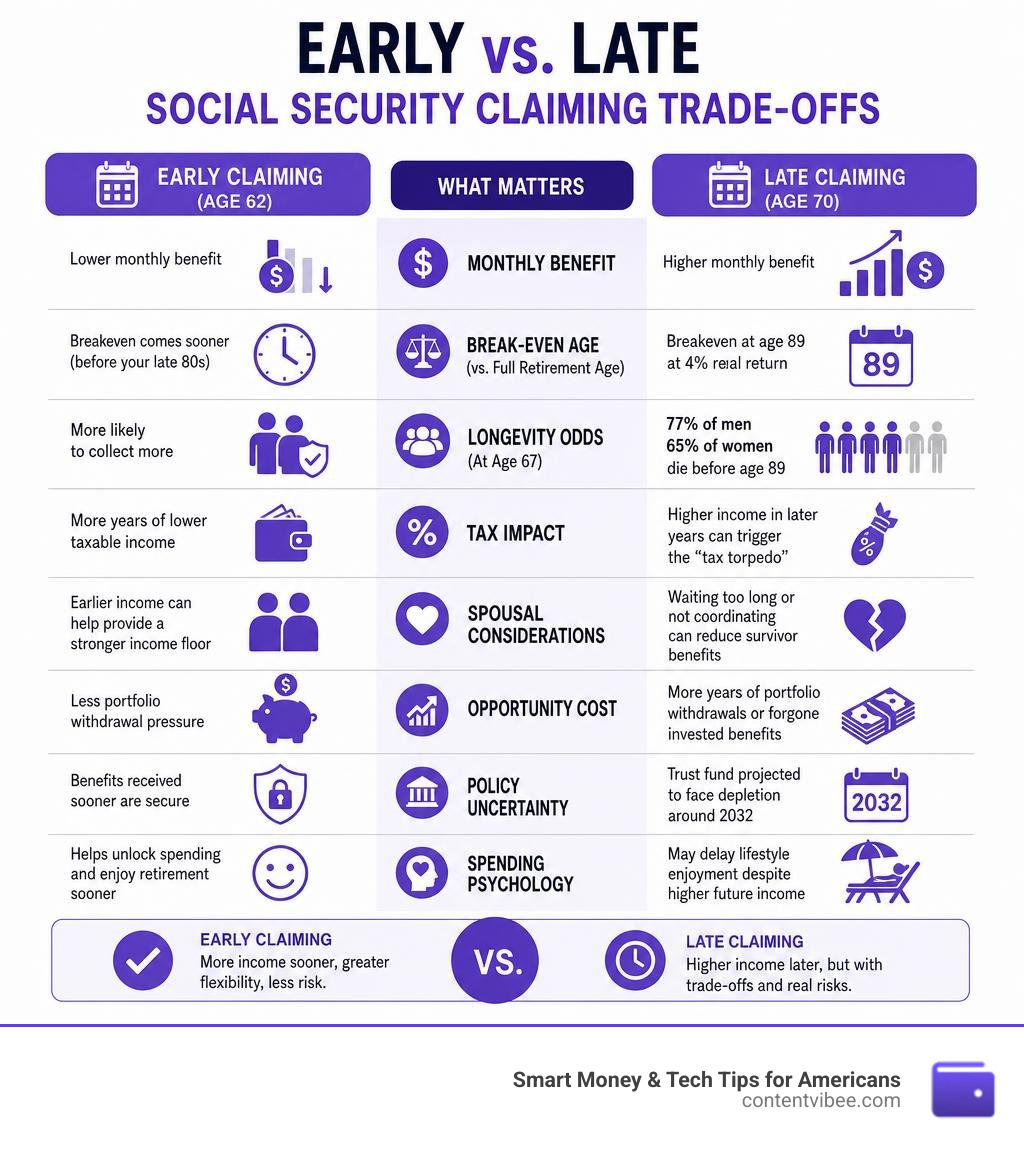
Here is a quick summary of the main drawbacks of late Social Security claiming:
- Opportunity cost – Every year you delay, you draw down your portfolio or forgo invested benefits, which reduces long-term wealth
- Break-even is later than you think – At a 4% real return, you need to live to age 89 for delay from full retirement age to pay off
- Most people don’t make it – About 77% of 67-year-old men and 65% of 67-year-old women die before reaching 89
- Lost tax planning window – Delay years are ideal for Roth conversions, but Social Security income can trigger the “tax torpedo” and complicate that strategy
- Spousal timing risks – Waiting too long, or not coordinating correctly, can leave a surviving spouse with a smaller income floor
- Policy uncertainty – The Social Security trust fund is projected to face depletion around 2032, adding real risk to a strategy that bets on future full benefits
- Spending psychology – Many retirees struggle to spend portfolio money freely but spend guaranteed income more naturally, meaning early claiming can actually unlock real lifestyle spending
In December 2022, 64% of all retired workers receiving Social Security had already claimed before their full retirement age. The average claiming age was around 65. Only about 10% of people who started benefits in 2022 were 70 or older.
That behavior is often dismissed as a mistake. But for a significant portion of retirees, it may reflect something the standard advice misses entirely.
Simple guide to Social Security late claiming cons:
- Social Security age 70 benefits
- Social Security tax on benefits
- Social Security windfall elimination provision
The Financial Drawbacks of Delaying Social Security Until Age 70
When we look at the decision to delay retirement benefits, we are often told that waiting is a risk-free way to secure a massive 8% annual boost. But this ignores the basic principles of opportunity cost and sequence-of-returns risk. Let’s look at how delaying your claim impacts your actual retirement portfolio.
For a deeper look at the benefits of waiting, you can read our guide on Why Waiting For Social Security Age 70 Benefits Might Be Your Best Move. However, here we are focusing on the hidden financial traps of that strategy.
The Opportunity Cost of Portfolio Depletion
Delaying Social Security doesn’t mean your bills stop coming. If you retire at 62 or 65 but wait until 70 to claim your benefits, you must fund your lifestyle from other sources. Usually, this means making heavier portfolio drawdowns from your 401(k), IRA, or taxable brokerage accounts.
Every dollar you pull from your investments to replace a missing Social Security check is a dollar that stops compounding. The opportunity cost of these early withdrawals can be immense. If your portfolio is earning a modest historical average return, drawing it down early permanently reduces your principal. You are trading liquid, growing investment assets for an illiquid, non-transferable government benefit. If you die early, that depleted portfolio is gone, and your heirs receive nothing from your forfeited Social Security credits.
Sequence-of-Returns Risk in the Gap Years
The “gap years” between your retirement and your delayed Social Security claim are highly vulnerable to sequence-of-returns risk. If the stock market experiences a bear market during these years, and you are forced to take larger portfolio withdrawals to cover your living expenses, you will be selling equities at the bottom of the market.
This can permanently damage your portfolio’s longevity. If you had claimed Social Security earlier, that guaranteed income floor would have reduced your portfolio withdrawal rate, helping protect your retirement assets from market volatility.
Why the Standard Break-Even Math Fails Retirees
The standard advice to delay Social Security is almost always based on a simple break-even calculation. But this math is deeply flawed because it assumes a 0% discount rate—meaning it treats a dollar received at age 90 as having the exact same value as a dollar in your hand at age 62.
A more realistic economic analysis shows that delaying may actually be a losing bet for many. For a detailed breakdown of this mathematical shift, see the research paper It May Be a Mistake to Delay Social Security Retirement Benefits .
The Illusion of the 8% Guaranteed Return
The Social Security Administration states that your benefits will increase by up to 8% per year for every year you delay past your Full Retirement Age (FRA) up to age 70. You can review the official rules on the Benefits Planner: Retirement | Delayed Retirement Credits | SSA page.
However, this 8% delayed retirement credit is not a true 8% rate of return. To get that higher monthly payment later, you must completely forgo 100% of the payments you could have received during the delay period. It takes many years of receiving the higher check just to recoup the money you gave up. If you die before reaching that break-even age, your actual rate of return on the delayed strategy is deeply negative.
How Realistic Discount Rates Shift the Break-Even Age
When you apply a realistic discount rate (or expected real return on investment) of 3% to 4%, the break-even age shifts dramatically.
At a 0% discount rate, the break-even age between claiming at 62 versus 70 is roughly 80.4 years. But if we assume a 4% real return on your invested money, you must live to age 89 just for delaying from FRA to 70 to be financially advantageous.
| Discount Rate (Real Return) | Break-Even Age (Claiming at 62 vs 70) | Percentage of Men Who Die Before This Age | Percentage of Women Who Die Before This Age |
|---|---|---|---|
| 0% | ~80.4 years | ~49% | ~36% |
| 3% | ~85.2 years | ~62% | ~50% |
| 4% | ~89.0 years | ~77% | ~65% |
For males, starting at age 70 is mathematically inferior to starting at age 67 unless the discount rate is less than 0.47%. For the vast majority of retirees, a 0.47% return is easily beaten by basic, low-risk investments like Treasury Inflation-Protected Securities (TIPS) or high-yield savings accounts.
Longevity Realities: Who Actually Wins the Waiting Game?
To win the waiting game, you have to outlive the averages. While we all hope to live a long, vibrant life, statistical realities should drive our financial planning.
The Statistical Odds of Outliving Your Delay
According to the Social Security Administration’s actuarial tables, the average life expectancy at age 62 is 81.61 years for men and 84.5 years for women.
Compare this to the break-even threshold under a realistic 4% discount rate (age 89). Roughly 77% of 67-year-old men and 65% of 67-year-old women will pass away before reaching age 89. This means the overwhelming majority of retirees who delay claiming until age 70 will actually receive less cumulative lifetime income than if they had claimed earlier and kept their personal portfolios intact.
Health, Family Longevity, and Personal Spending Patterns
Population averages are a starting point, but your personal health history is what matters most. If you have chronic health conditions, or if your family history does not suggest extreme longevity, delaying your claim is a highly risky bet.
Additionally, consider your spending patterns. Most retirees experience a “spending smile” where their active travel and lifestyle spending is highest in their 60s (the “go-go” years), slows down in their 70s (“slow-go”), and decreases further in their 80s (“no-go”), except for healthcare. Claiming earlier puts money in your hands when you are healthy and active enough to enjoy it, rather than maximizing your income floor at an age when your lifestyle spending has naturally declined.
Tax Planning and the Social Security Late Claiming Cons
Many financial planners overlook how delaying Social Security impacts your tax brackets during the early years of retirement.
To align your claiming age with your overall tax strategy, use our Timing Is Everything The Best Age To Take Social Security Calculator Guide.
The Loss of the Low-Tax Gap Window
The years between your retirement and the start of your Required Minimum Distributions (RMDs) represent a unique tax planning window. During these “gap years,” your taxable income is often at an all-time low. This makes it the perfect time to perform highly efficient Roth conversions, moving money from traditional IRAs to Roth IRAs at the lowest possible tax rates.
If you delay Social Security, you may have to withdraw larger amounts from your traditional pre-tax accounts to live on, which fills up those low tax brackets. Once you finally claim Social Security at 70, your combined income (Social Security plus RMDs) can push you into a much higher tax bracket, triggering the “tax torpedo” where up to 85% of your Social Security benefits become taxable.
IRMAA Surcharges and the Widow’s Tax Trap
Delaying Social Security to age 70 can also lead to a sudden spike in your Modified Adjusted Gross Income (MAGI) once RMDs and large Social Security checks hit simultaneously. This can easily push you over the thresholds for the Income-Related Monthly Adjustment Amount (IRMAA), resulting in heavy surcharges on your Medicare Part B and Part D premiums.
For married couples, this tax spike is amplified by the “widow’s tax trap.” When one spouse passes away, the survivor must file as a single taxpayer. The single tax brackets are much narrower, and the single IRMAA thresholds are lower. If the higher-earning spouse delayed until age 70 to maximize the benefit, the survivor may find themselves pushed into high tax brackets and IRMAA surcharges on a single filer’s schedule.
Spousal Coordination and the Risks of Late Claiming
For married couples, claiming decisions should never be made in isolation. The rules governing spousal and survivor benefits are complex, and late claiming can sometimes disrupt a couple’s overall plan.
For a complete framework on coordinating benefits, refer to The Smart Couples Guide To Social Security Strategies.
How Late Claiming Affects Spousal Benefits
Spousal benefits allow one spouse to receive up to 50% of the other’s Full Retirement Age benefit. However, a key rule is that you cannot claim a spousal benefit until the primary worker has actually filed for their own retirement benefit.
If the higher-earning spouse decides to delay claiming until age 70 to earn delayed retirement credits, the lower-earning spouse may be forced to wait to claim their spousal benefit as well. This can cost the household thousands of dollars in lost spousal payments during those intermediate years.
To avoid this, couples must carefully coordinate their timing. You can learn more about these rules in our guide to Social Security Spousal Benefits Timing Is Everything.
The Survivor Benefit Coordination Trap
While it is true that the higher earner delaying until 70 maximizes the ultimate survivor benefit for the remaining spouse, this strategy is not always optimal if there is a significant age gap or if the higher earner is in poor health.
If the higher earner dies during the delay period, the surviving spouse will receive a survivor benefit, but the couple will have permanently forfeited years of retirement income that could have been collected. If the lower earner has a shorter life expectancy, the value of that maximized survivor benefit may never be realized.
Non-Financial Drawbacks and Policy Risks of Waiting
Beyond the mathematical spreadsheets, there are psychological and structural risks to waiting until age 70 to claim your benefits.

Policy Risk and Trust Fund Solvency Concerns
About 45% of Americans fear that Social Security money may run out, which heavily influences their decision to claim early. While the program is highly unlikely to disappear entirely, policy risk is a real factor.
The Social Security board of trustees projects that the trust funds supporting retirement benefits could face depletion around 2032. If Congress does not act before then, benefits could theoretically be reduced to 72% to 77% of scheduled amounts. While we expect legislative fixes, claiming early and securing your benefits under the current rules acts as a hedge against future political and legislative changes.
The Psychology of Spending: Portfolio vs. Guaranteed Income
There is a major psychological difference between spending down your investment portfolio and spending guaranteed income. Academic studies show that retirees spend roughly 80% of their guaranteed income (like Social Security and pensions) but only about 50% of their investment portfolio wealth.
Many disciplined savers find it highly stressful to watch their investment balances go down during the delay years. Claiming Social Security earlier provides a steady, monthly “paycheck” that gives you the psychological permission to spend your money and enjoy your retirement while you are still young and healthy.
The Earnings Test and Claim-Suspend-Restart Rules
If you have already claimed early and regret your decision, you do have options. Under the SSA’s claim-suspend-restart (CSR) rules, once you reach Full Retirement Age, you can request to suspend your benefit payments to earn delayed retirement credits of 8% per year up to age 70. You can read the official guidelines on Suspending Your Retirement Benefit Payments | SSA .
That if you claim before your FRA and continue working, you will be subject to the Social Security earnings test. If you earn more than the annual limit, the SSA will temporarily withhold a portion of your benefits. While these benefits are recalculated and returned to you once you reach FRA, it is a complex rule that can catch working retirees off guard.
Frequently Asked Questions about Social Security Late Claiming Cons
What are the primary Social Security late claiming cons for single retirees?
For single retirees, the primary con is that there is no spousal or survivor benefit coordination to hedge their bets. If a single person delays until age 70 and dies at age 71, all the forfeited benefits are permanently lost to the system. Single claimants bear 100% of their own longevity risk.
How do Social Security late claiming cons impact tax planning?
Delaying Social Security forces you to use other retirement assets, often traditional IRAs, to fund your gap years. This can wipe out your ability to perform low-tax Roth conversions. Once delayed benefits and RMDs start at age 70, the combined income can trigger the “tax torpedo” (taxing up to 85% of your benefits) and push you into higher IRMAA Medicare premium brackets.
Can I undo a late claiming decision if my health changes?
If you delay past your Full Retirement Age and your health suddenly declines, you can request up to six months of retroactive benefits in a lump sum. However, this is strictly limited to a six-month lookback period, meaning you cannot recover multiple years of delayed payments if you receive a sudden diagnosis.
Conclusion
Deciding when to claim your retirement benefits is one of the most critical decisions you will make. While the conventional wisdom tells everyone to wait until age 70, looking closely at the Social Security late claiming cons reveals that this strategy is far from a guaranteed win.
Between opportunity costs, sequence-of-returns risk, realistic discount rates, and tax planning traps, claiming earlier is often the more secure and mathematically sound choice for many American households.
At Smart Money & Tech Tips for Americans, we believe in practical, personalized planning over generic rules of thumb. To find the right balance for your personal situation, read our comprehensive guide on the Best Age To Collect Ss.


