


Are Your Social Security Benefits Taxable? Here’s What You Need to Know
Understanding the Social Security tax on benefits is one of the most important — and most overlooked — parts of retirement planning. Many retirees are caught off guard when they discover that a portion of their monthly benefit check can be subject to federal income tax.
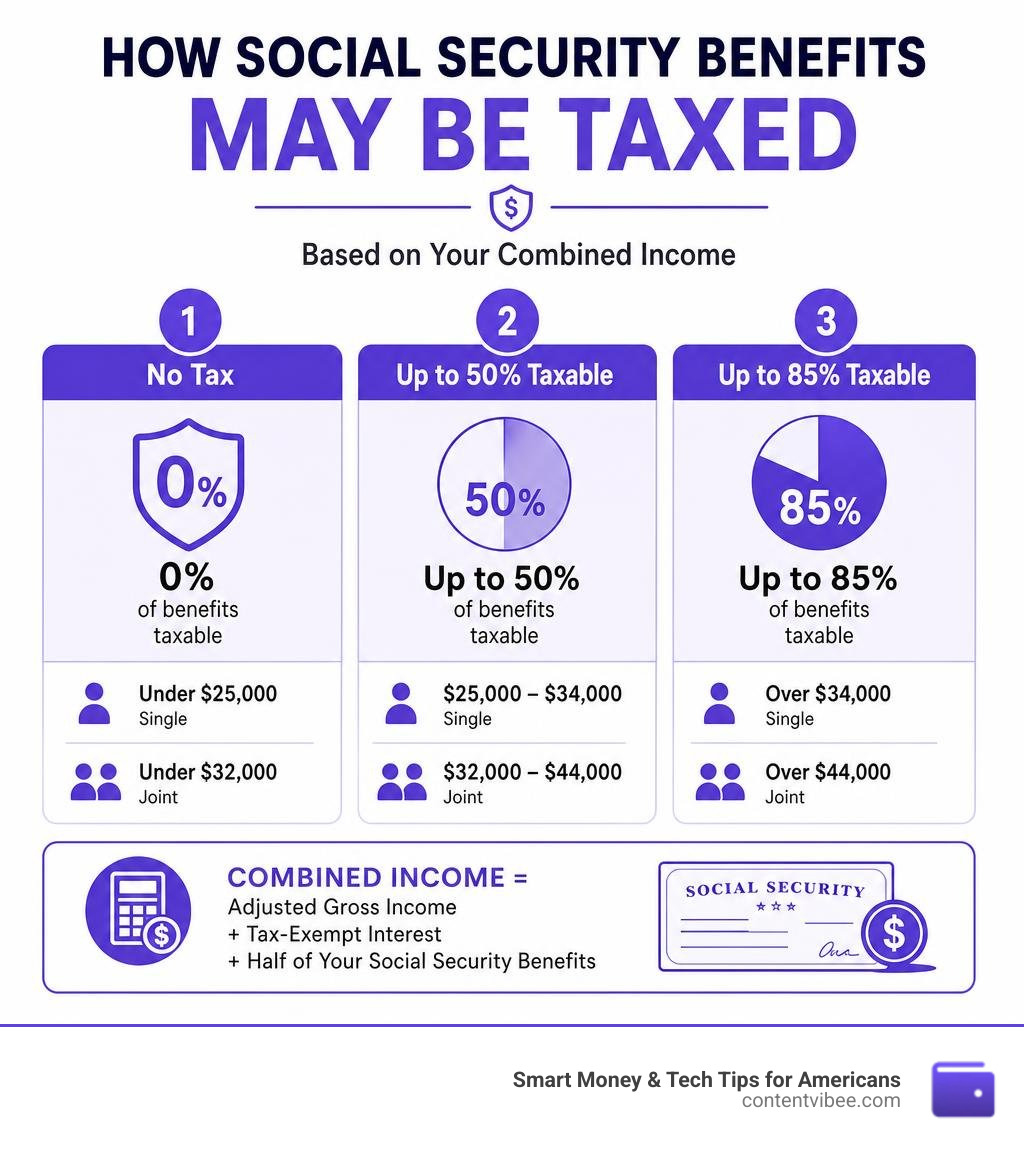
Quick Answer: Is Social Security income taxable?
| Your Situation | How Much of Your Benefit May Be Taxed |
|---|---|
| Combined income under $25,000 (single) or $32,000 (joint) | 0% — no federal tax |
| Combined income $25,000–$34,000 (single) or $32,000–$44,000 (joint) | Up to 50% of benefits taxable |
| Combined income over $34,000 (single) or $44,000 (joint) | Up to 85% of benefits taxable |
Combined income = Adjusted Gross Income + tax-exempt interest + half of your Social Security benefits.
About half of all Social Security recipients pay federal income tax on their benefits. And as retirement income from pensions, IRAs, and other sources adds up, the odds that your benefits are taxable go up too.
The rules aren’t always simple. Your filing status, where you live, and even how you draw down your retirement accounts can all affect how much of your benefit gets taxed. The good news? With the right planning, many retirees can legally reduce — or even eliminate — the tax bite on their Social Security income.
This guide walks you through everything you need to know, from how the rules work to strategies you can start using right now.
The History and Policy Behind Taxing Benefits
To understand why we pay Social Security tax on benefits today, we have to look back at how the system evolved. For the first several decades of the program, Social Security benefits were completely tax-free. Following a series of Treasury Department tax rulings between 1938 and 1941, the federal government treated Social Security payments as “gratuities” or public gifts. Because they were classified as gifts rather than earned income, they were excluded from federal income taxation.
This policy stood for over forty years, but by the early 1980s, the Social Security system faced severe financial strains. To ensure long-term solvency, Congress passed the landmark Social Security Amendments of 1983.
The 1983 Amendments: The First Tier of Taxation
The 1983 legislation introduced federal income taxation on Social Security benefits for the first time, starting in tax year 1984. Under these amendments, if a taxpayer’s “combined income” exceeded $25,000 for single filers or $32,000 for married couples filing jointly, up to 50% of their benefits could be subject to federal income tax.
At the time, Congress designed these thresholds to target only high-income retirees. The 1983 changes were estimated to affect only about 10% of Social Security beneficiaries initially, generating roughly $30 billion in revenue for the Social Security Trust Funds over the first seven years. The six-year savings from this taxation provision alone were estimated at $26.6 billion, directly improving the program’s solvency.
The 1993 Amendments: The Second Tier of Taxation
As inflation rose but the income thresholds remained completely unindexed, more retirees began paying taxes on their benefits. By the early 1990s, about 18% of beneficiaries had some tax liability.
To raise additional revenue and align Social Security taxation more closely with private pensions, Congress passed the Omnibus Budget Reconciliation Act of 1993. This law created a second tier of taxation. Beginning in 1994, if a single filer’s combined income exceeded $34,000 (or $44,000 for joint filers), up to 85% of their benefits could be taxed.
This change meant that of the 18.2% of beneficiaries already subject to potential taxation before 1993, approximately 10.6% saw their potential tax liability increase. The revenue raised from this second tier was directed to the Medicare Hospital Insurance (HI) Trust Fund, while the first tier’s revenue continued to flow back to the Social Security Trust Funds.
To explore how these historical milestones fit into the broader system of retirement security, check out our A Comprehensive Guide to Social Security Benefits.
Why Are Benefits Taxed Like Private Pensions?
The policy justification for taxing up to 85% of benefits is rooted in tax equity and how private pensions are treated. When you receive a private pension, you do not pay tax on the portion of the benefit that represents your own after-tax contributions. However, you do pay tax on the portion funded by your employer’s contributions and investment earnings.
Actuarial studies show that for the average worker, their own payroll tax contributions fund only about 15% of their lifetime Social Security benefits. The remaining 85% is funded by employer matching contributions and interest earned by the Trust Funds. Therefore, taxing up to 85% of the benefit mimics the tax treatment of a private pension, ensuring that retirees with substantial outside income pay a fair share of tax on the “non-contributed” portion of their benefits.
According to the Social Security Benefit Taxation Highlights, the share of Social Security benefits paid as federal income taxes has grown significantly over time. It rose from 2.2% of total benefits in 1994 to 6.6% in 2022. In 2023 alone, taxing benefits credited $50.7 billion to the Social Security trust funds (3.8% of its total income) and $35.0 billion to the Medicare HI trust fund (8.4% of its total income).
Key Legislative Milestones in Social Security Taxation
- 1938–1941: Treasury Department rulings exclude Social Security benefits from federal income tax, defining them as tax-free gifts.
- 1983: Congress passes the 1983 Amendments, establishing the first tier of taxation (up to 50% taxable) with unindexed thresholds of $25,000 (single) and $32,000 (joint).
- 1993: The Omnibus Budget Reconciliation Act adds a second tier of taxation (up to 85% taxable) with thresholds of $34,000 (single) and $44,000 (joint).
- Present Day: The thresholds remain unindexed for inflation, meaning an estimated 50% of beneficiaries now pay federal income tax on their benefits, with that number projected to exceed 56% by 2050.
Understanding the Federal Rules for Social Security Tax on Benefits
Federal taxation of Social Security is governed by Section 86 of the Internal Revenue Code. The IRS uses a specific formula to determine if you owe money, and it all comes down to your filing status and your “base amount.”
The base amounts are the income thresholds below which your benefits are completely tax-free. If your combined income is under these amounts, you do not owe any federal income tax on your benefits:
- Single, Head of Household, or Qualifying Surviving Spouse: $25,000
- Married Filing Jointly: $32,000
- Married Filing Separately (and lived apart from your spouse all year): $25,000
- Married Filing Separately (and lived with your spouse at any time during the year): $0
Because the base amount is $0 for married couples filing separately who lived together, almost any income will make their benefits taxable.
| Combined Income Level | Single Filer Taxable Portion | Joint Filer Taxable Portion |
|---|---|---|
| Below Tier 1 | Under $25,000: 0% taxable | Under $32,000: 0% taxable |
| Tier 1 (50% Bracket) | $25,000 to $34,000: Up to 50% taxable | $32,000 to $44,000: Up to 50% taxable |
| Tier 2 (85% Bracket) | Over $34,000: Up to 85% taxable | Over $44,000: Up to 85% taxable |
For complete instructions and worksheets to calculate your exact taxable portion, you can refer directly to Publication 915 (2025), Social Security and Equivalent Railroad Retirement Benefits | Internal Revenue Service or download the PDF version of Social Security and Equivalent Railroad Retirement Benefits.
The Enhanced Senior Deduction (2025–2028)
It is worth noting that for tax years 2025 through 2028, recent federal tax legislation has introduced a temporary enhanced senior deduction of $6,000 for qualifying seniors aged 65 and older. To qualify, your income must be less than or equal to $75,000 for single filers or $150,000 for married couples filing jointly. While this enhanced deduction reduces your overall federal taxable income, it does not alter the provisional income formula used to calculate how much of your Social Security benefit is subject to tax under Section 86.
How Combined Income Determines Your Social Security Tax on Benefits
Your provisional income (also known as “combined income”) is the specific metric the IRS uses to see where you fall on the taxation ladder. This is not the same as your Adjusted Gross Income (AGI) on your tax return.
To calculate your provisional income, use the following formula:
$$\text{Provisional Income} = \text{Adjusted Gross Income (AGI)} + \text{Tax-Exempt Interest} + \left( \frac{1}{2} \times \text{Social Security Benefits} \right)$$
- Adjusted Gross Income (AGI): This includes your wages, taxable pensions, traditional IRA distributions, capital gains, dividends, and interest.
- Tax-Exempt Interest: Even though municipal bond interest is exempt from regular federal income tax, you must add it back when calculating your provisional income.
- Half of Your Social Security Benefits: You only count 50% of the net benefits you (and your spouse, if filing jointly) received during the year.
This calculation becomes particularly important when Both Spouses Collect Social Security. When filing a joint return, you must combine the income and benefits of both spouses to determine if your joint provisional income exceeds the $32,000 threshold. Even if one spouse earned all the outside income and the other received only Social Security, the IRS looks at your combined household total.
To model different filing scenarios and see how your combined income affects your retirement cash flow, you can explore the Do the Math: Top Social Security Calculators for Married Couples or use our Tools/Finance Calculator/Social Security Spousal Benefit Calculator.
Special Rules for Nonresident Aliens and Citizens Abroad
If you are a U.S. citizen living abroad, your Social Security benefits are generally subject to the same federal tax rules as U.S. residents. You must report your benefits and calculate your provisional income on Form 1040. However, if you reside in certain treaty countries (such as Canada, Germany, Italy, or the United Kingdom), local tax treaties may exempt your U.S. Social Security benefits from U.S. federal income tax entirely, making them taxable only in your country of residence.
For nonresident aliens (individuals who are neither U.S. citizens nor green card holders), the rules are entirely different:
- By default, the IRS imposes a flat 30% withholding tax on 85% of your U.S. Social Security benefits. This results in an effective tax rate of 25.5% withheld directly from your monthly checks.
- No provisional income thresholds apply to nonresident aliens; the tax is withheld regardless of your total income.
- Lawful permanent residents (green card holders) are generally exempt from this 30% nonresident alien withholding tax and are taxed under standard resident rules instead.
- Many tax treaties modify or eliminate this 30% tax. For example, residents of Egypt, Japan, and Romania are often completely exempt from U.S. tax on their Social Security benefits under specific treaty provisions.
State vs. Federal Taxation: Where You Live Matters
While federal tax rules apply to everyone across the country, state-level taxation is a completely different story. Where you choose to live during your golden years can have a massive impact on your net retirement income.
As of June 2026, the vast majority of U.S. states do not tax Social Security benefits at all. Specifically, 32 states plus the District of Columbia fully exempt Social Security benefits from state income tax. Additionally, nine states have no state income tax on any form of earned or unearned income (or tax only very specific interest and dividends), meaning they also fully exempt benefits.
This leaves only nine states that levy some form of state income tax on Social Security benefits: Colorado, Connecticut, Kansas, Minnesota, Montana, New Mexico, Rhode Island, Utah, and Vermont.

If you live in California, you are in luck. The Golden State does not tax Social Security benefits. To understand how California treats other forms of retirement income, such as public pensions and cost-of-living adjustments, read our comprehensive piece, The Golden State Guide: Deciphering CalPERS COLA and California Tax Adjustments.
For more details on California’s specific rules, you can read Does California Tax Social Security? or visit the official Special Circumstances – California Tax Service Center – CA.gov .
State-Level Variations in Social Security Tax on Benefits
For retirees considering relocation, understanding these state-level variations is a key part of tax planning. If you move from a high-tax state to a state with full exemptions, you can significantly boost your monthly purchasing power.
However, even among the nine states that do tax Social Security, most offer generous exemptions, deductions, or credits for low- to moderate-income seniors. Only a small percentage of high-income retirees actually end up paying state income tax on their benefits in these areas.
The Minnesota Case Study: Subtractions and Phaseouts
To see how complex state-level taxation can get, let’s look at Minnesota. Minnesota is one of the few states that subjects a portion of Social Security benefits to state income tax, using a system of income-tested subtractions and phaseouts.
For tax year 2025, Minnesota resident returns are modeled under a restructured subtraction system:
- The Minnesota Subtraction: Minnesota allows taxpayers to subtract a portion of their federally taxable Social Security benefits from their state taxable income.
- Phaseout Thresholds: In 2025, this subtraction begins to phase out once a taxpayer’s Adjusted Gross Income (AGI) exceeds $108,320 for married joint filers or $84,490 for single and head of household filers.
- The Subtraction Phaseout: The subtraction fully phases out for joint filers with an AGI of $144,321 or greater. Consequently, 99% of the Social Security benefits subject to Minnesota state tax come from taxpayers with a Federal AGI of at least $75,000, and 87.5% come from those with an AGI of $125,000 or more.
- The “Alternative Subtraction”: Minnesota previously offered an alternative subtraction calculation as a hold-harmless provision. However, due to inflation adjustments and legislative restructuring, modeling shows that by tax year 2025, the alternative subtraction no longer benefits any taxpayers.
According to state research modeling for tax year 2025:
- Approximately 29.3% of Minnesota resident returns with Social Security benefits will pay state income tax on that income.
- After accounting for low-income residents who are not required to file state tax returns, about 21.1% of all Minnesota households receiving Social Security benefits pay state tax on their benefits.
- About 24.0% of all Social Security benefits reported on Minnesota resident returns will actually be taxed by the state, meaning the other 76% of benefit dollars remain completely exempt.
How to Minimize Your Tax Liability on Retirement Income
If you are worried about the Social Security tax on benefits eating into your nest egg, there are several proactive tax-minimization strategies you can use to keep your provisional income below the federal thresholds.

1. Optimize Your Withdrawal Timing
The order in which you withdraw funds from your various retirement accounts matters. If you withdraw heavily from traditional IRAs or 401(k)s, those distributions are fully taxable and count toward your AGI, which drives up your provisional income.
By strategically balancing withdrawals between traditional tax-deferred accounts, taxable brokerage accounts, and tax-free Roth accounts, you can keep your AGI low enough to avoid triggering taxes on your Social Security benefits. For a guide on how timing your retirement affects your overall benefit calculations, check out Timing Is Everything: The Best Age to Take Social Security Calculator Guide.
2. Leverage Roth Accounts
Distributions from Roth IRAs and Roth 401(k)s are completely tax-free and are not included in your AGI or provisional income calculations. If you can build up a significant Roth nest egg before you retire — or perform strategic Roth conversions in low-income years — you can draw tax-free income throughout retirement without making your Social Security benefits taxable.
3. Smooth Out Large Capital Gains
If you plan to sell a business, real estate, or highly appreciated stock in retirement, a massive one-year capital gain can spike your provisional income and make 85% of your Social Security benefits taxable for that year. To prevent this, consider structuring large transactions as installment sales over multiple years, or time the sale for a year before you begin claiming Social Security.
4. Manage Voluntary Tax Withholding (VTW)
If you cannot avoid paying tax on your benefits, you should manage your cash flow to avoid a surprise bill at tax time. You can request that the Social Security Administration withhold federal income tax from your monthly benefits by filing Form W-4V (Voluntary Withholding Request). You can choose to have 7%, 10%, 12%, or 22% of your monthly benefit withheld for federal taxes. You can easily start, change, or stop this withholding online by logging into your personal my Social Security account.
5. Understand Repayments and Lump-Sum Payments
If you received a lump-sum back payment of benefits (for example, after a lengthy disability appeal), the IRS allows you to use a special lump-sum election method. This method lets you calculate your tax liability by applying prior-year income levels to the portion of the payment meant for those prior years, which often results in a much lower taxable portion.
Additionally, if you had to repay benefits to the Social Security Administration (perhaps due to an overpayment), you can subtract the repayment amount from your gross benefits before calculating your taxable income. For official guidance on complex withholding and repayment scenarios, you can refer to IRS Letter 2025-0006 .
Frequently Asked Questions about Social Security Taxes
Do I have to pay taxes on my Social Security benefits?
It depends entirely on your total combined income and your filing status. If your combined income (AGI + tax-exempt interest + half of your Social Security benefits) is under $25,000 for single filers or $32,000 for married couples filing jointly, you will owe $0 in federal taxes on your benefits. If your income exceeds these base amounts, up to 50% or 85% of your benefits may be subject to federal income tax. You can find more answers to common tax questions on the official Social Security Income | Internal Revenue Service page or read Do you pay taxes on Social Security? – Retirement income .
Are children’s survivor benefits taxable?
Yes, survivor benefits paid to a child can be taxable, but they are calculated separately based on the child’s own income, not the parent’s income. Because children rarely have outside income that exceeds the $25,000 single base amount, their survivor benefits are almost always completely tax-free.
How do lump-sum back payments affect my tax liability?
If you receive a lump-sum back payment of benefits, you must report it in the tax year you actually receive the money. However, to keep this large payment from pushing you into a higher tax bracket, you can elect to use the lump-sum election method. This allows you to figure the taxable part of the back payment using your income levels from the prior years for which the benefits were paid, which usually reduces your overall tax bill.
Conclusion
Navigating the Social Security tax on benefits is a critical step in securing your financial future. Because the federal tax thresholds have remained unindexed for inflation since they were introduced in 1983, more and more middle-class retirees find themselves paying taxes on their hard-earned benefits each year.
At Smart Money & Tech Tips for Americans, we believe that proactive planning is the key to keeping more of your money in your pocket. By understanding how your provisional income is calculated, timing your retirement withdrawals strategically, and taking advantage of tax-free accounts like Roth IRAs, you can build a highly tax-efficient retirement plan.
To take the next step in optimizing your retirement income and determining the perfect moment to file, explore our comprehensive guide on the Best Age to Collect SS.


