


Why More Retirees Are Turning to Freelance Writing in 2026
Retirement freelance writing jobs are one of the most flexible, low-cost ways for seniors to earn extra income — and demand for skilled writers is strong right now.
Here’s a quick look at your best options:
| Writing Type | Typical Pay | Experience Needed |
|---|---|---|
| Copywriting (B2B/commercial) | $50–$125+/hr | Career expertise in any field |
| Content writing (blogs, web) | $0.50–$2/word | Basic writing skills |
| Proofreading/editing | Varies by project | Strong command of English |
| Senior living articles | $100–$150/article | Interest in senior topics |
| Kindle journals/planners | $300–$1,500+/mo | None required |
The appeal is real. Half of Americans haven’t saved enough for retirement, and Social Security alone rarely covers the gap. Freelance writing lets you fill that gap on your own schedule — from home, in your pajamas, for as many or as few hours as you choose.
And here’s the part that surprises most people: your decades of work experience are a major asset, not a liability. A former nurse, banker, or HR manager already knows more than most writers about their field. That expertise is exactly what businesses will pay for.
Whether you want to earn an extra $500 a month or build toward $5,000+, there’s a realistic path to get there — and this guide walks you through it step by step.
Why Retirement Freelance Writing Jobs Are the Perfect Second Act

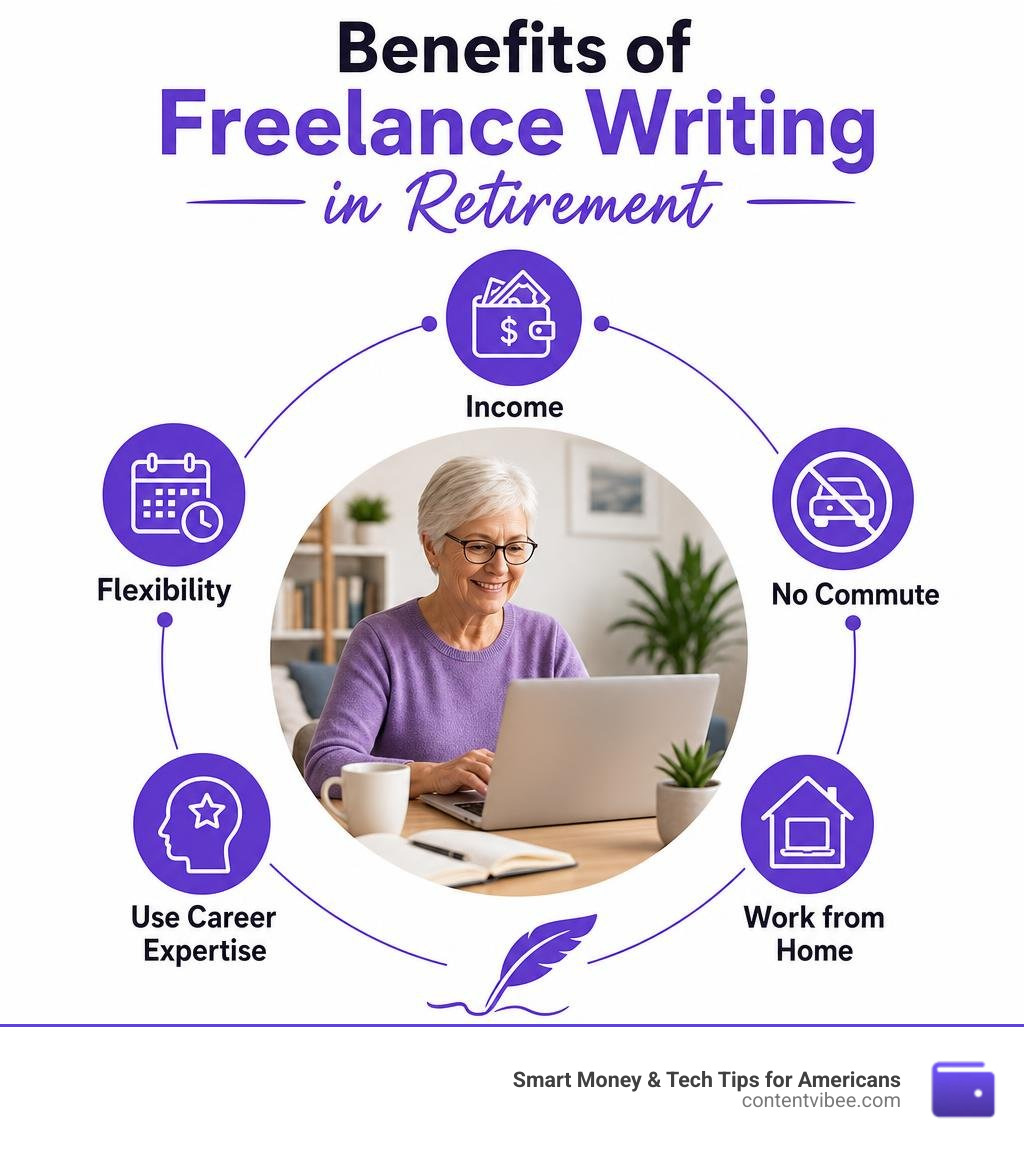
If you are looking for a meaningful way to spend your days while keeping your bank account happy, transitioning into freelance writing is one of the most rewarding decisions you can make. It is not just about the money (though the extra cash is fantastic); it is about finding a second act that keeps your mind sharp, values your life experience, and respects your freedom.
Many retirees find that traditional part-time jobs are physically demanding or offer little flexibility. Standing on your feet for hours as a greeter or cashier loses its charm quickly. Freelance writing, on the other hand, is entirely sedentary, intellectually stimulating, and highly adaptable.
Statistically, older adults are incredibly successful when they take the entrepreneurial leap. Research shows that 70% of startups founded by people age 50 or older last longer than three years, compared to just 28% for those launched by founders under 50. Furthermore, almost a quarter (24%) of those aged 50+ who started a business did so specifically to supplement their income. If you are looking for alternative ways to save for retirement or bolster an existing nest egg, freelance writing is a low-risk, high-reward business you can start for practically zero dollars.
For senior citizens, this is a highly feasible second career path. It does not require expensive equipment—just a reliable computer, an internet connection, and a willingness to learn. It allows you to protect your health, avoid exhausting commutes, and remain fully present for family events, travel, and hobbies. As highlighted in this look at a second career path for seniors, writing is an age-agnostic field where clients care about the quality of the words you deliver, not the number of candles on your birthday cake.
Top Types of Writing and Editing Roles for Retirees
The writing world is vast, meaning you do not have to limit yourself to one specific task. Depending on your interests and comfort level, you can specialize in several different areas.
Here is a breakdown of the most common roles available:
Copywriting
Copywriting is the art of writing persuasive text designed to prompt the reader to take action—whether that is buying a product, signing up for a newsletter, or downloading a guide. It includes writing marketing brochures, sales emails, direct mail packages, and website landing pages. Because copywriting directly drives revenue, businesses are willing to pay premium rates for it.
Content Writing
Content writers focus on educating, entertaining, or informing the reader rather than making a direct sales pitch. This includes writing blog posts, how-to guides, magazine articles, and company newsletters. Content writing is excellent for retirees who love researching new topics and explaining complex ideas in simple, warm language.
Proofreading and Editing
If you have an eagle eye for typos, misplaced commas, and spelling mistakes, proofreading and editing might be your calling. Proofreaders review drafted text to catch grammatical errors, while editors help restructure sentences for better clarity and flow. This role is highly structured and perfect for those who want to work with language without necessarily starting every project from a blank page.
| Role | Primary Goal | Best For | Typical Project Types |
|---|---|---|---|
| Copywriter | Drive sales and conversions | Persuasive communicators | Sales letters, product descriptions, email campaigns |
| Content Writer | Educate, inform, and build trust | Natural teachers and researchers | Blog posts, guidebooks, white papers |
| Proofreader / Editor | Polish existing text for accuracy | Detail-oriented readers | Novels, business reports, academic essays |
Finding Your Niche in Retirement Freelance Writing Jobs
One of the fastest ways to stand out in the freelance writing market is to specialize in a “niche.” Instead of calling yourself a generalist, you position yourself as an expert in a specific industry.
As a retiree, your niche is already built into your resume. Think back over your previous decades of employment. Were you in healthcare? Real estate? Education? Finance?
Businesses pay a premium for writers who actually understand their industry. For example, a marketing agency working with a medical client would much rather hire a retired nurse to write their blog posts than a 22-year-old generalist who has to research basic medical terms from scratch.
Excellent niches for retirees include:
- Personal Finance: Explaining retirement planning, investing, and tax strategies.
- Healthcare and Wellness: Writing about active aging, nutrition, and managing chronic conditions.
- Senior Living and Services: Crafting empathetic, informative guides for families navigating senior housing, Medicare, and estate planning. High-paying opportunities like a senior B2B content writer opportunity frequently look for writers who can speak authoritatively on these topics.
Technical and Creative Writing Options
If traditional client-based writing feels too high-pressure, there are alternative paths that offer even more autonomy.
One highly popular option is ghostwriting, where you write books, memoirs, or industry guides for other people who do not have the time or skill to write them themselves. This allows you to work on long-form, deeply engaging projects.
Another emerging avenue in 2026 is self-publishing structured digital products through the Kindle ecosystem. Many writers are finding success by creating and publishing niche planners, journals, goal trackers, and themed workbooks. This model focuses on consistent, structured formatting rather than long-form prose, and can generate reliable passive income over time.
If you prefer a structured approach without the pressure of managing demanding clients, looking into part-time online writing positions that focus on template-driven content creation can be a wonderful, low-stress alternative.
Realistic Income Potential and Financial Considerations
How much can you actually make from retirement freelance writing jobs? The short answer is: it depends entirely on how much you want to work and what services you offer.
Freelance writers typically charge in one of three ways:
- Hourly Rates: Ideal for consulting, heavy research, or editing. Commercial writing projects easily command $50 to $125+ per hour.
- Per-Word Rates: Common in journalism and blogging. Rates range from $0.10 per word for beginners to $0.50 to $2.00 per word for seasoned specialists.
- Flat Project Fees: A set price for a completed piece (e.g., $150 for an 800-word blog post or $1,000 for a multi-page brochure).
For part-time work, writers who publish consistently can realistically expect to earn between $300 and $1,500 per month. If you decide to scale up your business, build a steady client base, and treat it like a full-time endeavor, it is entirely possible to exceed $5,000 to $10,000 monthly.
Before you start counting your earnings, it is essential to plan ahead. We highly recommend using a retirement calculator for savings to see how your new freelance income fits into your overall financial picture.
Additionally, freelance income is subject to taxes. Unlike traditional employment where taxes are withheld from your paycheck, freelancers are responsible for paying self-employment tax. Make sure to read up on taxing your golden years to understand how additional income might impact your tax bracket and your net earnings.
Balancing Freelance Earnings with Social Security Benefits
If you are currently collecting Social Security benefits, you need to be mindful of the Social Security Administration’s (SSA) annual earnings limits.
If you have not yet reached your Full Retirement Age (FRA), earning too much money can temporarily reduce your monthly Social Security payments. In 2026, if you are under FRA, the SSA deducts $1 from your benefit payments for every $2 you earn above the annual limit. During the year you reach FRA, the rules become much more generous, and once you are fully past your FRA, there is absolutely no limit on how much you can earn.
To make sure you are maximizing your household income, it is smart to use a how much Social Security will I get tool to run the numbers. Knowing your limits helps you pace your freelance writing workload so you do not accidentally trigger a temporary reduction in your benefits.
How to Find and Secure Retirement Freelance Writing Jobs
Starting a new career can feel overwhelming, but finding clients is much easier when you know where to look. The key is to take a proactive approach and leverage modern digital tools.
Best Platforms for Retirement Freelance Writing Jobs

To get your foot in the door, you can use specialized platforms designed to connect freelance writers with businesses looking for content.
- Scripted: A great platform for finding consistent, high-quality assignments in specialized industries like senior services, finance, and healthcare.
- Upwork and Fiverr: These massive marketplaces allow you to create a profile, showcase your skills, and bid on writing projects from clients worldwide.
- Direct Pitching: Identify local businesses, magazines, or websites you love and send a polite email to the editor or marketing director offering your services.
- The Well-Fed Writer: This is an outstanding resource specifically tailored to the 55+ community. By visiting The Well-Fed Writer for 55+, you can access books, guides, and strategies designed to help older adults break into lucrative commercial copywriting without getting bogged down in low-paying “content mills.”
Building a Portfolio Without Recent Experience
“How do I get writing jobs if I don’t have a portfolio, and how do I get a portfolio if I don’t have writing jobs?” This classic paradox stops many aspiring writers in their tracks, but it is actually very easy to solve.
First, look at your past career. If you wrote training manuals, marketing emails, business proposals, or newsletters in your previous jobs, those are valid writing samples! Just make sure you have permission to share them and that they do not contain sensitive company data.
Second, consider doing a small amount of pro bono (free) work for a local charity, a friend’s startup, or a community organization. In exchange for your writing, ask them for a testimonial and permission to use the finished piece as a sample.
Third, you can write “spec” (speculative) pieces. Pick a topic in your chosen niche, write a high-quality blog post or brochure as if you were hired to do it, and save it as a PDF. This proves to prospective clients that you can write clean, professional copy. For a deeper dive into making this transition smoothly, check out this encouraging freelance to freedom guide written specifically for older adults.
Overcoming Challenges: Ageism, Tech, and Work-Life Balance
While freelance writing is a fantastic retirement option, it is not without its hurdles. Being aware of these challenges ahead of time allows you to navigate them gracefully.
- Beating Age Discrimination: Unfortunately, ageism exists in the corporate world. The good news? In freelance writing, you rarely have to show your face. Many successful senior freelancers choose to use a professional logo or a simple, text-based portfolio rather than a headshot. Let your writing quality, professionalism, and industry knowledge speak for themselves.
- Navigating the Tech Curve: You do not need to be a software engineer, but you do need to be comfortable with basic digital tools. Take some time to learn Microsoft Word, Google Docs, and basic email communication. Knowing how to format articles with headings and understand basic search engine optimization (SEO) will put you miles ahead of the competition.
- Managing Physical Strain: Spending hours staring at a computer screen can lead to eye strain and physical fatigue. Set up an ergonomic workspace with good lighting, a supportive chair, and perhaps a larger monitor.
- Maintaining Work-Life Balance: You retired for a reason! It is easy to get caught up in the excitement of landing new clients and take on too much work. A great practice is to set strict boundaries. For example, limit your writing to two hours in the morning, leaving your afternoons free for exercise, social visits, and relaxation.
Frequently Asked Questions about Retirement Freelance Writing
Let’s address some of the most common questions retirees ask when starting their freelance writing journey.
Do I need an English degree to start freelance writing in retirement?
Absolutely not! While a degree in English, journalism, or communications is nice to have, it is far from a requirement.
Clients in the commercial world do not care about academic credentials; they care about clarity, accuracy, and results. They want writers who can explain things simply, meet deadlines, and write in a friendly, conversational tone. To sharpen your skills, invest in a copy of The Chicago Manual of Style, keep a reliable dictionary handy, and practice writing short, clear paragraphs. Your real-world industry experience is worth far more to a business than a creative writing degree.
How many hours a week do retired freelance writers typically work?
You are the boss, which means you decide your schedule. Some retirees work just 3 to 5 hours a week to earn a little extra fun money, while others prefer a more structured schedule of 15 to 20 hours a week.
If you find your eyes getting tired or you want to travel, you can simply scale back your client load. The ultimate beauty of freelance writing is that you have complete control over your workload.
Will freelance writing income affect my Social Security benefits?
It can if you are under your Full Retirement Age and earn more than the annual SSA limit. However, once you reach your FRA, you can earn an unlimited amount of money without any reduction in your benefits.
Because timing is everything when it comes to retirement planning, we highly recommend reading our guide on Social Security spousal benefits timing to understand how to coordinate your earnings and benefit claims with your spouse for maximum financial security.
Conclusion
Retirement should not mean turning off your brain or worrying about how to stretch a fixed income. Retirement freelance writing jobs offer the perfect blend of mental stimulation, creative expression, and financial freedom. By utilizing your decades of professional experience, you can easily build a flexible, work-from-home business that fits beautifully into your lifestyle.
As you plan your next exciting chapter, we want to make sure you have all the facts. Be sure to learn how working in retirement affects your spousal benefits so you can write, earn, and enjoy your golden years with complete peace of mind!