


How Retirement for Spouse Benefits Works — and How to Claim Them
Planning retirement for a spouse is one of the most important financial decisions a couple can make — and Social Security offers real monthly income to help.
Here’s a quick overview of how spousal retirement benefits work:
| Question | Quick Answer |
|---|---|
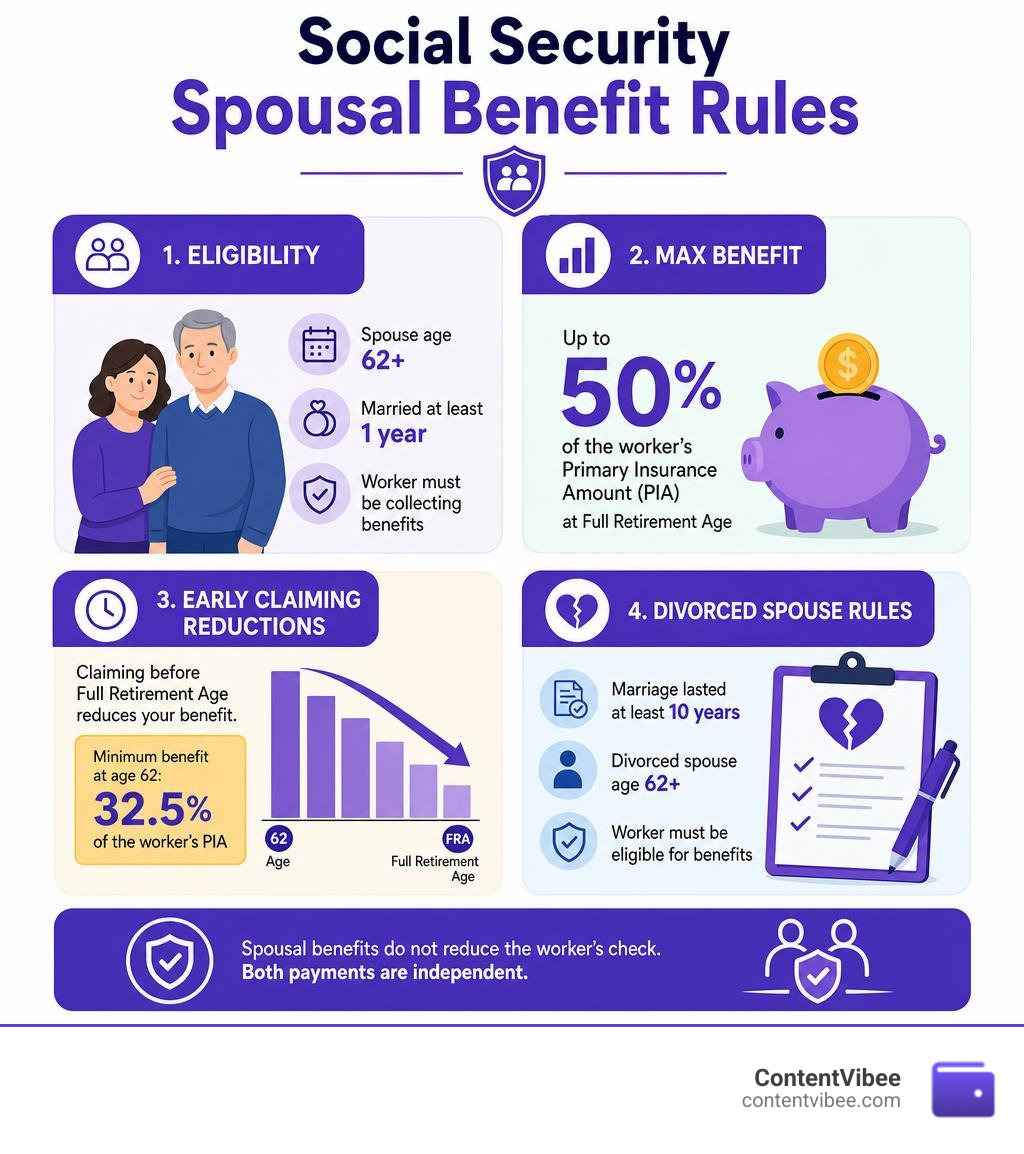
| Who qualifies? | Spouse age 62+, married at least 1 year, worker must be collecting benefits |
| Maximum benefit | 50% of the worker’s Primary Insurance Amount (PIA) at Full Retirement Age |
| Minimum benefit (age 62) | 32.5% of the worker’s PIA |
| Do you need your own work history? | No — a non-working spouse can still qualify |
| Does it reduce the worker’s check? | No — both payments are independent |
| Average monthly spousal benefit | ~$986/month |
About 2 million Americans currently receive Social Security spousal benefits. Yet many couples miss out — partly because the Social Security Administration does not automatically notify you if you’re eligible.
The rules can feel complicated. Benefit amounts depend on your age, your spouse’s earnings record, when you claim, and whether you have your own work history. Divorced spouses, railroad workers’ spouses, and military spouses each face a separate set of rules on top of that.
This guide walks you through all of it — eligibility, benefit calculations, strategic claiming decisions, and exactly how to apply.
Qualification Guidelines for Spousal Benefits
When evaluating eligibility for retirement for spouse benefits, the Social Security Administration (SSA) looks at clear legal and age criteria. You can explore The Complete Guide to Social Security Spousal Benefit Eligibility for a deep dive, but the basic prerequisites stem from statutory marriage duration and age limits.
Eligibility Requirements for Social Security Retirement for Spouse
Under official SSA rules codified in SSA – POMS: RS 00202.001 – Definitions and Requirements for Spouse Benefits – 07/24/2017 , a spouse must meet three core conditions to claim retirement payments based on a partner’s record:
- Age Threshold: You must be at least 62 years old, unless you qualify under the child-in-care exception.
- Marriage Duration: You must have been legally married to the primary worker for at least 1 continuous year prior to filing your application. (Exceptions apply if you are the biological parent of the worker’s child or were previously eligible for certain survivor or child benefits).
- Primary Worker Status: The primary earning spouse must have already filed for their own Social Security retirement or disability benefits.
A “deemed spouse” — someone who entered into a marriage ceremony in good faith despite an unknown legal defect — may also qualify under federal regulations.
Child-in-Care Exception Provisions
If you are caring for the primary worker’s qualifying child, the standard age 62 requirement and early claiming reductions are completely waived.
A qualifying child must be either:
- Under age 16, or
- Disabled (with a disability that began prior to age 22).
When you meet this exception, you can receive 100% of the maximum eligible spousal benefit regardless of how young you are when claiming. However, once the child turns 16 (unless disabled), the child-in-care spousal payments pause until you reach age 62.
Divorced Spouse Eligibility Criteria
Divorced individuals can collect spousal benefits based on an ex-spouse’s earnings history without reducing the ex-spouse’s payout or affecting a current spouse’s benefit. To qualify, you must satisfy four key requirements:
- 10-Year Marriage Rule: You were married to your ex-spouse for at least 10 consecutive years prior to the final divorce decree.
- Divorce Duration: You have been divorced for at least 2 consecutive years (if your ex-spouse hasn’t filed for benefits yet). If your ex-spouse is already receiving benefits, the 2-year waiting period is waived.
- Unmarried Status: You are currently single. Remarrying generally disqualifies you from collecting spousal benefits on a former partner’s record.
- Age Requirement: You are at least 62 years old.
Crucially, ex-spouses do not need to grant permission, nor does the SSA notify them when you apply on their earnings record.
Calculating Spousal Benefits and Dual Entitlement

Understanding how the Social Security Administration computes your check is essential to building an accurate retirement plan. You can use our tool to Calculate Spouse Retirement Benefits directly, or follow the math outlined below.
Maximum Spousal Benefit Formula
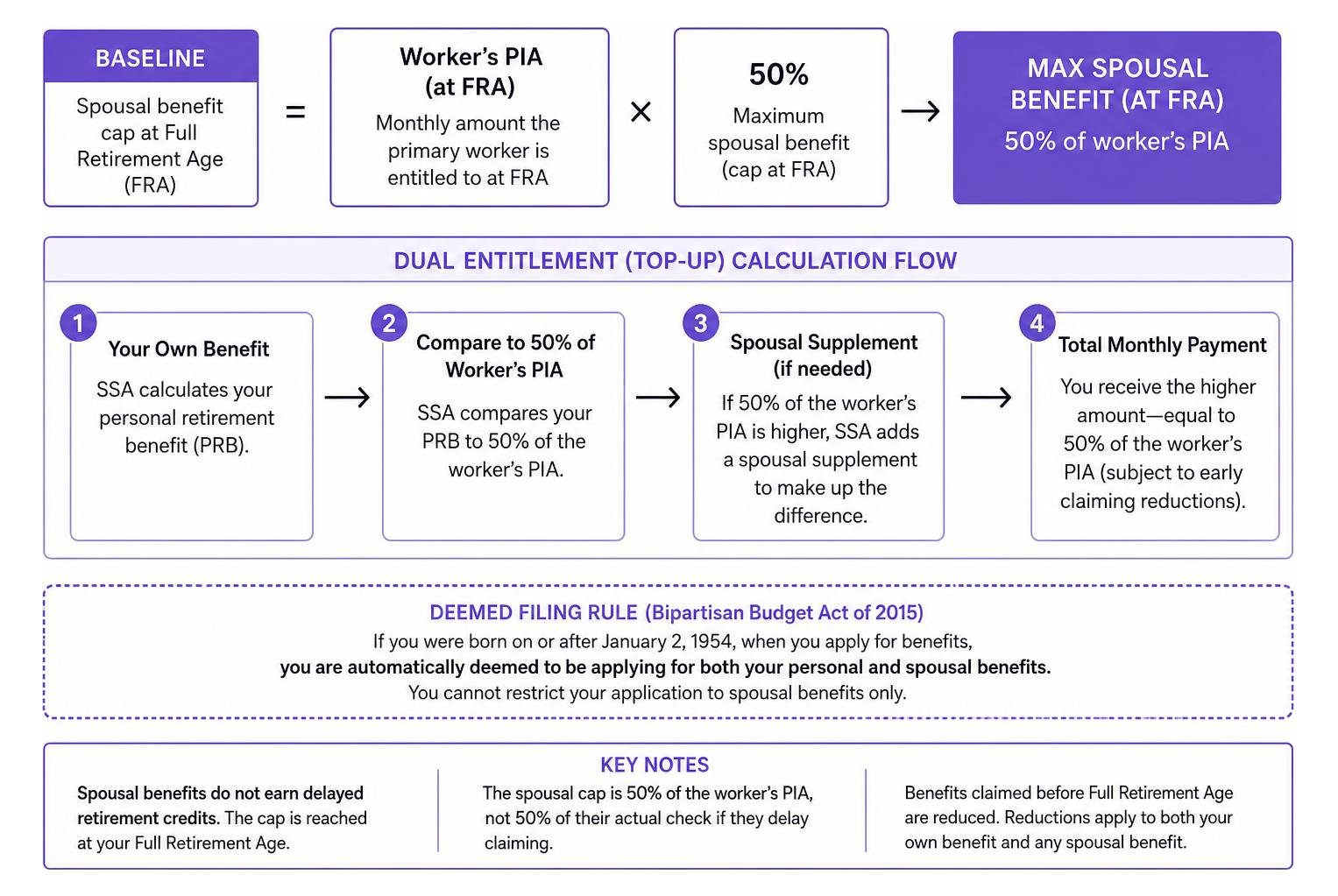
The absolute maximum spousal benefit you can receive is 50 percent of the primary worker’s Primary Insurance Amount (PIA). The PIA represents the monthly check the working spouse is entitled to receive at their exact Full Retirement Age (FRA) — which is 67 for everyone born in 1960 or later.
Key baseline parameters to keep in mind:
- No Delayed Credits: Unlike personal retirement benefits, which grow by 8% per year up to age 70, spousal benefits do not earn delayed retirement credits. They reach their full cap (50% of the worker’s PIA) at your Full Retirement Age.
- Worker’s Actual Claiming Age: Your spousal cap is strictly 50% of the primary worker’s PIA, not 50% of their actual check. If your spouse delayed claiming until age 70 and gets $3,000 per month on a $2,400 PIA, your full spousal benefit capped at FRA is $1,200 (50% of $2,400), not $1,500.
Dual Entitlement and Deemed Filing Rules
Many spouses have worked enough to earn their own Social Security retirement benefits. If you qualify for both your own benefit and a spousal benefit, the SSA applies the rules of dual entitlement. You can read more about How Social Security Spousal Benefits Work for Married Couples, but the mechanism works like a “top-up.”
- The SSA pays your own earned retirement benefit first.
- If 50% of your spouse’s PIA is higher than your own benefit, the SSA adds a spousal supplement to make up the difference.
- Your total monthly payment equals the higher spousal amount.
The Bipartisan Budget Act and Deemed Filing
Under the Bipartisan Budget Act of 2015, if you were born on or after January 2, 1954, you are subject to deemed filing. When you apply for benefits, you are automatically deemed to be applying for both your personal retirement benefit and your spousal benefit simultaneously. You cannot “restrict” your application to draw spousal benefits while letting your personal record grow.
Early Claiming Penalties and Reductions
Claiming spousal benefits before reaching your Full Retirement Age results in a permanent monthly reduction. You can consult Benefits for Spouses or learn How to Calculate Your Spousal Retirement Age Easily to establish your exact timeframe.
The SSA applies a two-tiered reduction formula for early spousal claiming:
- First 36 Months Early: Your benefit is reduced by 25/36 of 1% per month (up to a 25% reduction for claiming 3 years early).
- Additional Months Early (up to 24 months): Your benefit is further reduced by 5/12 of 1% per month.
For someone with an FRA of 67 who claims spousal benefits at age 62 (60 months early): $$text{Reduction} = left(36 times frac{25}{36}%right) + left(24 times frac{5}{12}%right) = 25% + 10% = 35%$$
This means claiming at age 62 drops your benefit from 50% down to 32.5% of the primary worker’s PIA.
| Claiming Age (FRA 67) | Months Claimed Early | Total Reduction | Percentage of Worker’s PIA Received |
|---|---|---|---|
| 67 (FRA) | 0 | 0% | 50.0% |
| 66 | 12 | 8.33% | 45.8% |
| 65 | 24 | 16.67% | 41.7% |
| 64 | 36 | 25.0% | 37.5% |
| 63 | 48 | 30.0% | 35.0% |
| 62 | 60 | 35.0% | 32.5% |
Real-World Example: If your partner’s PIA is $2,000, your maximum spousal benefit at FRA is $1,000. If you claim at age 62, your payment is reduced by 35% to $650 per month.
Strategic Decisions in Planning Retirement for Spouse Benefits
Because retirement income options vary across sectors and personal situations, coordinating claiming strategies requires comparing Social Security against survivor benefits, railroad pensions, and military provisions.
Comparing Spousal Benefits and Survivor Benefits
Spousal benefits and survivor benefits serve fundamentally different purposes under Social Security law.
| Feature | Spousal Benefits | Survivor Benefits |
|---|---|---|
| Status of Worker | Alive and receiving benefits | Deceased |
| Earliest Claiming Age | 62 (unless caring for qualifying child) | 60 (50 if disabled, any age if child in care) |
| Maximum Benefit Cap | 50% of worker’s Primary Insurance Amount | 100% of deceased worker’s benefit (including delayed credits) |
| Deemed Filing Applies? | Yes (must file for personal & spousal) | No (can claim survivor and switch to personal later) |
| Delayed Credit Growth | Capped at FRA | Includes credits earned up to age 70 by deceased |
Because survivor benefits can reach 100 percent of the deceased spouse’s actual check, having the primary earner delay claiming until age 70 is one of the most effective ways to protect a surviving lower-earning partner long-term.
Comparing Railroad Retirement Spouse Annuities to Social Security
If your partner worked in the railroad industry, spousal benefits follow the Railroad Retirement Act rather than standard Social Security. You can consult official agency guidance in Railroad Retirement Spouse Annuities and RB-30 – Spouse/Divorced Spouse Annuity .
Railroad retirement spouse annuities are split into two distinct tiers:
- Tier I Component: Equal to 50 percent of the employee’s unreduced Tier I amount (directly mimicking Social Security formulas).
- Tier II Component: Equal to 45 percent of the employee’s unreduced Tier II amount (functioning like a private industry pension).
Key Differences:
- Higher Average Payouts: The average monthly railroad retirement spouse annuity awarded in fiscal year 2025 was $1,305, compared to $986 for standard Social Security spousal benefits.
- 30-Year Service Rule: If the primary railroad employee completes 30 or more years of service and is at least age 60, the spouse can draw an unreduced spouse annuity starting at age 60.
- Divorced Railroad Spouses: Divorced spouse annuities (for marriages lasting 10+ years) consist only of Tier I benefits — they do not include Tier II payouts.
Military Spouse Retirement and Healthcare Benefits
For married partners of military retirees, spousal retirement security extends beyond monthly checks into comprehensive healthcare and survivor protections. Key military spousal benefits include:
- Survivor Benefit Plan (SBP): Provides an ongoing monthly annuity of up to 55 percent of the deceased veteran’s retired pay.
- TRICARE Health Coverage: Retired military spouses retain access to TRICARE Prime or TRICARE Select at reduced retiree rates, transitioning seamlessly into TRICARE For Life (wraparound coverage for Medicare Parts A & B) at age 65.
- DEERS Enrollment: Continuous access to base commissaries, exchanges, and military facility privileges requires maintaining updated status in the Defense Enrollment Eligibility Reporting System (DEERS).
- Divorce Overlap (20/20/20 Rule): Former military spouses retain full TRICARE and commissary privileges after divorce if 20 years of marriage overlapped with 20 years of creditable military service.
Steps to Apply for Spouse Retirement Benefits

Ready to claim? Following a clean process helps avoid delays or lost payments. For a step-by-step breakdown, check out How to Claim Spousal Retirement Benefits Without Losing Your Mind.
How Earned Income Affects Retirement for Spouse Payments
If you decide to claim spousal benefits before reaching your Full Retirement Age while continuing to work, your payments are subject to the Social Security Earnings Test:
- 2026 Pre-FRA Limit: If you earn more than $24,480 per year, the SSA withholds $1 in benefits for every $2 earned over the threshold.
- 2026 FRA Transition Year Limit: During the calendar year you reach FRA, the earnings limit rises to $65,160, with the SSA withholding $1 for every $3 earned above the limit prior to your birth month.
- Post-FRA Recalculation: Withheld benefits are not permanently lost. When you hit Full Retirement Age, the SSA automatically recalculates your monthly check upward to account for the months benefits were withheld.
Filing Workflow and Application Channels
You can apply for spousal benefits up to 3 months prior to the date you want your payments to begin.
- Online Portal: Visit
SSA.govto complete the electronic application (available if you are within 3 months of turning 62 and applying for retirement/spousal benefits). - Telephone Appointment: Call the SSA toll-free at 1-800-772-1213 (TTY 1-800-325-0778) to schedule a telephone interview.
- In-Person Field Office: Contact your local Social Security field office to schedule an in-person appointment.
Required Application Documents Checklist:
- [ ] Your birth certificate or official proof of age
- [ ] Proof of U.S. citizenship or lawful alien status
- [ ] Marriage certificate (showing legal date of marriage)
- [ ] Final divorce decree (if applying as a divorced spouse after a 10+ year marriage)
- [ ] Social Security numbers for both you and your primary earner spouse
- [ ] Recent W-2 forms or self-employment tax returns (Form 1040)
- [ ] Direct deposit banking details (Routing number and Account number)
Frequently Asked Questions About Spousal Benefits
Can a spouse receive benefits if they never worked?
Yes. A non-working spouse who lacks the 40 work credits required for their own retirement benefit can receive up to 50 percent of the working spouse’s Primary Insurance Amount at Full Retirement Age. The working spouse must have already filed for retirement or disability benefits, and the couple must meet the 1-year marriage duration requirement.
Does a spouse benefit reduce the primary worker’s check?
No. Claiming spousal benefits has zero impact on the primary worker’s monthly payout. The worker receives 100% of their eligible benefit regardless of whether a current spouse or divorced ex-spouse claims on their earnings record.
What happens to spousal benefits if the primary worker delays until age 70?
While delaying past FRA increases the primary worker’s personal retirement check by 8 percent annually (up to age 70), spousal benefits do not increase. Spousal benefits top out when the spouse reaches their own Full Retirement Age (capped at 50% of the worker’s FRA Primary Insurance Amount).
However, delaying until age 70 does increase the potential survivor benefit to 100% of that higher amount if the primary earner passes away first.
Conclusion
Unlocking the full value of retirement for spouse benefits requires looking at age thresholds, marriage rules, early claiming reductions, and overall household income goals. Whether you are claiming standard Social Security, evaluating divorced spouse eligibility, or navigating military and railroad pensions, taking time to coordinate your strategy pays off for life.
For complete financial guides, interactive calculations, and step-by-step claiming support, explore our Spousal Benefits 101 Guide on ContentVibee or set up a spousal account using our resource on How to Open a Spousal Retirement Account for Your Partner.


