


What Most Americans Get Wrong About Spousal Support Social Security
Spousal support Social Security benefits can add hundreds of dollars a month to your retirement income — yet most people don’t fully understand how they work, or even that they exist.
Here’s a quick answer to the most common questions:
| Question | Quick Answer |
|---|---|
| Who qualifies? | Spouses age 62+, married at least 1 year, whose partner is already receiving benefits |
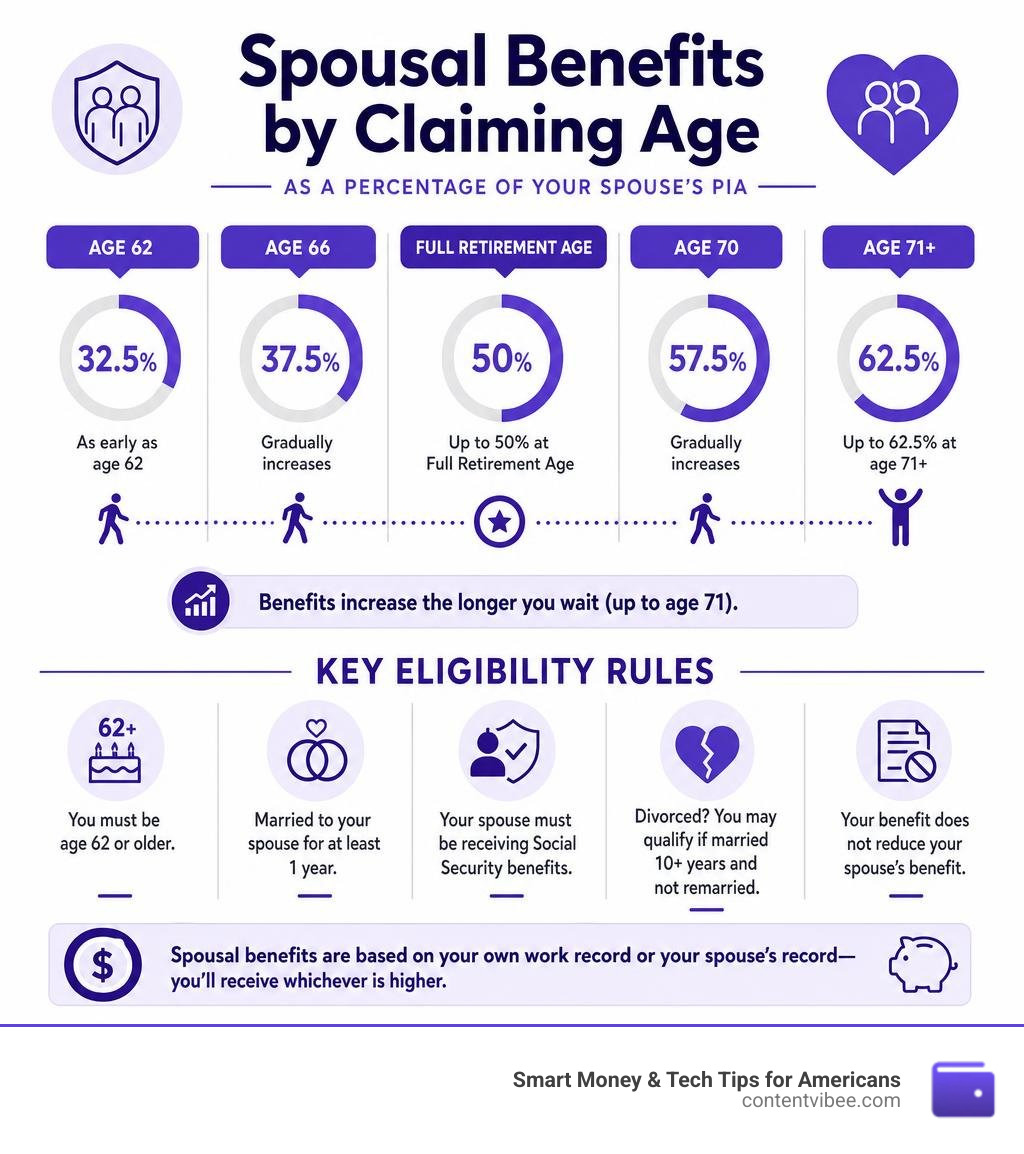
| How much can you get? | Up to 50% of your spouse’s Primary Insurance Amount (PIA) at full retirement age |
| What if you claim early? | As little as 32.5% of your spouse’s PIA if you claim at age 62 |
| Can divorced spouses qualify? | Yes — if married 10+ years and not remarried |
| Does it reduce your spouse’s benefit? | No — their payment stays the same |
The numbers tell a striking story about how misunderstood these benefits are:
- 30% of adults incorrectly believe Social Security offers no benefits for a spouse
- 50% of adults incorrectly believe divorced individuals cannot claim on an ex-spouse’s record
That’s a lot of people leaving money on the table.
If you’re approaching retirement and your spouse has a stronger earnings record than you, spousal benefits could significantly boost your monthly income. And if you’ve been divorced after a long marriage, you may have options you never knew about.
This guide breaks down exactly how spousal benefits work, what they pay, and how to claim them the right way — so you don’t lose a dollar you’re entitled to.
Understanding Spousal Support Social Security Eligibility

When we talk about maximizing retirement income, many couples overlook the rules surrounding spousal support Social Security. In simple terms, these benefits allow one spouse to receive a monthly check based on the work history of the other. But before you start planning how to spend that extra cash, you have to make sure you meet the strict criteria set by the Social Security Administration (SSA).
To qualify for a spousal benefit, the primary worker (your spouse) must already be entitled to and receiving their own retirement or disability benefits. Additionally, you must be at least 62 years old, or you must be caring for a qualifying child who is under age 16 or disabled.
The SSA recognizes two types of spouses:
- Legal Spouse: Your marriage is legally valid under the state laws where you live or where you were married.
- Deemed Spouse: If you went through a marriage ceremony in good faith, but a legal impediment (like an administrative error) made the marriage technically invalid, the SSA may still “deem” you a spouse for benefit purposes.
Understanding these definitions is the first step toward securing your retirement. For a comprehensive breakdown of these criteria, check out our guide on How to Check Your Eligibility for Spousal Social Security Benefits and review the official SSA Definitions and Requirements policy.
The One-Year Marriage Rule and Exceptions
For currently married couples, you generally must be married for at least one continuous year before you can file for benefits on your spouse’s record. This rule prevents people from getting married over the weekend just to claim a larger Social Security check on Monday!
However, the SSA does make exception shortcuts to this one-year rule. You may not have to wait a full year if:
- You are the natural mother or father of the worker’s child.
- You were already entitled to (or could have qualified for) certain other Social Security benefits—such as survivor, parent’s, or disabled adult child benefits—in the month before your marriage.
Child-in-Care Exceptions to Age Requirements
What if you aren’t 62 yet? You might still qualify for spousal benefits under the child-in-care exception.
If you are caring for a child of the primary worker, and that child is either under age 16 or became disabled before age 22, you can receive spousal benefits at any age. Even better, if you qualify under the child-in-care rule, your spousal benefit is not subject to the age-related reductions that apply when claiming before your Full Retirement Age (FRA). However, keep in mind that these benefits will terminate the month before the child turns 16, unless the child is disabled.
How Spousal Benefits Are Calculated and the Impact of Early Claiming
Calculating your potential payout doesn’t require an advanced math degree, but you do need to understand a few key terms. The most important of these is the Primary Insurance Amount (PIA). The PIA is the monthly benefit amount a worker is entitled to receive if they claim exactly at their Full Retirement Age.
At your own Full Retirement Age, your maximum spousal benefit is exactly 50% of your partner’s PIA. It is highly important to note that your spousal benefit is based on their PIA, not their actual monthly payout. If your spouse delayed claiming their own benefit until age 70 to get delayed retirement credits, your spousal benefit is still capped at 50% of what their benefit would have been at their FRA.
To see how these calculations fit into your broader retirement picture, read our companion piece Calculate Your Spousal Benefits the Easy Way and reference the official SSA Spouse’s Benefits Payment Policy.
Calculating Spousal Support Social Security at Full Retirement Age
For anyone born in 1960 or later, the Full Retirement Age is 67. If you wait until age 67 to claim your spousal benefit, you will receive the full 50% of your spouse’s PIA.
For example, if your spouse’s PIA is $2,000, your spousal benefit at age 67 will be $1,000. It’s a clean, straightforward calculation.
| Claiming Age (Assuming FRA of 67) | Percentage of Spouse’s PIA Received |
|---|---|
| 67 (Full Retirement Age) | 50.0% |
| 66 | 45.8% |
| 65 | 41.7% |
| 64 | 37.5% |
| 63 | 35.0% |
| 62 (Earliest Age) | 32.5% |
The Cost of Claiming Spousal Support Social Security Early
If you decide to claim your spousal benefit before reaching your FRA, the SSA will permanently reduce your monthly payment. The reduction is calculated using a specific formula:
- The benefit is reduced by 25/36 of 1% for each of the first 36 months before your FRA.
- If you claim even earlier, the benefit is reduced by an additional 5/12 of 1% for each month beyond 36 months.
When you do the math, claiming at the earliest possible age of 62 (with an FRA of 67) means your spousal benefit is reduced by a whopping 35%. Instead of getting 50% of your spouse’s PIA, you will only receive 32.5%.
Let’s look at a real-world example: If your spouse has a PIA of $1,600, your maximum spousal benefit at FRA would be $800. If you claim exactly 36 months early, your benefit is reduced by 25%, leaving you with $600 a month. If you claim at 62 (60 months early), you’ll receive just $520 a month. That is a permanent lifetime reduction, so think carefully before jumping the gun!
Rules for Divorced Spouses and Dual Entitlement

Many people assume that once a marriage ends, any claim to a spouse’s Social Security record disappears. Fortunately, that is not the case. The SSA provides robust protections for divorced individuals, ensuring they can still access spousal support Social Security benefits.
Crucially, claiming benefits on an ex-spouse’s record does not reduce the benefit amount that your ex-spouse (or their new spouse) receives. In fact, your ex-spouse won’t even be notified by the SSA that you have filed on their record. It is a completely private transaction.
For more details on how these rules apply to you, check out our guide on Can Divorced Spouse Get Social Security Benefits? and the technical guidelines in the SSA Spouse’s Benefits Deductions manual.
Divorced Spouse Eligibility and the Two-Year Rule
To claim a spousal benefit on an ex-spouse’s record, you must meet the following criteria:
- Your marriage must have lasted for at least 10 continuous years.
- You must currently be unmarried (if you remarry, you generally lose eligibility for benefits on your ex-spouse’s record, unless that subsequent marriage also ended).
- You must be at least 62 years old.
There is also an important timing rule known as the two-year rule. If your ex-spouse has already claimed their own retirement benefits, you can file for spousal benefits immediately upon divorce (provided you meet the other requirements). However, if your ex-spouse is eligible for benefits but has not yet claimed them, you can still file on their record—but only if you have been divorced for at least two consecutive years.
Dual Entitlement: Can You Receive Your Own Benefit and a Spousal Benefit?
A common question we hear is: “Can I collect my own retirement benefit and my spousal benefit at the same time?”
The short answer is no; you cannot “double dip” to receive two full checks. Under the SSA’s dual entitlement rules, when you apply for benefits, the SSA automatically checks both your own work record and your spouse’s record. They will calculate both benefit amounts and pay you your own retirement benefit first.
If your spousal benefit is higher than your own retirement benefit, they will add an extra spousal supplement to your check to bring the total up to the higher spousal benefit amount. In effect, you always receive the larger of the two payouts, but it is paid as a single, combined monthly check.
Survivor Benefits vs. Spousal Benefits and Eliminated Claiming Strategies
It is easy to confuse spousal benefits with survivor benefits, but they serve different purposes and operate under entirely different rules. Spousal benefits are designed for when your partner is still living, while survivor benefits provide financial support after your partner passes away.
To understand how to coordinate these options for a more secure retirement, we recommend reading Double the Fun: Understanding Your Spousal Social Security Benefits.
How Survivor Benefits Differ for Widows and Widowers
While spousal benefits max out at 50% of the worker’s PIA, survivor benefits can be up to 100% of the deceased worker’s actual benefit.
Additionally, widows and widowers can claim survivor benefits much earlier—starting at age 60 (or age 50 if disabled). If you claim survivor benefits early, they will be reduced, but waiting until your full retirement age as a survivor entitles you to the full 100% amount.
Another major difference is remarriage: if you remarry before age 60, you lose your eligibility for survivor benefits on your deceased spouse’s record. However, if you remarry after age 60, your eligibility remains completely intact.
The Demise of File-and-Suspend and Restricted Applications
In the past, savvy couples used advanced claiming strategies to maximize their joint payouts. The two most popular methods were “file-and-suspend” and “restricted applications.”
Under these old rules, a higher-earning spouse could file for retirement benefits and immediately suspend them, allowing their own benefit to grow via delayed retirement credits while their partner claimed a spousal benefit. Alternatively, a spouse could file a “restricted application” for spousal benefits only, allowing their own retirement benefit to build up until age 70.
However, the Bipartisan Budget Act of 2015 closed these loopholes. Today, for the vast majority of retirees, these strategies are completely gone. The only exception applies to individuals who were born before January 2, 1954. If you were born before that date, you may still be allowed to file a restricted application to claim only spousal benefits while delaying your own. For everyone else, filing for one benefit automatically triggers “deemed filing” for both, and you will simply receive the higher amount.
How to Estimate and Apply for Your Spousal Benefits
Now that you know the rules, how do you actually find out what you’ll receive and take action? The process is simpler than it used to be, thanks to online tools, but you still need to be prepared.
For a step-by-step walkthrough of the filing process, check out our guide on Applying for Spousal Benefits.
Using my Social Security Accounts for Estimates
The absolute best way to estimate your future payout is by setting up a personal my Social Security account on the official SSA website.
Once logged in, follow these steps to see your spousal estimates:
- Navigate to the Retirement Calculator section.
- Select the option to “Calculate a Benefit as a Spouse” or “Compare with Benefit as a Spouse.”
- Enter your spouse’s estimated retirement benefit at their Full Retirement Age (you can get this from their own online statement).
- Choose the future age or date you plan to start receiving benefits to see exactly how early claiming reductions will affect your monthly check.
Required Documents and Information for the Application
When you are ready to apply (which you can do online if you are within three months of turning 62 or older), you will need to complete Form SSA-2 and submit specific documentation.
Do not delay applying even if you don’t have all your documents ready, as the SSA can often help you track down missing records. However, having these items on hand will speed up the process:
- Your birth certificate or other proof of birth.
- Proof of U.S. citizenship or lawful alien status.
- Your marriage certificate (to prove your marriage has lasted at least one year).
- Your final divorce decree (if applying as a divorced spouse to prove the 10-year marriage duration).
- Your most recent W-2 forms or self-employment tax returns.
- Your bank account information (routing and account numbers) to set up direct deposit.
Frequently Asked Questions about Spousal Social Security
Does claiming a spousal benefit reduce my partner’s monthly payment?
No. This is one of the most common myths about Social Security. When you claim a spousal benefit on your partner’s record, their monthly retirement benefit is not reduced by a single penny.
Additionally, your spousal benefit is not affected by the “family maximum” rules if you are a legal spouse or a divorced spouse. You are entitled to your full calculated spousal benefit regardless of how many other family members might also be receiving benefits on that record.
What events can cause my spousal benefits to terminate?
While spousal benefits are generally designed to last for your lifetime, certain life events can cause them to end. According to SSA Spouse’s Benefits Termination Events guidelines, your benefits will stop if:
- You and your spouse divorce (unless you meet the 10-year marriage requirement to transition to divorced spouse benefits).
- Your marriage is annulled.
- You become entitled to your own retirement or disability benefit that is equal to or greater than your spousal benefit.
- The primary worker passes away (in which case you would transition to survivor benefits).
How does working while receiving spousal benefits affect my payments?
If you plan to keep working after claiming spousal benefits, you need to be aware of the earnings test.
If you are under your Full Retirement Age and earn more than the annual limit set by the SSA, your benefits will be temporarily reduced. For every $2 you earn above the limit, the SSA will withhold $1 in benefits. In the year you reach your FRA, the reduction drops to $1 for every $3 earned above a higher threshold. Once you reach your exact Full Retirement Age, the earnings test no longer applies, and you can earn as much as you like with zero benefit reductions.
Conclusion
Navigating spousal support Social Security can feel overwhelming, but taking the time to understand these rules is one of the smartest financial moves you can make as a couple. By coordinating your claiming ages and understanding how early retirement affects your lifetime payouts, you can secure thousands of dollars in extra retirement income.
At ContentVibee, we are dedicated to helping you make sense of your money. To get an instant, personalized estimate of your potential spousal payout based on your unique scenario, head over to our interactive Social Security Spousal Benefit Calculator and start planning for your dream retirement today!