


Why the SS Spousal Benefit Could Be the Most Important Retirement Decision You Make
An SS spousal benefit is one of the most underused tools in retirement planning — and if you’re nearing retirement age, understanding it now could mean thousands of dollars more each year.
Quick Answer: What Is the SS Spousal Benefit?
| Question | Answer |
|---|---|
| What is it? | A Social Security payment based on your spouse’s earnings record, not your own |
| Who qualifies? | Married spouses age 62+, divorced spouses married 10+ years |
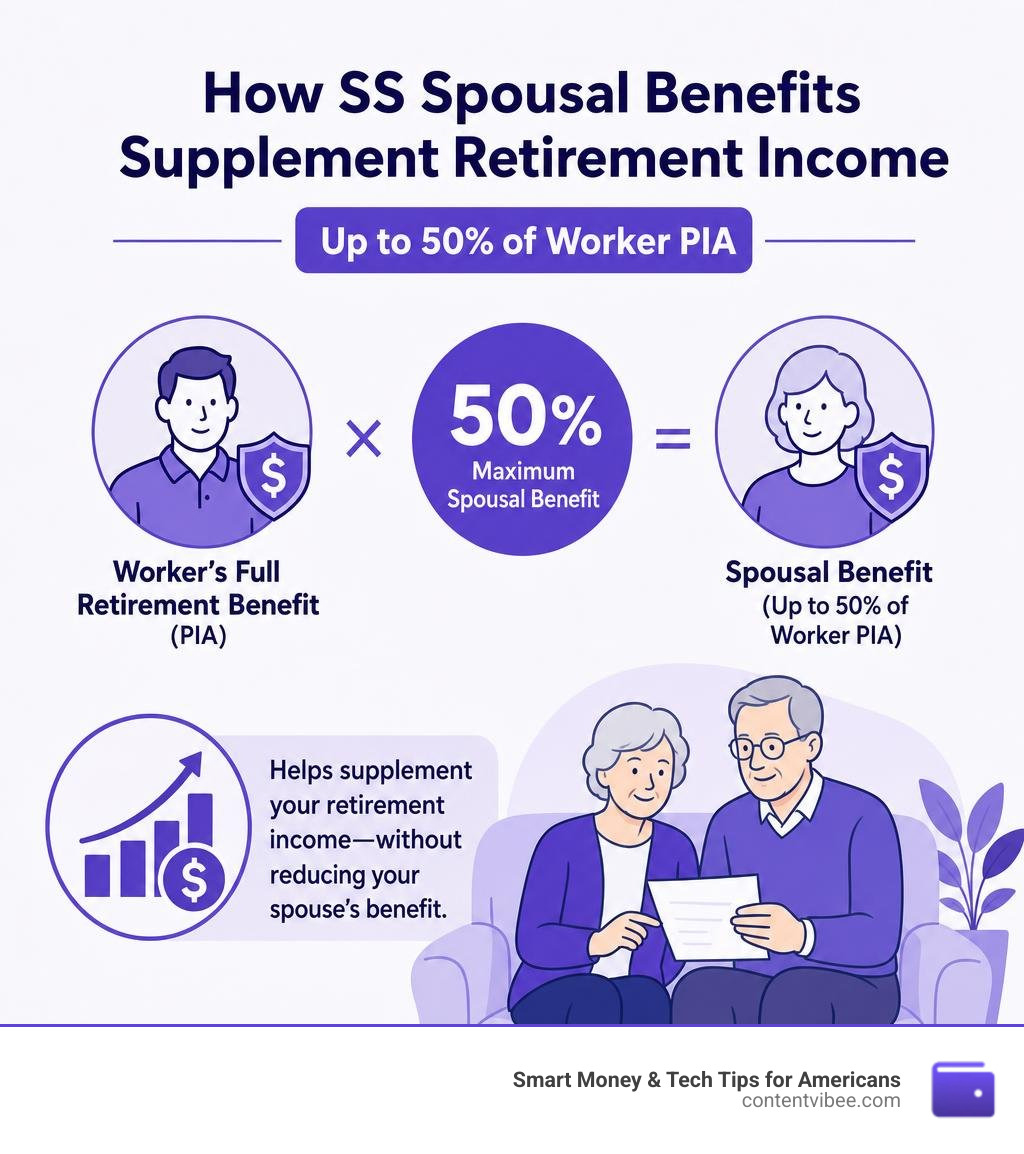
| How much? | Up to 50% of your spouse’s full retirement benefit amount |
| When is it reduced? | Any time you claim before your own full retirement age |
| Does it reduce your spouse’s benefit? | No — their payment stays the same |
Millions of Americans — especially those who took time away from work or earned significantly less than their partner — may qualify for a benefit they don’t even know exists.
The rules are specific, but not complicated once you break them down. This guide walks you through everything: who qualifies, how the benefit is calculated, what claiming early actually costs you, and how to apply.
Terms related to ss spousal benefit:
What is the SS Spousal Benefit and Who Qualifies?

When we plan for our golden years, we often focus entirely on our own work histories. We watch our Social Security statements, tracking how our years of hard work translate into a monthly retirement check. But the Social Security system was built with families in mind, recognizing that households often share labor, caregiving duties, and income disparities.
This is where the ss spousal benefit comes into play. It is a monthly payment designed to support a spouse with lower lifetime earnings (or no earnings history at all) by allowing them to receive a benefit based on their husband’s or wife’s work record. For a comprehensive look at how these dynamics play out, you can read more about How Social Security Spousal Benefits Work for Married Couples.
Basic Eligibility Requirements for the SS Spousal Benefit
To qualify for a spousal benefit on a current partner’s record, you must meet several strict requirements set by the Social Security Administration (SSA).
- Age Requirement: You must be at least 62 years old to claim spousal benefits, unless you qualify for an exception. The exception is if you have a qualifying child in your care. A qualifying child is either under age 16 or disabled, and they must be entitled to benefits on your spouse’s record.
- Marriage Duration: Generally, you must have been married to your spouse for at least one continuous year immediately before filing your application. However, there are exceptions to this one-year rule. For instance, if you are the natural parent of the worker’s child, or if you were entitled (or potentially entitled) to certain other Social Security benefits (like survivor or disability benefits) in the month before your marriage, you may not have to wait a full year.
- Worker Entitlement: Your spouse must already be receiving their own retirement or disability benefits (meaning they have filed and are actively collecting) for you to receive a spousal benefit. You cannot claim a spousal benefit on a living spouse’s record if they have not yet filed for their own benefits.
For those interested in the highly technical guidelines used by SSA claims representatives, you can review the official policy details in the SSA – POMS: RS 00202.001 – Definitions and Requirements for Spouse Benefits – 07/24/2017.
Legal vs. Deemed Spouse Definitions
The SSA is very precise about who qualifies as a “spouse.” Under their operating procedures, there are two primary classifications:
- Legal Spouse: To be recognized as a legal spouse, your marriage must be valid under the laws of the state where the primary worker is domiciled (lives) at the time you apply. Alternatively, you must have the same rights as a husband or wife to share in the distribution of intestate personal property (assets left behind without a will) under that state’s laws.
- Deemed Spouse: What happens if you went through a marriage ceremony in good faith, only to find out years later that a legal impediment made the marriage technically invalid? For example, perhaps your partner’s previous divorce was never fully finalized due to a clerical error. In these cases, the SSA may recognize you as a “deemed spouse.” If you entered the marriage in good faith, were living in the same household as the worker at the time of application, and there is no legal spouse currently receiving benefits on the record, you can still qualify for the ss spousal benefit.
How Spousal Benefits Are Calculated and the Impact of Early Claiming
Calculating your potential benefit is one of the most critical steps in retirement planning. While your own retirement benefit is based on your highest 35 years of indexed earnings, a spousal benefit is derived directly from your partner’s Primary Insurance Amount (PIA). The PIA is the monthly amount your spouse is entitled to receive if they wait until their exact Full Retirement Age (FRA) to claim.
The maximum spousal benefit you can receive is exactly 50% of your partner’s PIA. It is important to note that this is capped at 50% of their FRA benefit, even if your partner delays their own retirement past their FRA to earn delayed retirement credits. As a spouse, you do not benefit from your partner’s delayed retirement credits; your maximum benchmark remains half of their PIA.
For detailed scenario modeling, check out our guide on Social Security Spousal Benefits Timing Is Everything.
Calculating Your Potential SS Spousal Benefit
To understand how this calculation works in the real world, let’s look at a simple breakdown. If your spouse has a PIA of $2,000, your maximum possible spousal benefit at your own Full Retirement Age is $1,000.
If you are also entitled to your own retirement benefit, the SSA will look at both amounts. If your own retirement benefit is higher than the spousal benefit, you will receive your own benefit. If your spousal benefit is higher, the SSA will essentially pay you your own benefit first, and then add a spousal supplement to bring your total monthly payment up to the spousal benefit amount.
To explore this concept further, read our article on Double the Fun: Understanding Your Spousal Social Security Benefits. Additionally, you can utilize the official government calculator on the Benefits for Spouses page to run personalized calculations.
The Cost of Claiming Before Full Retirement Age
While you can claim a spousal benefit as early as age 62, doing so comes at a permanent financial cost. If you claim before reaching your own Full Retirement Age, your monthly check is subject to a permanent reduction.
The SSA uses a strict mathematical formula to reduce spousal benefits for each month you claim early:
- First 36 Months: The benefit is reduced by 25/36 of 1% for each month you claim prior to your FRA.
- Additional Months: If you claim even earlier (beyond 36 months), the benefit is reduced by an additional 5/12 of 1% for each of those months.
To visualize how these reductions stack up, review the table below:
| Claiming Age (Assuming FRA of 67) | Months Early | Spousal Benefit Percentage of Partner’s PIA |
|---|---|---|
| 67 (Full Retirement Age) | 0 | 50.0% |
| 66 | 12 | 45.8% |
| 65 | 24 | 41.7% |
| 64 | 36 | 37.5% |
| 63 | 48 | 35.0% |
| 62 | 60 | 32.5% |
As you can see, filing at age 62 reduces your spousal benefit to just 32.5% of your partner’s PIA (a 35% reduction from the maximum 50% benefit). This reduction is permanent and will last for the rest of your life, unless you qualify for the “child in care” exception. If you have a qualifying child under 16 or a disabled child in your care, your spousal benefit is not reduced, regardless of your age when you claim.
Rules for Divorced Spouses and Ex-Spouse Records
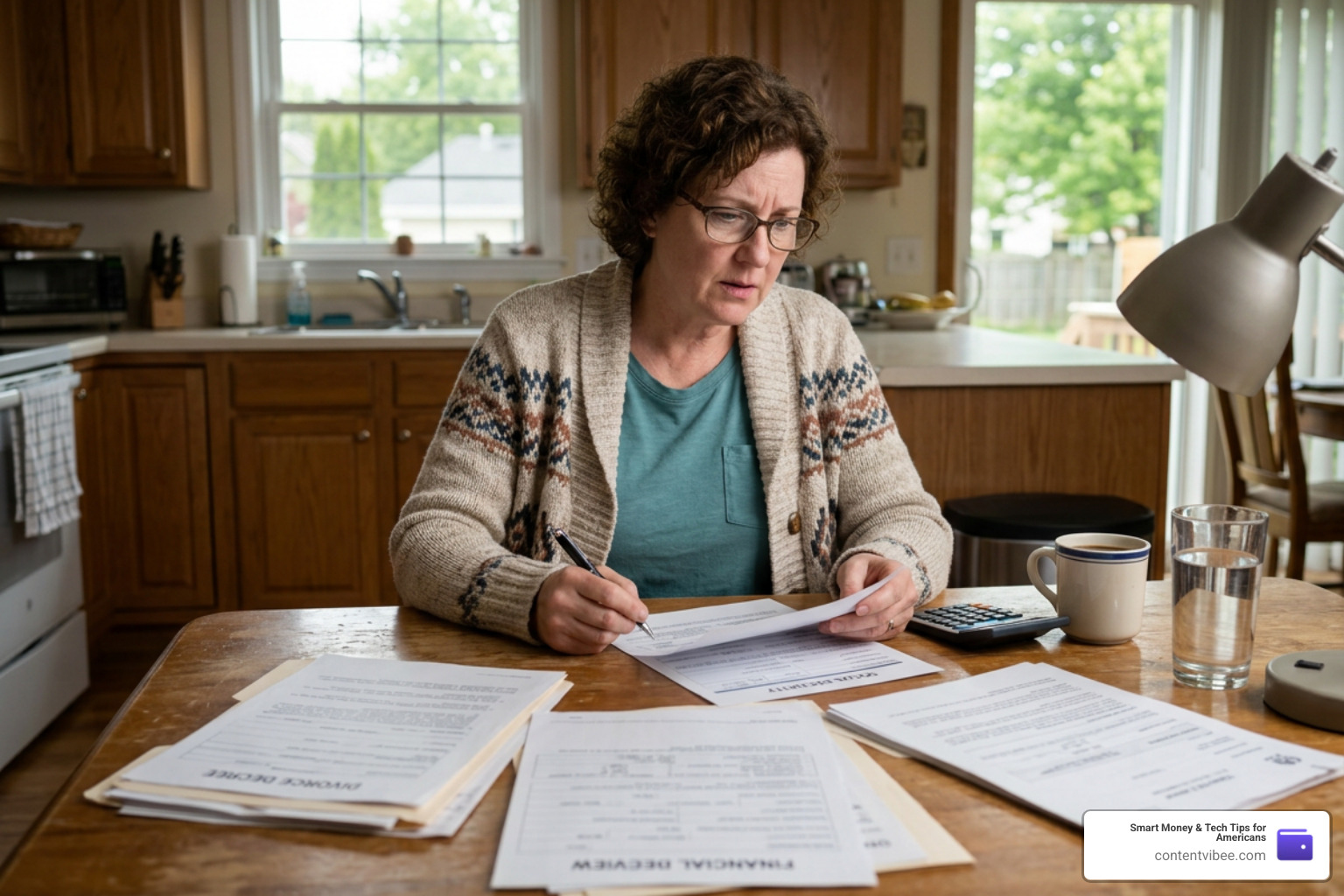
Many divorced individuals are completely unaware that they may be eligible to collect an ss spousal benefit based on their ex-spouse’s work record. The SSA has specific protections in place to ensure that divorced individuals are not left financially vulnerable, especially after long-term marriages.
To learn more about these specific rules, you can read our comprehensive breakdown on The Golden Rules: Can a Spouse Collect SS Spousal Benefits?.
Eligibility Criteria for Ex-Spouses
To collect a spousal benefit on an ex-spouse’s record, you must meet the following criteria:
- 10-Year Rule: Your marriage to your ex-spouse must have lasted for at least 10 consecutive years before the divorce was finalized.
- Age Requirement: You must be at least 62 years old and currently unmarried. If you remarry, you generally lose eligibility for benefits on your ex-spouse’s record (unless your subsequent marriage also ends by death, divorce, or annulment).
- The 2-Year Divorce Rule: If your ex-spouse has already filed for retirement benefits, you can apply for spousal benefits immediately (provided you meet the other requirements). However, if your ex-spouse is eligible for benefits but has not yet applied, you can still claim on their record if you have been divorced for at least two consecutive years. In this scenario, you are considered an “independently entitled divorced spouse.”
Privacy and Impact on the Worker’s Record
One of the most common concerns we hear from divorced readers is: “Will my ex-spouse find out, and will this hurt their own retirement benefits?”
The answer is a resounding no.
- Complete Privacy: The SSA maintains strict privacy rules. They will not notify your ex-spouse when you file a claim on their record.
- No Financial Impact on the Worker: Claiming a divorced spousal benefit has absolutely zero impact on your ex-spouse’s monthly benefit. They will receive their full retirement amount regardless of your claim.
- No Impact on Current Spouses: If your ex-spouse has remarried, your claim will not affect the benefits of their current husband or wife. Divorced spousal benefits are completely excluded from the family maximum benefit calculations, meaning multiple ex-spouses (provided each marriage lasted 10+ years) can claim on the same worker’s record without anyone’s payments being reduced.
How Spousal Benefits Are Affected by Your Own Retirement Record
A common misconception is that you can “double dip” by collecting both your full personal retirement benefit and a full spousal benefit. In reality, the SSA operates under strict coordination rules to prevent dual payments.
To understand how your personal work history interacts with spousal payments, we recommend reading His, Hers, and Ours: The Ultimate Guide to Dual Social Security Benefits.
The Deemed Filing Rule Explained
Under a policy known as “deemed filing,” when you apply for either your own retirement benefit or a spousal benefit, you are automatically deemed to be filing for both. The SSA will calculate both amounts and pay you a combined sum that equals the higher of the two benefits.
Let’s look at a real-world example featuring a taxpayer named Sandy:
- Sandy’s own retirement benefit at FRA is $1,000.
- Sandy’s husband has a PIA of $2,500, making Sandy’s maximum spousal benefit $1,250 (50% of $2,500).
- When Sandy files at her FRA, the SSA will not pay her $1,000 plus $1,250 (which would be $2,250).
- Instead, they will pay Sandy her own retirement benefit of $1,000 first.
- Then, they will add a spousal supplement of $250.
- Sandy’s total monthly payout is $1,250—the higher of the two options.
This “deemed filing” process is automatic, ensuring you always receive the maximum amount you are legally entitled to without having to navigate complex filing tricks. For more details on this process, you can read the SSA’s official blog post on the topic: Do You Qualify for Social Security Spouse’s Benefits? | Social Security Matters | SSA.
Phased-Out Strategies: Restricted Applications
In the past, savvy couples used advanced filing strategies like “file and suspend” or “restricted applications.” A restricted application allowed a spouse to file only for spousal benefits at their FRA, allowing their own personal retirement benefit to accrue delayed retirement credits (growing by 8% per year) until age 70, at which point they would switch to their own higher benefit.
However, Congress phased these strategies out. Under the Bipartisan Budget Act of 2015, restricted applications were eliminated for anyone born on or after January 2, 1954. Because we are currently in July 2026, anyone born before that cutoff date is already over 72 years old. This means the restricted application strategy is now a historical footnote and is no longer available to new retirees. Today, deemed filing applies to everyone entering retirement.
Step-by-Step Guide: How to Apply and Estimate Your Benefit
Applying for your ss spousal benefit does not have to be an overwhelming chore. With the right preparation, you can complete the process online in under an hour. To make sure you aren’t leaving any money on the table, check out our strategic guide on Maximizing Spousal Benefits Without Leaving Money on the Table.
Estimating Your Spousal Benefit Online
Before you apply, you should estimate your future monthly payments to make sure your timing aligns with your retirement goals.
- Create or Log In to Your Account: Go to the official SSA website and log in to your personal “my Social Security” account.
- Access the Retirement Calculator: Locate the interactive Retirement Calculator tool on your dashboard.
- Input Spouse’s Information: The tool allows you to estimate your benefit as a spouse. You will need to input your partner’s estimated benefit amount at their Full Retirement Age (their PIA).
- Compare Scenarios: Adjust your planned claiming age (from 62 up to 67) to see exactly how early claiming will permanently reduce your monthly check.
Required Documentation and Evidence
When you are ready to submit your application, having your documents organized will prevent processing delays. The SSA requires specific proof to verify your identity, age, and marital status.
The standard forms and documentation requirements are outlined in the SSA – POMS: RS 00202.050 – Spouse’s Benefits – Evidence and Forms Requirements – 02/16/2006. When you apply (whether online, by phone at 1-800-772-1213, or in person at a local SSA office), you should have the following items ready:
- Your Birth Certificate: To verify your age and identity.
- Marriage Certificate: Original or certified copy of your marriage certificate to prove your relationship to the primary worker.
- Divorce Decree: If you are claiming as a divorced spouse, you must provide your final divorce decree to prove the marriage lasted at least 10 years.
- Social Security Numbers: Both your SSN and your spouse’s (or ex-spouse’s) SSN.
- Bank Account Information: Direct deposit details (routing and account numbers) so the SSA can deposit your monthly payments.
- W-2 Forms or Self-Employment Tax Returns: For the most recent tax year.
If you are applying online, the system will guide you through the process, indicating if and where you need to mail physical documents for verification.
Frequently Asked Questions About Spousal Benefits
Navigating the rules of Social Security can feel like learning a foreign language. Here are some of the most common questions retirees ask us about spousal benefits.
Does claiming a spousal benefit reduce my partner’s retirement check?
No. This is one of the most persistent myths in retirement planning. When you claim a spousal benefit on your partner’s record, their monthly retirement check is completely unaffected. They will continue to receive their full benefit. Spousal benefits are paid out of the general Social Security trust funds, not deducted from your partner’s personal check.
Can I receive both my own retirement benefit and a spousal benefit?
No, you cannot combine both benefits to receive a double payment. Under the deemed filing rules, the SSA will calculate both your own retirement benefit and your spousal benefit. You will receive an amount equal to the higher of the two. If your own benefit is higher, you get your own. If the spousal benefit is higher, you get your own benefit supplemented by a spousal top-off to reach that higher amount.
What happens to my spousal benefit if my spouse passes away?
If your spouse passes away, your spousal benefit will end, and you will transition to a survivor benefit. As a surviving spouse, you can receive up to 100% of your deceased partner’s actual monthly benefit (including any delayed retirement credits they earned), provided you have reached your own Full Retirement Age. Survivor benefits can be claimed as early as age 60 (or age 50 if you are disabled), though claiming before your FRA will result in a reduced monthly amount.
To understand how the payment rules differ during this transition, you can consult the official administrative policies found in the SSA – POMS: RS 00202.020 – Spouse’s Benefits – Payment – 01/20/2026.
Conclusion
Understanding how the ss spousal benefit works is a vital step toward securing a comfortable retirement. Whether you are currently married, divorced after a long-term marriage, or planning for the future, knowing how your claiming age affects your lifetime income is key to maximizing your household benefits.
Don’t leave your hard-earned benefits to guesswork. We highly recommend using our interactive Social Security Spousal Benefit Calculator to run your numbers, compare different claiming ages, and build a retirement strategy that works for you and your family. Take control of your financial future today!