


More Americans Are Working Past Retirement Age — Know Your Rights
Retirement age employment rights are protections that stop employers from forcing you out of a job simply because of how old you are. Here is a quick summary of what those rights mean in practice:
- Age 40+: Federal law protects you from age discrimination at work
- Forced retirement: Illegal for most workers under the Age Discrimination in Employment Act (ADEA)
- Who is covered: Employees at companies with 20 or more workers (some states lower this to 4+)
- Key exceptions: Certain executives, airline pilots, and public safety roles
- If discrimination happens: You can file a complaint with the EEOC within 180–300 days
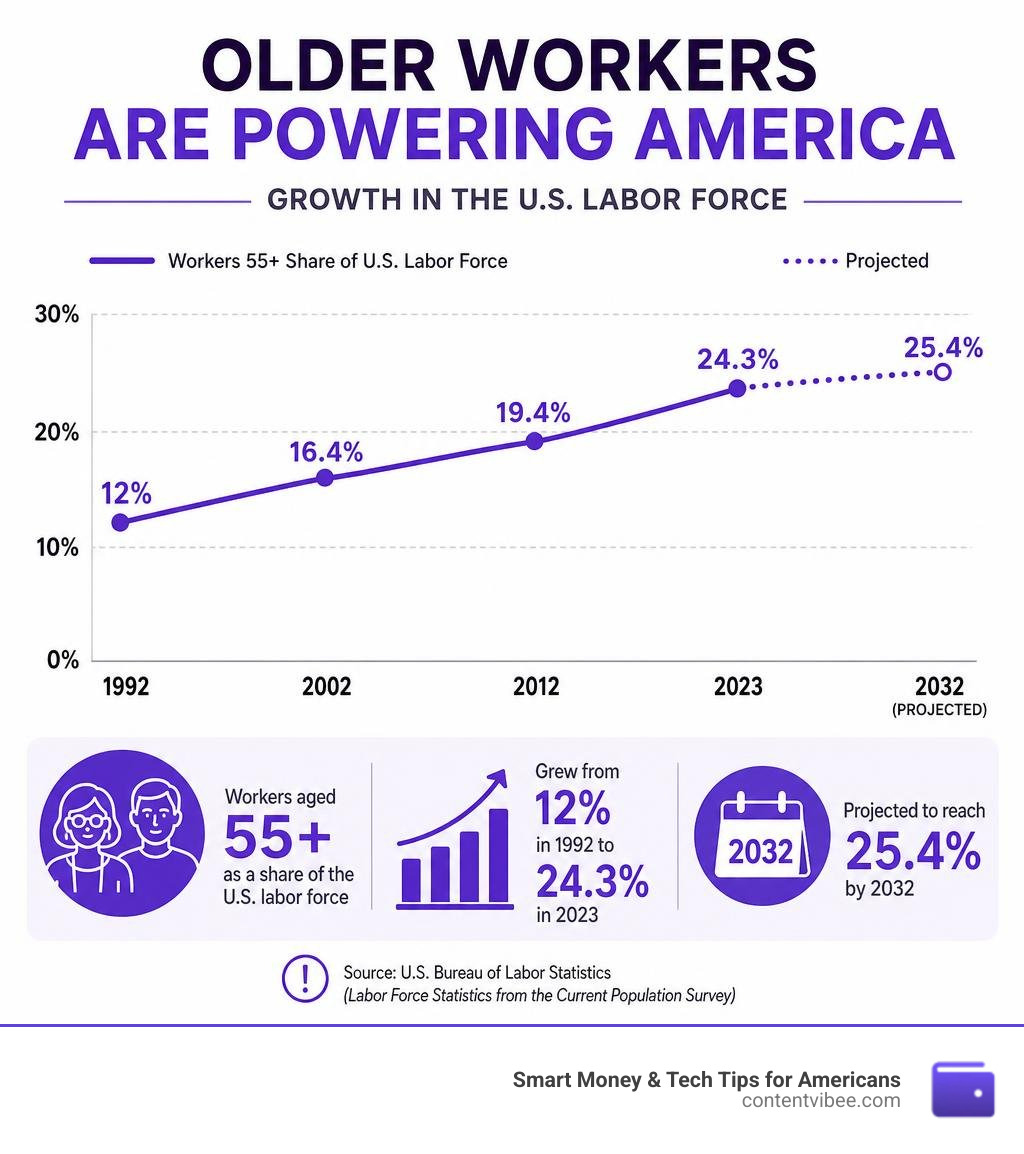
Something significant has shifted in the American workforce. Workers aged 55 and older made up just 12% of the U.S. labor force in 1992. By 2023, that share had climbed to 24.3%. The labor force participation rate for Americans 65 and older nearly doubled over the same period, reaching 19.2% in 2023.
Many people are simply not ready to stop working — whether for financial reasons, personal fulfillment, or both.
But staying in the workforce longer comes with a real concern: will your employer try to push you out?
That concern is not unfounded. The EEOC received over 11,300 age discrimination charges in fiscal year 2023 alone. Workers aged 45–64 filed 64% of those charges.
The good news is that federal law — and many state laws — give you strong protections. Understanding those rights is the first step to keeping them.
Terms related to retirement age employment rights:
- retirement health insurance options
- can you collect a pension and still work full-time
- seniors working past retirement
Understanding Your Retirement Age Employment Rights
As we navigate the landscape of July 2026, the data shows that the graying of the American workforce is not a temporary trend—it is our new reality. The median age of the U.S. labor force reached 42.2 years in 2023, up from 39.5 years in 2000. Furthermore, workers aged 55 and older are expected to account for a staggering 83% of labor force growth between 2022 and 2032. The labor force participation rate for men aged 65–69 alone surged from 24.8% in 1985 to 38.7% in 2023.
With so many of us choosing to remain active, we must understand that age is just a number, not a expiration date for our careers. If you are among the many not ready for the rocking chair why seniors are staying in the workforce, knowing your retirement age employment rights is absolutely critical.

Age discrimination in the workplace can take many forms, some of which are incredibly subtle. It might start with being passed over for training on new technology, or noticing that the most lucrative accounts are slowly being reassigned to younger colleagues. At its worst, it looks like overt pressure to retire or sudden, unexplained negative performance reviews after decades of stellar service.
Your legal rights exist to ensure that you are judged solely on your ability to do the job, not on assumptions about your stamina, adaptability, or proximity to retirement.
Federal Protections for Your Retirement Age Employment Rights
At the federal level, the shield protecting you from age-related workplace bias is the landmark Age Discrimination in Employment Act of 1967 | U.S. Equal Employment Opportunity Commission. Enacted nearly six decades ago, the ADEA was designed to promote the employment of older persons based on their ability rather than age, and to prohibit arbitrary age discrimination in employment.
Under federal law, specifically outlined in 29 USC 631: Age limits, these protections officially begin the day you turn 40.
The ADEA applies to:
- Private employers with 20 or more employees
- Employment agencies
- Labor organizations
- Federal, state, and local government employers
The law prohibits discrimination in virtually every aspect of employment. This includes hiring, firing, promotions, layoffs, compensation, benefits, job assignments, and training. It is even illegal for employers to publish job advertisements that express an age preference (such as asking for “recent college graduates” or setting an arbitrary age limit) unless a very rare, legally recognized exemption applies. Interestingly, the ADEA actually allows employers to favor older workers over younger ones—even when both parties are over the age of 40!
State-Level Expansions of Retirement Age Employment Rights
While federal law sets a strong baseline, many states have stepped up to offer even broader protections. This is particularly important if you work for a smaller business, as the federal ADEA only kicks in if an employer has at least 20 workers.
For example, the New York State Human Rights Law covers employers with just four or more employees, bringing a massive portion of the state’s small-business workforce under the umbrella of age protection. Additionally, New York law offers longer filing deadlines and broader avenues for recovering damages.
Similarly, the Arizona Civil Rights Act protects individuals aged 40 or older from age discrimination and applies to all employers within the state that have 15 or more employees.
No matter where you live, it is vital to research your specific state and local laws. Often, local administrative codes (such as the New York City Administrative Code) provide incredibly stringent protections that can make it much easier to hold a discriminatory employer accountable.
Exceptions to the Rule: When is Mandatory Retirement Legal?
A common question we hear at ContentVibee is: Can my boss ever legally force me to retire?
Generally, the answer is a resounding no. Under federal law, specifically 29 CFR § 1625.9 – Prohibition of involuntary retirement. | Electronic Code of Federal Regulations (e-CFR) | US Law | LII / Legal Information Institute, no employee benefit plan or seniority system can require or permit the involuntary retirement of any individual because of their age. The 1986 amendments to the ADEA officially removed the upper age cap of 70, meaning that for the vast majority of American workers, mandatory retirement is entirely illegal.
However, the law does carve out a few highly specific, narrow exceptions.

| Scenario | Legal or Illegal? | Legal Basis / Exception Details |
|---|---|---|
| Forcing a 66-year-old mid-level manager to retire due to their age | Illegal | Violates the general provisions of the ADEA. |
| Mandatory retirement for a 65-year-old CEO who will receive a $100,000 annual pension | Legal | “Bona Fide Executive” exception (pension over $44,000). |
| Compulsory retirement of a commercial airline pilot at age 65 | Legal | Public safety exception governed by the FAA. |
| Forcing a software engineer to retire at 60 because they “can’t keep up with new tech” | Illegal | Age-based stereotyping; performance must be evaluated individually. |
| Mandatory retirement of a local firefighter at age 57 | Legal | Public safety officer exception (subject to state/local variations). |
High-Level Executives and Policymakers
The first major exception applies to high-level corporate leaders. An employer can legally require an employee to retire at age 65 or older if they meet both of the following criteria:
- They have been employed in a bona fide executive or high policymaking position for the two-year period immediately preceding their retirement.
- They are entitled to an immediate, nonforfeitable, annual retirement benefit (such as a pension, profit-sharing plan, or deferred compensation) from their employer that totals at least $44,000 (excluding Social Security benefits).
This exception exists because organizations need to ensure a predictable succession plan for the absolute highest levels of leadership, and the law assumes these highly compensated individuals are financially secure enough to transition out of the workforce.
Public Safety and Specialized Roles
The second category of exceptions involves positions where age is considered a “Bona Fide Occupational Qualification” (BFOQ) due to safety concerns. These are roles where physical fitness and rapid reaction times are directly tied to public safety:
- Airline Pilots: Federal Aviation Administration (FAA) regulations legally require commercial airline pilots to step down or transition out of pilot-in-command roles at age 65.
- Public Safety Officers: Firefighters, police officers, and federal law enforcement agents often face mandatory retirement ages (frequently between 55 and 57, depending on the agency and state jurisdiction).
- Air Traffic Controllers: Due to the intense cognitive demands of the role, air traffic controllers face a federal mandatory retirement age of 56.
Outside of these highly regulated, safety-sensitive fields, any attempt by an employer to set a “retirement age” for their staff is a direct violation of federal law.
Voluntary Early Retirement, Buyouts, and Constructive Discharge
Sometimes, employers don’t outright fire older workers. Instead, they try to make them an offer they can’t refuse—or make their lives so miserable that they feel they have no choice but to resign.
Evaluating Early Retirement Packages and Buyouts
Voluntary early retirement programs and buyout packages are perfectly legal, and they can often be a win-win. If your company is downsizing, they might offer you a generous severance package, extended health insurance, or accelerated pension vesting to encourage you to retire early.
However, to protect older workers from being coerced, the federal Older Workers Benefit Protection Act (OWBPA) outlines strict rules that employers must follow when offering these packages:
- Written Agreement: The waiver of your right to sue for age discrimination must be written in clear, understandable language.
- Consideration Period: If the offer is made to you individually, you must be given at least 21 days to decide. If it is offered to a group of employees as part of an exit incentive program, you must be given at least 45 days.
- Revocation Period: After you sign the agreement, you have a mandatory 7-day period to change your mind and revoke your signature.
- Encouragement of Counsel: The agreement must explicitly advise you, in writing, to consult with an attorney before signing.
Before you sign any waiver, we highly recommend consulting an employment lawyer. Accepting a buyout might also impact your eligibility for state unemployment benefits, unless you can prove that you only accepted the package because a layoff was otherwise inevitable.
If you do decide to transition away from your traditional 9-to-5, retirement doesn’t have to mean stopping work entirely. Many seniors use this transition to start post-retirement consulting to share their decades of expertise on their own terms.
Recognizing and Proving Constructive Discharge
What happens if you decline a voluntary buyout, and suddenly your work environment turns hostile? This is where the concept of constructive discharge comes in.
Constructive discharge occurs when an employer deliberately creates working conditions so intolerable, hostile, or difficult that a reasonable person in your position would feel compelled to resign. In the eyes of the law, a constructive discharge is treated as an involuntary termination (a firing), meaning you retain your right to sue for wrongful termination and age discrimination.
Common signs of age-based pressure leading to constructive discharge include:
- Being reassigned to highly undesirable shifts or distant, travel-heavy territories.
- Having your primary job responsibilities stripped away and handed to younger, less-experienced colleagues.
- Being excluded from key meetings, emails, and training sessions necessary to do your job.
- Facing sudden, unwarranted disciplinary actions or hyper-criticism from management.
To prove constructive discharge, you must document everything. Keep a detailed, off-site journal of dates, times, specific comments, and changes in treatment.
How Working Past Retirement Affects Your Social Security and Benefits
If you decide to keep working, you need to understand how your paycheck will interact with your retirement benefits. This is a core focus of what we do here at ContentVibee: helping you maximize your hard-earned money.
First, let’s look at the Social Security Earnings Test. If you have reached your Full Retirement Age (FRA)—which is between 65 and 67 depending on the year you were born—you can work as much as you want and earn unlimited income without any reduction in your Social Security benefits.
However, if you claim Social Security before reaching your Full Retirement Age and continue to work, your benefits may be temporarily reduced if your earnings exceed certain thresholds:
- Under Full Retirement Age: If you are under your FRA for the entire year, Social Security will deduct $1 from your benefits for every $2 you earn above the annual limit (which was $15,720 in our historical baseline, though the Social Security Administration adjusts this limit annually for inflation).
- The Year You Reach Full Retirement Age: In the months leading up to your FRA, Social Security will deduct $1 for every $3 you earn above a much higher threshold (historically $41,880).
- After FRA: The moment you hit your Full Retirement Age, the earnings test disappears entirely. Furthermore, Social Security will recalculate your monthly benefit upward to account for any months where benefits were withheld.
If you are concerned about how your job might affect other retirement income, you should investigate whether you have to be retired to collect a pension. Many corporate and government pension plans allow you to draw a pension while continuing to work, provided you meet certain age and service requirements.
For those looking to ease into retirement without completely stepping away from a paycheck, transitioning to bridge jobs can be an excellent way to maintain an income while protecting your benefits.
Frequently Asked Questions About Working Past Retirement
Can my employer force me to retire at age 65?
No. For the vast majority of American workers, federal law under the ADEA completely outlaws mandatory retirement at age 65 or any other age. Unless you fall into a very narrow set of exceptions—such as being a high-level executive with a substantial corporate pension, a commercial airline pilot, or certain public safety personnel—you have the legal right to work as long as you are physically and mentally capable of performing your job duties.
What should I do if I face age discrimination at work?
If you believe you are being targeted or pressured to retire due to your age, take the following steps immediately:
- Document Everything: Keep a meticulous record of all discriminatory comments, changes in your workload, and differences in how you are treated compared to younger coworkers. Keep these records on your personal devices, not your work computer.
- Respond Professionally: If your manager asks about your retirement plans, respond professionally. You can state that you currently have no immediate plans to retire and are focused on meeting your performance goals. Ask if there are any specific performance concerns they would like to discuss.
- File an Internal Complaint: Report the behavior to your Human Resources department in writing, referencing your concerns about age discrimination. This establishes an official paper trail.
- Consult an Attorney: Speak with an experienced employment law attorney to understand your options before signing any agreements or resigning.
How do I file an age discrimination complaint with the EEOC?
To preserve your right to file a lawsuit under the ADEA, you must first file a formal charge of discrimination with the U.S. Equal Employment Opportunity Commission (EEOC):
- Filing Deadlines: Generally, you must file your charge within 180 days of the date the discrimination took place. This deadline is extended to 300 days in states that have their own age discrimination laws and enforcement agencies (such as New York or Arizona).
- The Process: The EEOC will investigate your claim and may attempt to mediate a settlement between you and your employer.
- Right-to-Sue Letter: If the EEOC cannot resolve the issue or decides not to pursue the case on your behalf, they will issue you a “Right-to-Sue” letter. Once you receive this letter, you have 90 days to file a private lawsuit in court.
Conclusion
At ContentVibee, we believe that your career longevity is something to be celebrated, not penalized. Working past traditional retirement age can keep your mind sharp, your social circle active, and your bank account healthy. Whether you are exploring flexible bridge jobs or taking a completely new path with retirement freelance writing jobs, you deserve to do so in a workplace that respects your experience and protects your legal rights.
If you are planning your financial future and want to ensure you are maximizing every dollar, check out our comprehensive guide on working in retirement and how it affects spousal benefits. Your years of hard work have earned you both your experience and your rights—make sure you stand up for both!


