


What Every Divorced American Needs to Know About Social Security Benefits
Can a divorced spouse get Social Security benefits? Yes — and it’s one of the most overlooked sources of retirement income available.
If you were married for at least 10 years and are now divorced, you may qualify to collect benefits based on your ex-spouse’s earnings record — even if they’ve remarried.
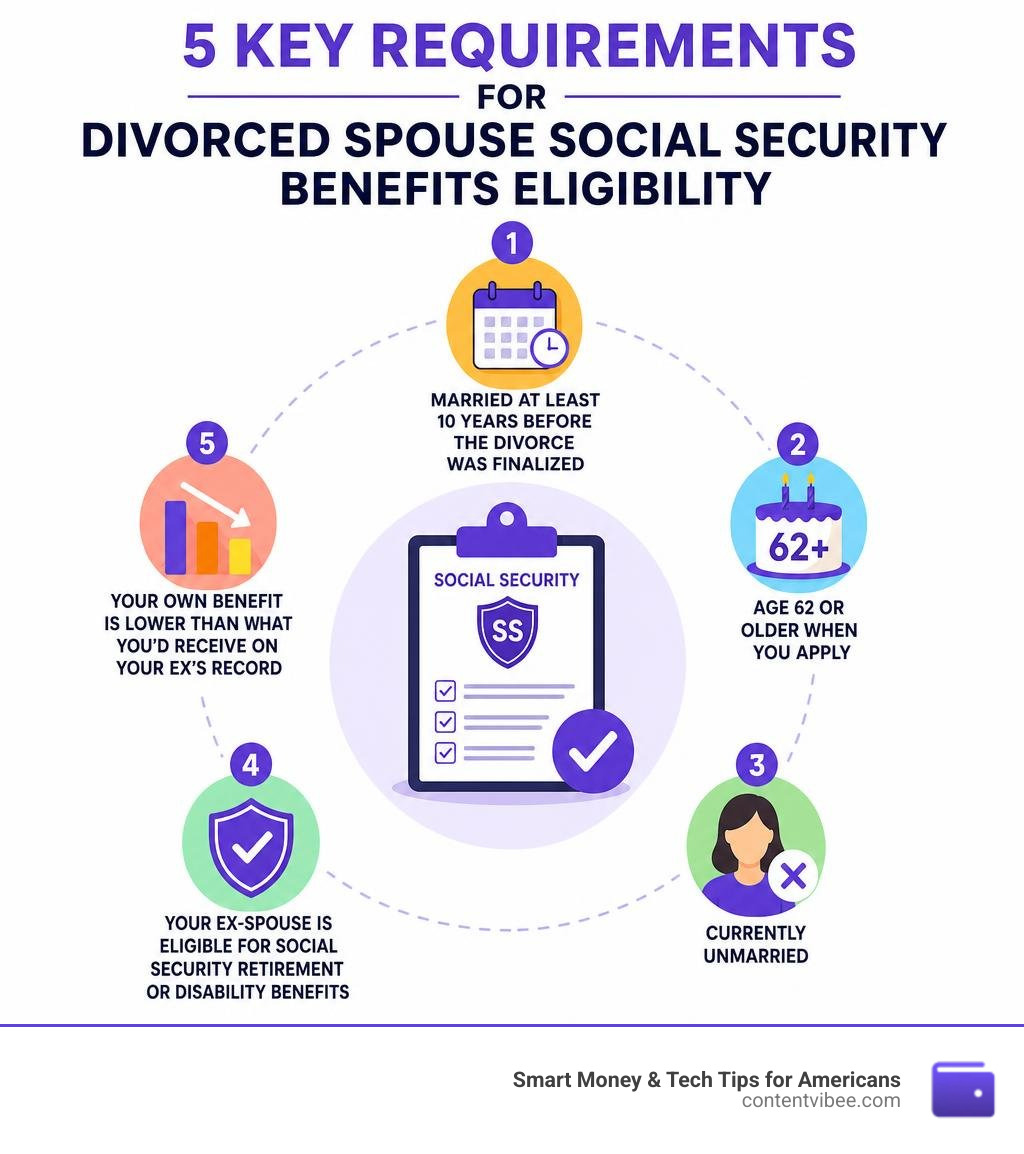
Here’s a quick summary of the core requirements:
- Married at least 10 years before the divorce was finalized
- Age 62 or older when you apply
- Currently unmarried
- Your ex-spouse is eligible for Social Security retirement or disability benefits
- Your own benefit is lower than what you’d receive on your ex’s record
If you meet all five of those conditions, you can likely claim — and your ex-spouse won’t even be notified when you do.
This matters more than most people realize. About 1.2 million divorced spouses received benefits based on a former spouse’s record in 2022, and over 90% of them were women. The average monthly payment was roughly $850, and eligible claimants can receive up to 50% of their ex-spouse’s Primary Insurance Amount (PIA) at full retirement age.
That’s real money — and many people who qualify never apply simply because they don’t know they can.
Can Divorced Spouse Get Social Security Benefits? Eligibility Rules Explained
When we sit down to map out our financial future, we often focus solely on the assets we built ourselves. However, if you have a prior marriage in your history, you might be sitting on a valuable financial asset without even realizing it.
To answer the pressing question of whether you qualify, we have to look closely at the strict eligibility rules established by the Social Security Administration (SSA). According to official guidelines, can divorced spouse get social security benefits? Yes, but only if you meet the following criteria:
- The 10-Year Marriage Rule: Your marriage must have lasted for at least 10 continuous years immediately before your divorce became final. The SSA is incredibly strict about this timeline. If your marriage lasted 9 years and 364 days, you do not qualify.
- The Age Requirement: You must be at least 62 years old to claim any spousal or divorced spousal benefits.
- Your Current Marital Status: You must be currently unmarried. If you have remarried, you generally cannot claim benefits on your ex-spouse’s record (with a few exceptions we will cover below).
- The Ex-Spouse’s Eligibility: Your ex-spouse must be at least 62 years old and eligible to receive Social Security retirement or disability benefits.
- The Benefit Comparison: The benefit you would receive based on your own work record must be less than the benefit you would receive based on your ex-spouse’s record. The SSA will always pay your own retirement benefit first, and then “top it off” with spousal benefits if the spousal amount is higher.
One fascinating detail hidden in the SSA policy manuals involves what happens if you married, divorced, and then remarried the same person. According to the official policy in SSA – POMS: RS 00202.005 – Divorced Spouse – 12/24/2014 , multiple marriages to the same individual can be treated as a single continuous marriage if you remarried each other no later than the calendar year immediately following the calendar year of the divorce.
For example, if we look at a real-world scenario: Robert and Lois married in May 1980, divorced in May 1986, remarried in July 1987, and divorced again in September 1990. Because they remarried within the calendar year following their first divorce, the SSA treats their marriage as meeting the 10-year duration requirement. Knowing these highly technical rules can make a massive difference in your retirement planning. To dive deeper into how these rules apply to your history, check out the official guidance on If You Had A Prior Marriage – Social Security Administration and our comprehensive breakdown on How to Check Your Eligibility for Spousal Social Security Benefits.
Can Divorced Spouse Get Social Security Benefits If the Ex-Spouse Has Not Filed Yet?
One of the most common points of confusion is whether you have to wait for your ex-spouse to retire and claim their own benefits before you can claim yours. Fortunately, the law protects divorced individuals from being held hostage by their ex-spouse’s financial decisions.
Under the “independently entitled divorced spouse” rule, you can claim benefits on your ex’s record even if they have not yet filed for their own retirement benefits. However, to do this, you must meet two additional conditions:
- Your ex-spouse must be at least 62 years old and fully insured.
- You must have been divorced for a continuous period of at least two years before you apply.
This two-year waiting period is designed to prevent couples from divorcing quickly just to access spousal benefits early. Once those two years have passed, you are free to claim your share independently. The SSA handles these claims with complete privacy; they will not notify your ex-spouse that you have filed, nor will your claim have any impact on the amount they or their current spouse receives. This policy is thoroughly documented in SSA – POMS: RS 00202.005 – Divorced Spouse – 12/24/2014 .
Can Divorced Spouse Get Social Security Benefits After Remarrying?
What happens if you find love again and decide to tie the knot? In almost all cases, remarriage acts as an immediate off-ramp for your divorced spousal benefits.
According to the SSA policy on termination events outlined in SSA – POMS: RS 00202.040 – Spouse’s Benefits – Termination Events – 08/25/2023 , your entitlement to benefits on an ex-spouse’s record ends the month before the month you marry someone else.
However, there are a few important exceptions and nuances to keep in mind:
- If your new marriage ends: If your second marriage ends due to divorce, death, or annulment, you may become eligible once again to claim benefits on your first ex-spouse’s record (assuming you still meet the 10-year marriage requirement for the first marriage).
- Marrying another beneficiary: If you remarry someone who is receiving certain types of Social Security benefits (such as spousal, survivor, or disability benefits), your divorced spousal benefits on your ex’s record may not terminate.
Because remarriage has such a significant impact on your monthly income, we always recommend calculating the financial trade-offs before walking down the aisle.
How Much Can You Receive and How Is It Calculated?
Now that we have established who qualifies, let’s talk numbers. How much money can you actually expect to receive each month?
The maximum benefit a divorced spouse can receive is 50% of the ex-spouse’s Primary Insurance Amount (PIA). The PIA is the monthly amount your ex-spouse is entitled to receive if they wait until their Full Retirement Age (FRA) to claim.
To understand how this works, we must look at three critical factors:
- Your Full Retirement Age (FRA): For anyone born in 1960 or later, the FRA is 67. If you wait until your own FRA to claim divorced spousal benefits, you will receive the full 50% of your ex’s PIA.
- Early Claiming Reductions: You can claim as early as age 62, but doing so permanently reduces your monthly payout. For example, if your FRA is 67 and you claim at age 62, your benefit will be reduced to about 32.5% of your ex-spouse’s PIA.
- No Delayed Retirement Credits: While your own personal retirement benefit grows by 8% each year you delay claiming past your FRA (up to age 70), divorced spousal benefits do not earn delayed retirement credits. There is absolutely no financial benefit to waiting past your FRA to claim a divorced spousal benefit.
Let’s look at a quick mathematical example. Suppose your ex-spouse’s PIA at their FRA is $2,400 per month.
- If you claim your divorced spousal benefit at your FRA, you will receive $1,200 per month (50%).
- If you claim early at age 62, your benefit will be permanently reduced to approximately $780 per month.
To run your own numbers and see how different ages affect your payout, we highly recommend using our Tools/Finance Calculator/Social Security Spousal Benefit Calculator. For a deeper understanding of how these limits are structured, read our guide on What Is a Social Security Spousal Benefit? and check out the official overview on Family benefits – Social Security Administration . Additional planning insights can also be found through the resources provided by the Understanding Social Security Benefits After Divorce – Hartford Funds .
Coordinating Your Own Work Record vs. Your Ex-Spouse’s Record
A common question we hear is: “Can I collect benefits on my own record and my ex-spouse’s record at the same time?”
The short answer is no. The SSA does not allow you to combine both benefits to get a double payout. Instead, they use a rule called deemed filing. When you apply for retirement benefits, you are “deemed” to be applying for both your own retirement benefit and any spousal/divorced spousal benefits you might qualify for.
The SSA will calculate both amounts and pay you your own benefit first. If your divorced spousal benefit is higher than your own, they will add a “top-off” to your monthly check so that the total amount you receive equals the higher spousal benefit.
Note on the Pre-1954 Rule: There is a historical exception to this rule. If you were born on or before January 1, 1954, you may still have the option to file a “restricted application.” This advanced strategy allowed individuals to claim only their divorced spousal benefit at FRA, while allowing their own personal retirement benefit to grow by 8% per year up to age 70. However, because we are currently in June 2026, virtually everyone reaching retirement age today was born after 1954, meaning deemed filing will apply to your claim. You can read more about how multiple benefits interact in our article Do Both Spouses Collect Social Security?.
Step-by-Step Guide: How to Apply for Divorced Spousal Benefits
Applying for Social Security benefits doesn’t have to be an overwhelming chore. If you have done your homework and gathered the necessary paperwork, the process can be surprisingly straightforward.
Here is our step-by-step guide to claiming what is yours:
Step 1: Gather Your Documentation
Before you contact the SSA, make sure you have all your documents ready. The SSA will require original documents or certified copies — photocopies are not accepted. You will need:
- Your Social Security card and birth certificate.
- Proof of US citizenship or lawful alien status.
- Your marriage certificate showing the date of your marriage.
- Your final divorce decree proving the marriage lasted at least 10 years and is officially dissolved.
- Your ex-spouse’s Social Security number (if you have it).
- Your recent W-2 forms or self-employment tax returns.
- Your bank account details (routing and account numbers) for direct deposit.
These requirements are outlined in detail in SSA – POMS: RS 00207.004 – Widow(er)’s Benefits – Table of Proofs and Development – Policy – 08/08/2011 . For a helpful checklist to keep you organized, refer to The Ultimate Checklist for Your Application for Spousal Benefits.
Step 2: Choose Your Application Method
You have three convenient ways to apply:
- Online: The fastest and most convenient way is to apply online at the official SSA website (ssa.gov).
- By Phone: You can call the SSA toll-free at 1-800-772-1213 to schedule an appointment or complete your application over the phone.
- In Person: You can visit your local Social Security office. We highly recommend calling ahead to schedule an appointment to avoid long wait times.
Step 3: Complete the Application and Interview
During the application process, the SSA representative will verify your identity, marriage history, and divorce details. If you are missing your ex-spouse’s Social Security number, do not panic. Provide their full name, date of birth, place of birth, and parents’ names. The SSA can search their database to locate the correct record.
Step 4: Review and Wait for Determination
Once submitted, keep your confirmation details and monitor your application status. The SSA will mail you a formal determination letter detailing your monthly benefit amount and the date your payments will begin.
Factors That Can Reduce Your Monthly Payout
Even if you qualify for the maximum 50% benefit, several real-world factors can shrink your monthly check:
- The Retirement Earnings Test: If you claim your divorced spousal benefit before your Full Retirement Age and continue to work, your benefits may be temporarily reduced. In 2026, if your earnings exceed the annual limit, the SSA will withhold $1 in benefits for every $2 you earn over the limit. Once you reach your FRA, these withheld benefits are recalculated and returned to you in the form of higher monthly payments. Read more about this in Working in Retirement: Are Spousal Benefits Reduced by Working?.
- The Government Pension Offset (GPO): If you receive a pension from a federal, state, or local government job where you did not pay Social Security taxes, your divorced spousal benefit may be reduced by two-thirds of the amount of your government pension. In many cases, this completely eliminates the Social Security benefit.
- Taxes and Medicare Premiums: Your Social Security benefits may be subject to federal income taxes depending on your combined income. Additionally, if you are enrolled in Medicare, your Part B premiums will be automatically deducted from your monthly Social Security check.
Divorced Spousal Benefits vs. Divorced Survivor Benefits
It is incredibly common to confuse divorced spousal benefits with divorced survivor benefits. However, these are two entirely different programs with different eligibility rules and vastly different payout structures.
If your ex-spouse passes away, you transition from being a divorced spouse to a surviving divorced spouse. The table below highlights the key differences between these two options:
| Feature | Divorced Spousal Benefits | Divorced Survivor Benefits |
|---|---|---|
| Ex-Spouse’s Status | Must be alive | Must be deceased |
| Minimum Claiming Age | Age 62 | Age 60 (or age 50 if disabled) |
| Maximum Payout | Up to 50% of the ex-spouse’s PIA | Up to 100% of the deceased ex-spouse’s benefit |
| Remarriage Rules | Remarriage at any age terminates benefits | Remarriage after age 60 does not affect eligibility |
| Marriage Duration | Must have lasted at least 10 years | Must have lasted at least 10 years (exceptions apply if caring for their child) |
As you can see, divorced survivor benefits are much more generous, offering up to 100% of your deceased ex-spouse’s monthly benefit. Additionally, the remarriage rules are far more lenient. If you wait until age 60 or older to remarry, you can still collect survivor benefits on your deceased ex-spouse’s record.
To explore this transition in detail, read Claiming What’s Yours: A Guide to Deceased Spouse Social Security.
Frequently Asked Questions About Divorced Spouse Social Security
Does claiming on my ex-spouse’s record reduce their own benefit?
No. This is perhaps the single biggest myth surrounding Social Security. Claiming benefits on your ex-spouse’s record has absolutely zero impact on their monthly payout, nor does it affect what their current spouse can receive. The SSA treats your claim as entirely independent. Furthermore, the SSA maintains strict privacy; they will never notify your ex-spouse that you have filed a claim on their record.
What if I don’t have my ex-spouse’s Social Security number?
You can still apply! While having their Social Security number makes the process faster, the SSA can look up their record using alternative identifiers. When you apply, simply provide as much information as you can, including their full legal name, date of birth, place of birth, and their parents’ names.
Can multiple ex-spouses claim benefits on the same worker’s record?
Yes, they can. If a worker was married multiple times, and each marriage lasted at least 10 years before ending in divorce, every single one of those ex-spouses can independently claim benefits on that worker’s record. Each eligible ex-spouse can receive up to the maximum 50% benefit, and these claims do not impact each other or the worker’s family maximum limit.
Conclusion
Navigating the complexities of Social Security after a divorce can feel like learning a foreign language. However, taking the time to understand these rules is one of the smartest retirement planning moves you can make. If you met the 10-year marriage requirement and are currently unmarried, you have a legal right to claim these benefits.
At Smart Money & Tech Tips for Americans, we are dedicated to helping you maximize your financial decisions and achieve true financial security in your golden years. Don’t leave your hard-earned benefits on the table. To continue building your retirement strategy, explore The Ultimate Guide to Spousal Social Security Eligibility.


