


Why Spousal Benefits Could Be Worth Thousands in Retirement
Spousal benefits from Social Security are one of the most valuable — and most overlooked — income sources available to married and divorced Americans approaching retirement.
Here is a quick summary of what you need to know:
| Key Question | Quick Answer |
|---|---|
| What are they? | Payments based on your spouse’s earnings record, not your own |
| Who qualifies? | Married spouses (age 62+) or divorced spouses after a 10-year marriage |
| How much can you get? | Up to 50% of your spouse’s full retirement benefit |
| When is the best time to claim? | At your full retirement age for the maximum amount |
| Does it reduce your spouse’s payment? | No — their benefit is completely unaffected |
Millions of Americans — especially those who earned less than their partner or took time out of the workforce — qualify for a monthly benefit based on their spouse’s work record rather than their own. Yet many people never claim it, simply because they don’t know it exists.
If your spouse is already collecting Social Security retirement or disability benefits, you may be entitled to a monthly check worth up to half of what they receive at full retirement age. And if you’re divorced after a marriage of 10 or more years, you may still qualify — even without your ex knowing you filed.
The rules around eligibility, timing, and how benefits are calculated can be tricky. Claiming too early can permanently reduce your monthly amount. This guide breaks it all down clearly so you can make the right decision for your retirement.
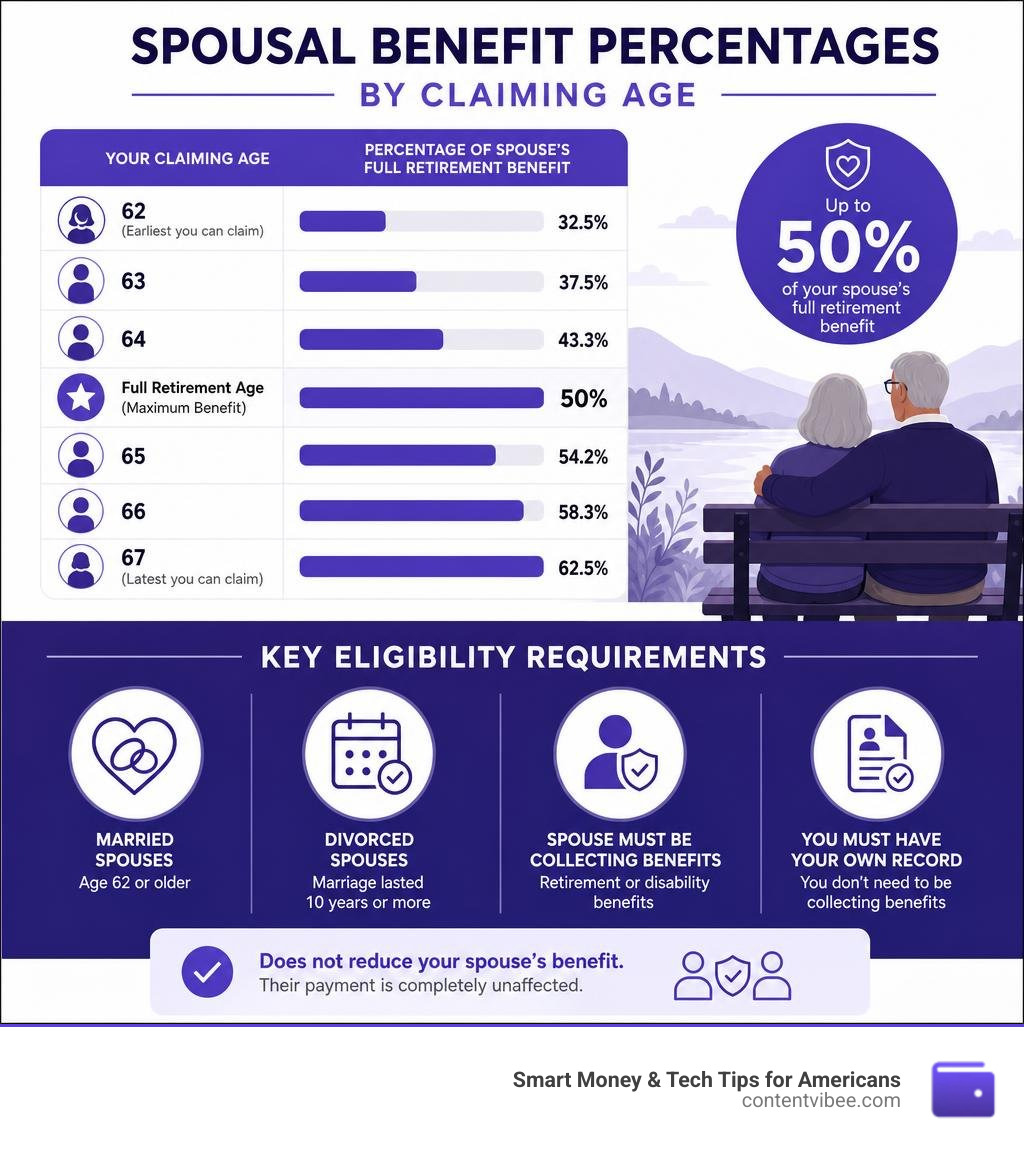
Quick look at spousal benefits:
What Are Social Security Spouse Benefits and Who Qualifies?
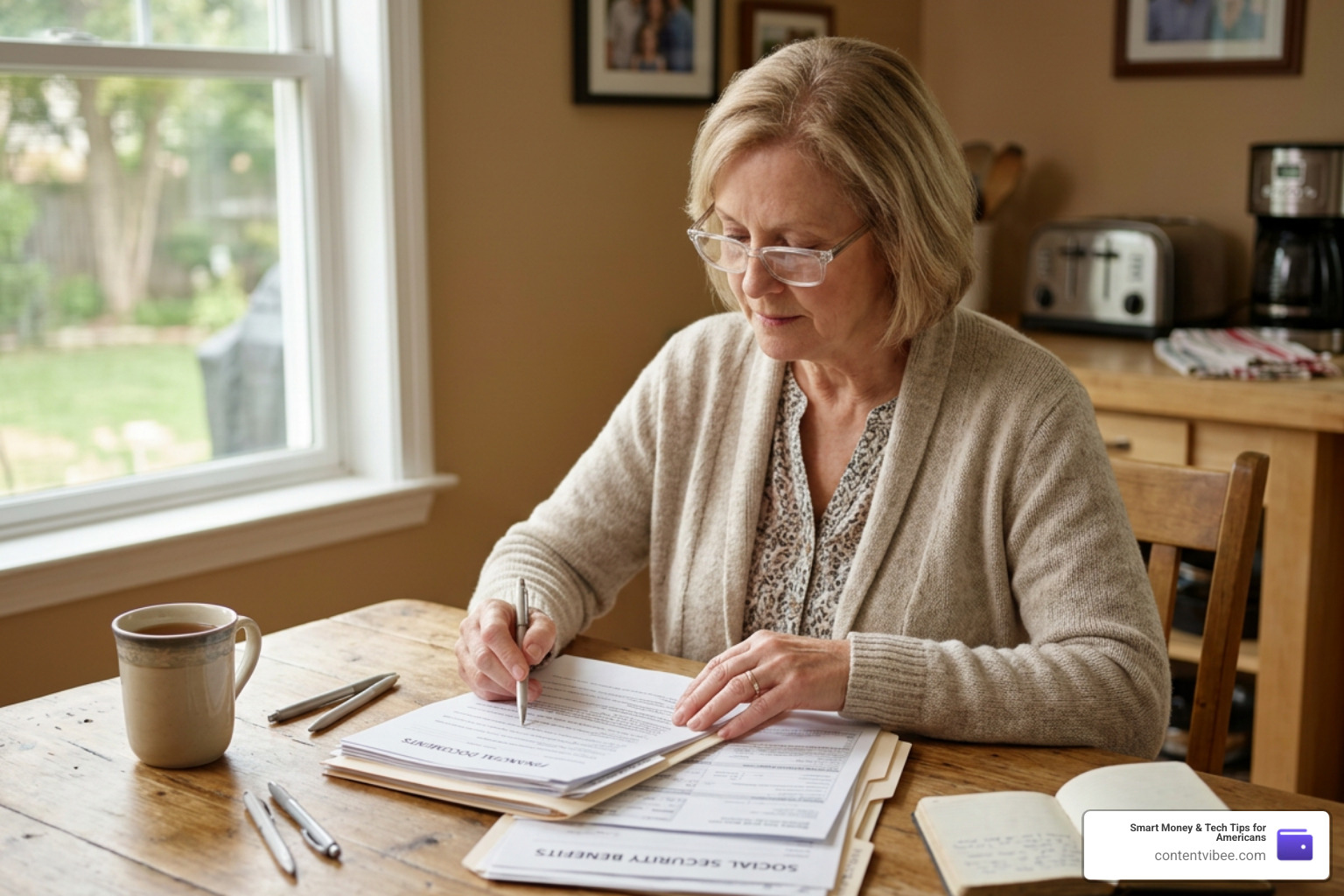
At its core, the Social Security administration designed spousal benefits to provide financial security for couples, particularly when one partner had lower lifetime earnings or took time away from their career to care for family. Instead of relying solely on your own work history, you can draw a benefit based on your spouse’s earnings record.
To begin qualifying, your spouse (the primary earner) must generally already be receiving their own retirement or disability benefits. Additionally, you must be at least 62 years old to claim, unless you qualify under a special caregiving exception (such as caring for a child who is under age 16 or disabled).
To dive deeper into the fundamental rules of who is eligible, you can read Do You Qualify for Social Security Spouse’s Benefits? as well as our complete breakdown in The Ultimate Guide to Spousal Social Security Eligibility.
Who Qualifies as a Legal Spouse?
The Social Security Administration (SSA) maintains strict definitions of who actually counts as a spouse. Generally, to qualify for spousal benefits, you must fall into one of two categories:
- A Legal Spouse: You must be legally married to the worker under the laws of the state where the worker lives (or lived at the time of application). This includes same-sex marriages validly performed in any U.S. jurisdiction.
- A Deemed Spouse: In some situations, if a marriage ceremony was entered into in good faith but was technically invalid due to a legal impediment (such as an administrative error in a prior divorce decree), the SSA may still “deem” you to be a spouse for benefit purposes.
These legal criteria are outlined in detail in SSA Handbook § 305. Understanding these parameters is crucial because a mistake here can completely stall your application. For a plain-English translation of these rules, check out The Golden Rules: Can a Spouse Collect SS Spousal Benefits?.
Key Eligibility Requirements for Spousal Benefits
Navigating the bureaucratic maze of the SSA requires knowing the exact checkboxes you need to tick. To qualify for a spousal payout, you must meet these core criteria:
- Age: You must be at least 62 years old, or have a qualifying child of the worker in your care.
- Worker Entitlement: Your spouse must already be entitled to and receiving their own retirement or disability benefits.
- Marriage Duration: You must generally meet a minimum marriage duration requirement (usually one continuous year for currently married couples).
- Benefit Comparison: Your own individual retirement benefit must not exceed half of your spouse’s primary insurance amount (PIA). If your own work record yields a larger check, the SSA will pay your benefit instead of the spousal option.
For the exact technical language from the official Program Operations Manual System, consult SSA – POMS: RS 00202.001 – Definitions and Requirements for Spouse Benefits – 07/24/2017. To evaluate your own personal standing, we recommend utilizing the steps outlined in How to Check Your Eligibility for Spousal Social Security Benefits.
The One-Year Marriage Rule and Exceptions
For currently married couples, you must have been married for at least one continuous year immediately before filing your claim. However, the SSA provides several key exceptions to this duration rule.
The one-year requirement is waived if:
- You are the natural parent of the worker’s child.
- You were entitled (or potentially entitled) to other Social Security auxiliary benefits (such as survivor, divorced spouse, or disability benefits) in the month before you married your current spouse.
Additionally, if you reach your one-year wedding anniversary while your application is being processed, the SSA allows the requirement to be satisfied as long as the milestone is met before they make their final decision. For a detailed breakdown of age-based filing rules and timing exceptions, refer to At What Age Can I Claim My Spouse’s Social Security?.
Calculating Your Spousal Benefit Amount and Dual Entitlement
The amount you receive from spousal benefits depends heavily on your age when you claim. While the absolute maximum spousal benefit is 50 percent of your partner’s Primary Insurance Amount (PIA)—which is the benefit they are entitled to at their Full Retirement Age (FRA)—claiming early will permanently reduce your monthly check.
Here is how the reduction breaks down if you claim before your Full Retirement Age:
| Age at Claiming | Percentage of Spouse’s Full Benefit | Reduction from Max Spousal Benefit |
|---|---|---|
| Full Retirement Age (67) | 50.0% | 0% |
| 66 | 45.8% | ~8.3% |
| 65 | 41.7% | ~16.7% |
| 64 | 37.5% | ~25.0% |
| 63 | 35.0% | ~30.0% |
| 62 | 32.5% | 35.0% |
The reduction math is strict: the benefit is reduced by 25/36 of 1 percent for each of the first 36 months before your FRA. If you claim even earlier (up to 60 months early if your FRA is 67), the benefit is further reduced by 5/12 of 1 percent for each additional month.
To run the numbers for your own situation, you can use the official tools at Benefits for Spouses. For a step-by-step guide to calculating these amounts manually, check out Determining Your Spousal Social Security Benefit Amount.
How to Maximize Your Spousal Benefits
To get the biggest possible check, patience is key. If you wait until you reach your own Full Retirement Age, you will receive the full 50 percent of your spouse’s PIA.
It is important to note that spousal benefits do not earn “delayed retirement credits.” If you delay claiming your own retirement benefit past your FRA, your payment increases by 8% per year up to age 70. However, the spousal benefit caps out strictly at your FRA. There is absolutely no financial benefit to waiting past your FRA to claim a spousal payment.
Understanding these timing rules is essential to avoid leaving money on the table. Discover how to align your claiming strategy by reading Social Security Spousal Benefits Timing Is Everything and Show Me the Money: How to Maximize Your Spouse’s Retirement Cash.
How the SSA Coordinates Dual Payments
Many retirees wonder: “Can I collect my own retirement benefit AND my spousal benefit at the same time?”
The short answer is no—you cannot “double dip” to receive two full checks. Under a rule called deemed filing, when you apply for either retirement or spousal benefits, you are automatically deemed to be applying for both. The SSA will calculate both amounts and pay your own retirement benefit first. If your spousal benefit is higher, they will add a “top-off” to make up the difference, ensuring you receive the higher total amount.
Let’s look at a quick example:
Sandy’s Story: Sandy is at her Full Retirement Age. Her own work history entitles her to a retirement benefit of $1,000 per month. Her husband’s PIA is $2,500, which means Sandy’s maximum spousal benefit is $1,250 (50% of $2,500).
When Sandy files, the SSA pays her own $1,000 retirement benefit first. Then, they add a spousal supplement of $250. Sandy receives a total monthly payment of $1,250.
For more on managing dual records, check out His, Hers, and Ours: The Ultimate Guide to Dual Social Security Benefits and Calculate Spouse Retirement Benefits.
Divorced Spouse Benefits: Rules and Timing
If you are divorced, you might still be eligible to claim spousal benefits on your ex-spouse’s work record. To qualify, you must meet the following federal requirements:
- Your marriage must have lasted at least 10 consecutive years.
- You must be currently unmarried (if you remarry, you generally lose eligibility, though exceptions apply if your subsequent marriage ends).
- You must be at least 62 years old.
- Your ex-spouse must be eligible for retirement or disability benefits.
If you have been divorced for at least two consecutive years, you can claim benefits on your ex-spouse’s record even if they have not yet filed for their own benefits. This is known as being an “independently entitled” divorced spouse. For a complete guide to these rules, see Double the Fun: Understanding Your Spousal Social Security Benefits.
Privacy and Independence in Divorced Claims
One of the biggest concerns divorced individuals have is whether their ex-spouse will be notified or if their claim will negatively impact their ex’s finances.
Rest assured, the SSA maintains strict privacy rules. Your ex-spouse will not be notified when you file on their record. Furthermore, claiming on an ex-spouse’s record has absolutely zero impact on their monthly benefit, nor does it reduce the benefit of their current spouse.
The payment calculations and regulatory provisions for these circumstances are detailed in SSA – POMS: RS 00202.020 – Spouse’s Benefits – Payment – 01/20/2026.
How to Apply for Spouse Benefits
Filing for benefits requires careful preparation. To ensure a smooth application process, you will need to gather several key documents:
- Your Social Security number and your spouse’s (or ex-spouse’s) Social Security number.
- Your birth certificate.
- Proof of marriage (marriage certificate) or divorce papers (if claiming as a divorced spouse).
- Your recent W-2 forms or self-employment tax returns.
- Direct deposit information (routing and account numbers).
Having these documents ready in advance prevents processing delays. Read our step-by-step walkthrough in Applying for Spousal Benefits to get started.
Applying for Spousal Benefits Online and Offline
The fastest and most convenient way to apply is online through the official SSA portal. If you are at least 61 years and 9 months old, you can submit your application from the comfort of your home.
During the online process, you will fill out the digital equivalent of Form SSA-2 (the official application for spouse’s insurance benefits). If you prefer to apply offline, you can schedule an appointment to apply over the phone or visit your local Social Security office in person.
To prepare for your application, use Your Digital Guide to Form SSA-2 and Online Spousal Claims and download The Complete Checklist of Documents for Spousal Social Security Benefits.
Frequently Asked Questions
Does claiming spousal benefits reduce my partner’s monthly payment?
No. Claiming spousal benefits will never reduce your partner’s monthly retirement check. Their benefit remains 100% intact. Additionally, if you are a divorced spouse claiming on their record, your benefit does not affect what their current spouse can receive. The SSA calculates these auxiliary benefits separately, and they are not subject to standard family maximum reductions in the case of divorced spouses. Learn more in Double the Fun: A Guide to Social Security Spousal Benefits for Couples.
Can I claim spousal benefits if my spouse hasn’t filed yet?
If you are currently married, your spouse must be actively receiving retirement or disability benefits for you to claim spousal payments. However, if you are divorced and have been divorced for at least two consecutive years, you are “independently entitled” and can claim benefits even if your ex-spouse has not yet filed, provided they are at least 62 and eligible to receive them. For details on how married couples can coordinate their filing timelines, see Timing Is Everything: How Married Couples Can Claim Social Security Simultaneously.
What happens to my spousal benefits if my spouse passes away?
If your spouse passes away, your spousal benefit will end, but you may become eligible for survivor benefits. Survivor benefits are much more generous—they can be worth up to 100 percent of your deceased spouse’s monthly benefit, rather than the 50 percent cap on spousal benefits. You can claim survivor benefits as early as age 60 (or age 50 if you are disabled). To understand how this transition works, read Claiming What’s Yours: A Guide to Deceased Spouse Social Security.
Conclusion
Securing your retirement involves maximizing every resource available to you. For married and divorced couples, spousal benefits are a powerful tool to boost your household income and establish long-term financial security.
At ContentVibee, we are dedicated to providing clear, actionable advice to help you navigate the complexities of Social Security. Don’t leave your hard-earned money on the table—evaluate your options, choose the optimal claiming age, and Claim your spousal benefits today to secure the retirement you deserve.