


Are Robo Advisor Fees Eating Into Your Retirement Savings?
Robo advisor fees can range from $0 to 0.35% per year in advisory charges alone — but that’s rarely the full picture.
Here’s a quick breakdown of what major platforms charge right now (as of June 2026):
| Platform | Advisory Fee | Account Minimum | Notable |
|---|---|---|---|
| Fidelity Go | $0 under $25K / 0.35% above | $0 | 0% expense ratio on proprietary funds |
| Vanguard Digital Advisor | ~0.15% net | $100 | 90-day fee waiver for new accounts |
| Schwab Intelligent Portfolios | $0 | $5,000 | Revenue earned via cash holdings |
| Wealthfront | 0.25% | $500 | 0.08% avg. expense ratio |
| Betterment | $5/mo or 0.25% | $0 | Depends on balance and deposit habits |
| Wells Fargo Intuitive Investor | 0.25%–0.35% | $500 | Discounts tied to checking account |
| Revolut Robo-Advisor | 0.25% | $100 | $0.25 minimum monthly fee |
The number you see advertised is almost never your total cost.
Most platforms charge two layers of fees:
- Advisory fees — what you pay the robo-advisor platform itself
- Expense ratios — what you pay the funds inside your portfolio (these go to fund managers, not the robo-advisor)
For example, a platform advertising “no advisory fee” may still cost you 0.12% or more per year in fund expenses. And some “free” platforms earn money in less obvious ways — like keeping your cash in low-yield sweep accounts.
If you’re nearing or in retirement, even a 0.10% difference in annual fees compounds significantly over 10–20 years. That’s real money that could be funding your lifestyle — not a platform’s revenue.
This guide walks you through how to spot the true cost of automated investing, which platforms are genuinely low-cost, and what questions to ask before you hand over your portfolio.
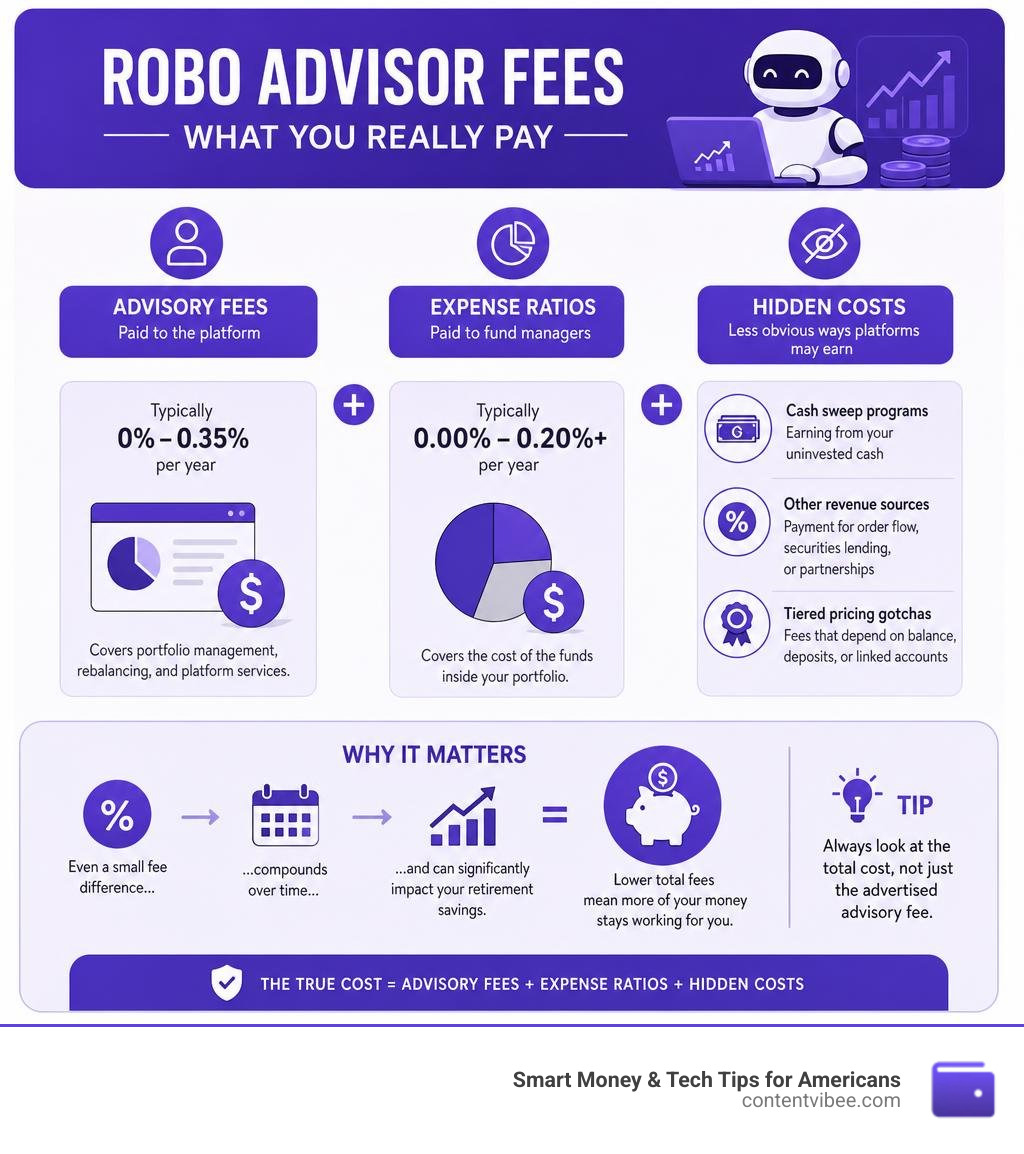
Glossary for robo advisor fees:
Understanding the True Cost of Robo Advisor Fees
When we evaluate automated investing platforms, it is easy to get swept up in slick marketing campaigns that scream “Zero Fees!” But as seasoned investors in California and across the country know, financial institutions are not charities. To understand what you are actually paying, we must dissect the layered pricing models used by automated platforms.
The baseline cost of any automated service is the annual management fee (often called the advisory fee). This is typically expressed as an annual percentage of your Assets Under Management (AUM) and billed on a monthly or quarterly basis. For instance, a 0.25% management fee on a $100,000 portfolio means you pay $250 a year.
However, looking strictly at this percentage is one of the biggest mistakes we see investors make. To find the exact dollar amount leaving your account, you must look at the total cost of ownership (TCO). This includes the direct advisory fee, the underlying fund costs, and any transactional or administrative overhead. To dive deeper into these structures, you can read The Ultimate Guide to Robo Advisor Fees.
How Underlying Expense Ratios Impact Your Returns
Even if your automated platform charges a 0% advisory fee, the exchange-traded funds (ETFs) or mutual funds that make up your portfolio are not free. Every fund has an expense ratio—an annual fee charged by the fund manager (such as Vanguard, BlackRock, or Charles Schwab) to cover operational expenses.
These fund expenses create what we call portfolio drag. If your robo-advisor builds a portfolio with an average expense ratio of 0.15%, and your advisory fee is 0.25%, your total drag is 0.40% annually. Over a 30-year investing horizon, that extra drag can quietly shave tens of thousands of dollars off your nest egg.
To keep this drag as low as possible, top-tier platforms build portfolios using low-cost index funds. These funds track broad market benchmarks and carry minimal operating costs. For a broader look at how these automated portfolios are constructed, check out our guide on What Is Robo Advisor?.
Hidden Administrative and Account Maintenance Charges
Beyond the ongoing management fees and fund expenses, there are several transactional and administrative costs that can catch you off guard. These are often tucked away in fine-print disclosures or the company’s Form CRS disclosures.
Before opening an account, always look out for these potential cash leaks:
- Account Termination and Transfer Fees: If you decide to move your money to another brokerage, many platforms charge an Outgoing Account Transfer (ACATS) fee. For example, some traditional bank robo-advisors charge an IRA termination fee of $49.95.
- Wire Transfer Fees: Sending money out of your account via domestic wire can run you $30 per transaction, while international wires can cost up to $40.
- Paper Document Fees: Opting out of electronic statements can cost you $2 to $5 per month just to receive paper mail.
- Account Minimum Penalties: Some platforms charge flat monthly fees if your balance dips below a certain threshold. For instance, some services charge a flat $5 per month for accounts under $24,000, which can represent a massive percentage fee for smaller balances.
How “Free” Automated Investing Platforms Actually Make Money
The old adage “if you aren’t paying for the product, you are the product” holds true in fintech. When an automated platform advertises a 0% management fee, it has to generate revenue elsewhere to keep the lights on. Understanding how these “free” platforms monetize your accounts is crucial to determining if they are actually saving you money. For a comprehensive breakdown of whether this style of investing fits your goals, explore Is Automated Portfolio Management Right for You?.
The Trade-offs of Zero Robo Advisor Fees
The most common way zero-fee platforms make money is through cash sweep programs. To manage risk and facilitate rebalancing, almost all automated platforms keep a portion of your portfolio in cash (typically between 1% and 10%).
With a cash sweep program, the platform moves your idle cash into partner banks. These banks pay interest on the cash, but instead of passing all of that interest to you, the platform keeps a significant portion of the spread. This creates “cash drag”—your money sits in cash earning a minimal return rather than being fully invested in the market. Over a long bull market, the opportunity cost of this cash drag can easily exceed what you would have paid in a standard 0.25% advisory fee.
Other ways free platforms generate revenue include:
- Proprietary Funds: Platforms may populate your portfolio with their own in-house mutual funds or ETFs. While they don’t charge an advisory fee, they collect the underlying expense ratios on those proprietary funds.
- Payment for Order Flow (PFOF): Some platforms route your trades through specific market makers who pay them a small fee for directing the trade volume.
- Affiliate Revenue: Offering partner products like high-yield savings accounts, credit cards, or personal loans.
To understand how to balance these trade-offs, read our article on how to Set and Forget Your Way to Wealth with Automated Investing.
Evaluating Value vs. Cost in Automated Portfolios
Just because a platform has a fee does not mean it is a bad deal. You must weigh the robo advisor fees against the value of the services provided. A high-quality automated manager handles complex tasks that would take you hours to perform manually, including:
- Automatic Rebalancing: As market movements shift your asset allocation, the algorithm automatically sells overperforming assets and buys underperforming ones to maintain your target risk profile.
- Tax Optimization: Premium platforms offer automated tax-loss harvesting, which can offset your capital gains and income taxes, often saving you more money than the annual advisory fee itself.
- Personalized Asset Allocation: Tailoring your portfolio to your specific risk tolerance and retirement timeline.
To see how automated systems evaluate your financial profile, read Robo Advisor Asset Allocation: Can Robots Really Gauge Your Risk Tolerance?.
Comparing Free and Low-Cost Automated Investment Services
Choosing the right service requires comparing not just the headline advisory rate, but also how these platforms handle balance thresholds, fund expenses, and promotional incentives.
Tiered Fee Structures and Account Minimums
Many platforms use tiered fee structures to attract beginners while monetizing larger accounts. For example:
- Fidelity Go charges a 0% advisory fee for accounts under $25,000. Once your balance hits $25,000 or more, the annual advisory fee becomes 0.35%.
- Betterment charges a flat $5 per month for accounts under $24,000 unless you set up a monthly recurring deposit of at least $250, in which case it shifts to a 0.25% annual fee.
- Revolut Robo-Advisor charges a 0.25% annual fee, but enforces a minimum monthly fee of $0.25 for any portfolio with a balance of $100 or more. This means if you have exactly $100, a $0.25 monthly fee ($3 per year) actually equates to a 3.0% annual fee!
Additionally, watch out for promotional waivers. For example, Vanguard Digital Advisor offers a 90-day introductory fee waiver for new clients, giving you a cost-free test drive of their automated software. To see how these platforms stack up head-to-head, read Robo Advisor Reviews: Which Automated Investing Platform Wins?.
How to Minimize Your Total Robo Advisor Fees
If you want to keep your investing costs as close to zero as possible, follow these strategic steps:
- Optimize Your Fund Selection: If your platform allows you to choose between different portfolio options (e.g., all-index vs. active/index), choose the all-index track. Index portfolios carry much lower underlying expense ratios.
- Leverage Fee Thresholds: Keep your balances strategically distributed. For example, keeping under $25,000 in a Fidelity Go account allows you to take advantage of their 0% advisory tier while utilizing their zero-expense-ratio Fidelity Flex funds.
- Enable Tax-Loss Harvesting: If you are investing in a taxable account, make sure tax-loss harvesting is turned on. Platforms like Schwab require a $50,000 minimum balance for this feature, while Wealthfront offers it starting at $500. To learn how this works, read Tax-Loss Harvesting: The Secret Weapon of Robo Advisors.
Robo-Advisors vs. Traditional Financial Management
How do automated costs stack up against traditional human help? The cost difference over a multi-decade investing career is staggering.
While a typical robo-advisor costs between 0.15% and 0.35% per year, a traditional Registered Investment Advisor (RIA) usually charges around 1.00% of your total assets annually. On a $500,000 portfolio, that is the difference between paying $1,000 a year for automated management versus $5,000 a year for a human advisor. Over 20 years, that cost gap can easily exceed $100,000 due to the lost compounding power of those fee dollars.
When Is Paying a Premium for Human Advice Worth It?
While automated platforms are incredibly cost-efficient, they are not a perfect fit for everyone. Paying a premium for a human financial advisor can make sense if you are dealing with highly complex financial situations, such as:
- Intricate Estate Planning: Setting up trusts, managing multi-generational wealth, or minimizing estate taxes.
- Complex Tax Situations: Owning multiple businesses, managing real estate portfolios, or dealing with highly concentrated stock options.
- Behavioral Coaching: Having a professional to talk you down during a market crash can prevent you from panic-selling at the bottom—a mistake that costs far more than a 1% management fee.
To read more about how to evaluate these premium costs, check out The No-Nonsense Guide to Fidelity Robo Advisor Fees.
Hybrid Models and Financial Coaching
For investors who want the best of both worlds, hybrid robo-advisors have become highly popular. These services combine low-cost algorithmic portfolio management with on-demand access to Certified Financial Planners (CFPs).
For example, once your balance reaches $25,000, platforms like Fidelity Go unlock access to 1-on-1 coaching sessions. Other services offer dedicated hybrid tiers for a slightly higher annual fee (typically around 0.30% to 0.40%). This allows you to keep your automated investing on autopilot while still having a human expert to consult when life gets complicated. To learn more about how these blended services operate, read our guide on Hybrid Robo Advisors.
Frequently Asked Questions About Automated Investing Costs
Are there completely free robo-advisors?
Yes, some platforms charge a 0% management fee (such as Schwab Intelligent Portfolios or Fidelity Go for balances under $25,000). However, these platforms are never entirely free. They generate revenue indirectly through cash sweep programs (earning interest on your cash holdings) or by utilizing proprietary funds that carry underlying expense ratios.
How do expense ratios differ from advisory fees?
Advisory fees are paid directly to the robo-advisor platform for managing your account, rebalancing your assets, and providing software access. Expense ratios are charged directly by the fund managers of the ETFs and mutual funds inside your portfolio. Even if your robo-advisor fee is 0%, you will still pay the underlying fund expense ratios.
Is tax-loss harvesting included in free plans?
It depends on the platform and your account balance. Some platforms offer tax-loss harvesting on all taxable accounts with very low minimums. Others, like Schwab Intelligent Portfolios, offer it for free but require a minimum account balance of $50,000 before the feature can be activated.
Conclusion
Finding the right automated investing platform is not about chasing the absolute lowest advertised percentage. It is about finding the sweet spot where low robo advisor fees, minimal underlying fund expenses, and high-value features align with your retirement goals.
At Smart Money & Tech Tips for Americans, we want to help you make highly informed financial decisions that maximize your long-term wealth. By understanding the hidden costs of cash drag, optimizing your underlying fund choices, and utilizing tax-saving features, you can keep more of your hard-earned money working for you.
Ready to take control of your financial future without getting bogged down in complex calculations? Read our step-by-step guide on the Best Autopilot Investing Strategies for Beginners Who Hate Math and start building your wealth on autopilot today!


