


bill ackman investment strategy- Bill Ackman 10 Billion Investment Strategy and Hedge Fund Returns Analysis is one of the most-watched stories in hedge fund investing right now — and for good reason.
Here is a quick snapshot of what you need to know:
| Key Metric | Detail |
|---|---|
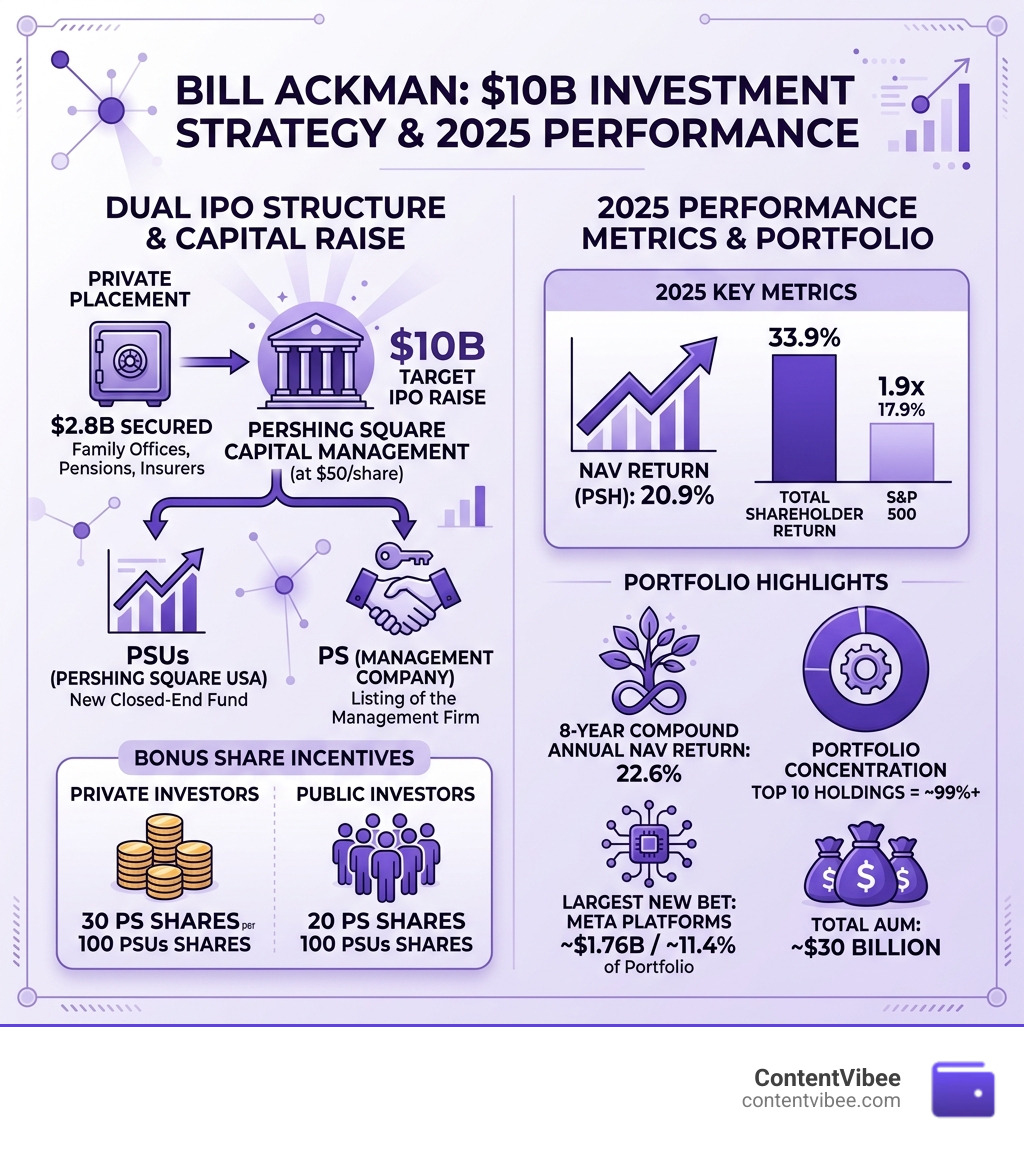
| Target IPO Raise (PSUS) | $5B – $10B at $50/share |
| Private Placement Secured | $2.8B (family offices, pensions, insurers) |
| Bonus Share Incentive (Public) | 20 PS shares per 100 PSUS shares |
| Bonus Share Incentive (Private) | 30 PS shares per 100 PSUS shares |
| 2025 NAV Return (PSH) | 20.9% |
| 2025 Total Shareholder Return | 33.9% (1.9x the S&P 500’s 17.9%) |
| 8-Year Compound Annual NAV Return | 22.6% |
| Total AUM | ~$30 billion |
| Portfolio Concentration | Top 10 holdings = ~99%+ of portfolio |
| Largest Single New Bet | Meta Platforms (~$1.76B, ~11.4% of portfolio) |
Bill Ackman‘s firm, Pershing Square Capital Management, is attempting something bold: a dual IPO that simultaneously lists both a new closed-end investment fund (Pershing Square USA, or PSUS) and the hedge fund management company itself. The goal is to raise up to $10 billion in fresh capital to deploy into a concentrated portfolio of 12 to 15 high-quality North American companies.
For self-directed investors, this raises real questions. How does the structure actually work? What are the fees and risks? And does the track record justify the complexity?
The returns have been impressive — Pershing Square’s 8-year compounded NAV return of 22.6% far outpaces the broader market. But the strategy comes with extreme concentration, closed-end fund risks, and a structure that can feel opaque.
This guide breaks it all down clearly, so you can evaluate the strategy on its merits before deciding if any part of it belongs in your own thinking.
The Mechanics of the Bill Ackman 10 Billion Investment Strategy and Hedge Fund Returns Analysis
To understand the Bill Ackman 10 Billion Investment Strategy and Hedge Fund Returns Analysis, we first have to look at the engine behind it. Ackman isn’t just launching a fund; he’s engineering a massive capital-raising event designed to capture the attention of everyone from retail traders to massive pension funds.
The centerpiece is Pershing Square USA (PSUS). Unlike a traditional hedge fund that requires millions to enter, PSUS is a closed-end fund intended to trade on the New York Stock Exchange. By pricing shares at $50 each, Ackman is opening the door to the public. However, the “10 Billion” figure isn’t just a goal—it’s a statement of intent. He plans to deploy this capital into a select group of “best-in-class” businesses that he believes are currently undervalued by the market.
This move is part of a broader trend where elite managers seek more “permanent capital”—money that doesn’t leave the fund when the market gets shaky. For those interested in how institutional fees stack up against these public offerings, exploring why GS investment strategies fees and portfolio choices matter can provide valuable context on the costs of high-level management.

Historical Context of the Bill Ackman 10 Billion Investment Strategy and Hedge Fund Returns Analysis
Ackman’s journey to this $10 billion moment began with a pivot in 2018. Before then, he was known primarily as a “corporate raider” or activist who took loud, public stands against management teams. While successful, that style was volatile.
The “Permanent Capital Era” shifted the focus. Instead of fighting with boards, Ackman began acting more like Warren Buffett—buying dominant, cash-generative franchises and holding them for years. This shift allowed him to focus on long-term compounding rather than short-term skirmishes. This evolution is similar to the shifts seen in other major firms; for instance, understanding why Bridge Investment Group private equity has become a staple for institutional investors can help explain why “sticky” capital is so prized by managers like Ackman.
The PSUS Sweetener and Shareholder Incentives
To ensure the PSUS IPO is a success, Ackman introduced a “sweetener” that has finance nerds buzzing. It’s essentially a bonus share program.
- Public Investors: Receive 20 Pershing Square (PS) shares for every 100 PSUS shares purchased.
- Private Placement: Institutional investors who committed early (to the tune of $2.8 billion) receive 30 PS shares for every 100 PSUS shares.
This structure is designed to offset the common “closed-end fund curse,” where shares often trade at a discount to their Net Asset Value (NAV). By giving away equity in the management company itself, Ackman is incentivizing investors to stay for the long haul. So far, family offices and insurance companies have bitten hard, providing a solid foundation for the remaining public raise.
Portfolio Concentration: Meta, Uber, and the AI Revolution
If there is one word that defines the Bill Ackman 10 Billion Investment Strategy and Hedge Fund Returns Analysis, it is concentration. Most mutual funds hold 100 stocks; Ackman often holds fewer than a dozen.
In late 2025 and early 2026, the big story was his massive $1.76 billion bet on Meta Platforms. This represented roughly 11.4% of his equity portfolio. Ackman isn’t just betting on social media; he’s betting on Meta as a “second-order AI play.” He believes that while others are fighting over who builds the chips, companies like Meta, Alphabet, and Amazon are the ones who will actually monetize AI by making their existing advertising and cloud monopolies more efficient.
High-Conviction Bets in the Bill Ackman 10 Billion Investment Strategy and Hedge Fund Returns Analysis
Pershing Square’s portfolio is a masterclass in high-conviction investing. As of early 2026, the top 10 holdings represent over 99% of the total portfolio value. This means if one stock moves, the whole fund feels it.
- Brookfield Corp (BN): Currently the largest holding at roughly 18.2% ($2.82B). Ackman loves their insurance float and asset management scale.
- Uber Technologies (UBER): A $2.47 billion position. Ackman views Uber as the ultimate “demand aggregator” for the future of autonomous vehicles.
- Amazon (AMZN): A $2.22 billion stake, focused on the dominance of AWS and retail logistics.
For investors following the tech sector, comparing this to other major moves like the strategic details of the Nvidia Marvell 2 billion deal or the Nvidia Xanadu investment story every self directed investor should know helps highlight how different managers play the AI theme.
Strategic Exits and Capital Redeployment
To fund these massive new bets, Ackman had to make some tough calls. The most notable was the full exit from Chipotle Mexican Grill. After years of incredible returns, Pershing Square sold its remaining stake to recycle capital into higher-conviction ideas like Meta.
Another major strategic move involves Howard Hughes Holdings (HHH). Pershing Square invested $900 million to help HHH transform into a diversified holding company, including the acquisition of Vantage Group Holdings. This move mimics the Berkshire Hathaway model, using real estate and insurance assets to create a “float” that can be reinvested into other businesses.
Performance Benchmarking: NAV Returns vs. S&P 500
Does the strategy work? The numbers suggest a resounding “yes” for recent years. In 2025, Pershing Square Holdings (PSH) posted a Net Asset Value (NAV) return of 20.9%. Even more impressive was the Total Shareholder Return (TSR) of 33.9%, which was nearly double the S&P 500’s return of 17.9%.
| Period | PSH NAV Return | S&P 500 Return |
|---|---|---|
| 2025 Full Year | 20.9% | 17.9% |
| 8-Year CAGR | 22.6% | ~12.5% |
| 10-Year CAGR | 15.5% | ~11.2% |
This level of outperformance is rare, especially for a fund of this size. If you’re wondering how this compares to other institutional titans, you might ask how much do you need to invest with Blackstone to see similar institutional-grade results.
Long-Term Compound Annual Growth Rates
The “Permanent Capital Era” (starting in 2018) has been the most successful stretch in the firm’s history. An 8-year compound annual return of 22.6% is the kind of math that turns $1 million into over $5 million in less than a decade. Ackman achieves this partly through the use of low-cost, investment-grade debt. By issuing long-term bonds with laddered maturities (stretching out to 2039), he gains “leverage” without the risk of a margin call during a market dip.
Addressing the NAV Discount and Share Buybacks
One frustration for PSH investors has been that the stock often trades for less than the value of the stocks it owns (the NAV discount). Ackman has been aggressive in fighting this. Pershing Square has repurchased 74 million shares—nearly 30% of the initial count—at an average discount of 29%. By buying back shares so cheaply, the firm effectively “manufactures” extra returns for the remaining shareholders. The inclusion in the FTSE 100 and the initiation of quarterly dividends have also helped narrow this gap.
Investor Protection: Managing Risks in High-Conviction Funds
We have to be honest: high-conviction investing isn’t for the faint of heart. When you have 99% of your money in ten stocks, a single bad earnings report from a company like Meta or Alphabet can cause a double-digit drop in the fund’s value.
Risk Mitigation in the Bill Ackman 10 Billion Investment Strategy and Hedge Fund Returns Analysis
Ackman mitigates this risk by only buying companies with “durable structural advantages.” These are businesses with “moats”—think of Uber’s network of drivers or Google’s search dominance. He also uses “stress testing,” running scenarios to see how the portfolio would handle a recession, a spike in interest rates, or geopolitical conflict. For those looking for more technical risk analysis, learning what investors need to know about Voloridge and their quantitative approach can offer a contrasting view on how to handle market volatility.
Due Diligence and Governance in High-Conviction Investing
At Autopilot, we believe in the power of comprehensive fee and management reviews. Ackman’s new PSUS structure is unique because it charges no performance fees, a massive departure from the traditional “2 and 20” hedge fund model. This makes it much more cost-effective for retail investors, though the management fee still exists. Transparency is key here—Ackman is one of the most vocal and public managers in the world, often explaining his trades in real-time on social media. This level of openness is a form of governance in itself, as it allows investors to track his logic.
However, investors must still perform their own due diligence. Understanding why GS investment strategies fees and portfolio structures vary across the industry can help you decide if Ackman’s “no performance fee” model is truly a bargain or just a different way of packaging costs.
Frequently Asked Questions about Pershing Square
What is the bonus share incentive for PSUS investors?
It is a “sweetener” to encourage IPO participation. Public investors get 20 shares of the management company (Pershing Square) for every 100 shares of the new fund (PSUS) they buy. This is intended to provide immediate value and protect against the fund trading at a discount.
How does Ackman’s Meta investment fit into his AI strategy?
Ackman views Meta as a “second-order” AI winner. Instead of betting on the companies making the hardware, he is betting on the platforms that have the data and user base to turn AI into massive advertising profits.
Why did Pershing Square exit its position in Chipotle?
While Chipotle was a massive success, the fund exited to “recycle” capital. Ackman believed that after a historic run, the money could be better spent on newer, higher-conviction ideas like the Meta bet and the Howard Hughes transformation.
Conclusion
The Bill Ackman 10 Billion Investment Strategy and Hedge Fund Returns Analysis paints a picture of a manager at the top of his game, pivoting from aggressive activism to a Buffett-style compounding machine. With a 2025 return that nearly doubled the S&P 500 and a bold new IPO structure, Pershing Square is positioning itself as a permanent fixture in the public markets.
For self-directed investors, the lesson is clear: concentration can lead to outsized rewards, but it requires extreme discipline and a focus on “moaty” businesses. Whether you’re looking to follow Ackman’s lead or simply want to understand the mechanics of high-conviction finance, we invite you to explore more info about investment strategy reviews on ContentVibee to stay ahead of the curve.
Financial Security Note: As markets become more digital, protecting your capital isn’t just about picking the right stocks. If you encounter issues like an unauthorized bank transaction online banking fraud, knowing how to dispute and recover money through proper bank protection options in the USA for 2026 is essential for any modern investor. Always ensure your digital identity is as secure as your portfolio.