


What Is the Retirement Age in California? Here’s Your Quick Answer
The retirement age in California depends on whether you work in the public or private sector — and which retirement system covers you. Here’s a fast breakdown:
| Retirement System | Minimum Age | Full Retirement Age |
|---|---|---|
| Social Security (born 1960+) | 62 (reduced benefits) | 67 |
| Social Security (born 1943–1954) | 62 (reduced benefits) | 66 |
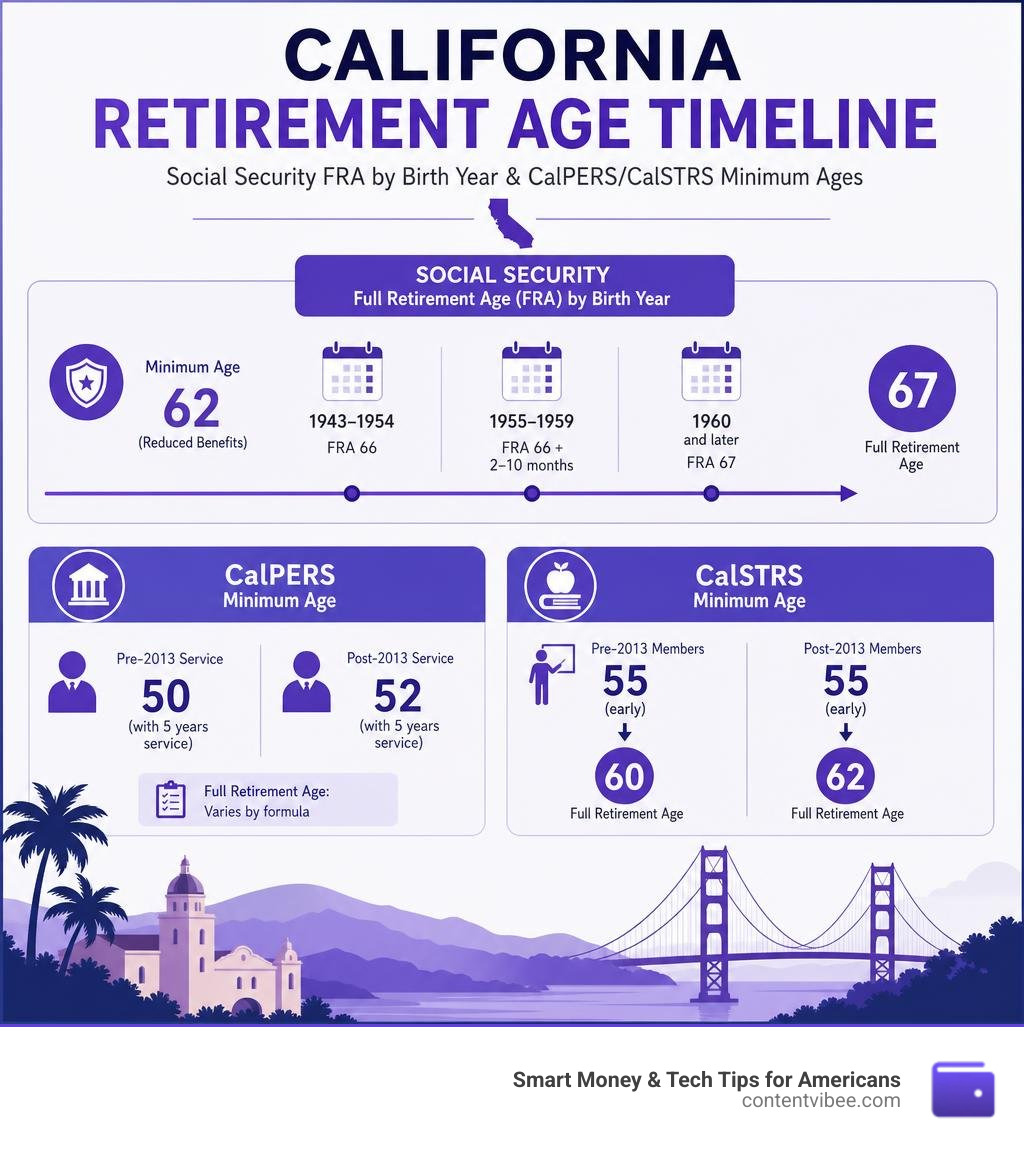
| CalPERS (pre-2013 service) | 50 (with 5 years service) | Varies by formula |
| CalPERS (post-2013 service) | 52 (with 5 years service) | Varies by formula |
| CalSTRS (pre-2013 members) | 55 (early) | 60 |
| CalSTRS (post-2013 members) | 55 (early) | 62 |
| Private sector | 62 (Social Security) | 67 (Social Security) |
Most Californians retire somewhere between 62 and 67, but public employees can often retire much earlier.
There’s no single answer to when you can stop working in California. A teacher, a state administrator, and a private-sector software engineer can all face very different retirement timelines — with different rules, different ages, and very different monthly checks waiting for them.
For couples especially, the timing question gets even more complex. When one spouse claims Social Security early, it can permanently reduce both their own benefit and what their partner may eventually receive. These decisions are hard to undo.
In 2026, the Social Security full retirement age officially reached 67 for anyone born in 1960 or later. That’s a big deal if you were counting on retiring this year with full benefits.
This guide breaks down everything you need to know — from Social Security rules and CalPERS eligibility to healthcare costs and tax implications — so you can make a confident decision about when to retire in California.
Understanding the Social Security Retirement Age in California

When we talk about the retirement age in California for private-sector workers, we are usually talking about the rules set by the Social Security Administration (SSA). Even though California is famous for doing things its own way, the state follows federal guidelines when it comes to federal retirement benefits.
The age at which you choose to claim Social Security has a massive, permanent impact on your monthly income. You can claim as early as age 62, wait until your Full Retirement Age (FRA), or delay claiming up to age 70.
For every year you delay claiming past your FRA, your monthly benefit increases by approximately 8% up to age 70. This means waiting can dramatically boost your standard of living, especially in a high-cost-of-living state like California. If you want to understand how these federal benefits fit into your broader plan, check out our A Comprehensive Guide To Social Security Benefits.
To see exactly when you qualify for unreduced benefits, you can See your Full Retirement Age (FRA) | SSA.
Full Retirement Age (FRA) by Birth Year
Your Full Retirement Age is the exact point in time when you are entitled to 100% of your monthly Social Security benefit. Your FRA is determined entirely by the year you were born:
- Born between 1943 and 1954: Your FRA is 66.
- Born in 1955: Your FRA is 66 and 2 months.
- Born in 1956: Your FRA is 66 and 4 months.
- (The FRA continues to increase by 2 months for each subsequent birth year).
- Born in 1960 or later: Your FRA is 67.
Because we are in 2026, anyone born in 1960 has reached age 66. If you were born in 1960 or later, you must wait until age 67 to receive your full, unreduced benefit. Planning this timing with a partner? You can learn How To Calculate Your Spousal Retirement Age Easily to align your timelines.
Early Claiming Penalties and the Minimum Retirement Age in California
The minimum age to claim Social Security retirement benefits is 62. However, taking your benefits early triggers a permanent penalty.
For those born in 1960 or later, claiming at age 62 results in a 30% reduction in your monthly benefit. For example, if your unreduced benefit at age 67 would be $1,000, claiming at age 62 reduces that monthly check to just $700.
The SSA reduces your benefit by a small fraction of a percent for each month you claim before your FRA. You can read the official breakdown of these reductions on the Retirement Age and Benefit Reduction – Social Security Administration page.
Deciding whether to take a smaller check early or wait for a larger check is one of the most critical decisions you will make. To help you weigh the pros and cons, read our guide on the Best Age To Collect Ss.
Spousal and Survivor Benefits Rules
If you are married, your retirement age decisions do not just affect you—they affect your spouse as well. A spouse can receive up to 50% of the primary earner’s full retirement benefit. However, if the spouse claims this benefit early, it is also subject to steep reductions.
For those born in 1960 or later, claiming a spousal benefit at age 62 reduces the maximum 50% benefit down to just 32.5% (a 35% reduction in the spousal benefit amount). If you are trying to understand how these calculations work, you can read more about What Is A Social Security Spousal Benefit or use our resources to Calculate Spouse Retirement Benefits.
California Public Employee Retirement Systems: CalPERS and CalSTRS
If you are a public employee in California, your retirement timeline looks very different from the private sector. California has some of the largest public pension systems in the world, primarily the California Public Employees’ Retirement System (CalPERS) and the California State Teachers’ Retirement System (CalSTRS).
These systems use a defined benefit formula to calculate your pension, which is based on three main factors:
- Service Credit: The total number of years you have worked under the system.
- Benefit Factor: A percentage determined by your age at retirement.
- Final Compensation: Your highest average salary over a specific period (usually 12 or 36 months).
| Pension System | Early Retirement Age | Full Retirement Age (Standard) | Key Requirements |
|---|---|---|---|
| CalPERS (Pre-2013) | Age 50 | Varies (often 55 to 60) | Minimum 5 years of service credit |
| CalPERS (Post-2013) | Age 52 | Varies (often 62 to 67) | Minimum 5 years of service credit |
| CalSTRS (Pre-2013) | Age 55 | Age 60 | Minimum 5 years of service credit |
| CalSTRS (Post-2013) | Age 55 | Age 62 | Minimum 5 years of service credit |
CalPERS Eligibility and Benefit Calculations
CalPERS covers state, school, and local public agency employees. Your minimum retirement age in California under CalPERS depends heavily on when you were hired.
For classic members (generally those who entered the system before January 1, 2013), you can retire as early as age 50 with at least 5 years of service credit.
However, the Public Employees’ Pension Reform Act (PEPRA) changed the rules for members hired on or after January 1, 2013. For these post-2013 members, the minimum retirement age is 52 with at least 5 years of service credit. Retiring at the minimum age will result in a much lower benefit factor, meaning a smaller monthly check.
CalPERS also administers disability and industrial disability retirement for members who become permanently disabled and can no longer perform their job duties. This generally requires at least 5 years of service credit (or 10 years for Second Tier members).
Note on WEP/GPO: Many California public employees do not pay into Social Security. Historically, the Windfall Elimination Provision (WEP) and Government Pension Offset (GPO) reduced Social Security benefits for those with public pensions. However, the Social Security Fairness Act repealed these provisions starting in early 2025, which has been a massive win for retired California public servants.
CalSTRS Guidelines for Educators
CalSTRS manages retirement benefits for California’s public school educators. Like CalPERS, CalSTRS splits its members into two categories based on their hire date:
- Pre-2013 Members (2% at 60 program): These educators can retire at age 60 with unreduced benefits, or as early as age 55 with at least 5 years of service credit.
- Post-2013 Members (2% at 62 program): Educators hired after PEPRA took effect have a full retirement age of 62. They can still retire as early as age 55, but with a reduced benefit factor.
For educators, staying in the classroom a few extra years can dramatically increase their benefit factor, making the choice of when to retire a highly personal financial calculation.
Private Sector vs. Public Sector Retirement Age in California
If you work in the private sector, you do not have a state-backed pension plan. Instead, your retirement timeline is determined by your personal savings, employer-sponsored plans like 401(k)s, Individual Retirement Accounts (IRAs), and Social Security.
This creates a distinct contrast between public and private retirement structures in California:
- Public Sector: Focuses on a guaranteed lifetime pension. Public employees can often retire in their 50s with a secure income stream, though they must carefully coordinate their pension with any potential Social Security benefits.
- Private Sector: Relies heavily on defined contribution plans. Private-sector workers must manage their own investment portfolios and determine how to stretch their savings over several decades.
Because private-sector workers bear all the investment risk, estimating your future income is essential. If you are in the private sector and trying to project your cash flow, you can Estimate Your Monthly Retirement Benefits In 5 Easy Steps.
Key Differences in the Retirement Age in California for Private Employees
Without a pension to rely on, private employees often base their retirement age on when they can access their retirement accounts without penalty:
- Age 59½: This is the age at which you can begin taking penalty-free distributions from traditional 401(k)s and IRAs.
- Age 62: The earliest age to claim reduced Social Security benefits.
- Age 67: Full Retirement Age for Social Security (for those born in 1960 or later).
Because of these milestones, many private-sector workers target ages 62 to 67 for their retirement. To see what your primary income source will look like at these ages, try using a How Much Social Security Will I Get Calculator.
Key Factors Influencing Your California Retirement Timeline
Deciding on your retirement age in California is about more than just hitting a specific birthday. The Golden State has unique economic realities that can either accelerate or delay your plans.
For a deeper dive into how health, lifestyle, and state-specific factors interact with your retirement age, read Understanding the Retirement Age | Health for California.
Cost of Living and Tax Implications in the Golden State
California is a beautiful place to live, but it is also one of the most expensive states in the country. High housing costs, expensive utilities, and gas prices mean your retirement savings need to stretch further here than almost anywhere else.
Taxes are another major consideration:
- Social Security Tax Exemption: California is one of the states that does not tax Social Security benefits. This is a huge benefit for retirees relying heavily on federal benefits.
- State Income Tax: California taxes other forms of retirement income, including pensions, 401(k) distributions, and traditional IRA withdrawals, at regular state income tax rates (which are among the highest in the nation).
Healthcare and Medicare Timing
If you retire before age 65, you will need to find a way to cover your medical expenses until you qualify for Medicare.
- Medicare Eligibility: You can enroll in Medicare starting at age 65. If you delay your retirement benefits past 65, you should still sign up for Medicare within three months of your 65th birthday to avoid late-enrollment penalties.
- Early Retirement Bridge: If you retire at 55 or 62, you must budget for private health insurance, COBRA, or coverage through Covered California. Healthcare costs can easily consume a significant portion of an early retiree’s budget.
Financial Planning Steps to Prepare for Your California Retirement
To ensure you can retire comfortably on your own terms, we recommend taking these proactive steps:
- List All Income Sources: Write down everything you expect to receive, including Social Security, pensions (CalPERS/CalSTRS), 401(k)s, IRAs, and any part-time work.
- Estimate Your Retirement Expenses: Account for California’s high cost of living, including housing, taxes, insurance, and travel.
- Pay Off High-Interest Debt: Entering retirement debt-free—especially if you can pay off your mortgage—drastically reduces your monthly income needs.
- Build an Emergency Fund: Keep 6 to 12 months of living expenses in a high-yield savings account to protect against market downturns.
- Review and Rebalance Your Portfolio: Ensure your investments align with your retirement timeline, shifting to more conservative assets as you get closer to your target retirement age.
If you are planning as a couple, coordinate your claiming times to maximize your household benefits. Check out The Smart Couples Guide To Social Security Strategies for tips on maximizing your combined income.
Frequently Asked Questions about California Retirement
What is the average retirement age in California?
The average retirement age in California typically hovers between 62 and 65. While public employees with robust pensions often retire in their late 50s or early 60s, private-sector workers frequently stay employed until age 65 or 67 to maximize Medicare and Social Security benefits.
Can I retire at 55 and collect Social Security in California?
You can retire from your job at age 55, but you cannot collect Social Security benefits at that age. The absolute earliest age to claim Social Security retirement benefits is 62, and doing so will result in a permanent reduction of up to 30% of your monthly benefit.
Does California tax Social Security benefits?
No! California is highly tax-friendly when it comes to Social Security. The state does not tax your Social Security retirement, spousal, or survivor benefits. However, keep in mind that your pensions, 401(k)s, and IRAs are subject to California’s standard state income tax.
Conclusion
Determining the ideal retirement age in California requires balancing your personal financial goals with the unique rules of your retirement system. Whether you are a dedicated public servant covered by CalPERS or CalSTRS, or a private-sector worker managing your own 401(k), the key to a stress-free retirement is early and thorough planning.
At Smart Money & Tech Tips for Americans, we want to help you make these critical decisions with clarity and confidence. Take the next step in securing your financial future by reading A Comprehensive Guide To Social Security Benefits today!


