


The Rise of Hybrid Robo Advisors: Automation Meets Human Expertise
Hybrid robo advisors are investment platforms that combine automated portfolio management with access to real human financial advisors — giving you the low cost of a robo-advisor and the personal guidance of a traditional advisor.
Here’s what you need to know at a glance:
- What they are: Digital platforms that use algorithms to build and manage your portfolio, with licensed human advisors available by phone or video when you need them
- Who they’re for: Investors who want more than a pure algorithm but don’t want to pay full-service advisor rates
- What they cost: Typically 0.30%–0.40% per year — more than a pure robo-advisor, less than a traditional human advisor
- Minimum investments: Usually $25,000–$50,000, depending on the platform
- Key features: Automatic rebalancing, tax-loss harvesting, goal tracking, and access to a real advisor for life events or complex questions
Investing used to feel like an all-or-nothing choice. You either handed everything to a human advisor (and paid for it), or you trusted a fully automated platform and hoped the algorithm understood your life.
Hybrid robo advisors changed that equation.
As investor demand for both affordability and personalized guidance grew, major platforms — including Vanguard, Fidelity, and TD — built services that sit squarely in the middle. Approximately 58% of investors now prefer hybrid models over either pure robo or traditional human advisors, according to industry data.
For retirees and those approaching retirement, this matters a lot. Life gets complicated fast — Social Security timing, spousal benefits, required minimum distributions, income shifts. A pure algorithm may not handle those nuances well. A full-service advisor may cost more than it’s worth. A hybrid model can bridge that gap.
What is a Hybrid Robo-Advisor?
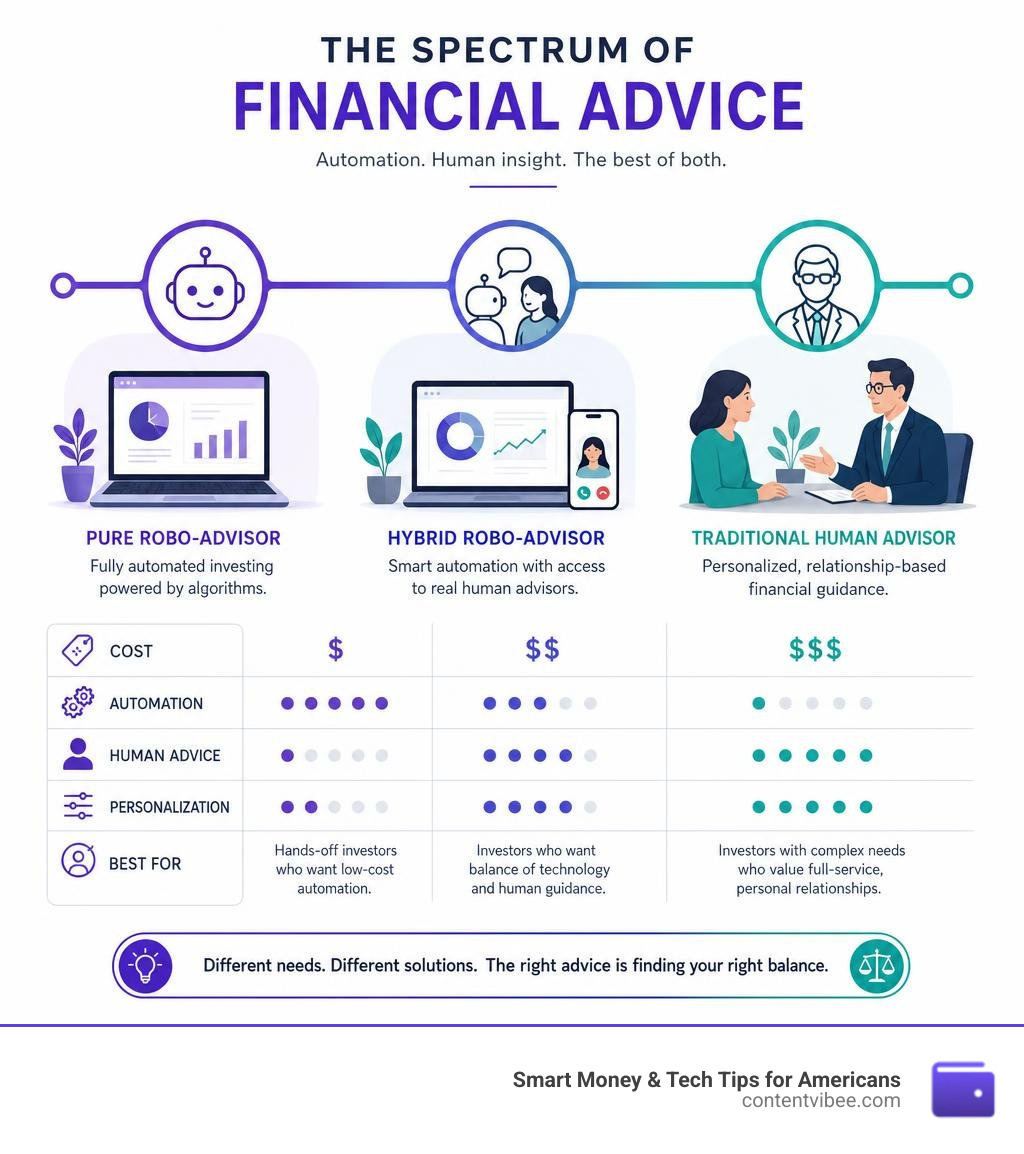
To understand hybrid robo advisors, it helps to look at how we got here. A decade ago, the investing world was divided. On one side stood the traditional human advisor, offering bespoke plans but charging premium fees (often 1.00% of your assets or more). On the other side emerged the “pure” robo-advisor, an entirely automated platform that used software to build and rebalance portfolios for a fraction of the cost.
A hybrid robo-advisor is the genetic splice of these two approaches. It uses computer algorithms to handle the day-to-day heavy lifting—such as asset allocation, dividend reinvestment, and portfolio automation—while keeping a staff of licensed human professionals on standby to answer your complex financial planning questions.
When you sign up, you do not just hand your money over to a machine, nor do you pay a human to manually buy and sell index funds for you. Instead, the technology manages the portfolio, while the humans manage you and your broader financial plan.
As noted in the regulatory guidance on robo-advisers, these platforms can range from discretionary models (where the platform automatically makes trades for you) to non-discretionary ones. Understanding how much control you want to hand over is a key first step. If you are trying to decide whether to outsource your portfolio management entirely or keep some control, our guide on To Manage or Not to Manage: Taking the Reins of Your Investments offers a deeper look at balancing control and convenience.
Pure Robo vs. Traditional Human vs. Hybrid Models
How do these three models stack up when we look at the core elements of investing? Let’s break down the differences in automation, personalized service, and cost balance.
| Feature | Pure Robo-Advisor | Hybrid Robo-Advisor | Traditional Human Advisor |
|---|---|---|---|
| Primary Manager | Computer Algorithm | Algorithm + Human Consultant | Human Financial Advisor |
| Typical Annual Fee | 0.15% – 0.25% of AUM | 0.30% – 0.60% of AUM | 1.00% – 1.50% of AUM |
| Human Access | None (or basic tech support) | Remote (Phone, Video, Chat) | In-Person, Phone, Video |
| Account Minimums | $0 – $500 | $25,000 – $50,000 | Often $100,000+ |
| Best For | Beginners, hands-off savers | Mid-level investors, retirees | High-net-worth, complex estates |
| Portfolio Rebalancing | Fully Automated | Fully Automated | Manual or Semi-Automated |
How Hybrid Robo Advisors Blend Tech and Human Touch
The magic of hybrid robo advisors lies in how they divide labor.
Machines excel at math, consistency, and speed. They do not get emotional when the market dips, they do not forget to rebalance your portfolio on a Tuesday afternoon, and they can calculate tax-loss harvesting opportunities across thousands of accounts in milliseconds. Therefore, the technology takes full ownership of automated portfolio management.
Humans, on the other hand, excel at empathy, behavioral coaching, and navigating the gray areas of life. A computer algorithm cannot comfort you when you are panicking during a market correction. It cannot help you negotiate how to merge finances with a new spouse who has significant debt, or help you figure out how to maximize your California state tax deductions when transitioning into retirement.
This is where remote advice and financial coaching come in. Under the hybrid model, if you experience a major life event, you can schedule a phone call or video conference with a CFP (Certified Financial Planner) or licensed investment professional. They look at the automated portfolio as one piece of your larger financial puzzle and help you adjust your strategy accordingly.
If you are wondering whether this middle-ground approach fits your personal style, check out our breakdown in Is Automated Portfolio Management Right for You?.
Human Interaction Tiers in Hybrid Robo Advisors
Not all hybrid advisors offer the same level of human contact. Depending on the platform and your account balance, your access to human help generally falls into three tiers:
- The Call Center Pool (Basic Hybrid): You have unlimited access to a team of licensed financial advisors. When you call or book a video appointment, you speak to whoever is available. They can see your portfolio notes and history, but you do not work with one dedicated person. This tier is highly affordable and common for accounts in the $25,000 to $50,000 range.
- Dedicated Planners (Premium Hybrid): Once your balance crosses a higher threshold (often $100,000 to $250,000), some platforms assign a specific, dedicated financial advisor to your account. You can build an ongoing relationship with this person, and they will proactively reach out to review your progress annually or semi-annually.
- Niche/Specialized Coaching: Some modern platforms offer holistic coaching that integrates your investments with outside financial realities. For instance, services like FitBUX focus on integrating debt (like student loans) and personal cash flow into your risk profile, matching you with specialized coaches to build a comprehensive plan.
Choosing the Best Hybrid Robo Advisors for Your Goals
When shopping around, it is critical to look past the marketing and evaluate how a platform aligns with your specific investor profile. If your financial situation is relatively straightforward—say, you are saving for retirement using a single Roth IRA—a basic hybrid model with a call center pool of advisors is likely more than enough.
However, if you have complex finances—such as managing multiple inherited IRAs, navigating self-employment income, or coordinating tax strategies across both taxable and tax-advantaged accounts—you will want to seek out a hybrid advisor that offers robust tax coordination and highly qualified CFPs.
To protect yourself, make sure you review regulatory alerts, such as the SEC Robo-Advisor Investor Bulletin, which outlines the disclosures these platforms must provide regarding their algorithms, fees, and potential conflicts of interest.
Behind the Scenes: Portfolio Construction and Tax Strategies
When you open an account with a hybrid robo-advisor, the onboarding process typically begins with a digital questionnaire. You will enter your age, investment horizon, financial goals, and risk tolerance.
The software uses these inputs to assign you a target asset allocation, typically built on Modern Portfolio Theory (MPT). This mathematical framework aims to maximize your expected return for a given level of risk by diversifying your money across various asset classes. But can an online quiz truly capture your emotional relationship with money? We dive deep into this question in our article, Robo Advisor Asset Allocation: Can Robots Really Gauge Your Risk Tolerance?.
Once your asset allocation is set, the platform’s automated engine takes over. It monitors your account daily or weekly. If market movements cause your portfolio to drift away from its target allocation (for example, if a stock market rally makes your portfolio too equity-heavy), the algorithm automatically executes trades to bring you back in line.
Investment Options: Index, Active, and ESG Portfolios
Hybrid robo-advisors build their portfolios using different investment philosophies. Depending on your preferences, you can typically choose from three main types of portfolios:
- All-Index Portfolios: Built entirely using low-cost exchange-traded funds (ETFs) and mutual funds that track broad market indexes (like the S&P 500 or aggregate bond indexes). These portfolios offer the lowest internal fund expenses.
- Active/Index Portfolios: A blend of passive index funds and actively managed funds where professional managers try to outperform the market. These portfolios come with slightly higher underlying fund fees but appeal to those who want a shot at beating the market index.
- ESG (Environmental, Social, and Governance) Portfolios: Designed for socially responsible investing. These portfolios focus on companies with strong environmental records, positive social impact, and ethical corporate governance, using prescreened criteria defined by third-party index providers.
For example, Vanguard’s hybrid model, Vanguard Personal Advisor, allows clients to select from all-index, active/index, or ESG options based on their personal preferences. You can learn more about how these portfolios are constructed directly on the Vanguard page for automated investing services.
Tax-Loss Harvesting and Rebalancing Mechanics
For taxable accounts, tax efficiency is a major driver of long-term returns. Many hybrid robo advisors offer automated tax-loss harvesting (TLH) to help offset your capital gains and income taxes.
Here is how it works: the algorithm continuously scans your portfolio for assets that have declined in value. It automatically sells those losing investments to “harvest” the capital loss. It then immediately buys a highly correlated, but not “substantially identical,” replacement asset to maintain your target asset allocation.
By doing this, the algorithm avoids violating the IRS’s 30-day “wash-sale rule” while generating tax losses you can use to offset capital gains or up to $3,000 of ordinary income. To understand how this works under the hood and why it can be a massive boost to your net returns, check out our guide on Tax-Loss Harvesting: The Secret Weapon of Robo Advisors.
The Cost of Convenience: Fees and Minimums
While hybrid robo-advisors are significantly cheaper than traditional, full-service wealth managers, they are not free. When evaluating the total cost of a hybrid service, you must look at three distinct fee layers:
- The Advisory Fee (AUM Fee): This is the fee charged by the platform for managing your money and providing advisor access. It is typically expressed as an annual percentage of your Assets Under Management (AUM), billed monthly or quarterly. In 2026, hybrid advisory fees generally hover between 0.30% and 0.40% per year, though some providers charge flat monthly fees or higher percentages (up to 0.60%) for specialized services.
- The Underlying Fund Expense Ratios: These are the internal management fees charged by the managers of the ETFs or mutual funds held in your portfolio. These fees do not go to the robo-advisor; they go to the fund companies (like Vanguard, BlackRock, or Charles Schwab). Index ETFs typically have very low expense ratios (0.03% to 0.15%), while active or ESG funds can be higher.
- Account Minimums: Because human time is expensive, hybrid services require higher minimum balances than pure robo-advisors. While you can start a pure robo account with $0 to $500, hybrid tiers usually require an investment of $25,000 to $50,000 to unlock human advisor access.
To help you understand how these costs impact your long-term wealth, we have put together The Ultimate Guide to Robo Advisor Fees. If you are specifically interested in how one of the industry giants structures its pricing, you can read The No-Nonsense Guide to Fidelity Robo Advisor Fees, which explains how their tiered pricing model scales as your balance grows.
Navigating Market Volatility and Life Milestones
It is easy to be a DIY investor when the stock market is marching steadily upward. But when a sudden market downturn hits, human psychology can become our own worst enemy. Investors frequently panic-sell at the bottom of a market crash, locking in losses and missing out on the subsequent recovery.
This is where the human element of a hybrid robo-advisor pays for itself. During times of high market volatility, having access to a licensed advisor provides crucial behavioral coaching. An advisor can talk you off the ledge, remind you of your long-term goals, and explain how the platform’s automated system is actually taking advantage of the downturn by rebalancing and harvesting tax losses.
Beyond market crashes, human advisors are invaluable when you hit major life milestones. Algorithms are great at calculating compound interest, but they struggle to navigate the complex emotional and financial realities of:
- Getting married or divorcing
- Having a baby or funding a child’s college education
- Receiving an inheritance
- Transitioning into retirement and deciding which accounts to draw from first
By combining automated investing with human guidance, you get a “set-it-and-forget-it” system that can pivot when your life does. For a closer look at the power of automation, read our article Set and Forget Your Way to Wealth with Automated Investing.
Regulatory and Safety Considerations
When choosing a hybrid robo-advisor, safety and regulatory compliance should be top of mind. In the United States, hybrid robo-advisors are typically registered as Registered Investment Advisers (RIAs) with the Securities and Exchange Commission (SEC) or state regulators (such as the California Department of Financial Protection and Innovation).
Because they are RIAs, these platforms have a fiduciary duty to act in your best financial interest. This is a higher legal standard than the “suitability standard” followed by traditional broker-dealers, meaning hybrid advisors cannot recommend investments simply because they pay the advisor a higher commission.
Additionally, you should ensure that your chosen platform partners with a custodian that is a member of the Securities Investor Protection Corporation (SIPC). SIPC protects customers of broker-dealers if the firm fails financially, covering up to $500,000 (including a limit of $250,000 for cash claims). SIPC does not protect you against market losses—it only protects your assets if the brokerage firm itself goes bankrupt.
Before transferring your hard-earned money, take five minutes to check the firm’s disciplinary history and registration status using the SEC’s Investment Adviser Public Disclosure (IAPD) website.
The Pros and Cons of Hybrid Models

Before committing to a hybrid robo-advisor, it is wise to weigh the advantages against the drawbacks to make sure it aligns with your style.
The Pros:
- Cost Efficiency: You get access to professional financial planning for a fraction of the cost of a traditional, in-person advisor.
- Behavioral Support: Having a professional to talk to during market corrections can prevent costly, panic-driven mistakes.
- Automated Efficiency: Features like automatic rebalancing and tax-loss harvesting run quietly in the background without requiring your time.
- Holistic Planning: Unlike pure robos, the human advisors can help you coordinate external financial elements like debt, real estate, and retirement income planning.
The Cons:
- Higher Fees Than Pure Robos: If you never plan to speak to an advisor, paying an extra 0.15% to 0.20% per year in advisory fees is an unnecessary drag on your returns.
- Account Minimums: The $25,000 to $50,000 minimums can be an entry barrier for young or beginner investors.
- Limited Portfolio Customization: You generally must choose from pre-built model portfolios of ETFs. If you want to trade individual stocks, options, or cryptocurrencies, a hybrid robo-advisor will feel too restrictive.
Frequently Asked Questions about Hybrid Investing
What is the typical minimum investment for a hybrid robo-advisor?
Most hybrid robo-advisors require a minimum investment between $25,000 and $50,000 to access their human advisory tiers. While some platforms allow you to open a basic automated account with as little as $10, you will not unlock the ability to schedule calls with human financial planners until you cross these higher balance thresholds.
Do hybrid robo-advisors offer tax-loss harvesting?
Yes, most major hybrid robo-advisors offer automated tax-loss harvesting for taxable brokerage accounts. However, some platforms only activate this feature once your account balance reaches a certain threshold (such as $25,000 or $50,000) because the tax savings on smaller accounts are often too negligible to justify the trading volume. Tax-loss harvesting is not applicable to tax-advantaged retirement accounts like traditional or Roth IRAs, as those accounts are already tax-sheltered.
How do hybrid robo-advisors handle market crashes?
During a market crash, the hybrid model uses a two-pronged approach. First, the automated algorithm works to maintain your target asset allocation by automatically buying equities at lower prices (rebalancing) and harvesting tax losses. Second, the platform’s human advisors are available to provide behavioral coaching, helping you stay disciplined, avoid panic-selling, and understand how market cycles work over the long term.
Conclusion
At Smart Money & Tech Tips for Americans, we believe that the best financial strategy is the one that gives you peace of mind while keeping your hard-earned cash working efficiently.
Hybrid robo advisors represent a major leap forward in personal finance. By automating the mechanical, math-heavy aspects of investing, they drive down costs and eliminate human error. At the same time, by preserving access to licensed human planners, they ensure that you never have to face major life changes or scary market drops alone.
If you are ready to start building your automated wealth strategy but want to keep things as simple as possible, take a look at our guide on the Best Autopilot Investing Strategies for Beginners Who Hate Math. Whether you choose a pure algorithm, a hybrid model, or a traditional advisor, taking that first step toward a disciplined, automated future is the smartest money move you can make.


