


What the Fidelity Fee Per Trade Actually Costs You
What You Actually Pay for a Fidelity Fee Per Trade

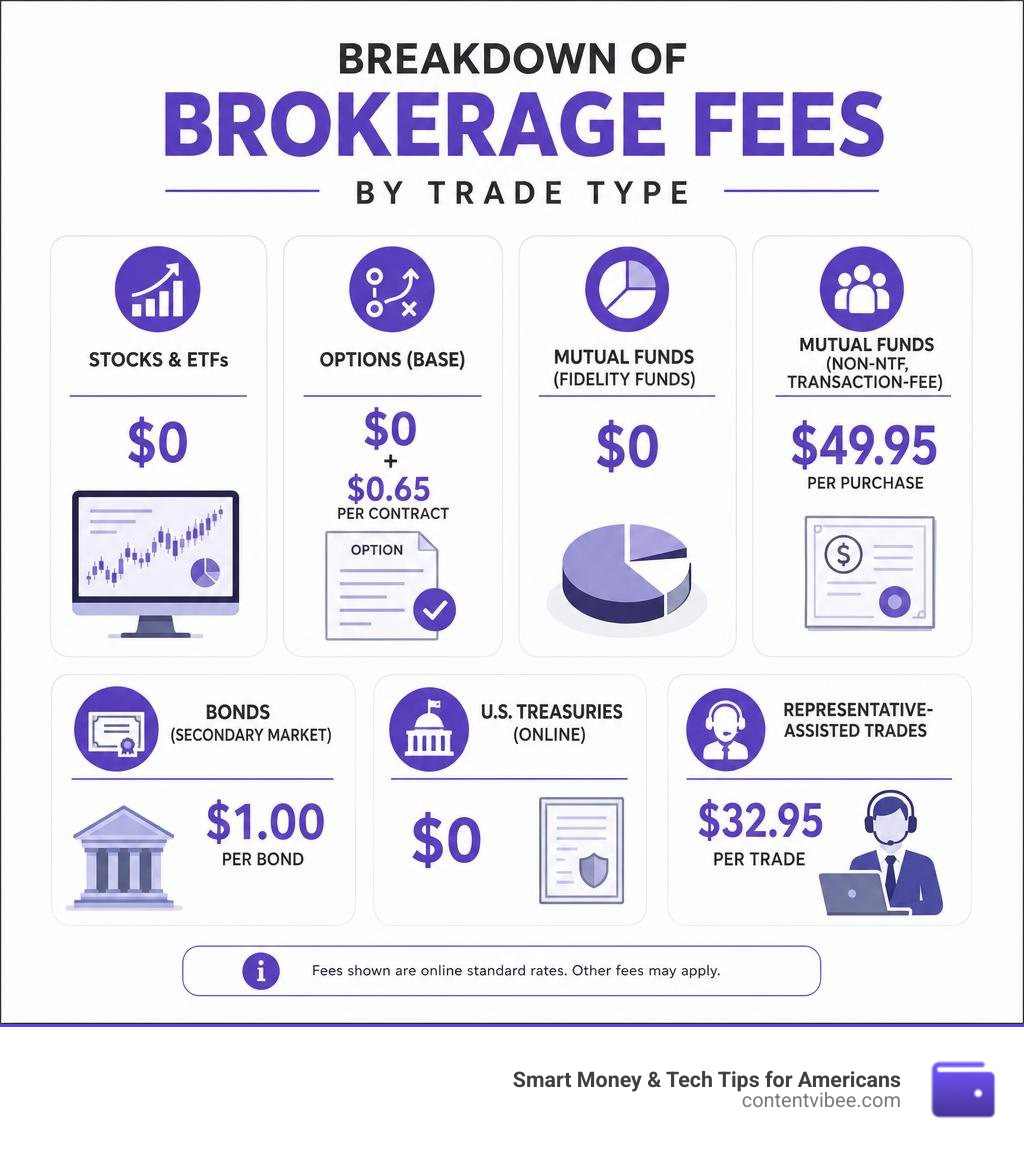
Understanding the Fidelity fee per trade is simpler than most people expect. Here’s the quick answer:
| Investment Type | Online Fee Per Trade |
|---|---|
| U.S. Stocks & ETFs | $0 |
| Options (base) | $0 + $0.65 per contract |
| Mutual Funds (Fidelity funds) | $0 |
| Mutual Funds (non-NTF, transaction-fee) | $49.95 per purchase |
| Bonds (secondary market) | $1.00 per bond |
| U.S. Treasuries (online) | $0 |
| Representative-assisted trades | $32.95 per trade |
For most everyday investors, Fidelity’s core trading costs are zero. No commissions on stocks, ETFs, or Fidelity’s own mutual funds. No account minimums. No inactivity fees.
But “free” trading isn’t the whole story.
A handful of fees do exist — on options contracts, certain mutual funds, margin borrowing, and some account services. Knowing exactly where those costs appear can save you real money over time, especially if you’re managing a retirement portfolio and watching every dollar.
This guide breaks down every fee category clearly, so you know what you’re actually paying — and what you’re not.
Understanding the Fidelity Fee Per Trade for Stocks and ETFs
When we talk about the standard fidelity fee per trade for equities, the news is overwhelmingly positive. For self-directed investors trading online, Fidelity offers $0 commissions on all U.S. stock and exchange-traded fund (ETF) transactions. Whether you buy one share or ten thousand, your online trading commission is exactly zero.
But how does this work in practice? We are often asked if “zero commission” is simply a marketing gimmick. In our is fidelity actually free or are you the product analysis, we dive deep into how modern brokerages generate revenue without charging upfront commissions. At Fidelity, the value goes beyond just the $0 sticker price.
For instance, Fidelity does not rely on payment for order flow (PFOF) for stock and ETF trades in the same way some other brokers do. Instead, they focus heavily on execution quality. In fact, on a typical 1,000-share equity order, Fidelity saves investors an average of $24.50 compared to the industry average of $4.34, thanks to their price improvement technology. This means you are often getting a slightly better buy or sell price than what is displayed on the public quote, putting real money back into your account.
Furthermore, we appreciate that Fidelity supports fractional share trading. You can buy and sell fractional shares of over 7,000 U.S. stocks and ETFs with a minimum transaction value of just $1. This makes dollar-based investing incredibly simple for beginners who want to build a diversified portfolio without needing thousands of dollars to buy full shares of high-priced tech stocks.
To explore how these stock and ETF trading rules compare to other services, you can review the official Straightforward and Transparent Pricing – Fidelity page.
How Options Impact Your Fidelity Fee Per Trade
If you decide to venture into options trading, the fee structure changes slightly. While there is still a $0 base commission for online options trades, you will pay a contract fee of $0.65 per contract.
For example, if you buy 10 call options on a stock, your total contract fee will be $6.50 ($0.65 x 10). To see a full breakdown of how these multi-leg strategies and contract limits work, read our comprehensive guide on fidelity options fees explained and demystified.
There is, however, an investor-friendly exception: “buy-to-close” orders. If you are closing out a short options position that is trading for $0.65 or less, Fidelity waives both the transaction fee and the contract fee. This allows you to close out low-value contracts early to eliminate risk without paying extra fees.
Phone Trades and Representative-Assisted Orders
While online trades are completely free, using other channels to place your trades will cost you. If you prefer not to use the website or mobile app, you have two alternative trading methods:
- FAST (Fidelity Automated Service Telephone): This automated phone system allows you to place stock and ETF trades for a service fee of $12.95 per trade.
- Representative-Assisted Trades: If you want to speak directly to a live broker to place your trade, you will be charged a steep $32.95 representative-assisted trading fee.
For the vast majority of our readers, we strongly recommend sticking to online trading channels to keep your fidelity fee per trade at exactly zero.
Mutual Fund Transaction Fees and Short-Term Trading Rules

Mutual funds are a staple of long-term retirement planning, but their fee structures can be more complex than stocks and ETFs. At Fidelity, mutual funds are generally categorized into three groups:
- Fidelity Funds: All Fidelity-branded mutual funds can be purchased and sold online with $0 transaction fees.
- No-Transaction-Fee (NTF) Funds: Fidelity partners with other fund families to offer thousands of third-party mutual funds with $0 transaction fees.
- Transaction-Fee Funds: Third-party mutual funds that are not part of the NTF program incur a transaction fee of $49.95 per purchase when placed online.
It is important to note that the $49.95 transaction fee only applies to the purchase of these non-NTF funds; there is typically no fee to sell them. However, if you place a purchase order for a non-NTF fund through a representative, that fee can jump significantly. To review the official legal disclosures, check out the Fidelity Brokerage and Commission Fee Schedule.
Minimizing Your Fidelity Fee Per Trade on Mutual Funds
To keep your mutual fund investing costs as low as possible, we recommend keeping two major strategies in mind:
First, always check the “Fees and Distributions” tab on any fund page on Fidelity’s website before buying. This will tell you explicitly whether the fund is an NTF fund or if it carries a transaction fee.
Second, be mindful of the short-term trading fee. To discourage investors from treating mutual funds like short-term trading vehicles, Fidelity charges a flat $49.95 short-term redemption fee if you sell shares of a non-Fidelity NTF fund that you have held for less than 60 days. If you execute this sale via the FAST phone system, the fee can scale up to $187.50, and a representative-assisted sale can cost up to $250.
If you want to avoid these fees entirely, we recommend looking into Fidelity’s proprietary index funds. In addition to having no transaction fees, Fidelity offers several “ZERO” index funds (such as FZROX and FZIPB) which carry a 0.00% expense ratio. Just keep in mind that these ZERO funds cannot be transferred in-kind to other brokerages; if you ever decide to leave Fidelity, you will have to liquidate them, which may trigger capital gains taxes.
Margin Rates and Borrowing Costs Explained
If you want to use leverage to buy securities, you can apply for margin borrowing. When you trade on margin, you are essentially taking out a loan from Fidelity, using your existing portfolio as collateral.
Margin interest is calculated daily based on your outstanding debit balance, and the rate charged is tiered. As your borrowing balance increases, the interest rate decreases. Fidelity’s base margin rate (which has been effective since December 12, 2025) is 10.575%.
Here is how the tiered margin rate structure looks across different debit balances:
| Margin Debit Balance | Interest Rate Markup/Discount | Effective Margin Rate |
|---|---|---|
| $0 to $24,999.99 | Base + 1.250% | 11.825% |
| $25,000 to $49,999.99 | Base + 0.750% | 11.325% |
| $50,000 to $99,999.99 | Base + 0.250% | 10.825% |
| $100,000 to $249,999.99 | Base – 0.250% | 10.325% |
| $250,000 to $499,999.99 | Base – 1.500% | 9.075% |
| $500,000 to $999,999.99 | Base – 2.000% | 8.575% |
| $1,000,000+ | Base – 3.075% | 7.500% |
To see the most up-to-date margin tiers and complete requirements, visit the Trading Commissions and Margin Rates | Fidelity page.
Tiered Margin Rate Structure
When we compare these margin rates to other major legacy brokerages, Fidelity’s pricing is highly competitive, especially for larger balances. For example, Fidelity’s lowest published margin rate is 7.50% for debit balances of $1 million or more.
By comparison, Schwab’s rate for the same tier sits at 10.075%, E*TRADE charges 10.45%, and Vanguard charges 10.00%. If you are an active trader utilizing significant portfolio leverage, these interest rate differences can translate to thousands of dollars in annual savings.
However, we always urge caution when borrowing on margin. If the value of your collateral falls below a certain threshold, you may face a margin call, requiring you to deposit cash immediately. If you fail to do so, Fidelity can liquidate your positions to cover the balance, and they charge a $32.95 margin liquidation fee for doing so.
Fixed Income, Foreign Stocks, and Regulatory Fees
For fixed-income investors, Fidelity is an exceptionally low-cost platform. If you buy new-issue bonds or certificates of deposit (CDs), or if you purchase U.S. Treasury securities at auction online, there is a $0 transaction fee.
For secondary market bond trades executed online, Fidelity charges a modest markup or markdown of $1.00 per bond. If you choose to execute secondary market bond trades through a representative, a $19.95 minimum markup/markdown applies. There is a maximum fee of $250 per trade, which drops to $50 for bonds maturing in one year or less.
Foreign Stocks and International Trading
If you want to trade international equities, the fees depend on whether the asset is “DTC-eligible” (meaning it can be cleared electronically in the U.S.) or if it requires settlement on a foreign exchange.
For non-DTC eligible foreign ordinary stocks, foreign settlement fees apply per trade. Additionally, if you trade directly on foreign exchanges, you will pay country-specific transaction taxes (such as the 0.40% Financial Transaction Tax in France) and currency exchange fees that can range up to 3% of the principal amount.
Regulatory and Activity Assessment Fees
Even on “commission-free” online stock and ETF sales, you will notice a tiny charge on your trade confirmations. This is not a fidelity fee per trade kept by the broker; rather, it is a pass-through regulatory fee.
Fidelity is required by law to pay fees to self-regulatory organizations (SROs) like the SEC and FINRA to offset governmental supervision costs. They pass this on to investors as an “Additional Assessment” fee (often listed as an Activity Assessment Fee) on all sell orders. This fee typically ranges from $0.01 to $0.03 per $1,000 of principal. Unless you are trading millions of dollars at a time, this fee is usually just a few pennies.
Account Maintenance, Wires, and Miscellaneous Fees
One of the biggest advantages of using Fidelity is the complete lack of sneaky administrative fees. Many brokerages charge annual maintenance fees, inactivity fees, or fees to close out an account. Fidelity charges $0 for all of these.
Specifically, there are:
- $0 annual or monthly account service fees
- $0 account transfer out (ACAT) fees (whereas some competitors charge up to $50 to transfer your assets elsewhere)
- $0 IRA closeout fees
For a complete side-by-side breakdown of how these administrative costs stack up against other institutions, take a look at our fidelity investments fees comparison guide.
Additionally, while many financial institutions charge $15 to $25 for outgoing bank wire transfers, Fidelity charges $0 for outgoing domestic wires initiated online. If you need to send an outgoing domestic wire through a representative, there is a maximum fee of $10.00, which is still the lowest among major brokerages.
Robo-Advisor and Wealth Management Fees
If you prefer a hands-off approach, you might consider Fidelity Go, their digital robo-advisor service. The fee structure for Fidelity Go is tiered based on your account balance:
- Under $25,000: $0 annual advisory fee.
- $25,000 and above: 0.35% annual advisory fee.
For example, if you have a $40,000 balance in a Fidelity Go account, you will pay an annual advisory fee of $140 (0.35% of the total balance). This fee covers all investment management and automated rebalancing, and there are no additional transaction fees or mutual fund expense ratios within the account. To see if this service makes sense for your retirement goals, read the no nonsense guide to fidelity robo advisor fees.
Frequently Asked Questions about Fidelity Trading Fees
Is there a fee to close a Fidelity IRA?
No. Unlike many other financial institutions that charge between $50 and $125 to close out a retirement account, Fidelity charges $0 to close an IRA. Furthermore, if you decide to execute a full account transfer (ACAT) to move your assets to another institution, Fidelity charges $0 for the outgoing transfer.
What is the additional assessment fee on sell orders?
The additional assessment fee is a tiny regulatory pass-through fee applied only to sell orders. It is used to offset fees charged to Fidelity by national securities exchanges and the SEC. It typically costs between $0.01 and $0.03 per $1,000 of principal, meaning a $10,000 stock sale will only cost you about 10 to 30 cents.
Does Fidelity charge for real-time streaming quotes?
For non-professional retail investors, real-time streaming quotes are completely free on Fidelity’s website, mobile app, and active trading platforms. However, professional traders are subject to different data agreements and must pay a monthly professional streaming quote subscription fee of $123.50. If you are looking for advanced trading setups, you can also read our update on the fidelity active trader pro replacement options.
Conclusion
At Smart Money & Tech Tips for Americans, we believe that fee transparency is one of the most critical elements of long-term wealth building. High fees can quietly erode your retirement savings over decades, making it harder to reach your financial milestones.
Fidelity stands out as an exceptionally investor-friendly brokerage. By keeping online stock, ETF, and U.S. Treasury trades at a $0 commission, and eliminating sneaky account maintenance, transfer, and wire fees, they allow you to keep more of your hard-earned money working for you.
While you should still remain mindful of options contract fees, transaction-fee mutual funds, and margin interest, avoiding these extra costs is simple once you know the rules. For a deeper dive into how these expenses impact your overall portfolio performance, check out our full fidelity cost transparency review.


