What a Divorced Spouse Social Security Benefits Calculator Can Tell You Right Now
A divorced spouse Social Security benefits calculator helps you quickly estimate how much you could receive from your ex-spouse’s earnings record — before you ever file a claim.
Quick answer for people nearing retirement:
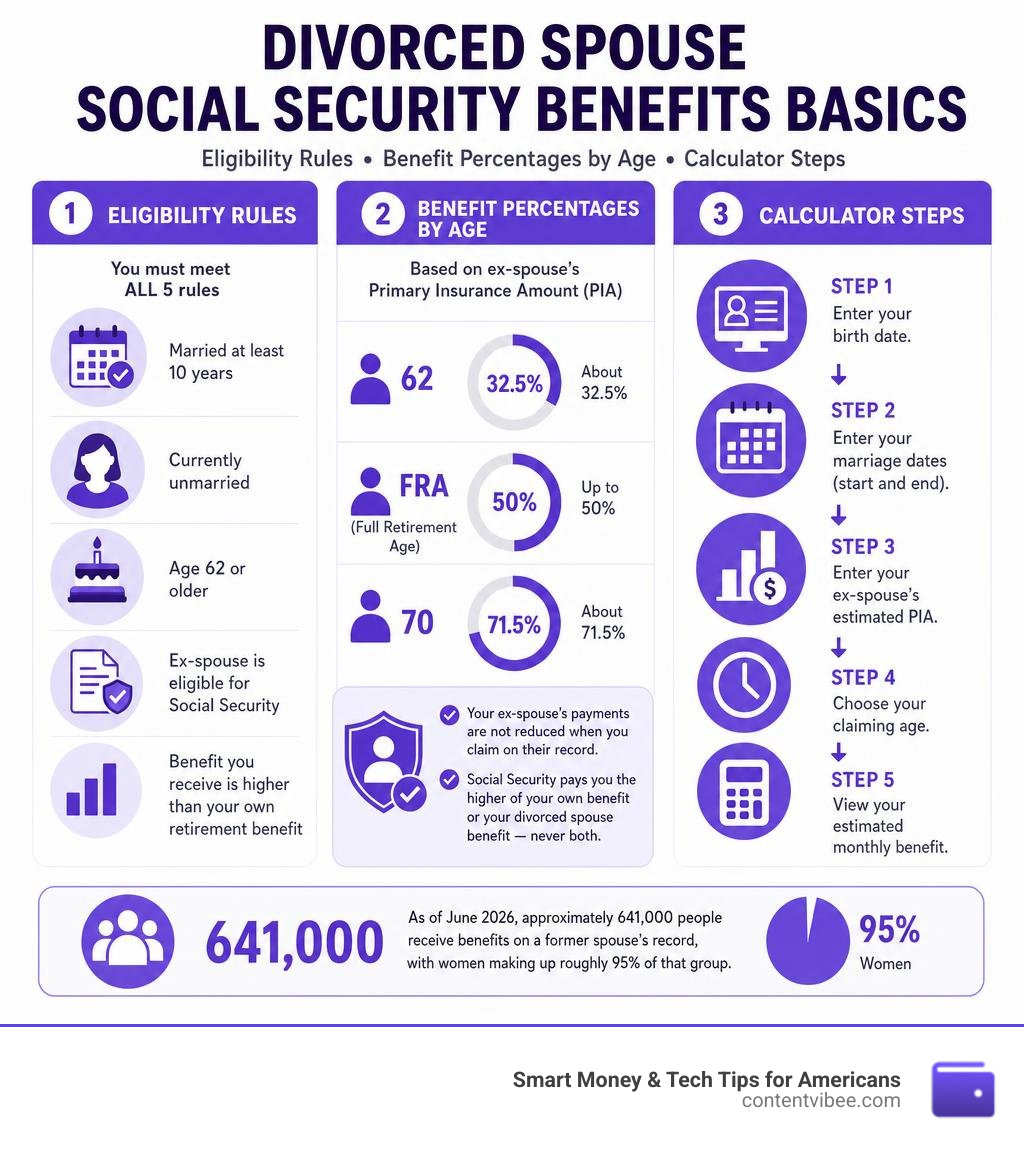
- You can receive up to 50% of your ex-spouse’s Primary Insurance Amount (PIA) if you claim at your Full Retirement Age (FRA)
- Claiming at age 62 permanently reduces that to about 32.5%
- Your ex-spouse’s payments are not reduced when you claim on their record
- You must have been married at least 10 years and be currently unmarried
- Social Security pays you the higher of your own benefit or your divorced spouse benefit — never both combined
- As of June 2026, approximately 641,000 people receive benefits on a former spouse’s record, with women making up roughly 95% of that group
That’s the short version. The details — especially around timing, remarriage, and survivor benefits — can significantly change how much you collect over your lifetime.
Many people nearing retirement don’t realize this benefit even exists. Others know about it but aren’t sure if they qualify, or they worry that filing will somehow hurt their ex. Neither confusion nor hesitation should cost you thousands of dollars in retirement income.
The good news: free online calculators make it easy to run the numbers in minutes, without needing your ex-spouse’s cooperation.
Eligibility Rules: Can a Divorced Spouse Get Social Security Benefits?
Before you start looking for a divorced spouse Social Security benefits calculator, you need to make sure you actually clear the hurdles set by the Social Security Administration (SSA). The federal government does not hand out these benefits to just anyone who has been through a breakup. There are five clear, non-negotiable criteria you must meet:
- The 10-Year Marriage Rule: Your marriage to your ex-spouse must have lasted for at least 10 consecutive years before the divorce was finalized. If your marriage ended at nine years and 364 days, unfortunately, you do not qualify.
- The Age 62 Requirement: You must be at least 62 years old to claim any form of spousal or divorced spousal benefit.
- Your Current Marital Status: You must be currently unmarried. If you remarried, you generally cannot claim benefits on your ex-spouse’s record (unless your subsequent marriage also ended by death, divorce, or annulment).
- Ex-Spouse Eligibility: Your ex-spouse must be at least 62 years old and eligible to receive Social Security retirement or disability benefits.
- The Benefit Comparison: The benefit you are entitled to based on your own work history must be less than the benefit you would receive based on your ex-spouse’s work history. The SSA automatically compares your personal benefit to your divorced spousal benefit and pays you the higher of the two.
A major point of confusion for many retirees is whether their ex-spouse must already be collecting their own retirement check. This is where the 2-year divorce rule and the concept of independent entitlement come into play.
If your ex-spouse has already filed for Social Security, you can claim your divorced spouse benefit immediately (assuming you meet the other criteria). However, if your ex-spouse is eligible for benefits but has not yet filed, you can still claim benefits on their record if you have been divorced for at least two consecutive years. This independent entitlement is a vital lifeline, ensuring that an uncooperative or delaying ex-spouse cannot block you from accessing the financial support you deserve.
For a deeper look into these specific rules, you can read our comprehensive guide on Can Divorced Spouse Get Social Security Benefits.
How Much Can You Receive? Calculating Your Divorced Spousal Benefit Amount
So, how much money are we actually talking about?
The maximum benefit a divorced spouse can receive is 50% of the ex-spouse’s Primary Insurance Amount (PIA). The PIA is the monthly amount your ex-spouse is entitled to receive at their exact Full Retirement Age (FRA).
For anyone born in 1960 or later, the Full Retirement Age is 67. If you wait until your own FRA to claim, you will get that full 50% amount. However, if you choose to claim early — which you can do starting at age 62 — your monthly check will be permanently reduced.
Claiming at age 62 means your spousal benefit is reduced to approximately 32.5% of your ex-spouse’s PIA. This reduction is calculated using a strict formula: the SSA subtractes 25/36 of 1% for each of the first 36 months before your FRA, and an additional 5/12 of 1% for each month beyond that.
Unlike your personal retirement benefit, divorced spousal benefits do not earn delayed retirement credits. While your own retirement benefit increases by 8% each year you delay claiming past your FRA (up to age 70), a divorced spousal benefit maxes out completely at your FRA. There is absolutely no financial benefit to waiting past age 67 to claim a divorced spousal benefit.
One of the most persistent myths we hear at ContentVibee is that claiming a divorced spousal benefit will reduce the ex-spouse’s own benefit check, or affect the benefits of their new spouse. Let us put this myth to rest: it has zero impact. Your divorced spousal benefit is paid out of a separate federal allocation within the Social Security general trust fund. Your ex-spouse will not be notified by the SSA when you claim, and their monthly check (as well as their current spouse’s check) will remain exactly the same.
It is also important to consider how other retirement incomes might impact your check. If you receive a pension from a government job where you did not pay Social Security taxes, your divorced spouse benefit may be heavily reduced or completely eliminated by the Government Pension Offset (GPO). Similarly, the Windfall Elimination Provision (WEP) can affect your personal retirement benefit calculations.
To help visualize how early claiming permanently alters your monthly retirement income, let’s look at the numbers.

Comparing Divorced Spousal Benefit Percentages by Claiming Age
The table below demonstrates how your claiming age affects the percentage of your ex-spouse’s PIA you will receive, assuming a Full Retirement Age of 67.
| Claiming Age | Months Before FRA | Percentage of Ex-Spouse’s PIA | Example Monthly Benefit (If Ex’s PIA is $2,000) | Example Monthly Benefit (If Ex’s PIA is $3,000) |
|---|---|---|---|---|
| 62 | 60 months | 32.5% | $650 | $975 |
| 63 | 48 months | 35.0% | $700 | $1,050 |
| 64 | 36 months | 37.5% | $750 | $1,125 |
| 65 | 24 months | 41.7% | $834 | $1,251 |
| 66 | 12 months | 45.8% | $916 | $1,374 |
| 67 (FRA) | 0 months | 50.0% | $1,000 | $1,500 |
| 68+ | 0 months | 50.0% (No delayed credits) | $1,000 | $1,500 |
For more details on navigating these calculations and avoiding costly timing mistakes, read our article on Determining Your Spousal Social Security Benefit Amount.
How to Estimate Your Payments with a Divorced Spouse Social Security Benefits Calculator
Because the math behind Social Security is notoriously complex, trying to calculate these numbers by hand can lead to major headaches. That is why using an online divorced spouse Social Security benefits calculator is the smartest way to plan.
To get the most accurate estimate, your first step should be to create or log into your personal “my Social Security” account on the official SSA website. While the SSA won’t show you your ex-spouse’s private earnings record directly, you can use their official tools to input estimates of your ex-spouse’s PIA to see how it compares to your own.
You can easily access these official tools via the Benefit Calculators | SSA page.
Once you have your own estimated retirement numbers, you can use our interactive Tools/Finance Calculator/Social Security Spousal Benefit Calculator to model different claiming scenarios side-by-side.
Step-by-Step Guide to Using a Divorced Spouse Social Security Benefits Calculator
Ready to run the numbers? Here is how to use a calculator to get a highly accurate estimate of your future monthly checks:
- Gather Your Information: You will need your own birth year, birth month, and your estimated PIA (which you can find on your Social Security Statement).
- Estimate Your Ex-Spouse’s PIA: If you don’t know your ex-spouse’s exact PIA, you can estimate it based on their highest-earning years. If they were a high earner who consistently hit the Social Security taxable wage cap, their PIA will be close to the maximum. For reference, in 2026, the maximum monthly benefit at FRA is $4,018.
- Input the Marriage Details: Enter the number of years you were married (must be 10 or more) and your current marital status (unmarried).
- Choose Your Claiming Age: Select the age at which you plan to claim (anywhere from 62 to 70).
- Run the Calculation: The calculator will apply the early-claiming reduction formulas to show you your estimated divorced spousal benefit versus your own retirement benefit, highlighting which option pays you more.
To get personalized estimates directly from the government database, check out the Social Security Spouse’s Benefit Estimates page.
Why You Should Use a Divorced Spouse Social Security Benefits Calculator Before Filing
Filing for Social Security is a permanent financial decision. Once you submit your application and begin receiving reduced early benefits, you generally cannot undo that decision (outside of a very limited 12-month withdrawal window that requires you to pay back every cent you received).
Using a divorced spouse Social Security benefits calculator before you file helps you:
- Avoid Permanent Reductions: See exactly how much money you leave on the table by claiming at 62 instead of waiting for your Full Retirement Age.
- Compare Claiming Ages: Model how different timeline strategies affect your cumulative lifetime benefits. For example, if you have a shorter life expectancy, claiming early might make sense. If you expect to live well into your 80s or 90s, waiting for your FRA to maximize your monthly check is often the superior strategy.
- Coordinate with Your Personal Record: Determine if and when your own retirement benefit might eventually surpass your divorced spousal benefit, allowing you to transition to a higher check later in life.
Remarriage and Death: Divorced Spouse vs. Divorced Survivor Benefits
Life is full of twists and turns, and what happens to your relationship status after your divorce can heavily impact your Social Security options.
First, let’s look at remarriage. If you are collecting a divorced spousal benefit on a living ex-spouse’s record and you decide to remarry, your eligibility for that benefit ends immediately. You must notify the SSA of your remarriage. However, if your subsequent marriage eventually ends due to divorce, death, or annulment, you may be able to reclaim benefits on your first ex-spouse’s record again.
Now, let’s look at what happens if your ex-spouse passes away. This changes your benefit category from a “divorced spouse benefit” to a “divorced survivor benefit.”
The rules for divorced survivor benefits are much more generous:
- Higher Payout: Instead of being capped at 50% of your ex-spouse’s PIA, a surviving divorced spouse can receive up to 100% of the deceased ex-spouse’s benefit.
- Earlier Claiming Age: You can claim divorced survivor benefits as early as age 60 (or age 50 if you are disabled), compared to age 62 for standard spousal benefits. Claiming at age 60 results in a reduced payout of 71.5% of their benefit, which scales up to 100% if you wait until your FRA.
- The Age 60 Remarriage Cutoff: If you remarry before age 60, you lose your eligibility for divorced survivor benefits. However, if you remarry after age 60 (or after age 50 if disabled), your eligibility is completely unaffected. You can still claim 100% of your deceased ex-spouse’s benefit, even while happily married to someone else!
This opens up highly effective switching strategies. For example, a widow or surviving divorced spouse might choose to claim a reduced survivor benefit at age 60, allow their own personal retirement benefit to grow through delayed retirement credits up to age 70, and then switch to their own maximized retirement check.
To explore these post-divorce scenarios and strategic claiming timelines in detail, check out our Divorced Spouse Social Security Guide 2026.
How to Apply: Your Checklist for Claiming Divorced Spousal Benefits
When you are ready to claim your benefits, you will apply using Form SSA-2 (Application for Spouse’s Insurance Benefits). You can complete this application online, over the phone by calling 1-800-772-1213, or by scheduling an appointment at your local Social Security office.
Because the SSA must verify your past marriage and divorce, you will need to provide specific documentation. To ensure a smooth, stress-free application process, use this checklist:
- [ ] Proof of Identity: Your birth certificate and Social Security card.
- [ ] Marriage Certificate: The original or a certified copy of your marriage certificate proving you were married.
- [ ] Divorce Decree: The final judgment of dissolution of marriage proving the marriage lasted at least 10 years.
- [ ] Ex-Spouse’s Information: Your ex-spouse’s Social Security number (SSN). If you do not have their SSN, you can still apply! You will need to provide their full legal name, date of birth, place of birth, and parents’ names so the SSA can locate their records.
- [ ] Bank Account Information: Your routing and account numbers for direct deposit.
For a comprehensive, step-by-step walkthrough of the application process, refer to The Ultimate Checklist For Your Application For Spousal Benefits.
Frequently Asked Questions about Divorced Spousal Benefits
We hear many of the same questions from our readers planning their retirement. Here are the answers to the most common misconceptions.
Does claiming on my ex-spouse’s record reduce their monthly payment?
No. Your divorced spouse benefit comes from a separate federal allocation within the general Social Security trust fund. It does not reduce your ex-spouse’s monthly payment, nor does it impact what their current spouse can receive. Furthermore, the SSA maintains strict privacy; they will not notify your ex-spouse when you file a claim on their record.
Can I collect both my own retirement benefit and my divorced spousal benefit?
No, there is no “double-dipping” allowed. The SSA will calculate both your personal retirement benefit and your divorced spousal benefit. They will then pay you the higher of the two amounts automatically.
What happens to my divorced spouse benefits if I remarry?
If your ex-spouse is still living, your divorced spousal benefits will terminate immediately upon your remarriage. If your subsequent marriage later ends due to death, divorce, or annulment, you can contact the SSA to restore your eligibility on your first ex-spouse’s record. If your ex-spouse is deceased, remarriage after age 60 will not affect your eligibility for survivor benefits.
Conclusion
Navigating retirement after a divorce can feel overwhelming, but you do not have to leave money on the table. Understanding how to claim benefits on an ex-spouse’s record is one of the most powerful ways to secure your financial future.
As we move through June 2026, staying informed on the latest cost-of-living adjustments (like the 2.8% COLA applied for this year) and earning limits is essential. At ContentVibee, we are dedicated to providing you with clear, actionable advice to maximize your retirement income and take the guesswork out of federal benefits.
Do not guess when it comes to your financial security. Use a divorced spouse Social Security benefits calculator to model your options, gather your documents, and build a retirement plan that gives you peace of mind.
Ready to see how all your potential income sources fit together? Estimate your total retirement income today and start planning for the secure, comfortable retirement you deserve.