


What Are Your Retirement Health Insurance Options Before Medicare?
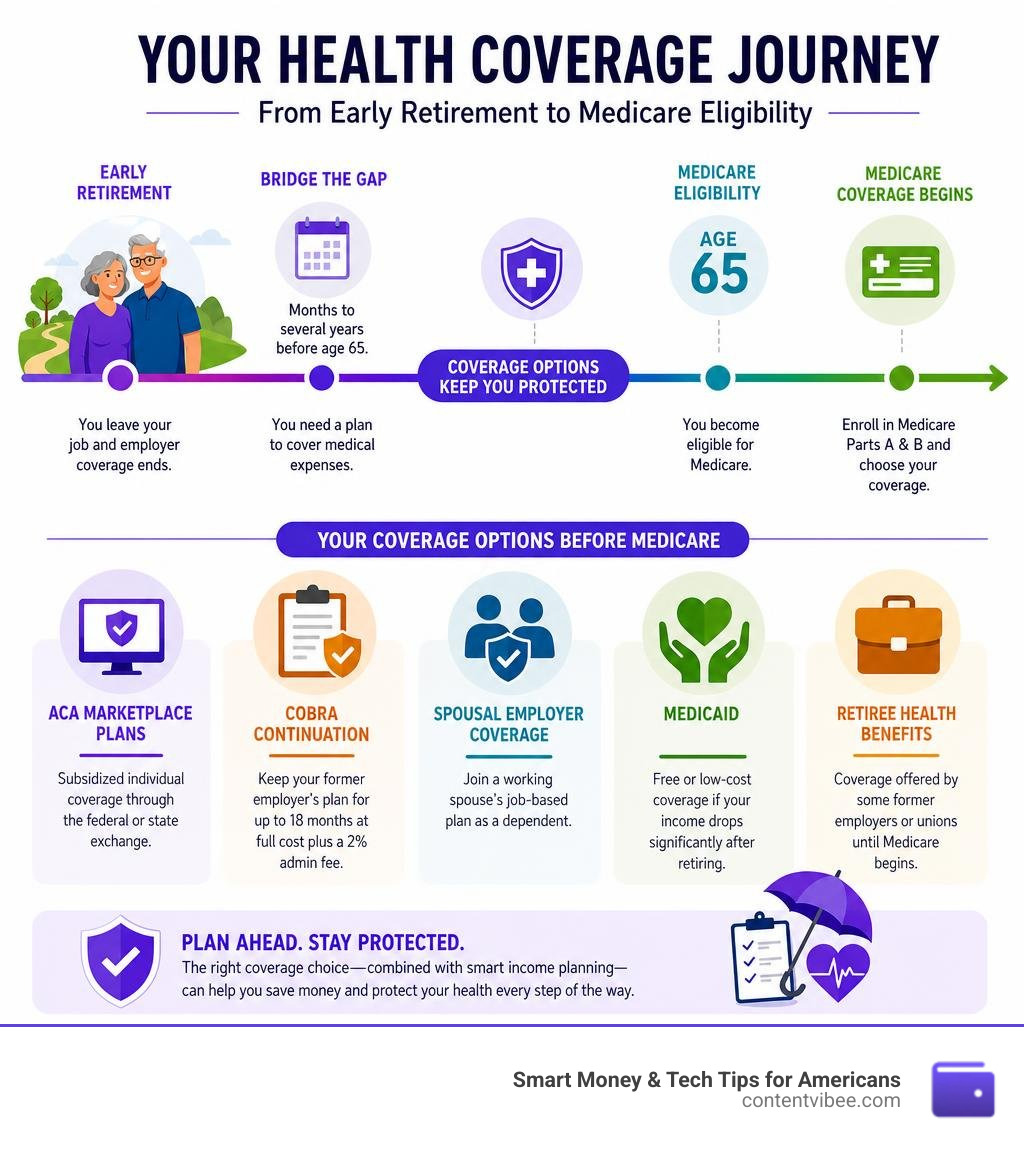
Retirement health insurance options for early retirees — those leaving work before age 65 — fall into five main categories:
- ACA Marketplace plans — subsidized individual coverage through the federal or state exchange
- COBRA continuation — keeps your former employer’s plan for up to 18 months at full cost plus a 2% admin fee
- Spousal employer coverage — join a working spouse’s job-based plan as a dependent
- Medicaid — free or low-cost coverage if your income drops significantly after retiring
- Retiree health benefits — coverage offered by some former employers or unions until Medicare begins
Picture this: you and your spouse have finally decided to retire early. The savings are there. The plan looks solid. Then the first private health insurance quote lands in your inbox — and everything stops.
That moment is more common than most people expect. The gap between your last day of work and the day Medicare coverage begins at age 65 can last anywhere from a few months to several years. During that window, you are entirely responsible for your own health coverage.
This is not a small problem. According to the 2025 Milliman Retiree Health Cost Index, retiring at age 60 instead of 65 can increase your lifetime healthcare costs by 56% to 90%, depending on which coverage path you choose. A healthy 65-year-old couple already needs to save between $174,000 and $388,000 just to cover healthcare in retirement — and that number climbs sharply when you add bridge years before Medicare.
The good news? The right coverage choice — combined with smart income planning — can cut those costs dramatically. This guide walks you through every option, what each one costs, and how to avoid the penalties that can follow you permanently into Medicare.
Simple retirement health insurance options glossary:
- best jobs after retirement
- can you collect a pension and still work full-time
- retirement bridge jobs examples
The Pre-Medicare Gap: Why Early Retirement Health Insurance Options Matter
When we talk about the “pre-Medicare gap,” we are referring to those years when you are no longer employed but are not yet 65. Because healthcare inflation consistently outpaces general inflation, this gap can become a financial black hole if you do not plan for it.
According to the 2025 Milliman Retiree Health Cost Index, a healthy 65-year-old couple retiring today can expect to spend hundreds of thousands of dollars on healthcare over their remaining lifetimes. If you retire at age 60 instead of 65, those lifetime expenses spike dramatically. You are not just adding five years of premiums; you are paying for those five years at the highest commercial rates of your life, without employer subsidies, before transitioning to Medicare.
This cost curve is why understanding when you can realistically afford to stop working is so critical. If you are a California resident, for instance, you have to weigh state-specific tax rates and cost-of-living adjustments alongside your health coverage. For a deeper dive into this timeline, check out our guide on When Can You Stop Working and Retire in California?.
Comparing Your Early Retirement Health Insurance Options
To help you visualize how these pathways stack up, we have broken down the primary pre-65 health insurance options by cost, out-of-pocket exposure, and network flexibility:
| Option | Monthly Premium Costs | Out-of-Pocket Exposure | Network Flexibility | Best For |
|---|---|---|---|---|
| ACA Marketplace | High (but low if subsidized) | Moderate to High | Moderate (mostly HMOs/PPOs) | Early retirees with controllable income |
| COBRA Continuation | Very High (102% of full cost) | Low to Moderate (same as job) | High (retains your active network) | Retirees with ongoing medical treatments |
| Spousal Coverage | Low to Moderate | Low to Moderate | Dependent on spouse’s plan | Couples with one spouse still working |
| Medicaid | $0 or extremely low | Extremely Low | Low (limited provider acceptance) | Retirees with very low taxable income |
| Private Insurance | Very High | High | High | High-income retirees ineligible for subsidies |
How to Choose the Best Retirement Health Insurance Options for Couples
If you and your spouse have an age difference, your retirement health planning becomes a game of musical chairs. Because Medicare eligibility is strictly individual—there are no “family” Medicare plans—one spouse will inevitably reach age 65 and transition to Medicare while the younger spouse is left behind in the pre-Medicare gap.
When the older spouse transitions, any family plan you had through an employer or COBRA will change. The younger spouse must secure individual coverage, which can trigger a sharp rise in premium costs.
To prepare, you need to calculate your true healthcare budget as a couple. If you are trying to estimate these expenses, our breakdown on How Much Does Health Insurance Actually Cost in California? offers a realistic look at premium structures and real-world costs.
Five Early Retirement Health Insurance Options Before Age 65

Navigating the transition to early retirement means choosing a bridge to carry you safely to 65. Let’s look closer at the five primary paths outlined in 8 health insurance options for early retirees | Empower .
ACA Marketplace Plans and Covered California
The Affordable Care Act (ACA) public marketplace is often the most flexible and affordable option for early retirees. Plans are organized into tiers (Bronze, Silver, Gold, Platinum) based on how you and the insurer split costs.
If you lose your job-based insurance when you retire, you do not have to wait for the standard Open Enrollment Period (which runs from November 1 to January 15). Losing your coverage qualifies you for a Special Enrollment Period (SEP), allowing you to sign up immediately.
For Californians, this marketplace is run through Covered California. Shopping the exchange can be complex, so we recommend reading The Ultimate Guide to Shopping for Health Insurance in California to understand how to select a plan. Additionally, you can get a sense of what your monthly costs might look like by visiting our page on the Covered California Estimated Cost.
COBRA Continuation and the Retroactive COBRA Strategy
Under the Consolidated Omnibus Budget Reconciliation Act (COBRA), you can keep your employer’s group health insurance plan for up to 18 months after leaving your job. The catch? You must pay the entire premium yourself, plus a 2% administrative fee. This means you are paying 102% of the plan’s actual cost, which is often shockingly expensive.
However, there is a legal, strategic maneuver known as the “Retroactive COBRA” trick that can save you thousands if you only have a short gap (under 60 days) between retirement and another coverage source.
When you leave your job, you have a 60-day window to elect COBRA coverage. If you do not sign up and remain healthy, you pay nothing. If you experience a medical emergency on day 45, you can elect COBRA, pay the premium retroactively to your retirement date, and have your medical bills covered. This strategy provides a cost-free safety net for short transition windows, as detailed in Bridging the Medicare Gap: Affordable Health Insurance Strategies for Early Retirees in 2026 | NTD .
Medicaid and Mental Health Coverage
If your taxable income drops significantly after you stop working, you may qualify for Medicaid (known as Medi-Cal in California). Medicaid provides comprehensive coverage with little to no monthly premiums or out-of-pocket costs.
Unlike commercial plans that may limit therapy or counseling visits, Medicaid and ACA-compliant plans must provide robust mental health services. If mental health support is a priority for your retirement years, check out our analysis of the Best Health Insurance for Mental Health in California: Our Top Picks.
Managing Your Income to Maximize ACA Subsidies

If you choose the ACA Marketplace, your premium costs will depend almost entirely on your Modified Adjusted Gross Income (MAGI).
Under the Inflation Reduction Act of 2022, enhanced premium tax credits lowered healthcare costs for millions of Americans. However, those temporary provisions expire at the end of 2025. As we move through 2026, the strict 400% Federal Poverty Level (FPL) subsidy cliff is back.
If your MAGI is even one dollar over the 400% FPL threshold (approximately $62,600 for an individual or $84,600 for a couple in 2026), your premium subsidies vanish entirely. This can cause your monthly premiums to skyrocket from a few hundred dollars to over $1,500.
Managing your income in early retirement is not just a tax strategy; it is a healthcare strategy. To keep your MAGI below the 400% FPL cliff, consider these moves:
- Live off cash savings: Spending down non-taxable cash reserves does not generate taxable income.
- Pull from Roth IRAs: Withdrawals from a Roth IRA are tax-free and do not count toward your MAGI.
- Harvest capital losses: Offset taxable investment gains by selling underperforming assets.
- Utilize your HSA: Spending money from a Health Savings Account (HSA) on qualified medical expenses keeps your taxable withdrawals low.
Transitioning to Medicare: Timelines, Deadlines, and Penalties
When you finally approach age 65, the transition from early retirement coverage to Medicare requires strict attention to detail. The rules are rigid, and the penalties for missing deadlines are permanent.
Your primary window is the Initial Enrollment Period (IEP). This is a strict 7-month window centered on your 65th birthday:
- 3 months before the month you turn 65
- The month of your birthday
- 3 months after the month you turn 65
For a step-by-step breakdown of how to prepare for this milestone, read the guide on Your bridge to Medicare – Fidelity Investments .
If you miss this window and do not have “creditable” coverage from an active employer (COBRA and retiree health plans do not count as active employer coverage), you face severe penalties:
- Part B Late Enrollment Penalty: Your Part B premium (standard rate of $185/month in 2026) will increase by 10% for every 12-month period you were eligible but did not enroll. This penalty is permanent and lasts for the rest of your life.
- Part D Late Enrollment Penalty: A permanent penalty of 1% of the national base beneficiary premium per month is added to your premium if you go 63 days or more without creditable drug coverage.
Additionally, high-income retirees must watch out for the Income-Related Monthly Adjustment Amount (IRMAA). IRMAA adds a hefty surcharge to your Part B and Part D premiums based on your income from a two-year lookback period. Your 2026 Medicare premiums are determined by your 2024 tax return. If you did large Roth conversions or sold a house in 2024, you might face unexpected surcharges in 2026. For a look at how these tax adjustments interact with retirement income, review The Golden State Guide: Deciphering CalPERS COLA and California Tax Adjustments.
Coordinating Retiree Employer Benefits with Medicare
If you are fortunate enough to have retiree health coverage from a former employer or union, you must understand how it interacts with Medicare.
In almost all cases, once you turn 65, Medicare becomes your primary payer, and your retiree coverage transitions to the secondary payer. If you fail to enroll in Medicare Part A and Part B on time, your retiree plan may refuse to pay its share of your medical claims, leaving you with massive out-of-pocket bills.
Make sure to verify if your retiree drug plan is considered “creditable coverage” by Medicare standards. If you are eligible for programs like the Health Options Program for PSERS retirees, you may also qualify for Premium Assistance (up to $100/month), which can save you $24,000 or more over your lifetime. For details on coordination, refer to the LargeSize 2026 Medicare-Eligible Enrollment Guide for the Health Options Program .
Medigap vs. Medicare Advantage Plans
Once enrolled in Original Medicare (Parts A and B), you have a choice in how you receive your benefits:
- Original Medicare + Medigap (Medicare Supplement) + Part D Plan: Medigap policies are sold by private insurers to cover the deductibles and coinsurance that Original Medicare leaves behind. This pathway offers maximum freedom, allowing you to see any doctor in the country who accepts Medicare, with highly predictable monthly costs.
- Medicare Advantage (Part C): These plans bundle medical, hospital, and often prescription drug coverage into a single private insurance network (HMO or PPO). They often feature low or $0 monthly premiums, but you must stay within a local network of doctors and obtain prior authorizations for care.
If you choose a stand-alone Part D prescription drug plan or a Medicare Advantage plan, keep the 2026 limits in mind:
- The maximum deductible for stand-alone Part D plans is $615 in 2026.
- Beginning January 2026, the annual maximum out-of-pocket threshold for all Part D plans is capped at $2,100.
Frequently Asked Questions About Pre-Medicare Coverage
Planning your transition to Medicare often brings up specific, technical questions about tax rules and coverage overlaps.
Can I use my HSA to pay for health insurance premiums in early retirement?
Generally, no. You cannot use tax-free HSA distributions to pay for standard health insurance premiums. However, there are three major exceptions. You can use your HSA to pay for:
- COBRA continuation premiums
- Health coverage premiums while receiving federal or state unemployment benefits
- Medicare premiums (Parts B and D) once you turn 65 (though not Medigap premiums)
What happens to my ACA marketplace plan when I turn 65?
Once you become eligible for Medicare at age 65, you must transition off your ACA marketplace plan. Your eligibility for premium tax credits/subsidies on the marketplace ends the month you turn 65, even if you choose not to enroll in Medicare. To avoid a gap in coverage or paying double premiums, you should coordinate the termination of your ACA plan with the start of your Medicare coverage, as detailed on Health Care Coverage for Retirees | HealthCare.gov .
How does working in retirement affect my health insurance and Social Security?
If you choose to take a part-time “bridge job” in retirement, you might secure affordable health insurance directly through your new employer. However, if you are under your Full Retirement Age (FRA) and collecting Social Security benefits, you must watch the earnings test limits. Earning too much can temporarily reduce your Social Security payments. To understand how these rules interact, read our guide on working in retirement and spousal benefits.
Conclusion
Securing the right retirement health insurance options requires careful planning, but it is one of the most important steps you can take to protect your nest egg. By managing your income to qualify for ACA subsidies, timing your transition to Medicare, and choosing the right supplemental coverage, you can retire early without sacrificing your financial security.
At ContentVibee, we specialize in providing clear, actionable advice to help you navigate these complex transitions. Learn more about working in retirement and spousal benefits to keep your financial plan on track.