
Why Every Working American Needs a Retirement Calculator Right Now
A retirement calculator is a tool that estimates how much money you’ll have saved by the time you stop working — and whether that amount will actually be enough to live on.
Here’s the quick answer most people are looking for:
| What You Want to Know | Quick Rule of Thumb |
|---|---|
| How much do I need to retire? | Multiply your desired annual income by 25 |
| What’s a safe yearly withdrawal? | 4% of your total nest egg |
| How much should I save each year? | 10-15% of your pre-tax income |
| How much will Social Security cover? | About 40% of your pre-retirement income |
| What return rate should I assume? | 6-7% before retirement, 4-5% after |
Those numbers are starting points. Your real number depends on your age, income, savings, and the retirement lifestyle you’re planning for.
Here’s why this matters right now: the gap between what most people save and what they actually need is enormous. Consider this — a 35-year-old earning $60,000 a year, with $30,000 already saved and contributing $500 a month, is on track to accumulate around $879,000 by age 67. But maintaining 70% of that income through retirement could require closer to $1.7 million. That’s nearly a $900,000 gap.
And if you’re earning more — say $120,000 a year — that same savings pace still produces about $879,000, while the target climbs to $3.4 million.
Social Security helps, but it was never designed to carry the full load. It replaces roughly 40% of the average worker’s pre-retirement income. The rest has to come from you.
The good news? A retirement calculator makes it easy to see exactly where you stand — and what small changes today can do for your future.
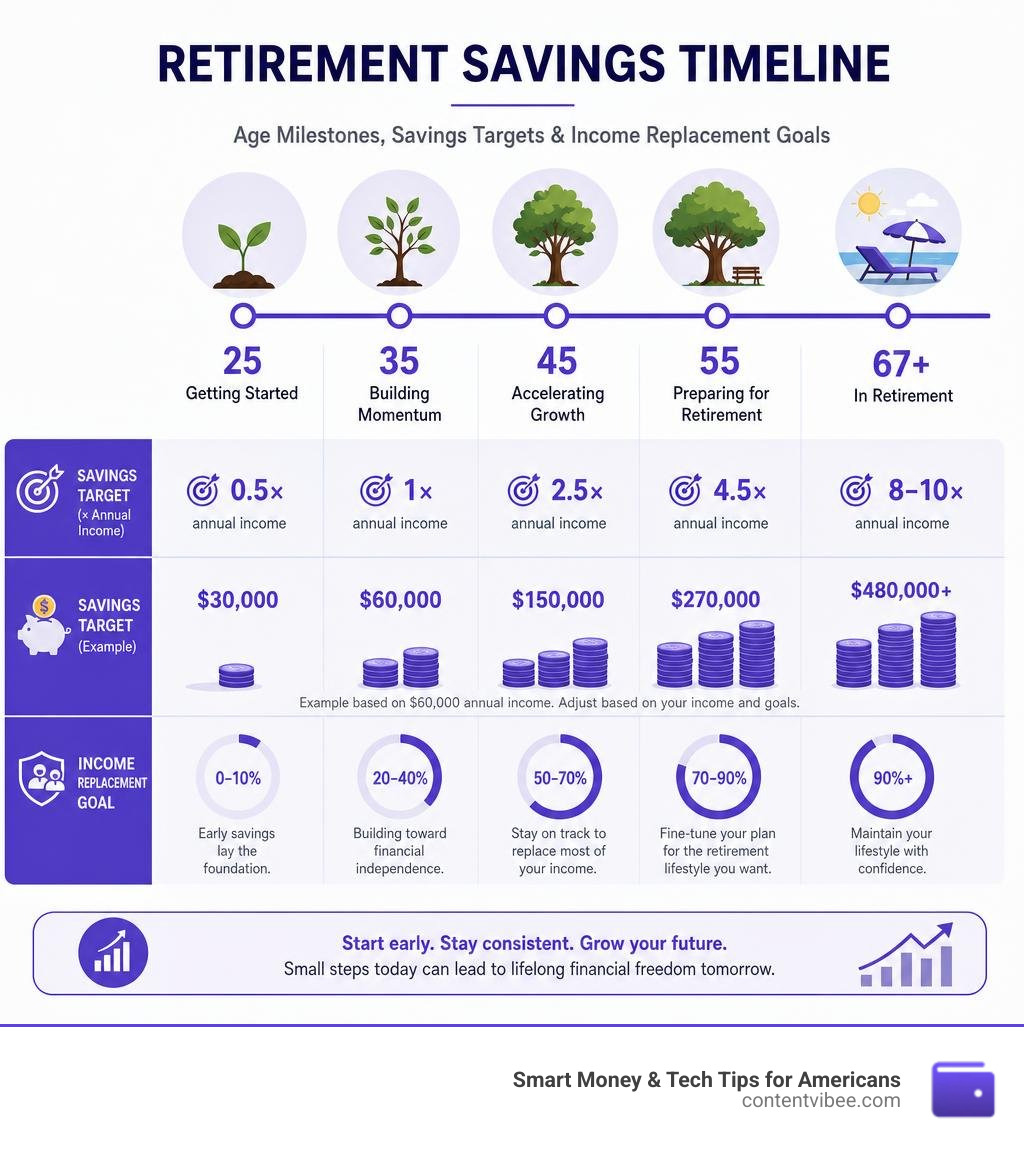
How Use a Retirement Calculator to Estimate Your Savings
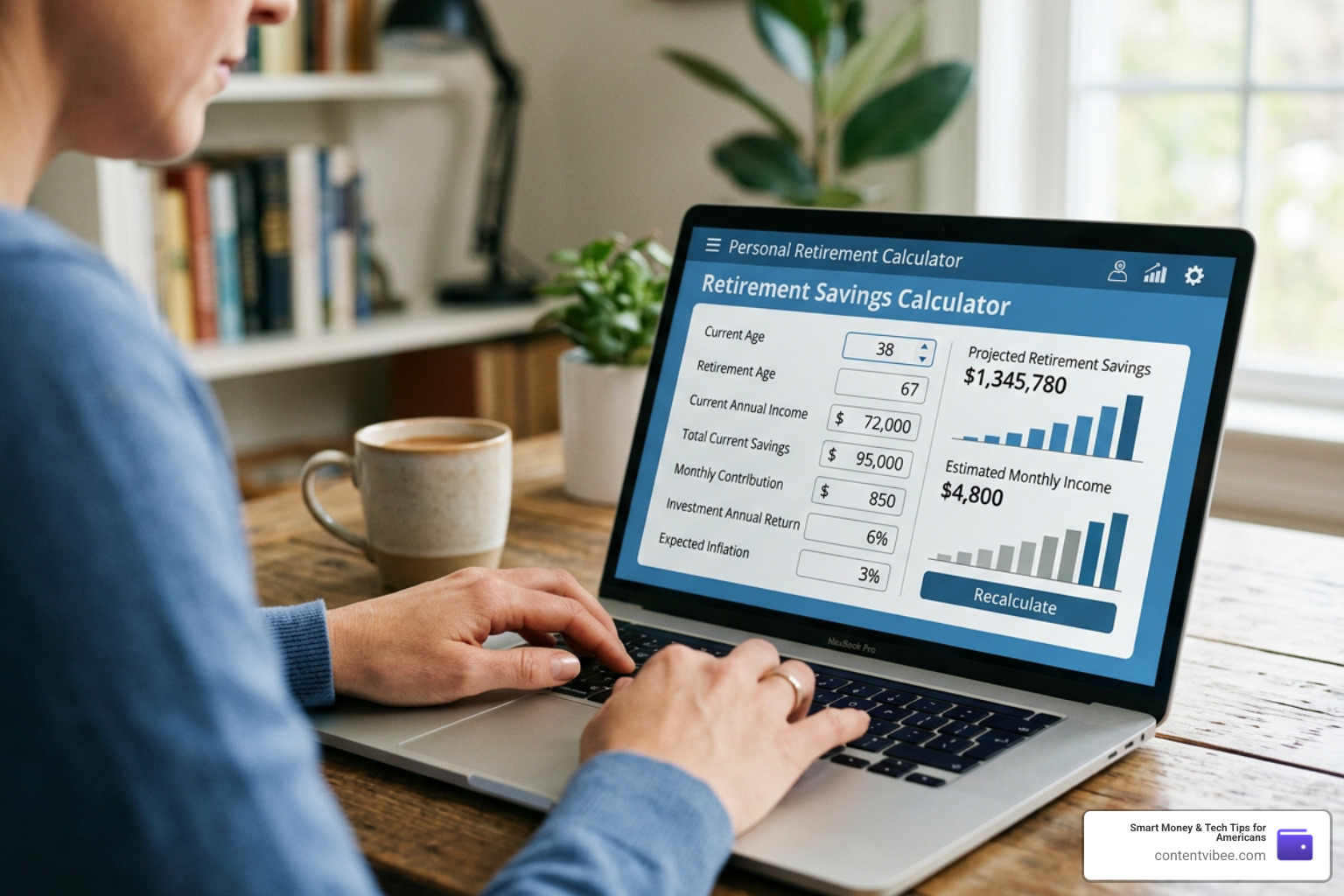
When you first sit down to map out your financial future, the numbers can feel overwhelming. It is easy to look at a multi-million-dollar target and feel like giving up before you even start. But the secret to successful retirement planning is breaking down those massive targets into bite-sized, daily habits. An interactive retirement calculator is the ultimate tool to help you bridge that gap.
By inputting a few simple details about your current financial life, you can instantly see where you are on the path to financial freedom. This tool helps you measure your retirement readiness — which is simply a way of asking, “Will my current savings rate allow me to maintain my lifestyle when I stop working?”
If you are ready to find your personal number, you can start by using our Retirement Calculator Estimate Savings Needed to get an instant snapshot of your financial trajectory.
Key Inputs for Your Retirement Calculator Projections
To get the most accurate projection possible, you need to understand the data points that drive the math. If you put inaccurate or overly optimistic numbers into a calculator, you will get a distorted picture of your readiness.
Here are the essential inputs you will need to gather:
- Current Age and Target Retirement Age: Your current age determines your compounding timeline. The younger you start, the more time your money has to grow. Your target retirement age defines when you plan to stop contributing and start withdrawing. For most Americans born in 1960 or later, the Social Security Administration defines Full Retirement Age (FRA) as 67.
- Life Expectancy: While no one has a crystal ball, it is financially safer to plan for a long life. The average American man reaching age 65 can expect to live to about 82, and the average woman to about 85. However, we highly recommend setting your life expectancy to 90 or 95 in your projections. It is much better to die with money left over than to run out of cash at age 86.
- Current Savings and Monthly Contributions: This includes the balances of all your retirement accounts: 401(k)s, IRAs, Roth accounts, and taxable brokerage accounts. Your monthly contribution is the total amount you (and your employer, via matching programs) add to these accounts each month.
- Salary Growth Rate: Over your career, your income will likely rise due to promotions and cost-of-living adjustments. Most comprehensive calculators use a default salary growth rate of 2% per year to keep your savings rate scaling with your earnings.
If you are looking for a simple way to run these numbers and test different scenarios, check out our Tools/Finance Calculator/ to play with different contribution rates and timelines.
Understanding the Math Behind a Retirement Calculator
The magic engine driving every retirement projection is compound interest — which is simply earning interest on your interest. When you invest, your money earns a rate of return. The next year, you earn returns on both your original investment and the returns from the year before. Over decades, this compounding effect turns modest monthly contributions into a massive nest egg.
For example, if you save $5,000 annually starting at age 30 and earn a 5% average annual return, you will accumulate approximately $634,200 by age 70. If you wait until age 50 to start saving that same $5,000 a year, you will only have about $173,600 by age 70. Starting 20 years earlier yields a portfolio that is nearly four times larger, even though you only contributed twice as much money!
To make these calculations realistic, we have to look at two distinct phases of returns:
- Pre-Retirement Rate of Return: This is the growth rate you expect while you are working and accumulating wealth. Historically, the U.S. stock market (S&P 500) has returned about 10% annually on average since 1957, or roughly 7% after adjusting for inflation. For a balanced, stock-heavy portfolio, a conservative pre-retirement return assumption of 6% to 8% is standard.
- Post-Retirement Rate of Return: Once you retire, you will want to protect your nest egg from market crashes. This means shifting some of your money into safer, lower-yielding assets like bonds and cash. Because of this conservative allocation, your post-retirement return assumption should be lower—usually between 4% and 5%.
To see how these shifting growth rates impact your long-term balance, you can experiment with our guide on Retirement Math Made Easy With A 401K Balance Calculator.
Comparing Different Types of Online Calculators
Not all retirement calculators are created equal. Some are simple three-question forms that give you a generic, single-number estimate. Others are highly sophisticated engines that model your taxes, account types, and Social Security benefits year-by-year.
| Feature | Simple Calculators | Comprehensive Calculators |
|---|---|---|
| Inputs Required | 3 to 5 basic questions | Detailed account balances, tax rates, and income sources |
| Default Assumptions | Flat, unchangeable return and inflation rates | Fully customizable growth, inflation, and life expectancy inputs |
| Tax Modeling | Treats all savings as a single, tax-free bucket | Models progressive federal brackets, capital gains, and RMDs |
| Best For | Quick, high-level sanity checks | Detailed, year-by-year cash flow and withdrawal planning |
Many basic tools on the internet use aggressive default assumptions that can lead to a false sense of security. For instance, some assume a permanent 10% return without factoring in inflation or fees, which can wildly overstate your future purchasing power.
We recommend starting with a well-respected tool like the Retirement Calculator – NerdWallet to get a solid grasp of your baseline numbers. For those looking for clean, educational layouts that focus on portfolio income, the Retirement Income Calculator – Vanguard is another excellent resource for visualizing how your assets convert into monthly retirement pay.
Core Rules of Thumb for Retirement Savings

When you are trying to figure out how much to save, financial planners often point to a few tried-and-true rules of thumb. While these guidelines are not personalized laws, they provide excellent benchmarks to help you gauge whether your nest egg is on track.
To dive deeper into how these withdrawal rules work in practice, read our breakdown on Demystifying The 4 Percent Retirement Withdrawal Calculator.
The 4% Safe Withdrawal Rule
The 4% rule is the gold standard for determining how much you can safely take out of your portfolio each year without running out of money. This rule originated from groundbreaking 1994 research by financial planner William Bengen, later supported by the famous “Trinity Study.”
Bengen analyzed historical market data through various economic cycles, including the Great Depression and the stagflation of the 1970s. He found that a retiree could withdraw 4% of their balanced portfolio (usually 50% to 60% equities, with the rest in bonds) in the first year of retirement, adjust that dollar amount for inflation every year after, and have a near-100% chance of their money lasting at least 30 years.
For example, if you have a $1 million nest egg, the 4% rule says you can safely withdraw $40,000 in your first year. If inflation is 3% that year, you would withdraw $41,200 the second year, and so on. This rule is designed to protect your portfolio against market volatility and sequence of returns risk—the danger of a market crash occurring right after you stop working.
The 70-80% Income Replacement Guideline
Another common benchmark is the income replacement guideline, which suggests you will need roughly 70% to 80% of your pre-retirement annual income to maintain your lifestyle after you stop working.
The logic is simple: once you retire, certain working-class expenses naturally disappear. You will no longer need to save for retirement, your payroll taxes (Social Security and Medicare) will drop, your daily commute costs will vanish, and ideally, your mortgage will be paid off.
However, be careful of lifestyle creep. If you plan to spend your golden years traveling the world, buying a second home, or pursuing expensive hobbies, your core expenses might actually equal or exceed your pre-retirement budget.
The 25x Annual Expenses Target
If you want to know your ultimate “financial independence” number, you can reverse-engineer the 4% rule. To do this, simply multiply your expected annual retirement expenses by 25.
If you estimate that you need $60,000 per year to live comfortably (after accounting for guaranteed income like Social Security), your target portfolio size is:
$$\$60,000 \times 25 = \$1,500,000$$
This 25x multiplier is highly popular in the FIRE (Financial Independence, Retire Early) movement because it gives savers a clear, tangible goal to aim for.
Factoring in Inflation, Taxes, and Investment Returns
One of the biggest mistakes people make when using a retirement calculator is ignoring the silent wealth-killers: inflation and taxes.
- The Erosion of Purchasing Power: Inflation is the steady rise of prices over time. Historically, U.S. inflation has averaged around 2.5% to 3% per year. While 3% sounds small, it has a massive cumulative effect. At a stable 2.5% inflation rate, your money loses half of its purchasing power every 28 years. This means a $4,000 monthly budget today will require roughly $8,400 a month in 30 years just to buy the exact same goods and services.
- The Impact of Progressive Tax Brackets: Unless your money is entirely in Roth accounts, Uncle Sam is going to take a cut of your retirement income. Withdrawals from traditional 401(k)s and IRAs are taxed as ordinary income. In retirement, your withdrawals will be subject to progressive federal tax brackets. If you fail to account for taxes, you might find that your $80,000 annual retirement budget is actually only $65,000 after federal and state income taxes are deducted.
- Tax-Advantaged Accounts vs. Taxable Brokerage: Where you save matters just as much as how much you save. Maximizing tax-advantaged accounts like 401(k)s and IRAs allows your money to grow tax-free or tax-deferred.
To make sure you are squeezing every drop of value out of your employer’s plan, check out Dont Leave Money On The Table The Ultimate 401K Max Calculator Guide for tips on optimizing your retirement contributions.
Integrating Social Security and Other Income Sources
Your retirement portfolio does not have to do all the heavy lifting on its own. Most Americans will have access to guaranteed income sources that significantly lower the amount they need to save in their personal accounts.
To see how these pieces fit together for your household, read our guide on the Best Free Social Security Calculator Options Your No Cost Retirement Roadmap.
Estimating Your Social Security Benefits
Social Security is a vital safety net, designed to replace about 40% of the average worker’s pre-retirement income. The age at which you choose to claim your benefits has a massive impact on your monthly check:
- Early Claiming (Age 62): You can claim as early as 62, but your monthly benefit will be permanently reduced by up to 30% compared to your Full Retirement Age benefit.
- Full Retirement Age (Age 67): Claiming at 67 secures 100% of your calculated benefit.
- Delayed Claiming (Age 70): For every year you delay claiming past your FRA up to age 70, your benefit increases by roughly 8% per year. Waiting from age 62 to 70 can increase your monthly benefit by about 77% permanently!
To get a rough estimate of your future monthly check, you can use the official Social Security Quick Calculator, which estimates benefits based on your current earnings. For a more detailed projection that allows you to enter your actual earnings history, check out the Benefits Planner: Retirement | Online Benefits Calculator | SSA.
Deciding when to claim is a highly personal choice based on your health, family longevity, and other savings. We break down this complex decision in Timing Is Everything The Best Age To Take Social Security Calculator Guide.
Factoring in Pensions and Passive Income
If you are fortunate enough to have a defined benefit pension plan (common among government employees, teachers, and military members), this guaranteed income further reduces your portfolio needs.
Other passive income streams, such as rental income from real estate or consistent side hustles, can also act as reliable income sources. For married couples, coordinating these benefits is crucial to maximizing your lifetime household income. You can learn how to model these combined benefits with our guide: Do The Math Top Social Security Calculators For Married Couples.
Frequently Asked Questions about Retirement Planning
How reliable are online retirement calculators?
While online calculators are incredible educational tools, they have distinct limitations. They are only as good as the assumptions you feed them. They cannot predict future tax law changes, healthcare inflation, or market unpredictability.
Specifically, most calculators fail to model sequence of returns risk. If the stock market crashes during the first three years of your retirement, your portfolio may never recover, even if the long-term historical average return is positive.
To build a truly reliable estimate of your benefits, take a look at our guide: Estimate Your Monthly Retirement Benefits In 5 Easy Steps.
What should I do if my retirement projection shows a shortfall?
If your calculator reveals a retirement shortfall, don’t panic. You have several highly effective levers you can pull to get back on track:
- Increase Your Savings Rate: Even finding an extra $50 or $100 a month to invest can make a massive difference over 15 to 20 years due to compounding.
- Work Slightly Longer: Delaying retirement by just two or three years gives your portfolio more time to grow, reduces the number of years you need to fund, and increases your Social Security benefit.
- Optimize Your Budget: Look for areas to cut discretionary spending today, or plan to downsize your home in retirement to lower your core living expenses.
What is the best withdrawal strategy for retirement accounts?
To minimize your lifetime tax bill, you should follow a strategic withdrawal sequencing plan. A common tax-efficient strategy is to withdraw money in this order:
- Required Minimum Distributions (RMDs): Take these first from traditional accounts once you reach age 73 or 75 (depending on your birth year) to avoid heavy IRS penalties.
- Taxable Brokerage Accounts: Withdraw from these next, taking advantage of lower long-term capital gains tax rates.
- Traditional IRAs and 401(k)s: Use these to fill up the lower income tax brackets.
- Roth IRAs and Roth 401(k)s: Save these for last. Since Roth withdrawals are 100% tax-free, keeping this money compounding as long as possible provides maximum tax-free growth and serves as an excellent estate planning tool.
Conclusion
At ContentVibee, we believe that building a secure retirement does not require a degree in finance. It simply requires the right tools, clear information, and the willingness to take action. A retirement calculator is your financial roadmap, turning vague dreams of retirement into a concrete, step-by-step plan.
Don’t leave your financial future to chance. Take the first step today by visiting our Retirement Calculator Estimate Savings Needed to run your numbers, find your targets, and start building the comfortable, stress-free retirement you deserve.