


Why Knowing Your Full Retirement Age Could Be Worth Thousands of Dollars
What is full retirement age? It’s the age at which you qualify for 100% of your Social Security retirement benefit — no reductions, no penalties.
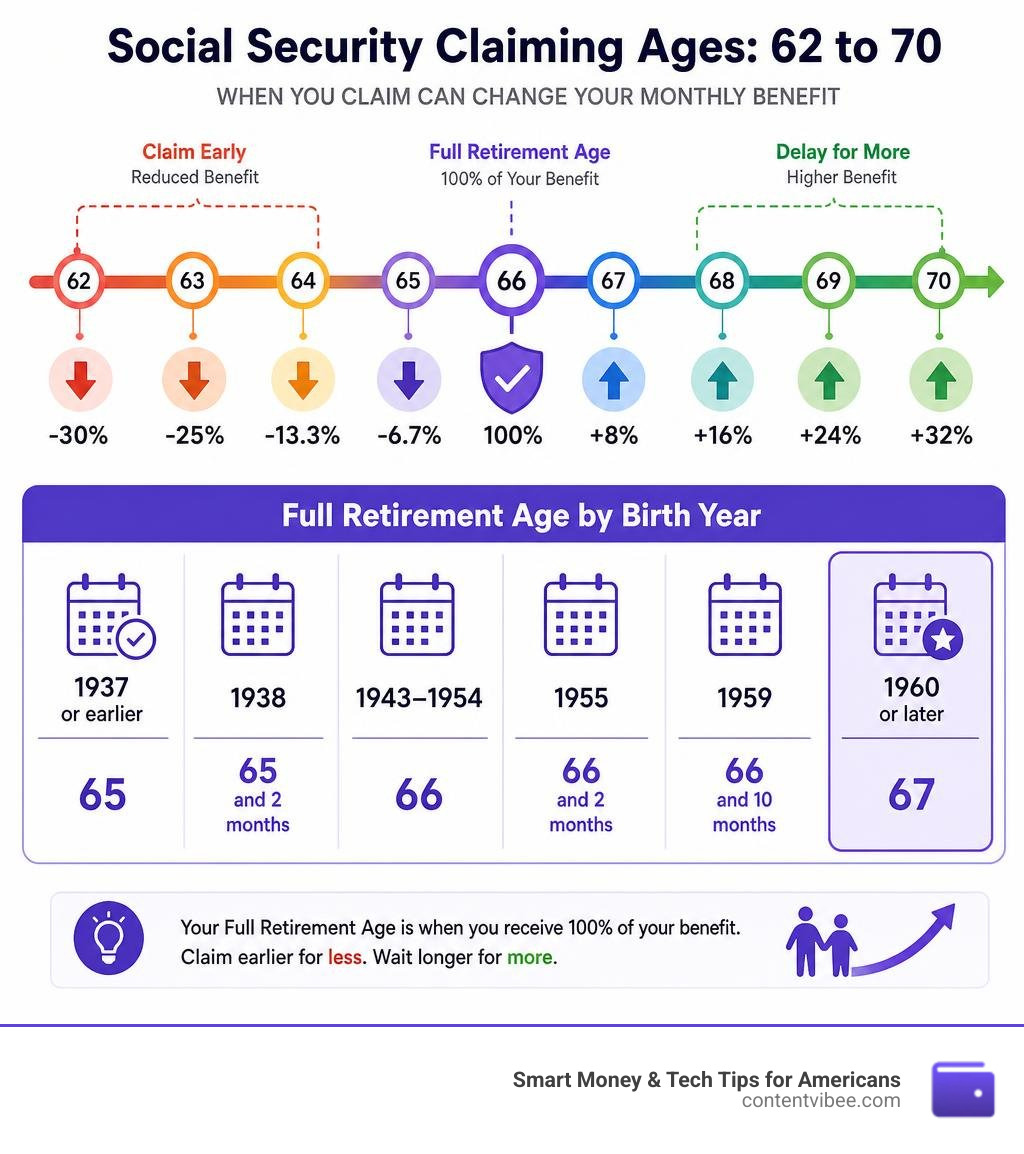
Here’s a quick answer based on your birth year:
| Birth Year | Full Retirement Age |
|---|---|
| 1937 or earlier | 65 |
| 1938 | 65 and 2 months |
| 1943–1954 | 66 |
| 1955 | 66 and 2 months |
| 1959 | 66 and 10 months |
| 1960 or later | 67 |
If you were born in 1960 or later — which includes anyone turning 62 in 2026 — your full retirement age is 67.
Claim at 62 instead, and your monthly benefit drops by 30%. Permanently. That could mean the difference between $1,000 and $700 every single month for the rest of your life.
And if you wait past your full retirement age? Your benefit grows by up to 8% per year until age 70 — turning that same $1,000 into roughly $1,360 a month.
For working spouses trying to time spousal benefits, coordinate with a partner’s claim, or avoid the earnings test, getting this number right matters even more.
What Is Full Retirement Age and Why Does It Matter?
To understand how your retirement benefit is calculated, we have to look at the baseline established by the Social Security Administration (SSA). That baseline is your Primary Insurance Amount (PIA).
Your PIA is the exact monthly benefit you are entitled to receive if you claim at your exact full retirement age. Think of your FRA as the “zero point” on the Social Security scale. If you claim earlier than this point, the SSA applies a permanent reduction to your monthly check. If you claim later, they reward you with delayed retirement credits.
But where did this magical number come from? Originally, when the Social Security Act was signed into law, the retirement age was set at a flat 65. However, as medical technology improved and lifespans increased, Congress realized the system needed to adapt. In the 1983 Social Security Amendments, lawmakers passed legislation to gradually raise the retirement age from 65 to 67. The reasoning was simple: Americans are living longer, healthier lives, and the system needed to maintain financial stability.
If you want to dig deeper into the official definitions, you can check out the Official SSA FAQ on Full Retirement Age. For a breakdown of how your work history translates into that baseline monthly check without getting bogged down in government jargon, read our guide on the Social Security Primary Insurance Amount Explained Without the Mind-Numbing Math.
Understanding what is full retirement age is the key to unlocking your entire retirement timeline. Without this anchor point, it is impossible to calculate how much you will actually receive.
How Your Birth Year Determines Your Full Retirement Age
Your personal full retirement age isn’t a matter of opinion or lifestyle; it is legally determined by the exact year you were born. The transition from age 65 to age 67 was designed as a gradual staircase, increasing by two months for every birth year starting with those born in 1938, holding steady for a stretch, and then stepping up again.
Under the law, specifically outlined in Code of Federal Regulations § 404.409 and 20 CFR § 404.409, the age increases incrementally. Here is the complete, official breakdown of how birth years correspond to your full retirement age:
| Year of Birth | Full Retirement Age |
|---|---|
| 1937 or earlier | 65 |
| 1938 | 65 and 2 months |
| 1939 | 65 and 4 months |
| 1940 | 65 and 6 months |
| 1941 | 65 and 8 months |
| 1942 | 65 and 10 months |
| 1943–1954 | 66 |
| 1955 | 66 and 2 months |
| 1956 | 66 and 4 months |
| 1957 | 66 and 6 months |
| 1958 | 66 and 8 months |
| 1959 | 66 and 10 months |
| 1960 or later | 67 |
The “Age Attainment” Quirks
There are a couple of fascinating legal rules that might shift your retirement timeline by a month.
First, the Age Attainment Rule: Under federal law, you legally attain a given age the day before your birthday. For example, if your birthday is on October 15th, you legally turn that age on October 14th.
This rule creates a unique edge case for January 1st births. If you were born on January 1, 1960, the SSA legally considers you to have reached age 62 (or age 67) on December 31, 2025. Because your age attainment falls in the previous year, you use the retirement guidelines for the previous birth year (1959). Therefore, your full retirement age is actually 66 and 10 months, not 67!
Additionally, there are special rules for widows and widowers. For survivor benefits, the FRA timeline is calculated slightly differently, often allowing survivors to reach their unreduced survivor benefit age up to two years earlier than their standard retirement age.
To double-check your specific birthdate and see how the government views your timeline, you can See your Full Retirement Age (FRA) on SSA.gov or read our detailed strategy guide, The Definitive Guide to Social Security Claiming Age.
Claiming Early vs. Delaying Past Your Full Retirement Age
Deciding when to pull the trigger on Social Security is one of the most critical financial decisions you will ever make. The system is designed to be actuarially neutral—meaning if you live to average life expectancy, you should receive roughly the same lifetime amount whether you claim early or late. However, very few of us are perfectly “average,” and your monthly cash flow will look dramatically different depending on your choice.

You can claim your retirement benefits as early as age 62, but doing so comes with a permanent cost. On the flip side, you can choose to delay your benefits past your FRA. For every month you delay, you earn delayed retirement credits. These credits increase your monthly benefit by 2/3 of 1% per month, which equals a whopping 8% simple interest per year.
These credits stop accumulating once you reach age 70. There is absolutely no financial benefit to waiting past age 70 to claim your benefits. If you delay past 70, you are simply leaving money on the table.
For a comprehensive analysis of how these timelines play out, check out the Schwab Guide on Taking Social Security: 62 vs. 67 vs. 70.
What is full retirement age reduction for early claimers?
If you decide to claim early, the SSA will permanently reduce your benefits. The mathematical formula for this reduction is strict:
- For the first 36 months before your FRA, your benefit is reduced by 5/9 of 1% for each month (about 6.67% per year).
- For any months beyond the first 36 months (such as claiming at 62 when your FRA is 67), your benefit is reduced by an additional 5/12 of 1% per month (5% per year).
For anyone born in 1960 or later, claiming at age 62 means you are claiming 60 months early.
- 36 months x 5/9 of 1% = 20% reduction
- 24 months x 5/12 of 1% = 10% reduction
- Total permanent reduction = 30%
This means if your PIA is $1,000 at age 67, claiming at 62 reduces your monthly check to just $700.
Spousal benefits are hit even harder. If you claim spousal benefits early, the maximum spousal benefit (which is 50% of your partner’s PIA at your FRA) is reduced by up to 35% if you claim at age 62.
To see the exact reduction tables and how they apply to your birth year, you can explore the SSA Guide on Retirement Age and Benefit Reduction. If you are trying to weigh the immediate cash vs. the long-term loss, check out our resource on the Best Age to Collect SS.
How to maximize your payout past what is full retirement age
For those who have the financial flexibility, waiting past your FRA is one of the safest ways to secure a guaranteed return on your money. No market investment guarantees an 8% annual return, but Social Security does.
Let’s look at the numbers for someone born in 1960 or later (FRA of 67):
- Delaying to age 68: 108% of your base benefit
- Delaying to age 69: 116% of your base benefit
- Delaying to age 70: 124% of your base benefit
If your base benefit (PIA) at age 67 is $1,000, waiting until age 70 boosts your monthly payment to $1,240 (plus any cost-of-living adjustments that occurred along the way!). If your FRA was 66, delaying to 70 yields a 32% increase, turning $1,000 into $1,320.
While delaying sounds like a no-brainer, it does require you to fund your life through other means in your late 60s. We break down the potential downsides and trade-offs of this strategy in our article, Patience is a Virtue but is it a Payoff: The Cons of Late Social Security Claiming. For a step-by-step roadmap on building a claiming strategy that maximizes your household’s total lifetime wealth, read The Ultimate Guide to Social Security Benefit Optimization.
Key Factors to Consider When Deciding When to Claim
Determining when to claim Social Security isn’t just about math; it’s about your life. Here are the core personal factors you must weigh before making your decision:
- Health History and Longevity: If you come from a family where people regularly live into their 90s and you are in excellent health, delaying benefits is almost always the winning mathematical play. Conversely, if you have chronic health issues, claiming earlier may ensure you actually get to enjoy the money you paid into the system.
- Immediate Cash Flow Needs: If you need the money to pay your mortgage or buy groceries today, claiming early is a necessity, not a choice.
- Tax Implications: Social Security benefits can be taxed depending on your “combined income.” If you have a large traditional 401(k) or IRA that will require large distributions, claiming Social Security early might push you into a higher tax bracket.
- Medicare Enrollment at Age 65: This is a critical point of confusion. Medicare eligibility remains fixed at age 65, regardless of your Social Security full retirement age. You must enroll in Medicare during your 7-month Initial Enrollment Period (which starts 3 months before you turn 65) even if you plan to delay your Social Security benefits until age 67 or 70. Failing to do so can result in permanent Medicare premium penalties.
- Spousal Coordination: If you are married, your decision affects your spouse. If you are the higher-earning spouse, delaying your benefit to age 70 guarantees a larger survivor benefit for your spouse if you pass away first.
To run different scenarios based on your actual earnings history, we highly recommend using the official SSA Retirement Age Calculator. To help put those calculator results into context, check out our guide, Timing is Everything: The Best Age to Take Social Security Calculator Guide.
Frequently Asked Questions About Full Retirement Age
What is the full retirement age for someone born in 1960 or later?
For anyone born in 1960 or later, your full retirement age is exactly 67. This is the maximum age currently set by law for standard, unreduced retirement benefits. To understand the underlying legal guidelines and definitions, you can reference the official Normal retirement age (NRA) rules.
Does Medicare eligibility align with my full retirement age?
No. Medicare eligibility is completely independent of your Social Security full retirement age. You qualify for Medicare at age 65.
If you are already receiving Social Security when you turn 65, you will be enrolled in Medicare Parts A and B automatically. If you are delaying Social Security, you must actively sign up for Medicare yourself when you turn 65 to avoid lifelong premium penalties.
Can I work and collect Social Security before reaching my full retirement age?
Yes, you can work and collect benefits, but if you are under your full retirement age, you are subject to the Social Security Earnings Test.
If you earn more than the annual limit set by the SSA, they will temporarily withhold a portion of your benefits:
- If you are under FRA for the entire year, the SSA deducts $1 from your benefits for every $2 you earn above the limit.
- In the year you reach your FRA, the SSA deducts $1 for every $3 you earn above a much higher limit, up to the month you actually reach FRA.
The good news? This money isn’t lost forever. Once you reach your exact full retirement age, the SSA recalculates your monthly benefit upward to account for the months they withheld benefits.
Conclusion
Navigating the complexities of Social Security can feel like trying to solve a puzzle in the dark. But once you understand what is full retirement age, the pieces begin to fall into place. Your FRA is the foundation of your entire retirement strategy, dictating whether you face lifetime benefit reductions or enjoy massive delayed retirement credits.
At ContentVibee, we believe in giving you clear, actionable advice to help you maximize your hard-earned benefits. There is no one-size-fits-all answer, but armed with the right data, you can build a personalized strategy that protects your financial security for the rest of your life.
Ready to see how the numbers stack up for your personal situation? Use our How Much Social Security Will I Get Calculator to estimate your future monthly checks and start planning your dream retirement today!