


Are Fidelity Options Trading Fees Worth It? Here’s What You Need to Know
Fidelity options trading fees are straightforward once you break them down. Here’s the quick answer:
| Fee Type | Cost |
|---|---|
| Online options trade commission | $0.00 per trade |
| Standard contract fee | $0.65 per contract |
| Buy-to-close (options priced $0.65 or less) | $0.00 |
| FAST automated phone trades | $12.95 + $0.65/contract |
| Representative-assisted trades | $32.95 + $0.65/contract |
| Professional trader surcharge | +$0.50 per contract |
| Index options (.SPX) surcharge | +$0.50 per contract |
| Maximum charge | 5% of principal |
So if you trade online, you pay nothing in commissions — just $0.65 per contract.
That’s the short version. But there’s more to the full picture.
Fidelity is one of the most popular brokerages in the U.S., and for good reason. It charges $0 commissions on online stock, ETF, and options trades. But options trading comes with a per-contract fee — and depending on how you trade, extra costs can add up fast.
Index options, professional trader status, phone-assisted trades, and multi-leg strategies all carry additional costs that many traders don’t notice until they see their statement.
This guide breaks down every layer of Fidelity’s options fee structure — clearly and without jargon — so you know exactly what you’re paying before you place a single trade.
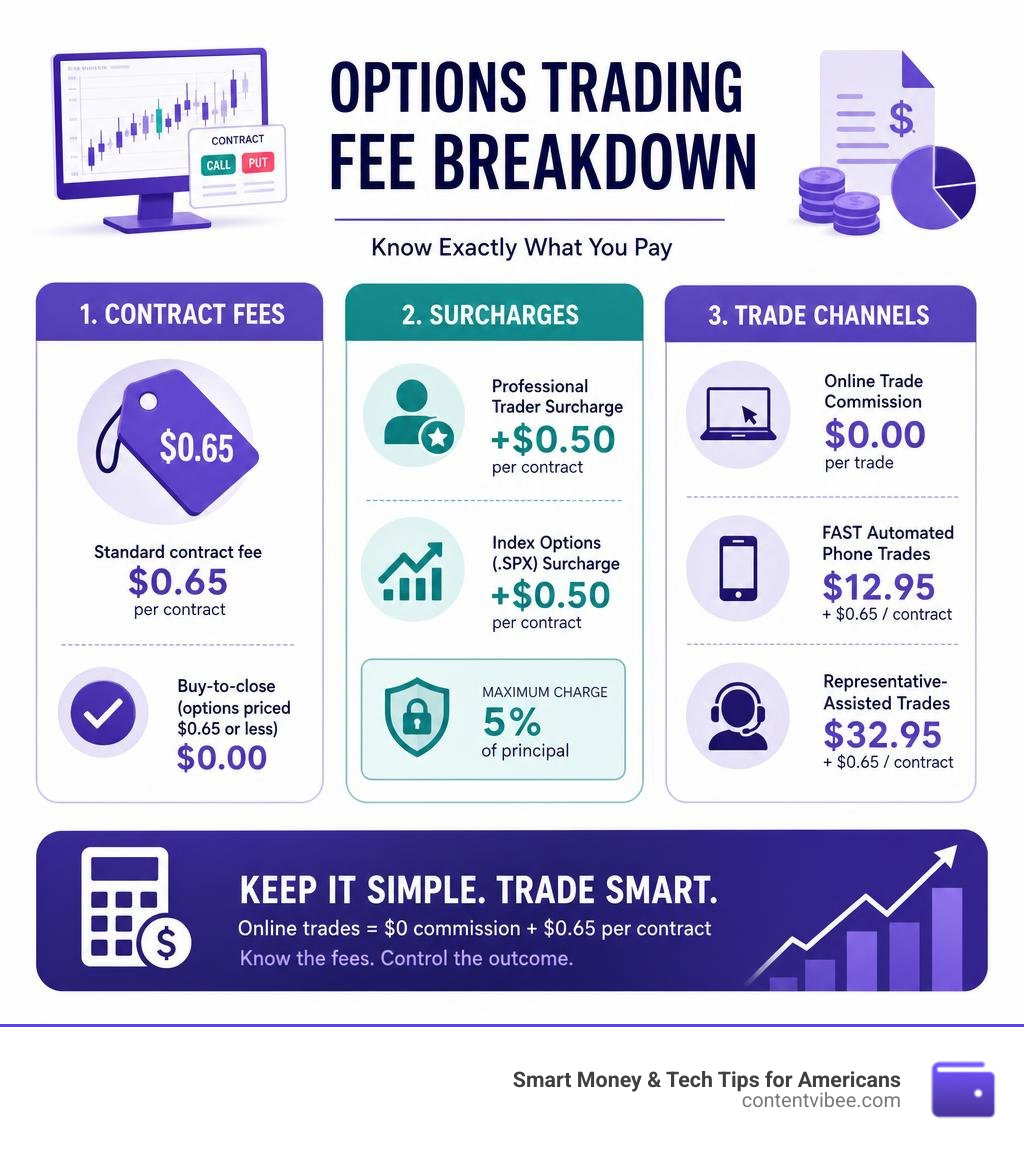
Basic Fidelity options trading fees glossary:
Understanding Fidelity Options Trading Fees: The Core Costs
When we talk about trading options at Fidelity, the headline news is always the “$0 commission” claim. But as seasoned investors, we know we have to look past the marquee advertising.
Fidelity offers commission-free online trading for U.S. equities, ETFs, and options. However, “commission-free” does not mean entirely free. The core cost of trading options at Fidelity centers on a standard per-contract fee.
To explore their full suite of options features, you can check out the Options Trading – Fidelity Investments page. But for now, let’s look at how these core costs actually hit your account balance.
Standard Online Fidelity Options Trading Fees
For the vast majority of retail traders operating online, the basic fee structure is incredibly simple:
- Base Commission: $0.00
- Per-Contract Fee: $0.65 per contract
If you buy 10 call options on a favorite stock, your entry cost will be $6.50 (10 contracts multiplied by $0.65). When you decide to sell those contracts to close your position, you will pay another $6.50.
However, there is an incredibly friendly exception to this rule: the buy-to-close waiver. If you are looking to close out a short options position (an option you previously sold to open) and the contract is currently priced at $0.65 or less, Fidelity waives the fee entirely. You can buy-to-close these low-priced options online for $0.00. This is a massive advantage for premium sellers who like to squeeze out the remaining value of their written options without paying a final transaction cost.
Phone-Assisted and Automated Trading Costs
While online trading is the standard in June 2026, there are times when you might need to place a trade using alternative channels. If you do, be prepared to pay a premium. Fidelity charges different rates depending on how your order is routed:
- FAST (Fidelity Automated Service Telephone): This interactive voice response system charges a base fee of $12.95 per trade, plus the standard $0.65 per-contract fee.
- Representative-Assisted Trades: If you need to speak directly to a human broker to place your options trade, the base fee jumps to $32.95 per trade, plus the $0.65 per-contract fee.
To protect retail traders from paying exorbitant fees on tiny trades, Fidelity implements a principal limit. The maximum charge for any options trade is capped at 5% of the total transaction principal. However, keep in mind that the minimum fees for phone-assisted options trades still apply ($12.95 for FAST and $32.95 for live representatives).
For a complete breakdown of how these channels are priced, you can review the official Fidelity Brokerage Commission and Fee Schedule | Trading information.
Hidden Costs, Surcharges, and Regulatory Fees
If you only trade standard equity options online, your math is simple. But financial markets are diverse, and trading index products or executing a high volume of trades can trigger surcharges.

Index Options Surcharges
Many retail traders love index options like the S&P 500 (.SPX) or Nasdaq 100 (.NDX) because of their cash settlement and favorable tax treatment. However, these are proprietary index products owned by specific exchanges. Because the exchanges charge licensing and transaction fees to brokers, Fidelity passes these costs directly to you.
When you trade specific index options, an additional proprietary exchange surcharge is added to your standard $0.65 contract fee:
- .SPX (S&P 500 Index): +$0.50 per contract
- .NDX (Nasdaq 100 Index): +$0.45 per contract
- .XEO (S&P 100 Index – European Style): +$0.35 per contract
- .OEX (S&P 100 Index): +$0.30 per contract
- .VIX (CBOE Volatility Index): +$0.30 per contract
- .RUT (Russell 2000 Index): +$0.15 per contract
- .DJX (Dow Jones Industrial Average Index): +$0.14 per contract
If you trade 10 online contracts of .SPX, your fee will be $0.65 (standard contract fee) plus $0.50 (index surcharge), totaling $1.15 per contract, or $11.50 for the entire order.
To learn more about why these surcharges exist, you can visit the Options Trading | FAQs | Fidelity page.
Professional Trader Fees and Regulatory Offsets
Are you a highly active trader? If so, you might cross the threshold into “professional” territory according to exchange guidelines.
The exchanges designate you as an options professional if you average 390 or more options orders per day over a calendar quarter. Once you receive this designation, Fidelity is required to add a $0.50 per-contract professional surcharge to all of your options executions.
Additionally, all options trades are subject to minor regulatory fees. The Options Regulatory Fee (ORF) is assessed by the Options Clearing Corporation (OCC) to cover the costs of regulation. This fee usually ranges from $0.02 to $0.04 per contract. Fidelity charges an “Options Fee” to offset this regulatory assessment. It is worth noting that the exact fee passed to you might slightly differ from the actual ORF charged to Fidelity, but it is typically a matter of pennies per trade.
How Account Types and Strategies Affect Your Costs
How you trade and what type of account you use can significantly impact your bottom line. Let’s look at how different accounts and strategies interact with Fidelity options trading fees.
For a broader discussion on how Fidelity structures its business model and whether its free services come with hidden compromises, read our analysis: Is Fidelity Actually Free or Are You the Product?.
How Account Types Impact Fidelity Options Trading Fees
Fidelity does not charge annual account service fees for standard retail brokerage accounts or Individual Retirement Accounts (IRAs). This is a massive savings compared to some legacy brokers that charge maintenance fees.
However, trading options in an IRA vs. a taxable margin account involves different rules and potential costs:
- IRAs: You can trade options in IRAs, but you are generally limited to defined-risk strategies (like covered calls, cash-secured puts, and buy-writes). If you want to trade spreads in an IRA, Fidelity requires you to establish a Cash Spread Reserve of at least $2,000 to cover potential obligations.
- Margin Accounts: If you want to trade more complex, undefined-risk options strategies, you will need a margin account. While there is no direct fee to maintain margin, carrying a debit balance will incur margin interest. Fidelity’s margin rates are tiered based on your debit balance. As of late 2025/2026, the base margin rate is 10.575%, with effective rates ranging from 11.825% for small balances under $25,000 down to 7.50% for balances over $1 million.
Impact on Spreads and Multi-Leg Strategies
When you execute multi-leg strategies (such as vertical spreads, iron condors, or butterflies), the per-contract fee applies to every single leg of the trade.
For example, if you open an Iron Condor, which consists of four separate options contracts:
- Opening the trade: 4 contracts x $0.65 = $2.60
- Closing the trade: 4 contracts x $0.65 = $2.60
- Total transaction cost: $5.20
Because multi-leg trades require simultaneous execution to avoid “leg-in” risk (where the market moves against you while you are trying to manually place individual legs), you should always use Fidelity’s multi-leg trading ticket. This ensures your order is executed as a single package.
For tips on how to manage these positions dynamically, refer to Options Trade Management.
Options Approval Tiers and Requirements
Fidelity structures its options trading permissions into distinct tiers. To qualify for higher tiers, you must fill out an options application detailing your net worth, income, and trading experience.
The standard approval levels are designed to manage risk:
- Level 1: Covered call writing and buy-writes.
- Level 2: Buying calls and puts, straddles, and combinations.
- Level 3: Spreads (requires a margin account or a $2,000 cash reserve in IRAs).
- Level 4 & 5: Uncovered writing of equity and index options (requires a minimum equity of $20,000 for equity options and $50,000 for index options).
Before applying, it is highly recommended to read the official Options Agreement to understand your legal liabilities and the risks associated with uncovered options writing.
Comparing Fidelity to Industry Standards and Minimizing Costs
How does Fidelity stack up against other major financial institutions? Let’s look at a side-by-side comparison of standard fees:
| Fee Category | Fidelity | Legacy Competitors (e.g., Schwab, Vanguard) |
|---|---|---|
| Online Stock/ETF Commission | $0.00 | $0.00 |
| Standard Options Contract Fee | $0.65 | $0.65 |
| Buy-To-Close Waiver | Yes (for options under $0.65) | Varies (often only under $0.05 or $0.10) |
| Full Account Transfer Out Fee | $0.00 | $50.00 |
| Late Settlement Fee | $0.00 | $25.00 |
| Insufficient Funds Fee | $0.00 | $20.00 to $25.00 |
As you can see, while the base contract fee of $0.65 is standard across the industry, Fidelity stands out by eliminating secondary administrative fees (like account transfers and insufficient funds fees) that other brokers use to nickel-and-dime their clients.
For a deeper dive into how these fee structures stack up over time, read our Fidelity Cost Transparency Review and check out our comprehensive Why the Fidelity Investments Fees Comparison article. If you are also utilizing advisory services, it is helpful to understand Why Fidelity Investments Advisory Fees are structured the way they are.
Tools and Resources to Reduce Trading Costs
Fidelity provides several state-of-the-art tools to help you optimize your options entries and avoid unnecessary trading costs.
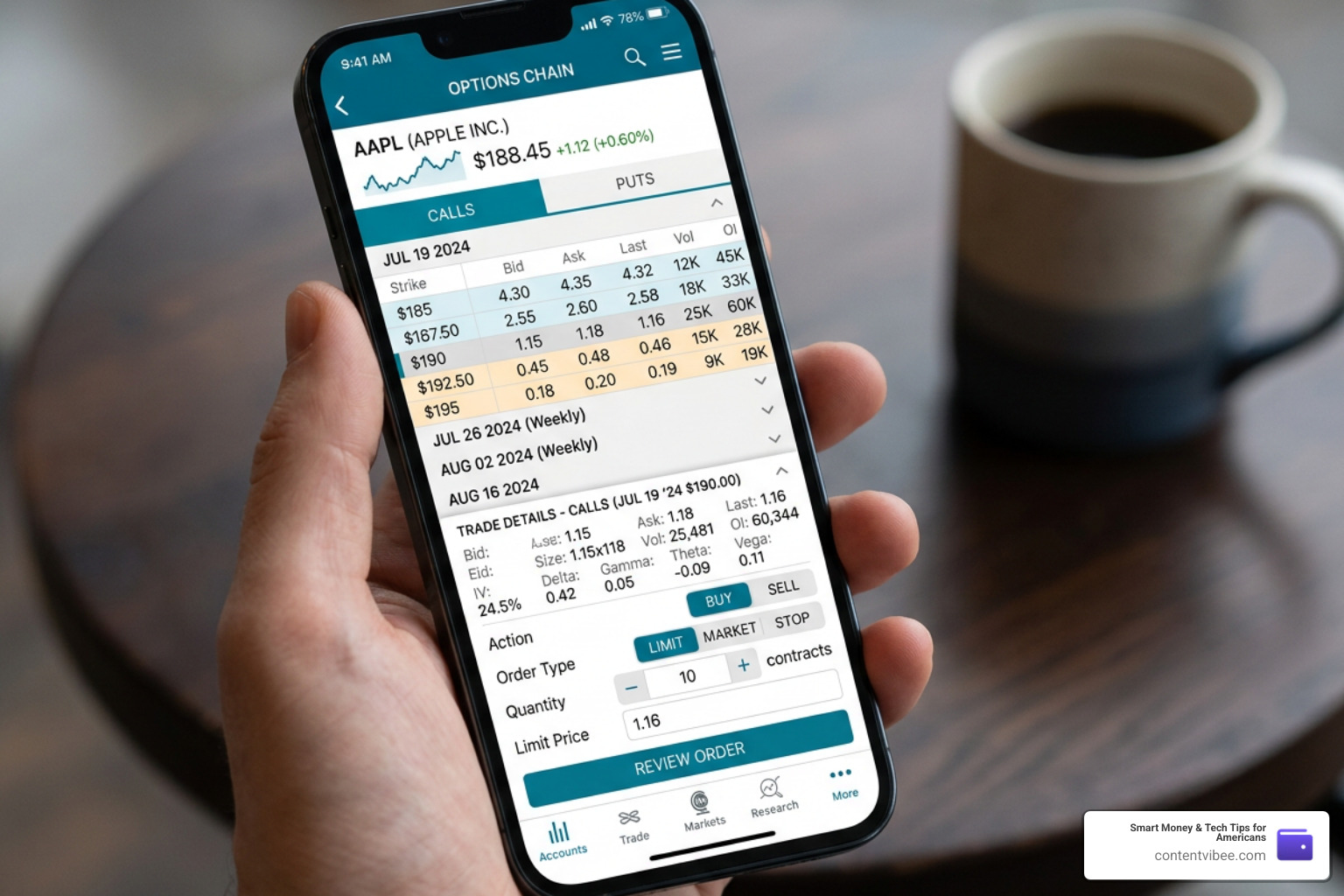
- Options Strategy Builder: This tool helps beginner and intermediate traders build multi-leg options strategies step-by-step, ensuring you select the correct strike prices and expirations to match your outlook.
- OptionsPlay Integration: Fidelity customers receive a 33% discount on OptionsPlay, a premium analytics platform that normally costs $67 per month. This tool provides visual trade ideas, technical analysis, and risk-reward profiles.
- Fidelity Learning Center: Access a massive library of video tutorials, on-demand webinars, and live classes hosted by the Trading Strategy Desk to help you master risk management.
To get a better understanding of how to use these tools on the platform, check out the Fidelity.com Help – Trading Options guide.
Frequently Asked Questions About Fidelity Options
Are options exercises and assignments free at Fidelity?
Yes! Unlike some brokers that charge $15 to $20 for options exercise or assignment, Fidelity charges $0.00. Whether you choose to exercise a long call or get assigned on a short put, there are no transaction fees involved.
What is the buy-to-close fee waiver at Fidelity?
If you have written (sold) an option and want to close the position before expiration, you can buy-to-close online for $0.00 in commission and contract fees, provided the option is trading at $0.65 or less. This is highly beneficial for credit spread and covered call traders.
How is a professional options trader defined?
The exchanges define a professional options trader as anyone who averages 390 or more options orders per day in a given quarter. If you hit this threshold, you will be subject to a $0.50 per-contract professional surcharge on all executions.
Conclusion
At Smart Money & Tech Tips for Americans, we believe that cost transparency is the cornerstone of successful long-term financial planning. When it comes to Fidelity options trading fees, the broker remains one of the most competitive options on the market.
By offering a clean $0.65 per-contract online fee, a generous $0.65 buy-to-close waiver, and $0 exercise and assignment fees, Fidelity makes it easy to keep your trading costs low. Just be sure to watch out for index surcharges and avoid phone-assisted orders to keep your hard-earned money in your account.
For more detailed reviews of financial platforms and transparency ratings, make sure to read our full Fidelity Cost Transparency Review.