


Investing Used to Be Complicated — Robo Advisors Changed That
What is a robo advisor? Here’s the short answer:
At a glance:
| Feature | Robo Advisor |
|---|---|
| How it works | Answers a questionnaire → algorithm builds your portfolio |
| Typical cost | 0.25% – 0.50% per year (vs. ~1% for human advisors) |
| Account minimum | $0 – $500 for most platforms |
| Human involvement | Minimal (some offer hybrid options) |
| Best for | Hands-off, long-term investors |
If you’re approaching retirement or already there, you’ve probably spent decades making careful decisions about savings, Social Security timing, and protecting what you’ve built. The last thing you want is to hand it all to a complicated investment system you don’t fully understand — or pay steep advisor fees that eat into your nest egg.
That’s exactly where robo advisors come in.
The robo advisory market was valued at $8.3 billion in 2024 and is projected to reach $33.6 billion by 2030. These platforms have gone from a niche tech experiment to a mainstream way millions of Americans manage their money — and for good reason.
They’re low-cost, always available, and remove the emotional guesswork from investing.
This guide breaks down exactly how they work, what they cost, and whether putting your portfolio on autopilot makes sense for where you are in life right now.
What Is a Robo Advisor?
To understand what is robo advisor technology and how it can help you, it helps to look at where it came from. Historically, wealth management was a luxury reserved for the ultra-wealthy. If you didn’t have $100,000 or more in investable assets, most traditional financial planners wouldn’t even open the door for you.
That changed during the financial crisis of 2008 when the first automated investment platforms launched. These early platforms utilized the same sophisticated portfolio allocation software that human wealth managers had been using since the early 2000s, but they cut out the middleman. By automating the portfolio building and management process, they made professional investing accessible to everyday retail investors. To learn more about the broader definition, you can check out Investopedia’s article on What Is a Robo-Advisor? or read the historical background on the Robo-advisor Wikipedia page.
At its core, a robo advisor is an online wealth management service that uses automated computer algorithms to manage your money. Instead of a human advisor picking individual stocks or timing the market, the platform’s software constructs and maintains a diversified portfolio of exchange-traded funds (ETFs) or mutual funds for you.
We love this approach because it takes the “guesswork” and emotion out of the equation. Markets go up and down, but an automated platform sticks to a disciplined strategy without panic-selling during a downturn.
What Is a Robo Advisor Suitability Assessment?
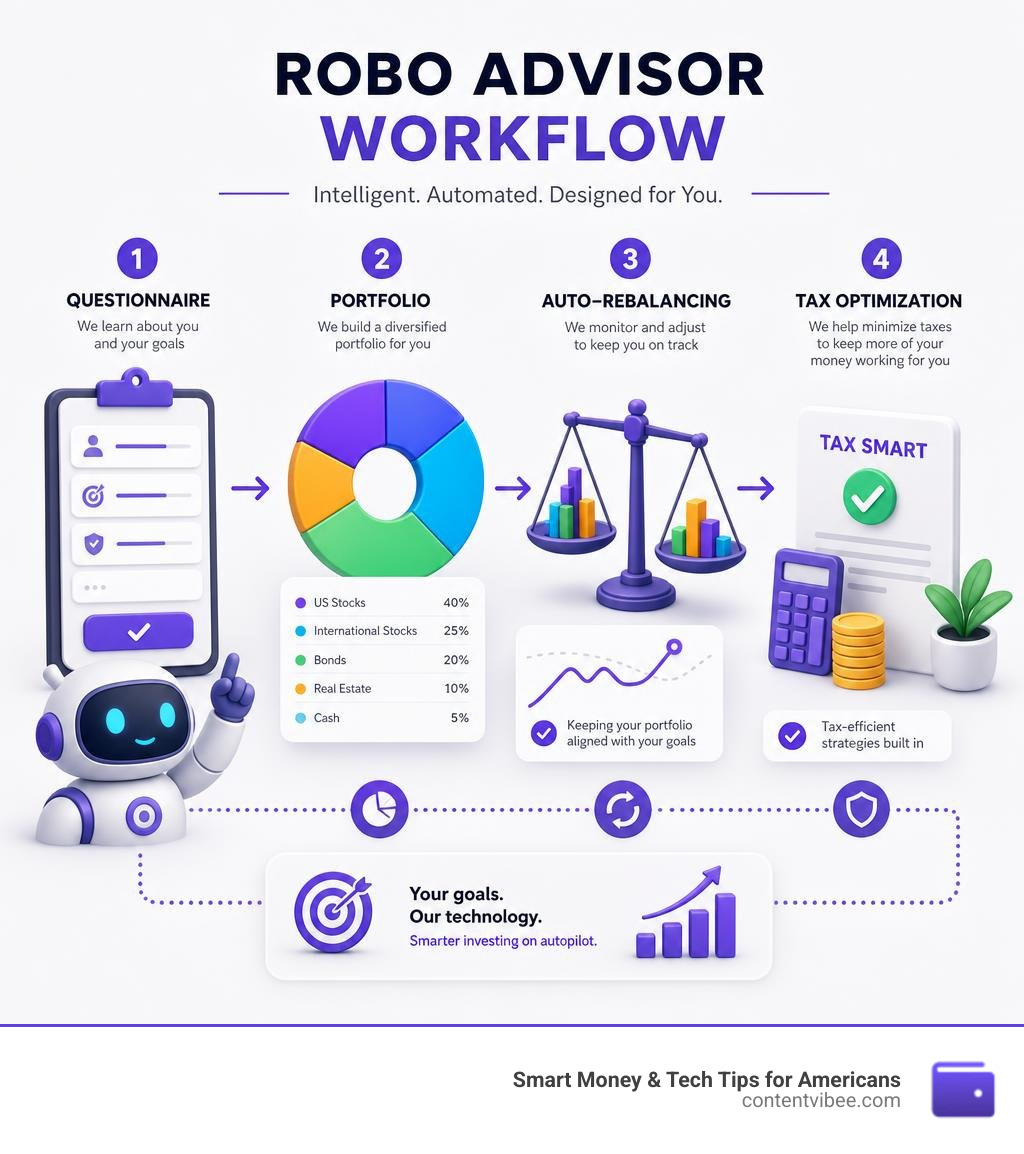
When you sign up for an automated platform, you don’t just dump your cash in and hope for the best. The process starts with a digital onboarding questionnaire known as a suitability assessment.
During this assessment, the platform will ask you a series of personal and financial questions, including:
- Your age and timeline: When do you plan to retire or withdraw these funds?
- Your financial goals: Are you saving for retirement, a down payment on a home, or simply building a rainy-day fund?
- Your income and net worth: What is your current financial cushion?
- Your risk tolerance: How would you feel if your portfolio dropped 10% in a single month?
The software uses your answers to gauge your appetite for risk and determine your ideal asset allocation. For example, if you are decades away from retirement and comfortable with market swings, the algorithm will assign you a growth-oriented portfolio heavily weighted in stocks. If you are close to retirement and need to protect your capital, the algorithm will lean toward a conservative portfolio dominated by stable bonds.
If you are curious about whether a computer can truly understand your personal comfort with risk, check out our deep dive into Robo Advisor Asset Allocation: Can Robots Really Gauge Your Risk Tolerance?
What Is a Robo Advisor Portfolio Rebalancing Strategy?
Once your portfolio is built, the market immediately goes to work changing it. Because different investments grow at different rates, your initial asset mix will eventually drift.
Imagine you start with a target allocation of 60% stocks and 40% bonds. If stocks have a fantastic year, they might grow to represent 70% of your total portfolio, while your bonds drop to 30%. Suddenly, your portfolio is much riskier than you intended.
To prevent this “portfolio drift,” automated platforms use a portfolio rebalancing strategy. Most platforms establish specific “rebalancing bands”—typically a tolerance range of ±5%. If any asset class drifts outside of its allowable band, the platform’s software automatically sells off a portion of the overperforming assets and buys more of the underperforming ones to bring you back to your target allocation.
Depending on the platform, this monitoring can happen daily, weekly, or quarterly. For example, Vanguard’s digital advisor monitors portfolios daily and automatically triggers a rebalance if drift exceeds 5%. This hands-off maintenance is a major reason why many people choose automated management. To see if this passive maintenance style matches your needs, read our article on Is Automated Portfolio Management Right for You?
How Automated Investing Platforms Work Under the Hood
Under the hood of every prominent automated platform is a Nobel Prize-winning framework called Modern Portfolio Theory (MPT). Developed by economist Harry Markowitz in 1952, MPT argues that you can minimize risk and maximize returns by diversifying your investments across a wide variety of uncorrelated asset classes.
Instead of trying to beat the market by picking the next hot stock, automated platforms use passive indexing strategies. They invest your money in low-cost, broad-market Exchange-Traded Funds (ETFs) that track major indexes, such as the S&P 500 or the aggregate bond market. This ensures your money is spread across thousands of global companies instantly.
For a formal overview of how these automated systems are defined by government watchdogs, you can read the SEC’s guide on Robo-Adviser | Investor.gov.
The Role of Algorithms and Asset Allocation
The algorithms driving these platforms are designed by experienced financial planners, investment managers, and data scientists. They handle the complex mathematics of asset allocation so you don’t have to.
By diversifying your portfolio across international stocks, domestic stocks, emerging markets, corporate bonds, and government treasuries, the algorithm builds an “efficient frontier.” This is the optimal mix of investments designed to give you the highest possible return for your chosen level of risk.
Because the software handles all the transactions behind the scenes, you can enjoy a true “set-it-and-forget-it” experience. If you want to explore the best ways to get started without getting bogged down in math, check out our guide on how to Set and Forget Your Way to Wealth with Automated Investing.
Tax-Loss Harvesting and Risk Mitigation
One of the most powerful features offered by high-end robo advisors is tax-loss harvesting. Previously, this strategy was only available to wealthy investors working with high-priced private wealth managers.
Tax-loss harvesting involves automatically selling certain investments that have experienced a temporary decline in value. By realizing these losses, you can offset taxable capital gains from other investments or write off up to $3,000 of ordinary income on your federal taxes.
Immediately after selling the losing investment, the robo advisor reinvests the proceeds into a highly similar, stable ETF to keep your overall asset allocation identical. To comply with the IRS’s “wash-sale rule” (which prohibits buying an identical security within 30 days of selling it for a loss), the algorithm is programmed to hold two or more pre-selected, non-identical ETFs for each asset class. This automation allows you to lower your tax bill seamlessly without changing your long-term investment strategy.
Comparing Costs: Automated vs. Traditional Financial Advisors
When it comes to building long-term wealth, fees are one of the quietest wealth killers. A seemingly small fee difference can add up to tens of thousands of dollars over a lifetime of investing.
Here is how automated platforms compare directly to traditional human financial planners:
| Fee Category | Robo Advisor | Traditional Financial Advisor |
|---|---|---|
| Annual Advisory Fee | 0.25% to 0.50% | 1.00% or more |
| Underlying Fund Fees (Expense Ratios) | 0.04% to 0.15% | Variable (often higher mutual fund fees) |
| Typical Minimum Account Balance | $0 to $500 | $50,000 to $100,000+ |
| Transaction Fees / Commissions | Usually $0 (waived) | Often charged per trade |
To see a complete breakdown of what you might pay, check out The Ultimate Guide to Robo Advisor Fees.
Typical Fee Structures and Account Minimums
Let’s look at how these fees play out in the real world. Many popular platforms, like Wealthfront, charge a flat annual management fee of 0.25%. On a $10,000 portfolio, that works out to just $25 per year (or about $2.08 a month). If you had a $100,000 portfolio, you would pay $250 annually.
By contrast, a traditional human advisor charging a standard 1% fee would cost you $1,000 a year on a $100,000 portfolio.
Additionally, automated platforms have incredibly low entry barriers. For example, Fidelity Go charges no advisory fees on account balances under $25,000, requires a $0 minimum to open an account, and needs only $10 to start investing. For balances above $25,000, it charges a reasonable 0.35% annually. For a deep dive into this specific option, read The No-Nonsense Guide to Fidelity Robo Advisor Fees.
The Pros and Cons of Putting Your Portfolio on Autopilot
Before you decide to automate your wealth, look at the complete picture. No financial tool is perfect for everyone.

The Advantages (The Pros)
- Incredible Cost Savings: Paying 0.25% instead of 1.00% keeps more of your hard-earned money compounding in your account.
- Low Minimums: You can start investing with whatever spare change you have, rather than waiting until you accumulate a fortune.
- Emotional Discipline: The platform’s automated system prevents you from making rash, fear-based decisions during market volatility.
- Time-Saving Efficiency: You don’t need to spend hours researching mutual funds, calculating asset allocations, or manually executing trades.
- Advanced Features for All: Features like automatic rebalancing and tax-loss harvesting are handled completely behind the scenes.
The Limitations (The Cons)
- Limited Customization: You cannot easily pick and choose individual stocks or decide to opt out of specific sectors within your pre-set portfolio.
- Inability to Handle Complex Needs: While a robo advisor is great for standard retirement saving, it cannot draft an estate plan, set up complex trusts, or optimize highly unique tax situations.
- Lack of Empathy: A computer algorithm cannot sit down with you to calm your fears during an unexpected life crisis or help you navigate the emotional aspects of inheritance.
Frequently Asked Questions About Automated Investing
We hear many of the same questions from our readers who are considering moving their money to an automated platform. Here are the facts you need to know.
How are automated investing platforms regulated and are they safe?
Yes, they are highly regulated. In the United States, robo advisors must register with the Securities and Exchange Commission (SEC) and are bound by the Investment Advisers Act of 1940. This means they operate as fiduciaries, legally requiring them to put your best financial interests first. Most platforms are also members of the Financial Industry Regulatory Authority (FINRA).
While your investments are subject to normal market fluctuations and are not FDIC-insured (since they are securities, not bank deposits), your brokerage account is protected by the Securities Investor Protection Corporation (SIPC). This protects up to $500,000 (including a $250,000 limit for cash) if the brokerage firm itself goes bankrupt. For more tips on doing your due diligence, review the guidelines from the North American Securities Administrators Association at Robo-Advisers – NASAA.
What is the difference between a pure and a hybrid robo-advisor?
A pure robo-advisor is entirely automated. You interact with the platform through a website or smartphone app, and all portfolio decisions are handled by the computer algorithm.
A hybrid robo-advisor gives you the best of both worlds. It uses the same low-cost automated technology to manage your portfolio, but it also gives you access to human financial planners for remote consultations via phone or video call. This is an excellent middle-ground option if you want automated management but still want to discuss your broader retirement goals with a living, breathing expert.
Can I use an automated advisor for retirement accounts?
Absolutely! Most automated platforms allow you to open a wide variety of account types, including:
- Traditional IRAs
- Roth IRAs
- Taxable individual or joint brokerage accounts
- 401(k) rollovers
Many platforms can even coordinate your investments across multiple account types to maximize your overall tax efficiency.
Conclusion

At Smart Money & Tech Tips for Americans, we believe that managing your wealth shouldn’t feel like a second full-time job. Understanding what is robo advisor technology is the first step toward taking control of your financial future without the high stress or high fees of the past.
If you want a simple, hands-off way to build a diversified portfolio that automatically keeps itself on track, putting your investments on autopilot is one of the smartest moves you can make.
Ready to take the next step and find the perfect hands-off approach for your money? Check out our guide on the Best Autopilot Investing Strategies for Beginners Who Hate Math to launch your automated journey today!


