


Why Using a Car Loan Prepayment Calculator Could Save You Thousands
A car loan prepayment calculator is one of the fastest ways to see exactly how much money you can save by paying off your auto loan ahead of schedule.
Here’s the quick answer if you’re short on time:
- Enter your current loan balance, interest rate (APR), and months remaining
- Add the extra monthly amount you can pay (even $50 makes a difference)
- The calculator shows your new payoff date and total interest saved
Example results at a glance:
| Extra Monthly Payment | Interest Saved | Months Cut |
|---|---|---|
| $50 | $322.72 | 3 months |
| $100 | $598.03 | 6 months |
| $150 | $834.93 | 9 months |
| $200 | $1,042.08 | 11 months |
Based on a $35,000 loan at 6.70% APR with 48 months remaining.
The average American carries an auto loan for nearly 68 months — almost six years. That’s a long time to be paying interest on a depreciating asset. And with today’s auto loan rates sitting higher than they were just a few years ago, the total interest cost adds up fast.
The good news? Even small extra payments can cut months off your loan and put real money back in your pocket. This guide walks you through everything you need to know — from how the calculator works to whether prepaying beats investing your spare cash.
What is a car loan prepayment calculator and How Does It Work?
At its core, a car loan prepayment calculator is a digital sandbox that lets you simulate different repayment strategies. It takes your current loan parameters and applies hypothetical extra payments to show you how much faster you can hold your car title outright.
To understand how it works, we have to look under the hood at amortization. When you take out an auto loan, your lender sets up an amortization schedule. This schedule determines how each of your monthly payments is split between paying off the actual money you borrowed (the principal) and paying the lender’s fee for lending it to you (the interest).
Early in your loan term, your payments are front-loaded with interest. Because interest is calculated based on your remaining principal balance, a higher balance means more of your monthly payment goes toward interest and less goes toward chipping away at the principal.
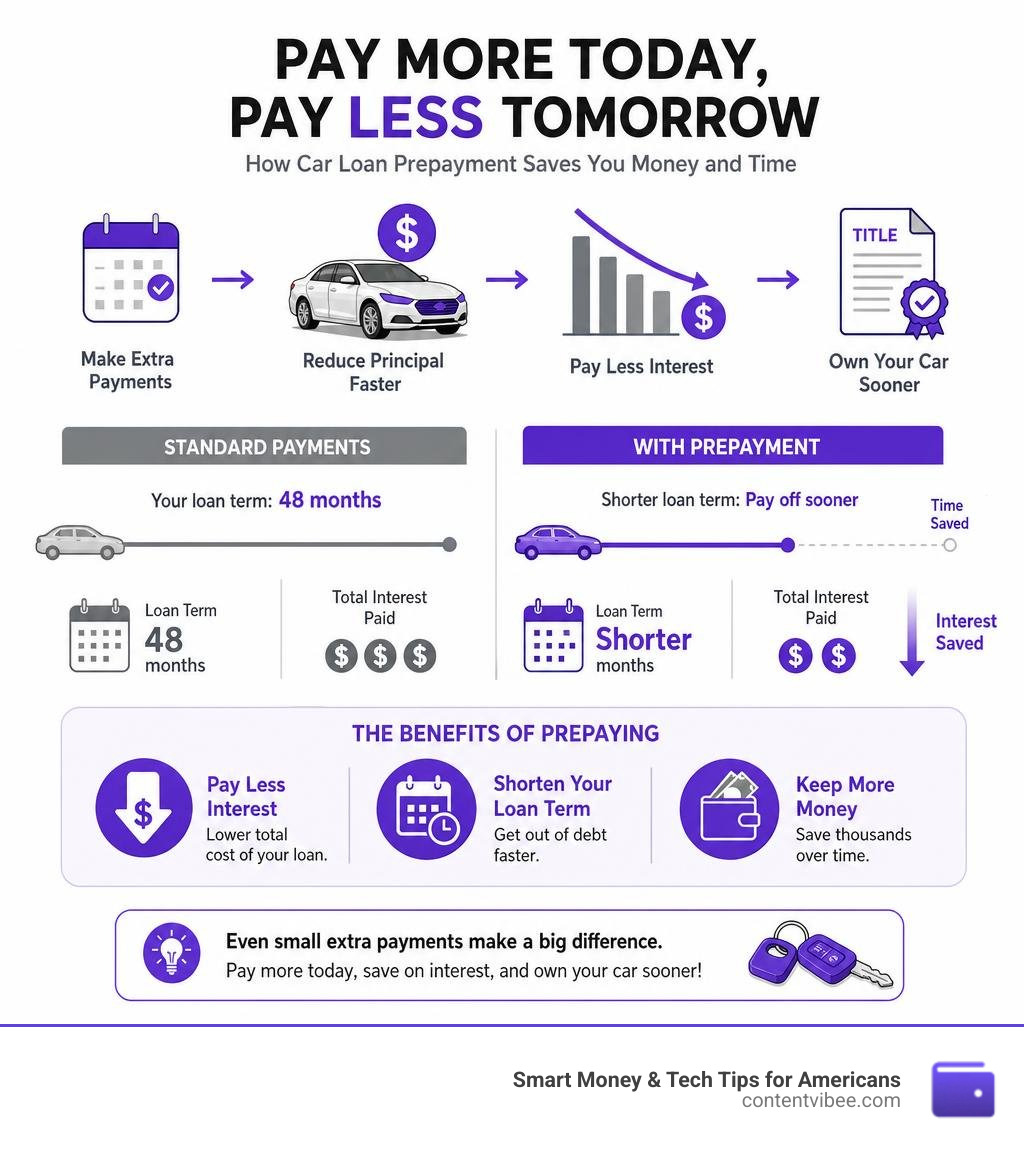
This is where a tool like the Car Loan Prepayment Calculator becomes incredibly valuable. When you make a prepayment—meaning you pay more than your scheduled monthly payment—that extra money bypasses the interest allocation entirely. It goes directly toward reducing your principal balance.
By shrinking the principal balance faster than scheduled, you accomplish two things simultaneously:
- You reduce the base balance on which your next month’s interest is calculated.
- You shorten the overall life of the loan, saving you from months (or years) of future interest charges.
Using an online prepayment tool allows you to visually map out these savings without having to do complex compounding interest math by hand.
Key Inputs Needed for Your car loan prepayment calculator
To get the most accurate results from a car loan prepayment calculator, you need to feed it the right data. Grabbing your most recent monthly auto loan statement will give you all the numbers you need. Here are the key inputs to have ready:
- Outstanding Balance: This is the actual amount you still owe on the car, not the original amount you borrowed. It is also different from your car’s resale value.
- Annual Percentage Rate (APR): The annual interest rate your lender charges. Be sure to enter this as a standard percentage (e.g., enter 6.5, not 0.065) to avoid calculation errors.
- Remaining Term: The number of months you have left on your loan agreement, not the original term length.
- Extra Payment Amount: The additional money you plan to put toward the loan. This can be entered as a recurring monthly addition, a one-time lump sum (like a tax refund or work bonus), or a combination of both.
How to Use a car loan prepayment calculator to Estimate Savings
Using an early payoff tool is straightforward, but following a structured approach ensures you get actionable insights. Here is our quick step-by-step guide to estimating your savings:
- Gather your current loan details: Open your lender’s online portal or look at your latest paper statement to find your current principal balance and interest rate.
- Input your baseline data: Enter your outstanding balance, APR, and remaining months into the calculator fields. The tool will automatically generate your standard monthly payment and project your total remaining interest if you make no changes.
- Experiment with extra payments: Start by entering a modest extra monthly payment, such as $50 or $100. Watch how the payoff timeline shrinks and the total interest cost drops.
- Compare different scenarios: Many advanced tools, like the Auto Loan Early Payoff Calculator | Bankrate, allow you to view a complete, updated amortization schedule. Compare a monthly extra payment strategy against a one-time lump-sum payment (for example, putting a $1,000 bonus toward the principal at month 12).
- Review the “View Report” or summary page: Look closely at the net interest saved. If your lender charges any prepayment fees, subtract those from the calculated savings to find your true net benefit.
The Financial Impact of Prepaying Your Auto Loan
The financial impact of prepaying an auto loan is often much larger than people expect. Because auto interest compounding is relentless, cutting down the principal early creates a compounding savings effect in your favor.
When you pay off your car early, you are essentially securing a guaranteed return on your money equal to your loan’s interest rate. If you have an auto loan at 7% APR, every dollar you prepay saves you 7% in annual interest. In the financial world, a guaranteed, risk-free 7% return is incredibly hard to find.

To help visualize how standard payments compare to accelerated strategies, let’s look at a comparative table of a standard auto loan versus various prepayment strategies.
Comparison: Standard Payments vs. Extra Payments
Based on a $35,000 outstanding balance at 6.70% APR with 48 months remaining.
| Strategy | Monthly Payment | Additional Monthly | Total Interest Paid | Total Interest Saved | Months Saved | Payoff Timeline |
|---|---|---|---|---|---|---|
| Standard | $832.93 | $0 | $4,980.64 | $0.00 | 0 | 48 months |
| +$50 Monthly | $882.93 | $50 | $4,657.92 | $322.72 | 3 | 45 months |
| +$100 Monthly | $932.93 | $100 | $4,382.61 | $598.03 | 6 | 42 months |
| +$150 Monthly | $982.93 | $150 | $4,145.71 | $834.93 | 9 | 39 months |
| +$200 Monthly | $1,032.93 | $200 | $3,938.56 | $1,042.08 | 11 | 37 months |
As the table shows, adding just $100 a month to your payment saves almost $600 in interest and gets you out of debt half a year early. If you can bump that to $200 a month, you save over $1,000 in interest and shave nearly a full year off your loan term.
Real-World Savings Scenarios
Let’s look at a few other common loan scenarios to see how prepayments perform across different balance sizes and interest rates:
- The $30,000 Mid-Sized Loan: Imagine you have a $30,000 auto loan at an 8% interest rate over 48 months. Your standard monthly payment is $733, resulting in $5,145 in total interest over the life of the loan. If you decide to add an extra $250 to your monthly payment starting after your 12th payment, your monthly outflow rises to $983. This adjustment shortens your remaining term by 10 months and saves you $880 in interest.
- The $20,000 Used Car Balance: Suppose you have a $20,000 balance left on a used car loan at 6.5% APR with 48 months remaining. Your standard payment is roughly $474.30. By committing to an extra $100 per month, your loan pays off in about 39 months instead of 48. This simple budget adjustment saves you $542.90 in interest and gives you 9 months of payment-free driving.
- Lump-Sum Windfalls: If you don’t want to commit to an extra monthly payment, one-time payments still make a major dent. On a typical 5-year auto loan, throwing a one-time $2,500 tax refund toward your principal at the 24-month mark can save you around $1,200 in interest and shorten your term by 8 months, depending on your APR.
To test your own numbers and see specific scenarios, you can use the Auto Loan Early Payoff Calculator – Save Interest & Finish Your Loan Sooner or check out the Auto Loan Early Payoff Calculator for quick, dynamic results.
Key Factors and Strategies for Prepaying Your Car Loan
Before you start sending extra money to your lender, it is important to understand the variables that dictate your actual savings. Not all prepayments are created equal, and timing can play a massive role in your financial outcome.
- Your Interest Rate: The higher your APR, the more financial sense prepayment makes. If you have a legacy loan locked in at a 2.9% rate from years ago, your incentive to prepay is low because you can earn more in a basic high-yield savings account. If your rate is 7% or higher, prepaying is an excellent use of cash.
- Remaining Tenure: Prepaying early in your loan term yields the highest savings. Because interest is front-loaded, reducing the principal during the first 12 to 24 months of a 60-month loan prevents a massive amount of interest from ever compounding. Prepaying in the final 6 months of a loan offers very little interest savings, though it does clear the debt sooner.
- Prepayment Timing: Making smaller, consistent extra payments throughout the year (or aligning them with your bi-weekly paychecks) keeps your principal balance lower on average than waiting to make one large payment at the end of the year.

Prepayment Penalties and Fees
One of the most critical steps in early payoff planning is checking your loan agreement for prepayment penalties. While many modern auto loans are simple-interest loans with no penalties for early payoff, some lenders still charge fees to protect their projected interest earnings.
Additionally, be aware of precomputed interest loans. In a precomputed loan, the total interest for the entire term is calculated upfront and combined with your principal. If you pay off a precomputed loan early, you might not save any money on interest at all unless your contract explicitly outlines a rebate formula (such as the Rule of 78s).
Before making extra payments:
- Call your lender and ask: “Are there any prepayment penalties or fees if I pay off my loan early?”
- Ask: “Do you accept principal-only payments, and how should I submit them?”
- If there is a fee, compare it to your projected savings. If a lender charges a $150 early payoff fee but the calculator shows you will save $600 in interest, prepaying still nets you $450 in savings. If the fee is higher than the interest saved, prepayment is not worth it.
For a detailed look at how prepayments are calculated alongside potential fees, you can use the Loan Prepayment Calculator – Calculate Savings on Early Loan Repayment | Apna Calculator or the Loan Prepayment Calculator 2026 – Interest Saved & Fast Payoff | MonuMoney.in.
Shorten Loan Tenure vs. Reduce Monthly EMI
When you make a partial prepayment, lenders typically handle it in one of two ways: they either shorten your loan tenure (keeping your monthly payment the same but ending the loan sooner) or reduce your monthly payment (keeping the original end date but lowering your monthly bill).
Here is a quick look at the pros and cons of each strategy:
- Shortening Loan Tenure (Recommended for Max Savings)
- Pros: Maximizes interest savings; gets you out of debt faster; builds equity in the vehicle quickly.
- Cons: Requires you to maintain your current monthly budget outflow.
- Reducing Monthly Payments (Recommended for Cash Flow)
- Pros: Lowers your monthly financial obligation; frees up immediate cash flow in your monthly budget.
- Cons: Saves significantly less interest overall because the loan remains active for the original duration.
If your primary goal is to save the maximum amount of money, shortening your loan tenure is almost always the better option. It keeps your money working actively to kill the debt.
Prepaying vs. Investing Your Extra Cash
A common dilemma is deciding whether to use extra cash to pay down a car loan or invest it in the market. To make this decision, you need to compare your loan’s interest rate against your expected post-tax investment return.
- The Math: If your auto loan APR is 7%, prepaying gives you a guaranteed 7% return. If you invest that money instead, you would need to earn more than 7% after taxes to break even.
- The Risk Factor: Stock market investments carry risk, while paying off debt is a guaranteed financial win.
- The Hybrid Strategy: Many financial planners suggest a 50/50 approach. Put half of your extra cash toward early debt payoff and the other half toward long-term investing.
If you are evaluating your broader financial picture, check out our Beginners Guide To Retirement Calculator to see how your savings rate impacts your long-term wealth goals.
How Early Payoff Affects Your Insurance and Overall Finances
Paying off your car loan early does more than just clear a monthly bill; it has a ripple effect across your entire financial life:
- Insurance Flexibility: When you finance a car, lenders require you to carry comprehensive and collision insurance with low deductibles. Once you own the car outright, you can adjust these coverages to fit your budget.
- Canceling Gap Insurance: If you bought gap insurance (which covers the difference between what the car is worth and what you owe on the loan), you can cancel it the moment your loan balance hits zero. This can save you hundreds of dollars a year.
- Debt-to-Income (DTI) Ratio: Eliminating a car payment immediately lowers your DTI ratio, making it much easier to qualify for a mortgage or other competitive financial products.
To see how freeing up monthly cash flow impacts your retirement withdrawal plans, read our guide on Demystifying The 4 Percent Retirement Withdrawal Calculator.
Frequently Asked Questions About Car Loan Prepayment
Does prepaying a car loan hurt your credit score?
In the short term, you might see a minor, temporary dip in your credit score when you pay off an auto loan. This happens because closing an active account can slightly reduce your credit mix diversity and lower the average age of your active accounts. However, this dip is usually small and temporary. In the long run, having a history of a fully paid-off auto loan and a lower overall debt burden is highly beneficial for your credit profile and debt-to-income ratio.
Can you make multiple partial prepayments in a year?
Yes, most lenders allow you to make multiple extra payments throughout the year. However, you must ensure your lender is applying these extra funds correctly. Some lenders will default to advancing your next payment due date (meaning they treat it as an early regular payment) rather than applying it to your principal balance. Always instruct your lender to apply extra payments as “principal-only” payments.
Is it better to prepay a car loan or save for retirement?
It depends on your loan’s interest rate and whether your employer offers a retirement match. If your employer matches your 401(k) contributions, always prioritize saving enough to get the full match first—that is essentially a 100% return on your money. After securing your match, if your car loan interest rate is high (above 6% or 7%), prepaying the loan is generally better than investing in taxable accounts. If your loan rate is very low (under 4%), prioritizing retirement savings is usually the smarter move.
For help balancing these priorities, use our Retirement Calculator Estimate Savings Needed to see if your current retirement track is secure before accelerating your car payments.
Conclusion
Paying off your car loan early is a powerful way to claim financial freedom, eliminate a major monthly obligation, and save hundreds—or even thousands—of dollars in interest. By using a car loan prepayment calculator, you can take the guesswork out of the process and build a clear, actionable roadmap to owning your vehicle free and clear.
At ContentVibee, we believe that smart money decisions start with having the right tools. Whether you want to add $50 a month to your payment or drop a lump sum onto your principal, taking control of your auto debt is a step toward building lasting wealth.
Ready to run the numbers on your other financial goals? Explore our comprehensive suite of tools on our Tools/Finance Calculator page to optimize your budget, retirement plans, and debt payoff strategies today!
Additional Resources:
- For specialized calculators from regional lenders, you can also explore the Auto Loan Early Payoff Calculator – Twin Falls to compare early payoff structures.