


How to Calculate Spouse Retirement Benefits (Quick Answer)
If you need to calculate spouse retirement benefits, here is the short version:
The maximum spousal benefit = 50% of your spouse’s Primary Insurance Amount (PIA) at your Full Retirement Age (FRA).
Claiming before your FRA reduces that amount. Here is how the numbers break down:
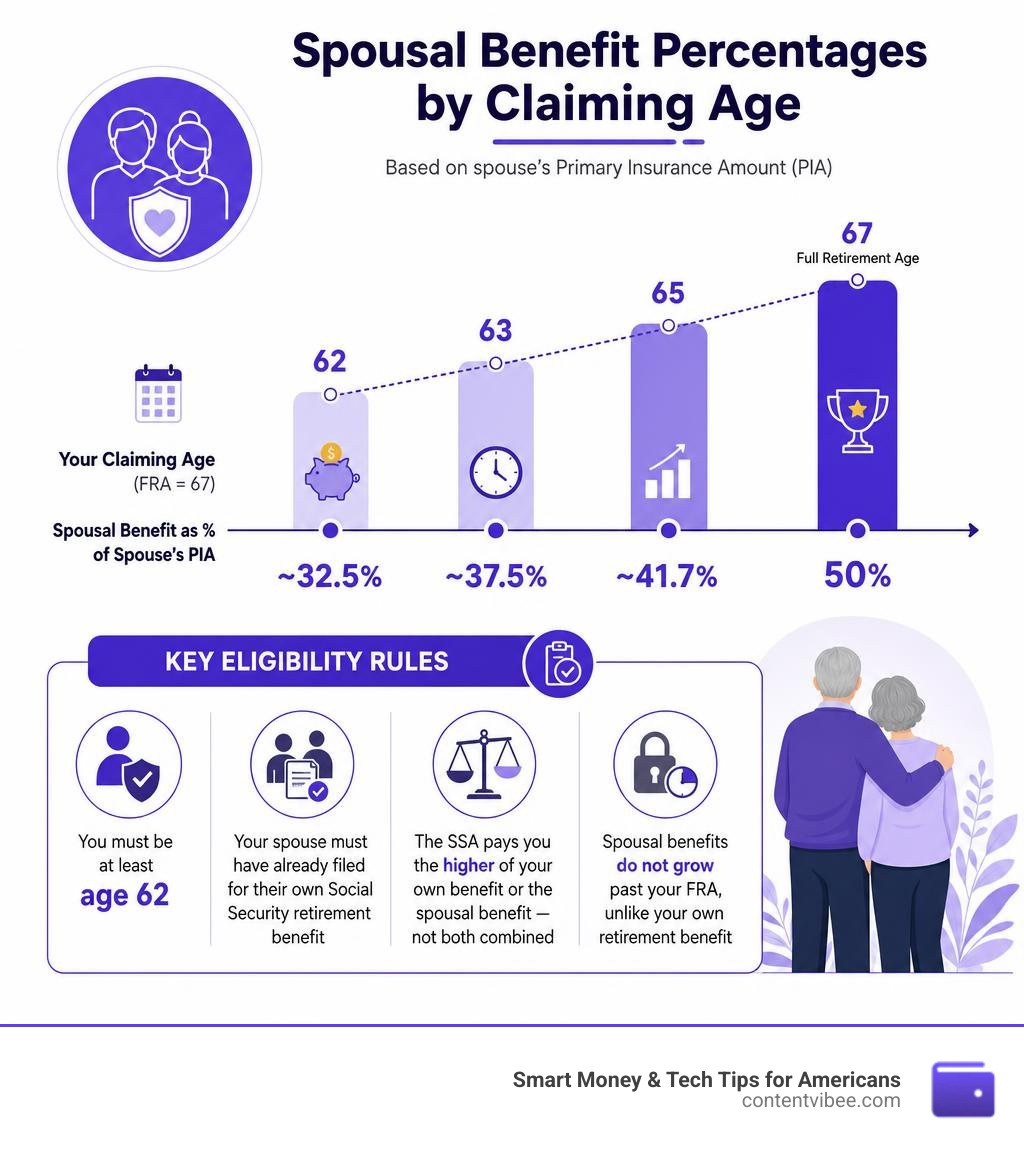
| Your Claiming Age (FRA = 67) | Spousal Benefit as % of Spouse’s PIA |
|---|---|
| 67 (Full Retirement Age) | 50% |
| 65 | ~41.7% |
| 63 | ~37.5% |
| 62 | ~32.5% |
Key rules to know upfront:
- You must be at least age 62 to claim
- Your spouse must have already filed for their own Social Security retirement benefit
- The SSA pays you the higher of your own benefit or the spousal benefit — not both combined
- Spousal benefits do not grow past your FRA, unlike your own retirement benefit
For millions of Americans approaching retirement, figuring out how to calculate spouse retirement benefits is one of the most important — and most confusing — financial decisions they will face.
The rules are layered. Claiming age matters. Your own earnings record matters. And the order in which you and your spouse file can affect your household income for decades, especially if one of you outlives the other by many years.
The good news? Once you understand a few core concepts — the 50% rule, early claiming reductions, and how survivor benefits connect to spousal benefits — the whole picture starts to make sense.
This guide walks you through everything step by step, including the official SSA calculator tools, divorce rules, and the latest 2026 policy updates.
What Are Spousal Social Security Benefits and Who Qualifies?
Before diving into the math, let’s define exactly What Is A Social Security Spousal Benefit and who qualifies to receive it.
Spousal benefits are designed to provide retirement income to a spouse who may have had lower lifetime earnings, spent years out of the workforce raising a family, or did not work at all. This ensures that a married couple can enjoy a more secure retirement together.
To qualify for these benefits on your living spouse’s record, you must meet the following baseline criteria:
- Marriage Duration: You must have been married to your spouse for at least one continuous year at the time of filing. (Note: This rule is different for divorced spouses, which we will cover later).
- Age Requirement: You must be at least 62 years old to claim spousal benefits, unless you are caring for a qualifying child. A qualifying child is one who is under age 16 or who became disabled before age 22. In that specific “child-in-care” scenario, the age 62 requirement is waived.
- The Worker Spouse Must Have Filed: Your spouse must already be receiving their own retirement benefits for you to claim a spousal benefit on their record. You cannot file for a spousal benefit if your partner has not yet claimed theirs.
- The Benefit Difference: To actually receive a spousal payment, 50% of your spouse’s Primary Insurance Amount (PIA) must be greater than your own retirement benefit based on your own work history. If your own benefit is higher, the Social Security Administration (SSA) will simply pay your benefit.
Understanding these foundational rules is the first step in retirement planning. For a deeper dive into these requirements, you can read The Ultimate Guide To Spousal Social Security Eligibility and learn How To Check Your Eligibility For Spousal Social Security Benefits to make sure you meet every condition before you proceed.
How to Calculate Spouse Retirement Benefits
At the heart of the spousal benefit calculation is a concept known as the Primary Insurance Amount (PIA).
Your spouse’s PIA is the monthly amount they are entitled to receive if they claim their benefits at their exact Full Retirement Age (FRA). For anyone born in 1960 or later, the FRA is 67.
When you calculate spouse retirement benefits, the maximum amount you can receive is exactly 50% of your spouse’s PIA.

However, this 50% maximum is only available if you wait until your own Full Retirement Age to claim. If you decide to claim your spousal benefit earlier—which you can do starting at age 62—the SSA applies a permanent reduction to your monthly payment.
The early claiming reduction formulas are calculated as follows:
- The First 36 Months: For the first 36 months you claim prior to your FRA, the spousal benefit is reduced by 25/36 of 1% per month (about 0.69% per month).
- Additional Months: If you claim more than 36 months early (up to the maximum of 60 months early at age 62), the benefit is further reduced by 5/12 of 1% per month (about 0.42% per month).
Let’s look at a quick mathematical example. Suppose your spouse’s PIA at their FRA of 67 is $2,000.
- If you wait until your own FRA (67) to claim, your spousal benefit is 50% of $2,000, which equals $1,000 per month.
- If you claim at age 62 (60 months before your FRA), your benefit is reduced by 35% overall. This leaves you with approximately 32.5% of your spouse’s PIA, which translates to $650 per month.
To explore how these reduction formulas impact various scenarios, you can use the official Benefits for Spouses calculator provided by the SSA, or check out our own How Much Social Security Will I Get Calculator to model your household numbers.
Step-by-Step Guide to Calculate Spouse Retirement Benefits Online
The most accurate way to estimate your actual spousal benefit is to use the official government portal. The SSA allows you to view personalized estimates based on real earnings records.
Here is the step-by-step process to do this online:
- Log In or Sign Up: Go to the official SSA website and log into your personal my Social Security account. If you do not have one yet, creating an account takes less than 10 minutes.
- Locate the Retirement Calculator: Once logged in, scroll down to the “Retirement Calculator” section on your dashboard.
- Select Spousal Estimation: Look for the options labeled “Calculate a Benefit as a Spouse” or “Compare with Benefit as a Spouse.”
- Enter Your Spouse’s Information: To run the calculation, you will need to input your spouse’s estimated retirement benefit at their Full Retirement Age (their PIA). You can get this number directly from their own my Social Security statement.
- Choose Future Dates: Select the hypothetical ages or dates at which you plan to retire and claim your benefits.
- Review Your Estimates: The tool will compare your own retirement benefit with the spousal benefit at your chosen ages, showing you which option yields the higher monthly payment.
For more details on how to navigate this tool, visit the official Spouse’s Benefit Estimates | SSA page.
How Claiming Age Affects Your Spousal Benefit Calculation
The age at which you choose to claim has a massive, permanent effect on your monthly income. It is vital to understand that spousal benefits are calculated differently than your own retirement benefits when it comes to delaying.
While your own retirement benefit continues to grow by 8% per year past your FRA up to age 70 (thanks to Delayed Retirement Credits), spousal benefits do not earn delayed credits. Once you reach your Full Retirement Age, your spousal benefit tops out at 50% of your partner’s PIA. There is absolutely no financial benefit to waiting past your FRA to claim a spousal benefit.
To help you visualize how claiming early reduces your spousal benefit, let’s look at the exact percentages based on an FRA of 67:
| Age at Claiming | Months Before FRA | Spousal Reduction Percentage | Final Spousal Benefit (% of Spouse’s PIA) |
|---|---|---|---|
| 67 (FRA) | 0 | 0% | 50.0% |
| 66 | 12 | 8.33% | 45.8% |
| 65 | 24 | 16.67% | 41.7% |
| 64 | 36 | 25.00% | 37.5% |
| 63 | 48 | 30.00% | 35.0% |
| 62 | 60 | 35.00% | 32.5% |
If you are wondering, “At What Age Can I Claim My Spouses Social Security,” the answer is that while 62 is the earliest, waiting until 67 (or your specific FRA) is the only way to avoid a permanent reduction.
Key Rules: Deemed Filing, Dual Entitlement, and Divorce
The Social Security Administration has strict rules designed to prevent what they call “double-dipping.” In the past, retirees could use complex strategies like “file and suspend” or “restricted applications” to claim a spousal benefit while letting their own retirement benefit grow.
However, following major legislative changes, those strategies are no longer available for the vast majority of retirees. Today, two major rules govern how claims are processed: Deemed Filing and Dual Entitlement.
Under the deemed filing rule, when you apply for retirement benefits, you are “deemed” to be applying for both your own retirement benefit and your spousal benefit at the same time. You cannot choose to claim only the spousal benefit while letting your own record grow. The SSA will automatically evaluate both records and pay you the maximum amount you are eligible to receive.
These rules apply to all married couples. If you are planning with your partner, it is helpful to explore whether Can A Married Couple Both Collect Social Security and review The Golden Rules Can A Spouse Collect Ss Spousal Benefits to avoid unexpected filing surprises.
Can You Receive Both Your Own Benefit and a Spousal Benefit?
The short answer is no. You cannot combine or “stack” both benefits to receive a double payment.
Instead, the SSA operates under the rule of dual entitlement. If you qualify for both your own retirement benefit and a spousal benefit, the SSA will first pay your own retirement benefit. If your spousal benefit is higher than your own, they will then add an extra amount on top of your payment to bring the total up to the spousal benefit level.
For example, if your own retirement benefit at FRA is $800, and your spousal benefit at FRA is $1,000, you will receive your $800 first. The SSA will then add a $200 spousal supplement, giving you a total monthly payment of $1,000.
To learn more about how this works for two-income households, check out our articles on Do Both Spouses Collect Social Security and Both Spouses Collect Social Security.
How to Calculate Spouse Retirement Benefits After Divorce
Many divorced Americans are surprised to learn that they may still be eligible to claim spousal benefits on their ex-spouse’s earnings record. In fact, as of late 2023, approximately 641,000 individuals were receiving spousal or survivor benefits based on the record of a former spouse—and women accounted for roughly 95% of those recipients.
To qualify for divorced spousal benefits, you must meet the following criteria:
- The 10-Year Rule: Your marriage to your ex-spouse must have lasted for at least 10 consecutive years before the divorce was finalized.
- Unmarried Status: You must currently be unmarried. If you remarry, you lose your eligibility to claim on your ex-spouse’s record (unless your subsequent marriage also ends by death, divorce, or annulment).
- Age Requirement: You must be at least age 62.
- The 2-Year Rule: If your ex-spouse has not yet filed for their own retirement benefits, you can still claim on their record if you have been divorced for at least two continuous years and both of you are at least 62.
Importantly, claiming benefits on your ex-spouse’s record does not affect their benefit amount, nor does it impact the benefits of their current spouse if they have remarried. It is completely confidential; your ex-spouse is not notified when you claim.
Spousal Benefits vs. Survivor Benefits
It is incredibly common to confuse spousal benefits with survivor benefits, but they are fundamentally different programs with different calculation rules.

While a spousal benefit is paid while your partner is still living and tops out at 50% of their PIA, a survivor benefit is paid after your partner passes away and can be up to 100% of their actual monthly benefit.
Here is a quick comparison of how the two benefits differ:
- Benefit Amount: Spousal benefits range from 32.5% to 50% of the worker’s PIA. Survivor benefits for a widow or widower range from 71.5% (if claimed at the minimum age of 60) to 100% of the deceased worker’s actual benefit (if claimed at the survivor’s Full Retirement Age).
- Minimum Age: You can claim spousal benefits starting at age 62. You can claim reduced survivor benefits starting at age 60 (or age 50 if you are disabled).
- Delayed Credits: Spousal benefits do not increase if you delay past your FRA. Survivor benefits, however, do reflect any delayed retirement credits the deceased spouse earned by waiting until age 70 to claim.
Because survivor benefits can be significantly higher, it is crucial to understand your rights. For a complete walkthrough of this transition, read our guide on Claiming Whats Yours A Guide To Deceased Spouse Social Security.
Why Delaying the Higher Earner’s Claim to Age 70 is Crucial
Because survivor benefits are based on what the deceased spouse was actually receiving at the time of their death, the claiming decision of the higher earner is a joint household decision.
If the higher earner claims their benefit early at age 62, they permanently reduce the future survivor benefit for their surviving partner. Conversely, if the higher earner delays claiming until age 70, they maximize their monthly benefit by earning delayed retirement credits. This establishes a much higher “survivor floor” for the remaining spouse.
Since husbands historically predecease their wives by an average of 5 to 7 years, coordinating this strategy is one of the most effective ways to protect the surviving partner from a sudden drop in household income later in life.
Advanced Claiming Strategies and 2026 Policy Updates
Retirement planning isn’t static. Rules change, thresholds are adjusted for inflation, and new laws are passed. If you are planning to claim benefits in 2026, there are a few critical updates you need to build into your calculations.
The 2026 Earnings Test and Spousal Benefit Reductions
If you plan to claim spousal benefits early while continuing to work, you must keep the Social Security earnings test in mind.
If you are under your Full Retirement Age for the entire year, the SSA will withhold a portion of your benefits if your earned income exceeds a specific annual limit. For 2026, the earnings test limit is $24,480.
- The Rule: The SSA will withhold $1 in benefits for every $2 you earn above $24,480.
- The Impact: This withholding applies to both your own retirement benefits and any spousal benefits claimed on your record.
If you are working, it is highly recommended to read Working In Retirement Are Spousal Benefits Reduced By Working to understand how this test might temporarily reduce your monthly checks.
How the Social Security Fairness Act Affects Spousal Benefits
For decades, public servants—such as teachers, police officers, and firefighters—who earned a government pension faced severe reductions in their spousal and survivor benefits due to the Government Pension Offset (GPO) and the Windfall Elimination Provision (WEP).
However, the passage of the Social Security Fairness Act has eliminated these offsets. Under this legislation, individuals receiving non-covered government pensions are no longer subject to the GPO.
This means retired public servants can now receive their full spousal and survivor benefits without the previous two-thirds reduction. If you were previously affected by the GPO, you may be eligible for a retroactive recalculation of your benefits.
Comparing Official SSA Calculators and Our Spousal Benefit Tool
When you are ready to start running your own numbers, you have a few options.
The official SSA calculators on the Spouse’s Benefit Estimates | SSA page are excellent for pulling your exact, verified earnings record. However, government tools can sometimes be rigid and difficult to use if you want to quickly compare different “what-if” scenarios side-by-side.
That is why we designed our own interactive Tools/Finance Calculator/Social Security Spousal Benefit Calculator.
Our tool allows you to:
- Easily input hypothetical PIAs for both partners.
- Slide claiming ages back and forth to see instant, visual comparisons of your combined monthly household income.
- Model the long-term impact of early claiming penalties and survivor benefit scenarios without needing to log into multiple government accounts.
Frequently Asked Questions about Spousal Benefits
Does my spouse have to be retired for me to collect spousal benefits?
Yes, if you are currently married. Your spouse must have already filed and be actively receiving their own retirement benefits for you to claim a spousal benefit on their record. The only exception is if you are divorced; if you have been divorced for at least two years, you can claim on your ex-spouse’s record even if they haven’t filed yet, provided both of you are at least 62.
Do spousal benefits increase if I delay claiming past my Full Retirement Age?
No. Unlike individual retirement benefits, spousal benefits do not earn Delayed Retirement Credits. They are capped at a maximum of 50% of your spouse’s PIA once you reach your Full Retirement Age. Delaying past your FRA will not increase your monthly spousal payment.
Will claiming spousal benefits reduce my partner’s monthly payment?
No. Claiming a spousal benefit on your partner’s record has absolutely no impact on their monthly payment. They will continue to receive their full retirement benefit, and their record remains completely independent of yours.
Conclusion
At Smart Money & Tech Tips for Americans, we believe that maximizing your retirement income shouldn’t require a degree in advanced mathematics. While the rules surrounding Social Security can seem overwhelming, taking the time to coordinate your claiming strategies can secure thousands of dollars in extra lifetime benefits for your household.
The key to success is planning together. By understanding how claiming age impacts your benefits, staying aware of the 2026 earnings test limits, and utilizing interactive tools, you can make highly informed financial decisions.
Ready to see how different claiming ages will impact your household budget? Use our free Tools/Finance Calculator/Social Security Spousal Benefit Calculator today to map out your personalized retirement strategy!


