


What You Need to Know Before You Calculate Survivor Retirement Benefits
If you need to calculate survivor retirement benefits quickly, here is the short answer:
How much can a surviving spouse receive?
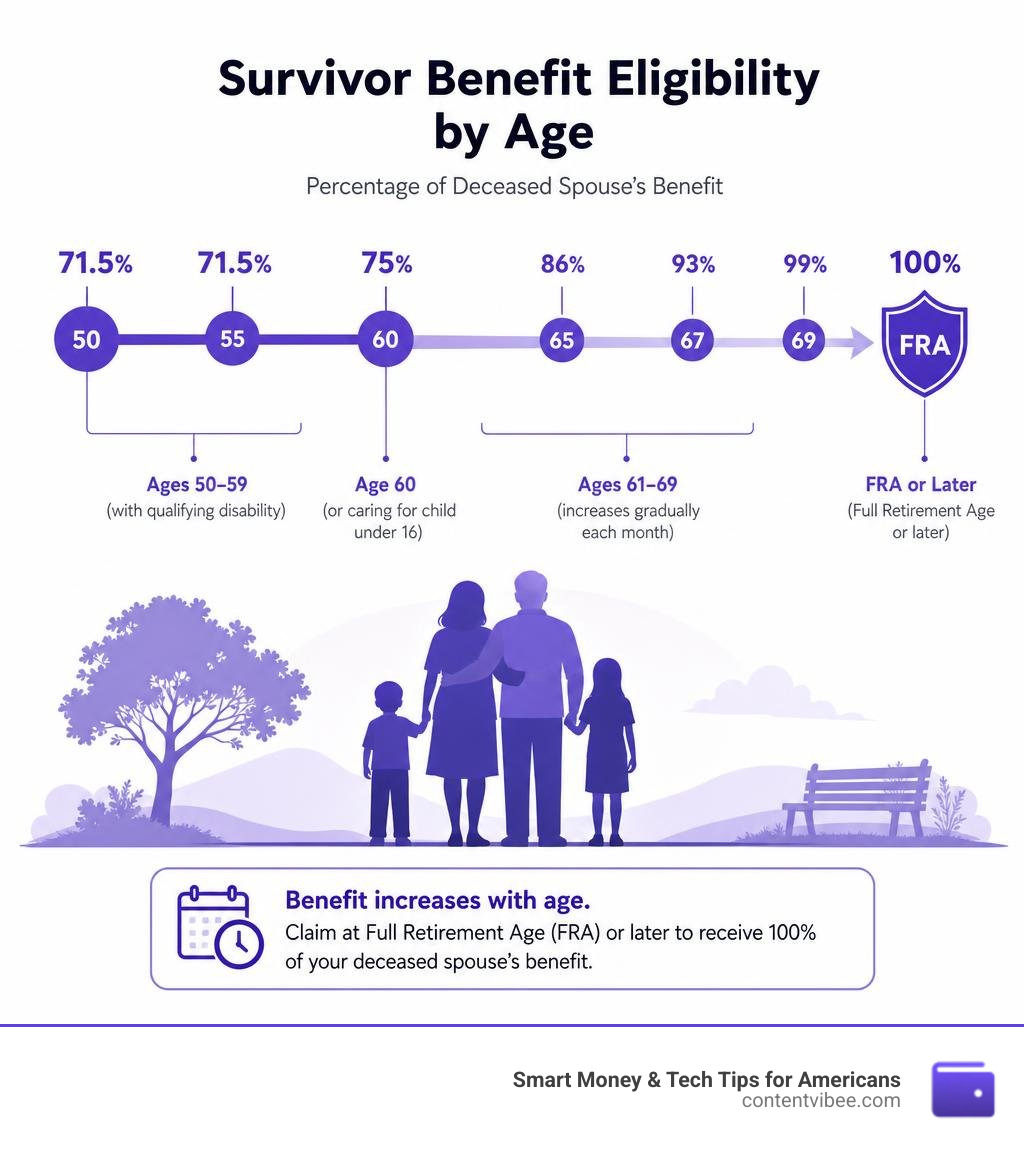
| Survivor’s Claiming Age | Benefit Amount |
|---|---|
| Full Retirement Age (FRA) or later | 100% of deceased spouse’s benefit |
| Age 60 to FRA | 71.5% to 99% of deceased’s benefit |
| Age 50–59 (with qualifying disability) | 71.5% of deceased’s benefit |
| Any age (caring for child under 16) | 75% of deceased’s benefit |
The exact amount also depends on when the deceased spouse claimed their own Social Security — if they claimed early, a special limit called the “widow’s limit” may apply.
Losing a spouse is hard enough without also having to navigate a maze of Social Security rules. But the financial decisions you make in the months after a spouse’s death — or even before — can make a significant difference in your lifetime income.
More than 3.8 million widows and widowers were receiving Social Security survivor benefits as of September 2025. Yet many of them didn’t know they could switch between benefits, delay claiming to get a higher amount, or in some cases collect a separate pension survivor benefit on top.
This guide walks you through exactly how to estimate what you’re owed, what factors affect your amount, and how to avoid the most common mistakes.
What Are Social Security Survivor Benefits and Who Qualifies?
Before we dive into the math, let’s establish exactly what Social Security survivor benefits are and who is allowed to claim them. At its core, this program is designed to provide life-insurance-like protection for families when a working spouse or parent passes away. In fact, for many families, the value of these benefits exceeds that of a private life insurance policy.
To qualify for these benefits, the deceased worker must have earned enough Social Security credits during their working years. Most people need 40 credits (roughly 10 years of work) to be fully insured. However, a special rule allows younger workers who die prematurely to provide benefits for their families with as little as 1.5 years of work within the three years leading up to their death.
So, who is eligible to claim on a deceased worker’s record?
- Surviving Spouses: A widow or widower can qualify for full benefits once they reach their survivor Full Retirement Age (FRA). They can also claim reduced benefits as early as age 60.
- Disabled Surviving Spouses: If the survivor has a qualifying disability that started before or within seven years of the worker’s death, the eligibility age drops to 50.
- Surviving Spouses Caring for Children: A surviving spouse of any age can collect benefits if they are caring for the deceased’s child, provided the child is under age 16 or disabled.
- Dependent Children: Unmarried children under age 18 (or up to 19 if still attending high school full-time) can receive benefits. Disabled children whose disability began before age 22 are also eligible.
- Dependent Parents: Parents aged 62 or older who relied on the deceased worker for at least half of their financial support may also qualify.
For a standard spouse, the general rule is that you must have been married for at least nine months before your spouse’s passing to qualify for survivor benefits. If the death was accidental or occurred in the line of military duty, this nine-month requirement is waived. For a deeper dive into these requirements and what documents you need to gather, check out our guide on Claiming What’s Yours: A Guide to Deceased Spouse Social Security.
Understanding these core eligibility requirements is the first step. Once you know you qualify, you can begin the process of estimating your actual monthly payments.
How to Calculate Survivor Retirement Benefits
When you sit down to calculate survivor retirement benefits, the final number is determined by a combination of three major factors: the deceased spouse’s Primary Insurance Amount (PIA), the age at which the deceased spouse originally claimed their benefits, and the age at which you, the survivor, decide to claim yours.

Let’s break down how these variables interact:
1. The Deceased Spouse’s Primary Insurance Amount (PIA)
The foundational building block of any survivor benefit is the deceased worker’s PIA. This is the monthly amount they were entitled to receive at their own Full Retirement Age. If your spouse had not yet claimed benefits before they passed away, the Social Security Administration (SSA) will calculate their PIA based on their historical earnings record. To get a rough idea of these numbers, you can use the official Benefit Calculators | SSA to estimate potential benefit amounts based on different earnings histories.
2. The Deceased Spouse’s Claiming Age
Did your spouse claim Social Security early, or did they delay it? This decision permanently impacts what you can receive:
- If they claimed early: If your spouse claimed retirement benefits before reaching their FRA, their monthly check was permanently reduced. Consequently, your maximum survivor benefit will also be capped. Under a rule known as the “widow’s limit” (or RIB-LIM), your benefit is generally limited to the larger of what the deceased spouse was receiving, or 82.5% of their PIA.
- If they delayed claiming: If your spouse waited until after their FRA to claim, they accumulated delayed retirement credits (which increase the benefit by 8% for each year they waited up to age 70). As a survivor, you inherit this higher, boosted benefit amount.
3. The Survivor’s Claiming Age
The final piece of the puzzle is your own age when you file the survivor claim. While your survivor FRA may differ slightly from your normal retirement FRA (for example, those born in 1962 or later have a survivor FRA of 67), claiming before this age results in a permanent reduction.
If you claim at age 60, you will receive 71.5% of the deceased spouse’s benefit. This percentage scales up gradually for every month you delay, reaching 100% once you hit your survivor FRA.
| Survivor’s Age at Claim | Percentage of Deceased’s Benefit |
|---|---|
| Survivor Full Retirement Age (FRA) | 100% |
| Age 65 | ~86% to 92% (depending on birth year) |
| Age 62 | ~79% to 81% |
| Age 60 | 71.5% |
| Age 50 (with disability) | 71.5% |
It is important to remember that the percentage reduction applied to your survivor benefit is completely independent of when you claimed your own personal retirement or spousal benefits. If you need help visualizing how these percentages work alongside standard retirement options, you can read more in our A Comprehensive Guide to Social Security Benefits.
Strategic Claiming: Maximizing Your Combined Benefits
One of the most powerful aspects of survivor benefits is that they are legally distinct from your own retirement benefits. This means you do not have to settle for just one timeline; instead, you can strategically switch between the two to maximize your lifetime income.
The SSA allows you to file for a reduced survivor benefit first, while letting your own retirement benefit grow. For every year you delay your own retirement benefit past your FRA (up to age 70), your benefit increases by 8% due to delayed retirement credits. Once you reach age 70, you can switch from the survivor benefit to your own maximized retirement benefit if it is larger.
Alternatively, you can do the reverse. If your own retirement benefit is relatively small but your deceased spouse had a high benefit, you can claim your own reduced retirement benefit at age 62, and then switch to your full survivor benefit (worth up to 100% of your late spouse’s amount) once you reach your survivor FRA.
Consider this example: Suppose both you and your late spouse are age 62. Your own retirement benefit at FRA would be $2,000, while your spouse’s FRA benefit was $3,000. If you claim your own reduced benefit at age 62, you will receive a smaller check for a few years. However, by waiting until your survivor FRA to claim the survivor benefit, you can switch to the full, unreduced $3,000 monthly benefit.
Choosing the right timing is crucial to avoiding leaving money on the table. To help you decide when to pull the trigger on each benefit, take a look at our analysis of the Best Age to Collect SS. To calculate what your own retirement checks might look like at different ages, you can also use our How Much Social Security Will I Get Calculator.
How to Calculate Survivor Retirement Benefits for Divorced Spouses
If you are divorced, you might still be eligible to calculate survivor retirement benefits using your deceased ex-spouse’s work record. The federal government recognizes that long-term marriages contribute significantly to a household’s financial foundation, even if those marriages ultimately end.
To qualify as a surviving divorced spouse, you must meet the following criteria:
- The Ten-Year Rule: Your marriage to the deceased ex-spouse must have lasted for at least 10 consecutive years before the divorce was finalized.
- Age Requirements: You must be at least 60 years old (or 50 if you are disabled).
- Marital Status: You must currently be unmarried, unless you remarried after reaching age 60 (or age 50 if disabled). Remarrying before age 60 disqualifies you from claiming survivor benefits on your ex-spouse’s record, unless that subsequent marriage also ends.
Crucially, claiming a surviving divorced spouse benefit has absolutely no impact on the benefits of the deceased’s current widow or any other surviving divorced spouses. Each eligible survivor receives their full percentage independently, without shrinking the others’ checks.
For those trying to understand how these rules compare to benefits while an ex-spouse is still living, we break down the core differences in our guide on Can a Spouse Collect SS Spousal Benefits. If you are still married and planning ahead, you may also want to read up on What Is a Social Security Spousal Benefit and learn How to Check Your Eligibility for Spousal Social Security Benefits to see how your claiming options change over time.
How to Calculate Survivor Retirement Benefits Alongside Government and Military Pensions
If you or your deceased spouse worked in a government position, served in the military, or qualified for a state pension, your survivor benefits calculations will have a few extra layers of complexity. In these situations, federal provisions and specific pension programs can directly alter your monthly income.
The Government Pension Offset (GPO)
If you receive a pension from a federal, state, or local government job where you did not pay Social Security taxes (such as some public school teachers or civil servants), your Social Security survivor benefit may be reduced. Under the GPO, your survivor benefit is typically reduced by two-thirds of the amount of your government pension. If two-thirds of your pension is larger than your potential survivor benefit, your Social Security survivor payment could be reduced to zero.
The Windfall Elimination Provision (WEP)
While the WEP primarily affects your own retirement or disability benefits if you worked in jobs that did not pay Social Security taxes, it is a critical factor when planning your household’s overall retirement income. If you are trying to understand the age thresholds for these complex claiming scenarios, check out our guide on At What Age Can I Claim My Spouse’s Social Security.
Military Survivor Benefits
For families of military veterans, the Department of Defense offers the Survivor Benefit Plan (SBP). This plan allows retired service members to allocate a portion of their military retirement pay to a surviving spouse or child.
- The Full SBP Election: This choice reduces the veteran’s retirement annuity by 10% while they are alive. In exchange, the surviving spouse receives 50% of the unreduced annuity after the veteran passes away.
- The Partial SBP Election: This option reduces the retirement annuity by 5%, providing the surviving spouse with 25% of the unreduced retirement pay after death.
To estimate these specific premiums and payouts, you can utilize the SBP Premium | The Official Army Benefits Website or the SBP Premium | An Official Air Force Benefits Website . For broader military-specific survivor calculations, the Survivor Benefits | The Official Army Benefits Website is an invaluable tool.
California Public Employees (CalPERS)
Since we are headquartered in California, we pay close attention to local public employees. If your deceased spouse was a California public servant covered under the California Public Employees’ Retirement System, they may be entitled to CalPERS death benefits. Depending on the member’s retirement status and the specific coverage elected, survivors may receive a lump-sum death payment, a monthly survivor continuance, or a return of remaining contributions. To explore these options, you can review the official guidelines on Benefits Payable – CalPERS.
Frequently Asked Questions about Survivor Benefits
Navigating the rules of survivor benefits often brings up practical questions. Here are the answers to some of the most common questions we receive.
Can I receive both my own retirement benefit and a survivor benefit?
The short answer is no. Under the Social Security Administration’s “dual entitlement” rule, you cannot simply add your own retirement check to your survivor check to get a double payment. Instead, the SSA will calculate both benefits and pay you an amount equal to the higher of the two.
If you file for both, the SSA will pay your own retirement benefit first. If the survivor benefit is larger, they will add an extra payment to make up the difference, bringing your total monthly deposit up to the matching level of the survivor benefit. However, as we discussed in our strategic claiming section, you can choose to receive one benefit first while letting the other grow, switching to the larger amount later on.
How does working affect my survivor benefits?
If you choose to work while receiving survivor benefits before you reach your Full Retirement Age, your monthly checks may be temporarily reduced by the Social Security earnings test.
For the current year of 2026, the earnings limits are:
- If you are under FRA for the entire year: The earnings limit is $24,480. If you earn more than this threshold, the SSA will withhold $1 in benefits for every $2 you earn above the limit.
- In the year you reach FRA: The earnings limit rises to $65,160. During this year, the SSA will withhold $1 in benefits for every $3 you earn above the limit, counting only the months prior to your birthday month.
Once you reach your Full Retirement Age, the earnings test no longer applies. You can earn as much as you like without any reductions to your survivor benefits. Furthermore, the SSA will recalculate your benefit amount at FRA to credit you for any months your benefits were withheld. To see how these rules apply to spousal payments, you can read more in our detailed article Are Spousal Benefits Reduced by Working.
What happens to my survivor benefits if I remarry?
Remarriage can affect your eligibility, but the outcome depends entirely on your age when you tie the knot:
- Remarriage before age 60: If you remarry before reaching age 60 (or age 50 if you are disabled), you lose your eligibility to receive survivor benefits on your deceased spouse’s record. You will only regain eligibility if the new marriage ends due to divorce, annulment, or death.
- Remarriage at or after age 60: If you wait until age 60 or older to remarry, your eligibility for survivor benefits from your late spouse is completely unaffected. You can continue to receive the survivor benefit, or you can choose to claim a spousal benefit on your new partner’s record if that amount is higher.
Conclusion
Calculating and maximizing your survivor retirement benefits is a critical part of securing your financial future. By understanding how your claiming age, your late spouse’s claiming age, and other retirement assets interact, you can make informed decisions that protect your household income.
At Smart Money & Tech Tips for Americans, we are dedicated to helping you navigate these complex choices with ease. To estimate your potential spousal and survivor options side-by-side, we invite you to try our interactive Social Security Spousal Benefit Calculator. Taking the time to run these calculations today can help ensure you receive every dollar you are entitled to in retirement.


