


Why a Social Security Calculator Is the First Step Toward a Secure Retirement
A Social Security calculator is one of the most powerful — and most underused — tools available to American retirees and near-retirees. Before diving into the details, here’s a quick answer to what you came for:
How to estimate your Social Security retirement benefit in 5 steps:
- Gather your earnings history — log in to ssa.gov/myaccount to get your official record
- Choose a calculator — use the SSA Quick Calculator, Online Calculator, or Detailed Calculator
- Enter your date of birth and annual earnings — accuracy here directly affects your estimate
- Select your planned claiming age — compare payouts at 62, your Full Retirement Age (FRA), and 70
- Review your estimated monthly benefit — in today’s dollars or future (inflation-adjusted) dollars
The difference between claiming at 62 versus waiting until 70 can mean hundreds of dollars per month — permanently. For couples, the stakes are even higher, since your claiming decision also sets the survivor benefit your spouse would receive if you die first.
In 2026, the average monthly Social Security benefit is about $2,071, while the maximum benefit at Full Retirement Age is $4,152 per month. Most people land somewhere in between — and where you land depends heavily on when you claim and how many years you worked.
This guide walks you through exactly how to use a Social Security calculator to estimate your payout, avoid common mistakes, and make smarter decisions about when to claim.

What is a Social Security Calculator and How Does It Work?
At its core, a social security calculator is a mathematical tool designed to mimic the complex formulas used by the Social Security Administration (SSA). Instead of making you crunch decades of wage data by hand, these calculators do the heavy lifting to project what your monthly check will look like.
To understand how these calculators work, we have to look at the three-step formula the SSA uses to determine your benefit:
- Average Indexed Monthly Earnings (AIME): The SSA looks at your entire work history and selects your 35 highest-earning years. It indexes these earnings to account for changes in average wages over time (indexing up to age 60). If you worked fewer than 35 years, the missing years are factored in as $0, which can drag down your average significantly.
- Primary Insurance Amount (PIA): This is your baseline monthly benefit if you claim at exactly your Full Retirement Age (FRA). To calculate your PIA, the SSA applies a progressive formula using “bend points” to your AIME.
- The 2026 Bend Points: For workers turning 62 in 2026, the bend points are $1,286 and $7,749. The formula is highly progressive, replacing:
- 90% of the first $1,286 of your AIME.
- 32% of your AIME between $1,286 and $7,749.
- 15% of any AIME over $7,749.
Let’s look at a quick example. If your average inflation-adjusted career earnings (AIME) equal $5,000 per month, your PIA using the 2026 bend points would be calculated as:
- 90% of $1,286 = $1,157.40
- 32% of ($5,000 – $1,286) = 32% of $3,714 = $1,188.48
- Total PIA = $2,345.88 per month (at your Full Retirement Age).
Any reputable social security calculator takes these exact bend points and wage caps into account. In 2026, the maximum wage base is $184,500 (up from $176,100 in 2025). This means any earnings above this cap are not taxed and do not count toward your benefit calculations. To get a complete overview of how these pieces fit together, check out A Comprehensive Guide To Social Security Benefits.
Types of Official Social Security Calculators
The SSA offers several different calculators depending on how much information you want to input and how precise you need the estimate to be.
- The Quick Calculator: If you want a ballpark figure in under 60 seconds, this is your tool. The Social Security Quick Calculator (also accessible via the Quick Calculator ) does not access your actual earnings record. Instead, it estimates your lifetime earnings based on your current year’s income and your date of birth. While convenient, it is only a rough approximation. You must be at least 22 years old to use it.
- The Online Calculator: For a more customized approach, the Benefits Planner: Retirement | Online Benefits Calculator | SSA (or its secondary link Benefits Planner: Retirement | Online Benefits Calculator | SSA ) allows you to manually enter your yearly earnings from 1951 to the present. This tool protects your privacy because it doesn’t link directly to your live database records, but it does require you to have a copy of your earnings statement handy.
- The Detailed Calculator: If you are a financial planner or a numbers enthusiast who wants to run highly complex scenarios, the Benefit Calculators – Estimate Your Benefit (also available at Benefit Calculators – Estimate Your Benefit ) is a downloadable software program for Windows and Mac. It can compute almost any type of Social Security benefit, including complex disability and survivor scenarios, and accounts for historical legislative changes.
Accuracy of a Social Security Calculator vs. Official SSA Records
While third-party calculators and quick online tools are incredibly helpful for “what-if” planning, they are only as accurate as the data you feed them. If you enter a rough guess of your average career earnings, the output will be a rough guess.
The gold standard for accuracy is your personal my Social Security account. By logging in, you gain direct access to your actual, verified earnings history reported by your employers over the decades.
If you use a manual-entry online tool, like the one featured in our How Much Social Security Will I Get Calculator, you can copy and paste your exact yearly earnings from your official statement to achieve near-perfect accuracy. Checking your official earnings record annually is a smart financial habit; correcting simple reporting errors on your record can save you $50 to $200 per month in retirement.
How Claiming Age and Full Retirement Age (FRA) Affect Your Payout
The age at which you choose to claim your benefit is the single most critical decision in your retirement planning process. Your Full Retirement Age (FRA) is the age at which you are entitled to 100% of your Primary Insurance Amount (PIA).
For anyone born in 1960 or later, your FRA is 67. If you were born between 1943 and 1954, your FRA is 66, with a gradual step-up of two months per year for those born between 1955 and 1959.
Claiming before your FRA results in a permanent monthly reduction. Claiming after your FRA, up to age 70, results in a permanent monthly increase. To weigh your options, you can read more about finding the Best Age To Collect Ss.
The Math Behind Early Claiming Reductions
If you choose to claim your retirement benefits as early as possible — at age 62 — and your FRA is 67, your monthly benefit will be permanently slashed by 30%.
The mathematical reduction is calculated as follows:
- First 36 months early: Your benefit is reduced by 5/9 of 1% for each month (or 6.67% per year).
- Any additional months early: Your benefit is further reduced by 5/12 of 1% for each month (or 5% per year).
For a worker with an FRA of 67 claiming at age 62, that is a full 60 months of early claiming, resulting in a permanent 30% reduction. If your FRA benefit is $2,000, claiming at 62 means you will only receive $1,400 per month.
Here is a quick reference table comparing how your claiming age affects your monthly payout, assuming a baseline FRA benefit (PIA) of $2,000:
| Claiming Age | % of FRA Benefit | Monthly Payout (Assuming $2,000 PIA) | Lifetime Impact Description |
|---|---|---|---|
| 62 (Earliest) | 70% | $1,400 | Permanent 30% reduction; highest number of checks but lowest amount |
| 63 | 75% | $1,500 | Permanent 25% reduction |
| 64 | 80% | $1,600 | Permanent 20% reduction |
| 65 | 86.7% | $1,733 | Permanent 13.3% reduction |
| 66 | 93.3% | $1,867 | Permanent 6.7% reduction |
| 67 (FRA) | 100% | $2,000 | Baseline unreduced benefit |
| 68 | 108% | $2,160 | 8% permanent increase via delayed credits |
| 69 | 116% | $2,320 | 16% permanent increase via delayed credits |
| 70 (Max) | 124% | $2,480 | 24% permanent increase; maximum possible monthly check |
Maximizing Payouts with Delayed Retirement Credits
On the flip side, delaying your claim past your FRA earns you Delayed Retirement Credits. For every year you wait past your FRA (up to age 70), your benefit increases by 8% per year (or 2/3 of 1% for each month).
If your FRA is 67 and you delay claiming until age 70, you will receive a permanent 24% increase over your baseline PIA. Using our $2,000 example, your monthly check climbs to $2,480. When combined with compounding Cost-of-Living Adjustments (COLA), your age-70 check can easily end up being 76% larger than your age-62 check.
For many, waiting is one of the safest and highest-returning financial decisions available, offering a guaranteed 8% annual increase with zero market risk. You can run these exact numbers for your specific career history using our How Much Social Security Will I Get Calculator.
Step-by-Step Guide: How to Use a Social Security Calculator
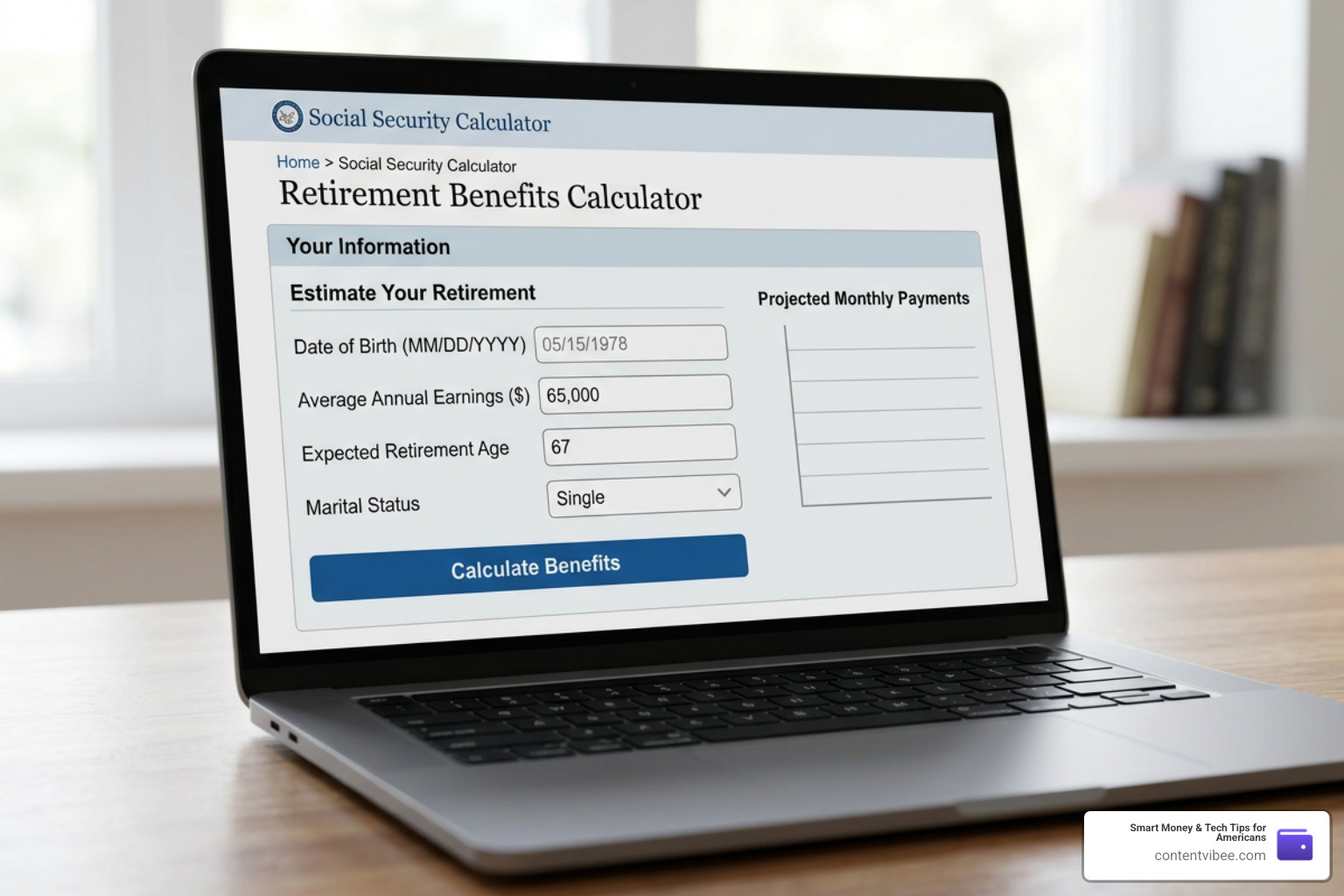
Ready to see your numbers? Let’s walk through how to use a social security calculator to map out your retirement strategy.
Step 1: Retrieve Your Earnings Record
Before opening any tool, log in to your secure account at ssa.gov. Download your PDF statement and look at your year-by-year taxed Social Security earnings. If you do not have an account, grab your most recent tax returns or W-2s.
Step 2: Choose the Right Calculator
- If you want a quick, 1-minute estimate, use the Social Security Quick Calculator.
- If you have your year-by-year earnings ready and want an accurate, private estimate, use the Benefits Planner: Retirement | Online Benefits Calculator | SSA .
- If you want a visual, highly interactive planning experience that helps you compare early vs. late claiming, try the Social Security Calculator: Estimate Your Benefits .
Step 3: Input Your Demographics and Earnings
Enter your correct date of birth. (Note: If you were born on January 1st, the SSA calculates your benefit as if you were born in the previous year!). Input your current annual earnings and, if using the Online Calculator, enter your historical earnings.
Step 4: Toggle the “Today’s vs. Future Dollars” Option
Most official calculators allow you to view your benefits in “today’s dollars” (purchasing power in 2026) or “future inflated dollars.” Viewing in today’s dollars is generally best for retirement planning because it aligns with your current budget and expenses.
Step 5: Compare Scenarios and Analyze the COLA Impact
Run different scenarios for claiming at 62, 67, and 70. Cost-of-Living Adjustments (COLA) compound over time. A larger starting benefit at age 70 means that future COLA percentage increases will apply to a much larger base, accelerating your income growth in later years.
How Earnings History, Spousal Benefits, and the Earnings Test Impact Your Payout
Your career length, your marital history, and whether you plan to keep working after claiming your benefits all play massive roles in your final payout.
First, the SSA uses your 35 highest-earning years. If you only worked 30 years, the formula will insert five years of “$0” earnings. Working even a few part-time years to replace those zeros can dramatically increase your monthly benefit. Each additional year of work that replaces a low-earning or zero-earning year can add $50 to $150 per month to your lifetime benefit.
Second, if you plan to work while collecting benefits before your FRA, you must watch out for the Earnings Test. In 2026, the earnings limit for beneficiaries under FRA is $24,480. If you earn more than this limit, the SSA will withhold $1 for every $2 you earn above the threshold.
The year you reach FRA, the limit rises to $65,160, with $1 withheld for every $3 earned above the limit until the month you actually hit FRA. The good news? This money isn’t gone forever. Once you reach your FRA, the SSA recalculates your monthly benefit upward to account for the months benefits were withheld. To see how these variables interact, explore our Tools/Finance Calculator.
Coordinating Spousal Benefits with a Social Security Calculator
If you are married, divorced, or widowed, you may be eligible for benefits based on your spouse’s work record instead of (or in addition to) your own.
A spousal benefit can be worth up to 50% of the higher-earning spouse’s PIA when claimed at the lower-earning spouse’s Full Retirement Age. If you claim spousal benefits early, they will be reduced.
To help couples coordinate their claiming strategies, we have built dedicated resources. You can read about how spousal coordination works in Can A Married Couple Both Collect Social Security and see if you are both eligible at Do Both Spouses Collect Social Security. To calculate your potential spousal payout, utilize our guide to Calculate Spouse Retirement Benefits.
Planning for Survivor Benefits
Survivor benefits are designed to protect a surviving spouse from a massive income drop when one partner passes away. A surviving spouse can inherit up to 100% of the deceased spouse’s monthly benefit, provided they have reached their own FRA.
Because the survivor benefit is based on what the deceased spouse was actually receiving at the time of death, it is highly beneficial for the higher-earning spouse to delay claiming until age 70. This maximizes the monthly check that will eventually be left behind for the surviving partner.
You can learn more about the rules of claiming a spouse’s record at At What Age Can I Claim My Spouses Social Security and run calculations using our guide to Calculate Survivor Retirement Benefits.
Key Limitations and Caveats of Social Security Calculators
While a social security calculator is an invaluable tool, it cannot predict the future. There are several critical limitations and caveats you must keep in mind:

- The 2034 Trust Fund Depletion: The Social Security Administration projects that the Old-Age and Survivors Insurance (OASI) Trust Fund will be depleted in 2034. If Congress takes no action before then, ongoing payroll taxes are projected to fund approximately 77% of scheduled benefits. While complete insolvency is highly unlikely, building a moderate level of uncertainty into your long-term retirement calculations is a smart planning step.
- The Windfall Elimination Provision (WEP): If you receive a pension from employment where you did not pay Social Security taxes (such as certain federal, state, or local government jobs, including many teachers in California), your Social Security benefit may be reduced. Standard calculators do not account for WEP unless you use the special-purpose WEP version of the Online Calculator.
- The Government Pension Offset (GPO): Similar to WEP, GPO reduces spousal or survivor benefits for those who receive non-covered government pensions. The offset can reduce your spousal benefit by up to two-thirds of your government pension amount, sometimes wiping out the Social Security benefit entirely.
- Taxation of Benefits: Depending on your “combined income” (adjusted gross income + nontaxable interest + half of your Social Security benefits), up to 85% of your benefits may be subject to federal income taxes. Fortunately for our local readers, California is one of the states that does not tax Social Security benefits at the state level!
Frequently Asked Questions about Social Security Calculators
What is the maximum Social Security benefit in 2026?
The maximum monthly benefit at Full Retirement Age in 2026 is $4,152. To qualify for this maximum amount, you must have earned at or above the maximum taxable wage base (which is $184,500 in 2026) for at least 35 years of your working career. If you delay claiming until age 70, the maximum benefit increases to $5,251 per month.
How does the 2026 earnings test work if I work while collecting?
If you claim benefits before your FRA and continue working, the 2026 earnings test limit is $24,480. For every $2 you earn over this limit, the SSA will withhold $1 in benefits. In the calendar year you reach FRA, the limit is $65,160, with $1 withheld for every $3 earned above the limit until your birth month. Once you reach FRA, the earnings test no longer applies, and your benefit is adjusted upward to credit you for the withheld amounts.
What happens to my benefits if the OASI Trust Fund is depleted in 2034?
If the trust fund is depleted in 2034 and Congress does not pass reform, ongoing payroll taxes will still collect enough to pay approximately 77% of scheduled benefits. This means benefits would not disappear, but they could face a automatic 23% reduction. Most financial experts anticipate that Congress will implement bipartisan reforms (such as adjusting the wage cap or retirement age) before 2034 to prevent this scenario.
Conclusion
Planning your retirement doesn’t have to feel like guesswork. By using a reliable social security calculator and coordinating your claiming age with your spouse, you can lock in a larger, inflation-protected stream of income for the rest of your life.
At Smart Money & Tech Tips for Americans, we are dedicated to helping you navigate these complex rules with ease. Take control of your financial future today by calculating your personalized estimate using our How Much Social Security Will I Get Calculator and exploring our suite of retirement planning tools.


