


What Are Social Security Student Benefits — and Who Gets Them?
Social Security student benefits are monthly payments made to children of retired, disabled, or deceased workers — and they don’t have to stop at age 18 if the child is still in school.
Here’s a quick breakdown of how student benefits compare to general child benefits:
| Feature | General Child Benefits | Student Benefits (Age 18-19) |
|---|---|---|
| Age limit | Under 18 | 18 to 19 (or graduation) |
| Requirement | Parent retired, disabled, or deceased | Same, plus full-time school enrollment |
| School level covered | Not applicable | Elementary or secondary (grade 12 or below) |
| College coverage | No | No (eliminated in 1981) |
| Benefit amount | Up to 50% of parent’s benefit | Same rate continues |
| How to claim | Apply with SSA | File Form SSA-1372-BK |
The key difference: regular child benefits stop automatically when a child turns 18. Student benefits let those payments continue — but only if the child is enrolled full-time in a qualifying school.
This matters more than most families realize. Around 100,000 students receive these benefits each year. If your child is approaching their 18th birthday and still in high school, missing this window means leaving real money on the table.
Real people have used these benefits to stay in school after a parent’s death or disability. One account from an advocacy report describes a student who used Social Security survivor benefits to remain in college after losing his father — and noted his sister benefited from the same program. That kind of financial bridge can make or break a student’s ability to finish their education.
The rules are specific, the deadlines are tight, and the paperwork has to happen before the month your child turns 18. This guide walks you through exactly what you need to know.
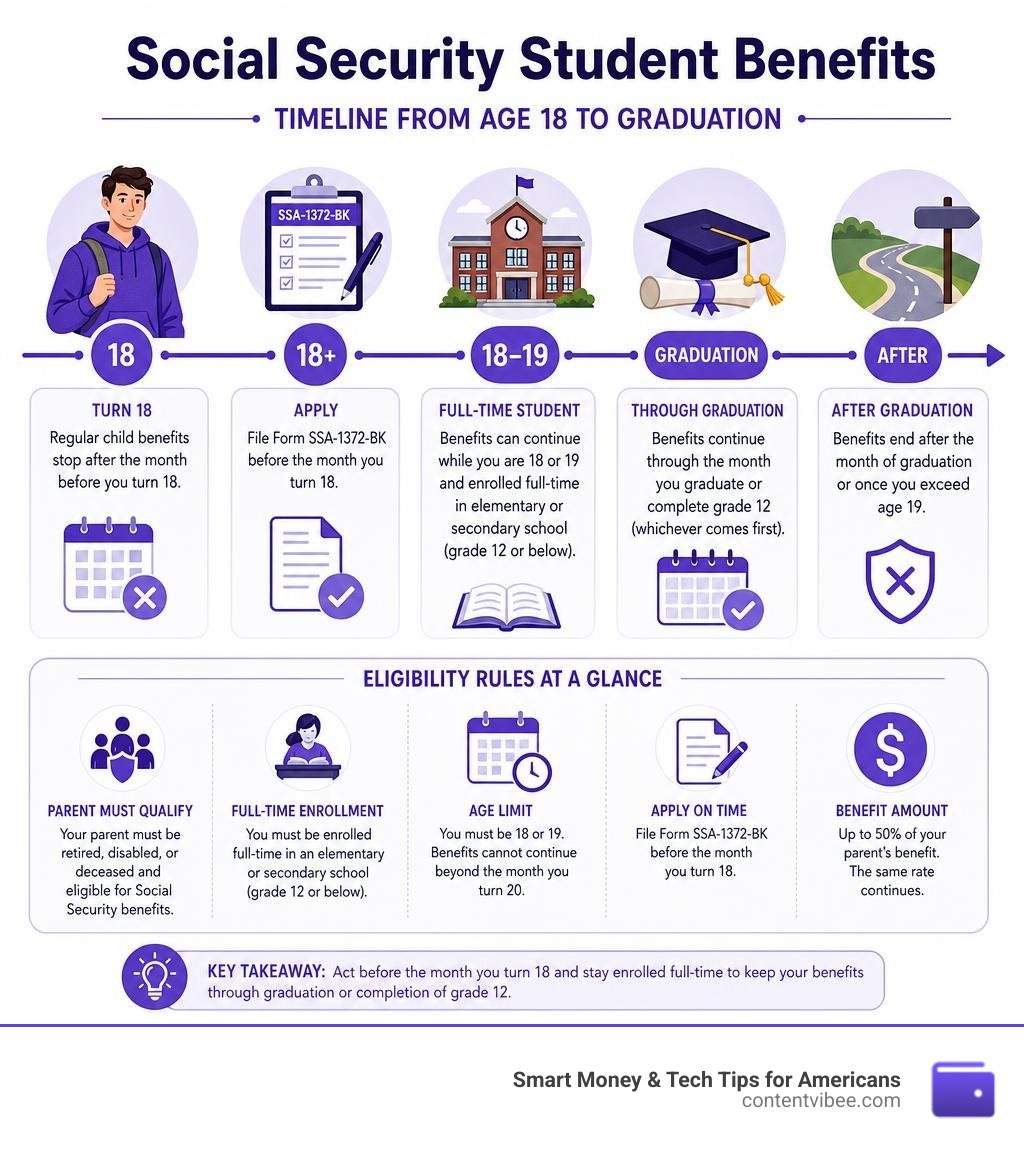
Understanding Social Security Student Benefits vs. General Child Benefits
To truly understand how social security student benefits function, we must first look at the broader umbrella of Social Security Child’s Insurance Benefits. Under normal circumstances, when a parent retires, becomes disabled, or passes away, their unmarried minor children may receive monthly cash benefits. These general child benefits are designed to help families cover basic living and educational expenses.
However, the law states that a child legally “attains” age 18 on the day before their 18th birthday. Consequently, regular child benefits automatically end with the payment for the month prior to the month in which they turn 18. For instance, if a student’s 18th birthday is June 1, their final regular child’s benefit check would cover April, meaning no payment is made for May unless they qualify for an extension.
This is where student benefits step in as a crucial financial bridge. If the child is still attending an elementary or secondary school full-time, the benefits can continue until they graduate or turn 19, whichever comes first.
These payments are calculated as a percentage of the parent’s basic Social Security benefit:
- Retired or Disabled Parent: A child can receive up to 50% of the parent’s full retirement or disability benefit.
- Deceased Parent: Survivors benefits can be up to 75% of the deceased parent’s basic benefit rate.
It is important to keep in mind the family maximum limit. The Social Security Administration (SSA) caps the total amount a family can receive on a single worker’s record. This maximum family payment typically ranges from 150% to 180% of the parent’s full benefit amount. If the total benefits of all dependents exceed this cap, individual payments are reduced proportionally. To understand how these limits interact with your family’s overall financial plan, you can read The Complete Guide to Benefit Rules.
Eligibility Criteria and Approved Educational Programs

Not every educational path qualifies a student to receive extended benefits past age 18. The SSA has strict definitions regarding what constitutes an approved educational institution and what qualifies as full-time attendance. For a comprehensive overview of how child-based payments work, you can reference the official [PDF] Benefits for Children – Social Security Administration .
Who Qualifies for Social Security Student Benefits?
To qualify for extended social security student benefits, a young adult must meet several strict criteria simultaneously:
- Age Limit: They must be between 18 and 19 years old. (Benefits can sometimes extend past age 19 if the student is in the middle of a school term, which we will discuss below).
- Marital Status: The student must remain unmarried. If they marry, their student benefits stop immediately.
- Parental Status: They must have a parent who is currently receiving Social Security retirement or disability benefits, or a parent who is deceased but worked long enough to pay Social Security taxes.
- Educational Status: They must be a full-time student at an elementary or secondary school (grade 12 or below).
For answers to specific situational questions regarding these criteria, you can check the Frequently Asked Questions for Students | School Officials | SSA .
What Counts as Full-Time Attendance?
According to federal regulations, a student is considered to be in full-time attendance if they meet the following criteria:
- Weekly Hours: They are scheduled to attend school at a rate of at least 20 hours per week.
- Course Duration: They are enrolled in a non-correspondence course that is at least 13 weeks in duration.
- School Standards: They carry a subject load that their school officially considers full-time for day students.
Whether a school or program qualifies as an approved educational institution depends heavily on state law. The SSA refers to the state’s education department to verify if an online academy, private school, or alternative program is officially recognized.
For example, legal disputes often arise regarding whether non-traditional programs qualify. In the administrative precedent SSA – POMS: PR 07905.036 – North Carolina – 01/16/2020 , the SSA analyzed several cases to determine educational institution status:
- A student attending a High School Equivalency Diploma (HSED) program at Pitt Community College for 20 hours per week was approved because the college is chartered by the state.
- A public early college high school was easily confirmed as eligible.
- Conversely, a private academy was denied because it failed to meet North Carolina’s specific record-keeping and standardized testing requirements for non-public schools.
This means that if your child attends a home school, an online high school, or a GED program, they can still receive social security student benefits, but only if the program is authorized under state law and they maintain the 20-hour weekly attendance requirement.
How Earnings Affect Your Social Security Student Benefits
Many high school seniors work part-time jobs. If your child is receiving Supplemental Security Income (SSI) as a student, their earnings could impact their monthly payments. Fortunately, the SSA provides a highly generous safety net known as the Student Earned Income Exclusion (SEIE).
Under the SEIE, working students under the age of 22 who regularly attend school can exclude a significant portion of their earned income from their SSI benefit calculations. For the current year of 2026, the SEIE limits are:
- Monthly Exclusion Limit: $2,410
- Yearly Exclusion Limit: $9,730
This means a working student in 2026 can earn up to $2,410 in a single month (up to the annual cap of $9,730) without seeing a single dollar reduced from their SSI payment. To explore how the SSA defines these limits and tracks them, review SSA – POMS: SI 00820.510 – Student Earned Income Exclusion – 12/08/2025 and SSA – POMS: SI 00501.020 – Student – SSI – 05/31/2023 . If you want to understand how general tax laws apply to these payments, our Social Security Taxable Income Guide 2026 has you covered.
How to Apply: A Step-by-Step Guide to Form SSA-1372-BK

Applying for student benefits requires proactive planning. The SSA will send an advance notice of termination approximately three months before your child’s 18th birthday. Do not ignore this notice! If you wait until after their birthday, payments will stop, and restarting them can cause significant delays.
Before diving into the paperwork, you can use our Social Security Calculator: Estimate Your Benefit Amount to project your family’s ongoing monthly payments.
To prevent an interruption in benefits, you must complete and submit Form SSA-1372-BK (Student’s Statement Regarding School Attendance) before the month the child turns 18. Here is the step-by-step process.
Step 1: Complete the Student’s Statement
The student is responsible for filling out pages 2 and 3 of Form SSA-1372-BK | School Officials . This form acts as the student’s official statement of their school enrollment and intent to graduate.
On this form, the student must answer several critical questions, including:
- Are you currently in full-time attendance?
- Do you expect to earn more than the annual earnings limit?
- Are you married?
- Are you being paid by an employer to attend school?
- Do you have any outstanding warrants for your arrest?
The student must sign and date the statement, certifying that all information provided is accurate under penalty of perjury.
Step 2: Obtain School Official Certification
Once pages 2 and 3 are complete, the student must take the entire packet to their school. A school official (such as a principal, counselor, or registrar) must certify the attendance details on page 4.
The school official will:
- Verify that the student’s scheduled weekly hours and graduation date match school records.
- Sign, date, and provide their official title and phone number on page 4.
- Annotate page 5 (the Notice of Cessation) with the student’s expected graduation date and keep pages 5 and 6 in the school’s records.
Once certified, pages 2 and 3 must be returned to your local Social Security office. You can mail them or drop them off in person. We highly recommend keeping a copy of the certified form for your own records.
Step 3: Report Changes and Maintain Status
After benefits are approved, the student assumes the legal responsibility to notify the SSA immediately of any changes that could affect their eligibility. You must report if the student:
- Marries
- Stops attending school entirely or drops out
- Reduces their school attendance below the 20-hour weekly minimum
- Changes schools (which requires filing a new Form SSA-1372-BK)
- Begins receiving pay from an employer to attend school
- Changes their mailing address
What about summer breaks? The SSA allows student benefits to continue during summer vacation, provided the break does not exceed 4 months, the student was in full-time attendance immediately before the break, and they have a clear intent to return to full-time school immediately after the break.
The History, Elimination, and Future of College Student Benefits
Many parents are surprised to learn that social security student benefits do not cover college. However, this was not always the case.
Why Post-Secondary Benefits Were Eliminated in 1981
The program has a rich and complex history. In the 1965 Social Security Amendments, Congress expanded the Child’s Benefit concept to full-time students aged 18 to 22 who were pursuing higher education. Lawmakers recognized that college-aged children of deceased, disabled, or retired workers were still dependent on parental support and needed financial assistance to secure their economic futures.
For more on this era, you can read the historical analysis on the Social Security History page.
The program expanded rapidly. By its peak year in 1977, almost 900,000 students were receiving these benefits. In 1981, the peak payout year, the program distributed nearly $2.4 billion to college students. In fact, in 1978, two-thirds of the students receiving this benefit came from households with incomes below the poverty line.
Despite its success, the program faced heavy criticism. Critics pointed to high overpayment rates (estimated at $150 million to $300 million annually by the late 1970s) driven by self-reporting failures. Furthermore, during the Reagan administration, Social Security faced a severe solvency crisis.
Under the Omnibus Budget Reconciliation Act of 1981, Congress voted to phase out post-secondary student benefits entirely, arguing that the newly established Pell Grant program and other federal student loans should handle higher education funding. The phase-out was completed by April 1985, leaving only secondary students (grade 12 and below) eligible.
The Modern Argument for Reinstating College Benefits
Today, the landscape of higher education is vastly different than it was in 1981. Tuition prices have skyrocketed, and the purchasing power of federal aid has plummeted. For example, while the maximum Pell Grant covered 58% of public university costs in 1981, it covers only about 32% of those costs today.
Advocates argue that reinstating college student benefits would provide life-changing economic opportunity for low-income and minority students. A 2003 academic study highlighted that the 1981 elimination led to a disproportionate drop in college enrollment among Black and low-income youth.
Public support for restoring this benefit is incredibly high. Surveys show that 78 percent of Americans support extending Social Security benefits to children of deceased or disabled parents until age 22 if they are enrolled in college.
Furthermore, the financial impact on the Social Security Trust Fund would be minimal. Actuarial estimates suggest that reinstating the student benefit up to age 22 would only cost approximately 0.07 percent of taxable payroll over the 75-year actuarial horizon. For an average worker earning $50,000 a year, this would amount to paying just an extra $35 per year in payroll taxes.
Frequently Asked Questions about Student Benefits
Navigating the rules of the SSA can feel overwhelming. Here are direct answers to the most common questions families ask.
When do student benefits officially stop?
In general, your benefits will stop in the month you turn 19, or the first month in which you are no longer a full-time secondary student, whichever occurs earlier.
However, there is a special extension rule: if you turn 19 while actively enrolled in school, benefits can continue until the end of the current school term (quarter or semester), or for up to two months after your 19th birthday if the school does not operate on a term basis.
Can I receive benefits during summer vacation?
Yes. You can receive benefits during summer vacation if the break is 4 months or less, you were a full-time student immediately before the break, and you plan to return to school full-time immediately after. If you turn 19 during the summer break, your benefits will stop in the month you turn 19.
What changes must I report to the SSA?
You must report any changes in your school enrollment, dropping below 20 hours a week, graduating early, changing schools, getting married, changing your address, or if your estimated yearly earnings exceed the standard Social Security earnings limits.
Conclusion
Securing social security student benefits past age 18 requires careful attention to deadlines, accurate form submission, and proactive communication with school officials. By completing Form SSA-1372-BK before your child’s 18th birthday, you can prevent a sudden halt to the monthly financial support your family relies on.
At ContentVibee, we are dedicated to providing clear, actionable financial advice to help your family navigate retirement, disability, and survivor programs. For more strategies on maximizing your household’s monthly income, check out A Comprehensive Guide to Social Security Benefits.


