


How Much Will You Get from Social Security? Start Here
A social security calculator is the fastest way to estimate your monthly retirement benefit before you file — and the number it shows can vary dramatically depending on when you claim.
Here’s a quick snapshot of what you can expect in 2026:
| Claiming Age | Benefit Impact | 2026 Maximum Monthly Benefit |
|---|---|---|
| 62 (earliest) | Up to 30% permanent reduction | ~$2,831 |
| 67 (Full Retirement Age) | 100% of your earned benefit | $4,152 |
| 70 (latest for credits) | Up to 24% bonus above FRA | $5,251 |
The bottom line: The longer you wait to claim (up to age 70), the larger your monthly check — for life.
This matters more than most people realize. Nearly 44% of women and 39% of men aged 65 and older rely on Social Security for more than half of their retirement income. For a working spouse trying to time benefits just right — especially while still earning a paycheck — knowing your number ahead of time isn’t optional. It’s essential.
The challenge? Most people don’t know where to start, which calculator to trust, or what inputs actually move the needle. This guide walks you through all of it.
How a Social Security Calculator Estimates Your Retirement Benefits

At its core, a social security calculator is a mathematical model designed to replicate the Social Security Administration’s (SSA) complex formulas. Instead of making you calculate your inflation-adjusted earnings for the past several decades by hand, these tools do the heavy lifting in seconds.
By taking a few pieces of personal data, the calculator estimates your future monthly checks. It essentially acts as a financial crystal ball, helping you map out your retirement cash flow. If you are trying to figure out how your Social Security income fits into your broader financial plan, utilizing a Best Free Social Security Calculator Options Your No Cost Retirement Roadmap is a fantastic first step to building a reliable income strategy.
Official SSA Tools vs. Third-Party Estimators
When searching for a calculator, you will find both official government tools and third-party options. Understanding their differences is key to getting the best data:
- The my Social Security Account: This is the gold standard. By logging into your personal account on the official SSA website, the calculator links directly to your actual, verified earnings database. It knows exactly what you paid in payroll taxes every year, resulting in the most accurate estimate possible.
- The SSA Quick Calculator: If you do not want to create an account or are worried about inputting personal data, the Social Security Quick Calculator is a great alternative. It provides a rough estimate of retirement, disability, and survivor benefits based on your current earnings without accessing your official records.
- The Online Calculator: The Benefits Planner: Retirement | Online Benefits Calculator | SSA is slightly more accurate than the Quick Calculator, but it requires you to manually type in your year-by-year earnings record from your paper statement.
- The Detailed Calculator: This is a highly robust software program that you can download to your computer from the Benefit Calculators – Estimate Your Benefit page. It is capable of computing complex, highly customized scenarios, making it the tool of choice for professional financial planners.
- Third-Party Calculators: Tools like the Social Security Calculator: Estimate Your Benefits – AARP are highly interactive. They excel at visual comparisons, allowing you to slide your retirement age back and forth to see how your monthly check changes in real-time. They are also fantastic for modeling spousal and divorced-spouse benefits side-by-side.
To see the full suite of official tools available, you can browse the official Benefit Calculators | SSA directory.
Key Inputs Required for an Accurate Social Security Calculator Estimate
To get a precise estimate from any social security calculator, you need to feed it accurate information. The calculation relies heavily on four key variables:
- Date of Birth: This determines your exact Full Retirement Age (FRA). For anyone born in 1960 or later, your FRA is 67.
- Earnings History: Social Security is based on your highest 35 years of indexed earnings. If you have fewer than 35 years of work history, the calculation will plug in $0 for the missing years, which can significantly drag down your estimated benefit.
- Planned Retirement Age: The age you choose to start collecting benefits (anywhere from 62 to 70) dictates the permanent reduction or bonus applied to your base amount.
- Marital Status: This is critical because you might be eligible for spousal, survivor, or divorced-spouse benefits that pay more than your own work record would.
If you are eager to run these numbers for yourself, a great place to start is our comprehensive How Much Social Security Will I Get Calculator, which simplifies these variables into an easy-to-use interface.
Calculating Your AIME and PIA Under 2026 Rules
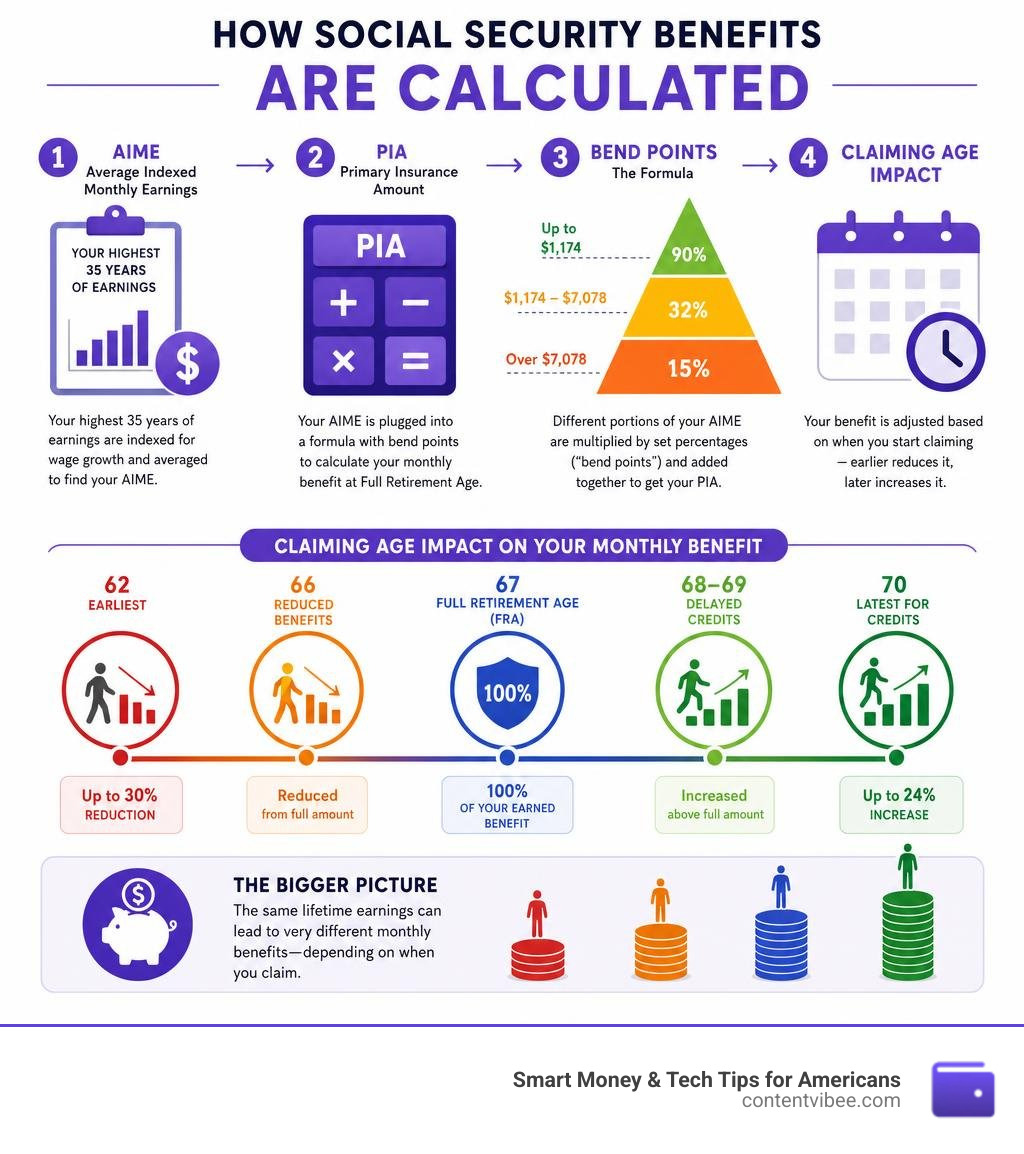
To truly understand how a social security calculator works, we have to look under the hood at two acronyms: AIME (Average Indexed Monthly Earnings) and PIA (Primary Insurance Amount).
First, the SSA takes your historical earnings and adjusts them for wage inflation using the Average Wage Index (AWI) up to the year you turn 60. This ensures that the $15,000 you earned decades ago is valued fairly in today’s economy. The SSA then takes your 35 highest-earning indexed years, adds them up, and divides the total by 420 (the number of months in 35 years) to establish your AIME.
Once your AIME is calculated, the SSA applies a progressive formula using “bend points” to determine your PIA—which is the exact monthly benefit you are entitled to at your Full Retirement Age.
Understanding the 2026 Bend Points and Wage Base
For the current year of 2026, the maximum taxable wage base is $184,500. Any earnings you make above this limit are not subject to the 12.4% Social Security payroll tax (which is split evenly at 6.2% each between you and your employer, or paid fully at 12.4% if you are self-employed), and they do not count toward your future benefit calculation.
The 2026 bend points are set at $1,286 and $7,749. The progressive PIA formula for 2026 is calculated as follows:
| Portion of AIME | Benefit Percentage |
|---|---|
| First $1,286 | 90% |
| Amount between $1,286 and $7,749 | 32% |
| Amount above $7,749 (up to the cap) | 15% |
Let’s look at a quick mathematical example. If your 35-year work history results in an AIME of $5,000 per month, your PIA would be calculated like this:
- 90% of the first $1,286 = $1,157.40
- 32% of the remaining amount ($5,000 – $1,286 = $3,714) = $1,188.48
- Total 2026 PIA = $1,157.40 + $1,188.48 = $2,345.88 per month (rounded down to the nearest dime)
Because the formula is progressive, it replaces a higher percentage of income for lower earners than it does for higher earners.
How Claiming Age Affects Your Monthly Payout
Your PIA is the amount you receive only if you claim at your Full Retirement Age (FRA). Claiming earlier or later will permanently alter this amount:
- Claiming at Age 62: If your FRA is 67 and you claim at 62, your benefit is permanently reduced by 30%. The reduction math is 5/9 of 1% for each of the first 36 months early, plus 5/12 of 1% for any additional months.
- Claiming at Age 70: If you delay claiming past your FRA, you earn Delayed Retirement Credits of 8% per year. Waiting from age 67 to 70 yields a permanent 24% bonus on top of your PIA.
This means your age-70 monthly check is roughly 76% larger than your age-62 check! When modeling these different timelines, we highly recommend integrating your Social Security estimates with a Retirement Calculator Estimate Savings Needed to see how much personal savings you will need to bridge any gaps.
Spousal Benefits, Working, and Taxation Rules
Social Security is not just an individual program; it is designed to protect families. This is where spousal, survivor, and divorced-spouse benefits come into play. If you are married, coordinating who claims what—and when—is one of the most powerful ways to maximize your joint lifetime benefits. To help model these complex household dynamics, you can use our dedicated Tools/Finance Calculator/Social Security Spousal Benefit Calculator.
Coordinating Benefits for Married and Divorced Couples
For married couples, a lower-earning spouse can claim a spousal benefit worth up to 50% of the higher-earning spouse’s PIA. However, there are a few rules to keep in mind:
- The higher-earning spouse must already be receiving their own retirement benefits for the other spouse to claim spousal benefits.
- If the lower-earning spouse claims before their own FRA, their spousal benefit will be permanently reduced.
- Divorced Spouses: If you were married for at least 10 years, are currently unmarried, and your ex-spouse is at least 62, you can claim benefits based on their record (up to 50% of their PIA) without affecting their current benefits or their new spouse’s benefits. For more details, see our guide on Ex Files A Guide To Using The Divorced Spouse Social Security Benefits Calculator.
- Survivor Benefits: When one spouse passes away, the survivor can inherit 100% of the deceased spouse’s monthly benefit, dropping their own smaller benefit. For couples, it is often wise for the higher earner to delay claiming until age 70, as this permanently maximizes the survivor benefit for the remaining spouse.
For married couples looking to optimize their filing strategy, we recommend reading our deep dive: Do The Math Top Social Security Calculators For Married Couples.
Working While Receiving Benefits and the Earnings Test
Can you work and collect Social Security at the same time? Yes, but if you are under your Full Retirement Age, your benefits may be temporarily withheld if you earn too much. This is known as the Earnings Test:
- Under FRA for the Whole Year (2026): The earnings limit is $24,480. For every $2 you earn above this limit, the SSA will withhold $1 in benefits.
- The Year You Reach FRA (2026): The limit jumps to $65,160. The SSA will withhold $1 for every $3 you earn above this limit up until the month you actually reach FRA.
- Once You Reach FRA: The earnings test disappears entirely. You can earn millions of dollars a year, and your Social Security check will not be reduced by a single penny.
Additionally, any benefits withheld under the earnings test are not lost forever. Once you reach FRA, the SSA recalculates your monthly benefit upward to credit you for the months benefits were withheld.
How Combined Income Determines Your Social Security Taxes
Many retirees are shocked to find out that their Social Security benefits can be taxed. Whether you owe federal income tax on your benefits depends on your combined income (also known as provisional income), which is calculated as:
$$\text{Combined Income} = \text{Adjusted Gross Income (AGI)} + \text{Nontaxable Interest} + 50\% \text{ of your Social Security benefits}$$
The federal tax thresholds are as follows:
- Single Filers:
- Combined income between $25,000 and $34,000: Up to 50% of your benefits may be taxable.
- Combined income over $34,000: Up to 85% of your benefits may be taxable.
- Married Filing Jointly:
- Combined income between $32,000 and $44,000: Up to 50% of your benefits may be taxable.
- Combined income over $44,000: Up to 85% of your benefits may be taxable.
To manage your tax brackets effectively in retirement, it is helpful to look at how your overall withdrawals are structured. You can check out our guide on Demystifying The 4 Percent Retirement Withdrawal Calculator to learn how to balance taxable and tax-free retirement accounts.
Frequently Asked Questions About Social Security Planning
What happens to my benefits if the Social Security trust fund is depleted?
The Old-Age and Survivors Insurance (OASI) Trust Fund is currently projected to be depleted by 2033 (or 2034, depending on economic shifts). If Congress does not act before then, ongoing payroll taxes would still cover approximately 77% of scheduled benefits.
However, it is highly unlikely that Congress will allow a sudden 23% benefit cut for millions of voters. Potential legislative fixes include raising the retirement age, increasing the payroll tax rate, or raising the maximum taxable wage base. When planning, you can use the Social Security Quick Calculator to run conservative estimates, perhaps factoring in a slight buffer for safety.
What is the maximum Social Security benefit in 2026?
For high earners who have hit the maximum taxable wage base for at least 35 years, the maximum monthly benefits in 2026 are:
- At Full Retirement Age (67): $4,152 per month.
- At Age 70: $5,251 per month.
For comparison, the maximum monthly federal Supplemental Security Income (SSI) payment for 2026 is $994 for a single person and $1,491 for a married couple.
How Can You Use a Social Security Calculator to Maximize Your Lifetime Benefits?
To get the absolute most out of the system, use a social security calculator to perform a “break-even analysis.”
For most healthy individuals, delaying benefits until age 70 is mathematically the best decision. The break-even age between claiming at 62 versus waiting until 70 is typically between 78 and 82 years old. If you expect to live past age 80, waiting to claim will net you a significantly larger lifetime payout.
Additionally, make sure you have a full 35-year work history to replace any zero-earning years. As you optimize your plan, you can coordinate your Social Security strategy with your personal savings using our Retirement Math Made Easy With A 401K Balance Calculator.
Conclusion
Navigating your retirement roadmap does not have to be an overwhelming mathematical chore. By utilizing a reliable social security calculator, you can take control of your financial destiny, run realistic scenarios, and make an informed decision on the exact age to file.
Whether you decide to claim early at 62 to enjoy retirement right away, wait until your Full Retirement Age of 67, or maximize your monthly check by delaying until age 70, knowing your numbers is the key to financial peace of mind.
Ready to see what your future monthly checks will look like? Take five minutes today to estimate your personalized benefits with our easy-to-use How Much Social Security Will I Get Calculator and start planning your dream retirement with confidence!