


Why More Retirees Are Choosing Part-Time Work in 2026
Retirement part-time work is one of the smartest moves a near-retiree can make — and more Americans are catching on every year.
Here are the most popular and practical part-time options for retirees right now:
| Job Type | Avg. Hourly Pay | Flexibility |
|---|---|---|
| Virtual Assistant | ~$21/hr | High (fully remote) |
| Consulting / Freelance | ~$46/hr | High (set your own hours) |
| Online Tutor | ~$22/hr | High (remote, self-scheduled) |
| Customer Service Rep | ~$21/hr | Medium (some remote options) |
| Retail Associate | ~$16/hr | Medium (shift-based) |
| Seasonal Tax Preparer | ~$25/hr | High (Jan–April only) |
But the numbers only tell part of the story.
In 2024, nearly 19.5% of Americans aged 65 and older were working or looking for work — almost double the rate from 1985. And of those working seniors, roughly 40% chose part-time arrangements. Yet there’s a striking gap: while 75% of pre-retirees plan to keep working after they retire, only 29% of current retirees actually follow through.
That gap exists because most people don’t know where to start — or they worry about triggering Social Security penalties, higher Medicare premiums, or unexpected tax bills.
This guide cuts through all of that. Whether you’re looking to pad your savings, stay mentally sharp, or simply keep a reason to get out of bed on Tuesday mornings, part-time work in retirement can deliver on all fronts — if you play it right.
Basic retirement part time work glossary:
Why Retirement Part-Time Work is the Ultimate Financial and Lifestyle Hack
For decades, the standard narrative of American life was simple: work full-time until age 65, throw a party, collect a gold watch, and never earn another dime. But today, we are witnessing a massive shift. Abrupt transitions into full-time leisure often lead to isolation, boredom, or even depression. Instead, many of us are realizing that a gradual transition — often utilizing bridge jobs to help you ease into retirement — is a much healthier and more financially secure path.
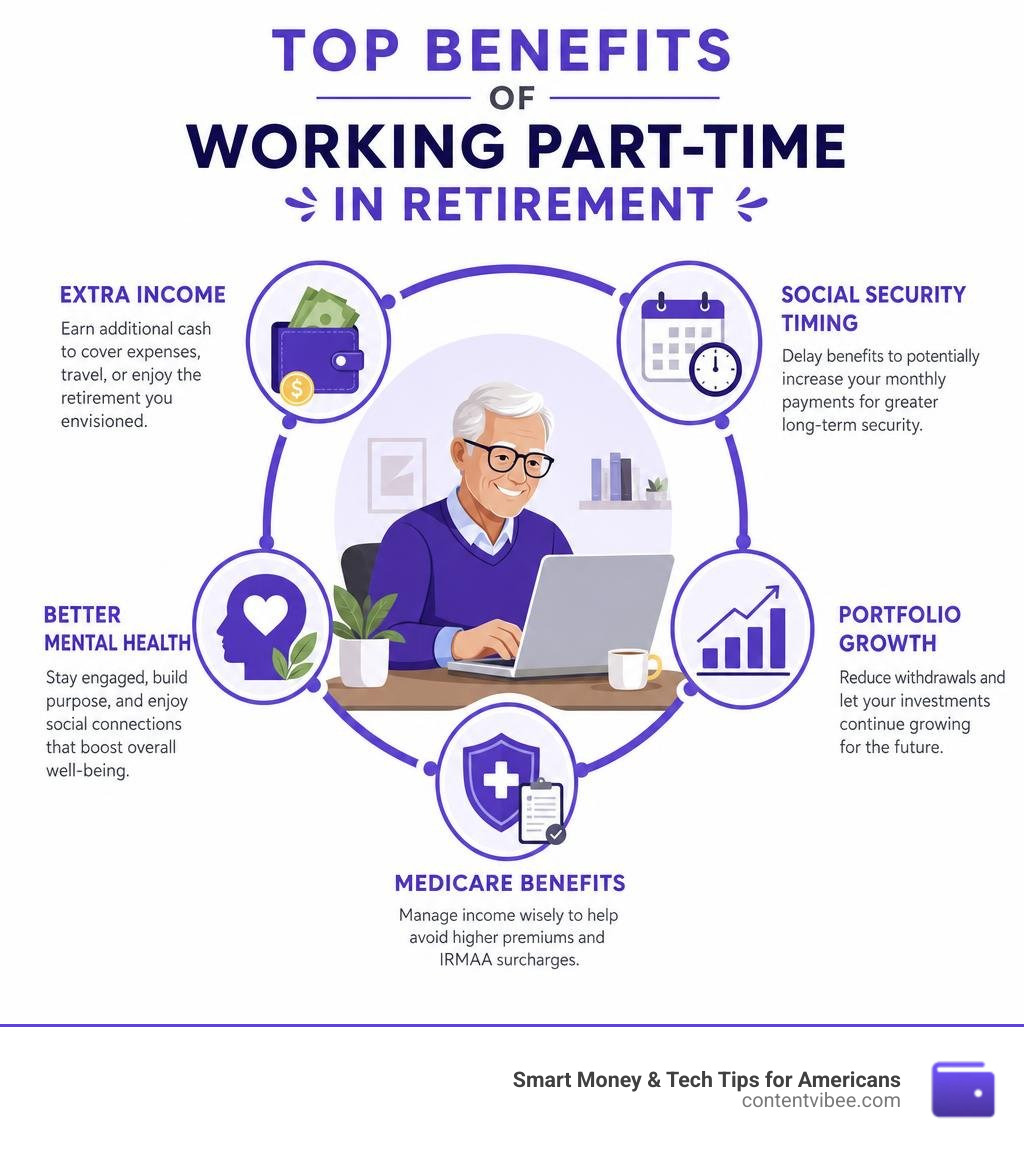
Financially, the math behind a modest part-time income is incredibly powerful. Let’s look at how it solves two of the largest financial threats to your golden years: sequence-of-returns risk and Social Security optimization.
1. Defeating Sequence-of-Returns Risk
When you first retire, your portfolio is highly vulnerable to market downturns. If the stock market drops in your first few years of retirement and you are forced to withdraw 4% or 5% of your portfolio to cover living expenses, you permanently lock in those losses. This is sequence-of-returns risk.
However, earning just $15,000 to $25,000 a year through retirement part time work can dramatically reduce or even eliminate your need to draw down your investment portfolio during those critical early years.
For example, if you have a $500,000 nest egg, a standard 4% withdrawal rule would yield $20,000 a year. If you earn that $20,000 through a flexible part-time role instead, you can leave your portfolio untouched. Assuming a modest 6% average annual return, keeping that $500,000 fully invested from age 62 to 67 can add over $100,000 to your nest egg by the time you fully stop working.
2. The Social Security Timing Bridge
Every year you delay claiming Social Security past your Full Retirement Age (FRA) up to age 70, your permanent monthly benefit increases by approximately 8%. Yet, many retirees claim early at age 62 (accepting a permanent reduction of up to 30%) simply because they need the cash flow to survive.
Part-time work provides the financial runway — or “bridge” — to defer claiming. By using a part-time job to cover your basic expenses, you can let your future Social Security check grow to its maximum possible size. If you want to know more about how this works, check out our guide on double dipping: how to work and collect Social Security at the same time.
The Non-Financial Payoff: Staying Sharp and Connected
Beyond the dollars and cents, the lifestyle benefits of staying engaged are profound. According to research, senior volunteers and part-time workers experience significantly better health outcomes. In fact, 80% of senior volunteers report good to excellent health, compared to just 50% of non-volunteers.
Working part-time keeps your mind active. Regular problem-solving, learning new digital tools, and interacting with colleagues or clients help maintain cognitive skills, slow memory decline, and support overall brain health. Additionally, it preserves your professional identity, offers daily structure, and prevents the social isolation that often creeps in when we leave the traditional workplace. To explore these emotional benefits further, read about the surprising perks of keeping your day job in your golden years.
Top Part-Time Jobs for Seniors in 2026

Finding the right post-retirement career isn’t about taking just any job that’s available; it’s about finding roles that respect your boundaries, leverage your hard-earned expertise, and offer the flexibility you deserve. For a broader overview, you can read the best retirement jobs for seniors to stay active and earn.
Many seniors are realizing they are not ready for the rocking chair: why seniors are staying in the workforce and are actively seeking engaging roles. Let’s look at the premier options available in 2026.
Virtual Assistant: The Premier Retirement Part-Time Work Option
If you want the ultimate blend of remote flexibility and professional engagement, becoming a Virtual Assistant (VA) is hard to beat. As businesses increasingly shift to decentralized, digital operations, the demand for organized, reliable administrative support has skyrocketed.
As a virtual assistant, you might manage email inboxes, schedule appointments, handle basic data entry, coordinate travel, or assist with customer inquiries — all from the comfort of your home office. Many retirees love this role because it allows them to use the software and communication skills they spent decades refining, without the stress of corporate office politics.
Typical pay ranges from $18 to $25 per hour, depending on your experience and the complexity of the tasks. If you have specialized skills, such as bookkeeping or digital marketing, your rate can go even higher. To get started, you will want to brush up on common digital collaboration platforms.
Essential skills for a modern retirement Virtual Assistant:
- Communication: Clear email writing and professional phone/video etiquette.
- Organization: Calendar management (Google Calendar, Outlook) and file organization (Dropbox, Google Drive).
- Software Proficiency: Basic Microsoft Office (Word, Excel) and project management basics (Trello, Asana).
- Tech Savviness: Comfort using Zoom, Slack, and basic customer relationship management (CRM) software.
If you enjoy the digital space but want to focus purely on writing, you might also consider retirement freelance writing jobs for seniors.
Other Flexible Retirement Part-Time Work Roles to Consider
If being a virtual assistant doesn’t appeal to you, there are plenty of other fantastic options to explore:
- Post-Retirement Consulting: This is the highest-paying option for many retirees, averaging $45.81 per hour (and often much more). If you spent your career in management, finance, engineering, or legal fields, you can package your decades of knowledge and consult for former employers or new clients on a project basis. To learn how to structure this, read how to work on your own terms with post-retirement consulting.
- Remote Customer Service: With roughly 33% of job postings in 2026 offering fully remote or hybrid arrangements, customer service is highly accessible. Many companies run 24-hour help lines and hire retirees to split shifts or handle evening/weekend hours from home. We have a detailed guide on how to land remote retirement customer service jobs.
- Tutoring and Instruction: If you love teaching, online and in-person tutoring is incredibly rewarding. Average pay sits around $21.55 per hour. You don’t always need a formal teaching degree; strong subject-matter expertise is often enough, though obtaining a National Tutoring Association certification can make you stand out.
- Seasonal Tax Preparation: For retired accountants or those comfortable with numbers, seasonal tax prep (running from January through April) offers a great way to earn a solid income without a year-round commitment. Check out retirement tax preparer jobs for retired accountants for more details.
- The Gig Economy: From pet sitting and dog walking to driving for rideshare services, the gig economy allows you to work entirely on your own terms. Learn how to master the gig economy in retirement to maximize your earnings.
- Affiliate and Digital Marketing: If you want to build a flexible online business, you can explore affiliate marketing for seniors: your guide to retirement income or search for a late career pivot: finding retirement digital marketing jobs.
Navigating the Financial Rules: Social Security, Taxes, and Medicare

While earning extra cash is great, working in retirement requires you to navigate a complex web of federal rules. If you aren’t careful, your part-time income could accidentally trigger Social Security benefit withholdings, push you into a higher tax bracket, or increase your Medicare premiums.
Social Security Earnings Limits in 2026
If you choose to work and collect Social Security at the same time, you must pay close attention to your age.
Once you reach your Full Retirement Age (FRA) — which is 67 for anyone born in 1960 or later — there is absolutely no limit on your earnings. You can earn millions of dollars at a part-time or full-time job, and your Social Security benefits will not be reduced by a single penny. For those working past this milestone, we cover the details in working past 70: how to handle your social security benefits.
However, if you claim benefits before reaching your FRA, the Social Security Administration enforces an Earnings Test. In 2026, the earnings limits are as follows:
- If you are under FRA for the entire year: The earnings limit is $24,480. If you earn more than this, the SSA will withhold $1 in benefits for every $2 you earn above the limit.
- In the year you reach FRA: The limit is much higher at $65,160 for the months leading up to your birthday month. For earnings above this threshold, the SSA will withhold $1 in benefits for every $3 you earn.
The Silver Lining: Recalculation
It is vital to understand that withheld benefits are not permanently lost. Once you reach your Full Retirement Age, the SSA will automatically recalculate your monthly benefit upward to credit you for the months they withheld payments. Still, to avoid cash-flow surprises, it’s best to keep your earnings under the threshold if you are drawing benefits early. For a deep dive into avoiding these clawbacks, read how to avoid the dreaded social security earnings limit penalty.
Tax Planning and Medicare Coordination
Earning a part-time income can also impact your taxes and healthcare costs.
1. Taxing Your Social Security
Your part-time wages could make your Social Security benefits taxable. The IRS uses a metric called “combined income” (Adjusted Gross Income + Nontaxable Interest + 1/2 of your Social Security benefits) to determine this:
- Single Filers: If your combined income is between $25,000 and $34,000, up to 50% of your benefits may be taxable. Above $34,000, up to 85% may be taxable.
- Joint Filers: If your combined income is between $32,000 and $44,000, up to 50% of your benefits may be taxable. Above $44,000, up to 85% may be taxable.
2. Medicare Premiums and IRMAA Surcharges
If your income rises too high, you could trigger the Income-Related Monthly Adjustment Amount (IRMAA). Medicare Part B and Part D premiums are based on your tax returns from two years prior.
For 2026, the standard Part B premium is roughly $185 per month. However, if your modified adjusted gross income (MAGI) from two years ago exceeds $106,000 for single filers or $212,000 for joint filers, your monthly Part B premium will jump to between $259 and $628.90 per month. Keeping your part-time income below these thresholds is a critical tax-planning strategy.
3. Tax-Planning Opportunities: Roth Conversions
Transition years — when you have left full-time work but haven’t yet reached the age for Required Minimum Distributions (RMDs) at 73 — represent a golden opportunity. You can use your part-time income to cover living expenses, leaving your tax bracket low enough to execute highly tax-efficient Roth conversions. Converting traditional IRA funds to a Roth IRA during these low-income years allows you to pay taxes at a lower rate, setting up tax-free withdrawals for the rest of your life.
Additionally, we recommend reading about your legal rights when working past retirement age to ensure you are fully protected in the workplace.
Practical Steps to Launch Your Post-Retirement Career
Ready to take the plunge into post-retirement work? Transitioning can feel daunting, but taking structured, deliberate steps will set you up for success. For a comprehensive roadmap, read the essential guide to returning to work after retirement and the ultimate guide to working past 65 and beyond.
Here is our checklist to help you get started:
- Clarify Your Goals: Are you working primarily for the money, the social connection, or the mental stimulation? If it’s purely for social connection, volunteering might be a better fit. If it’s for money, calculate exactly how much you need to earn to meet your financial goals.
- Define Your Boundaries: Decide in advance how many hours you want to work. Most working retirees find that 12 to 20 hours per week is the sweet spot. Set firm boundaries about your availability (e.g., “no weekends” or “only mornings”) before you start interviewing.
- Update Your Resume: Modernize your resume by focusing on the last 10 to 15 years of experience. Drop graduation dates and older jobs to keep the document concise and avoid age-bias. Highlight your familiarity with modern technology like Zoom, Microsoft Teams, and Google Workspace.
- Leverage Your Network: Reach out to former colleagues, industry contacts, and friends. Let them know you are looking for flexible, part-time opportunities. Many of the best consulting and project-based roles are never officially advertised; they are filled through word-of-mouth.
- Use Senior-Friendly Job Boards: In addition to standard job boards, utilize resources tailored specifically to older workers. Sites like the AARP Job Board and RetirementJobs.com are excellent places to find employers who actively value the reliability and experience of mature workers.
- Start Small: Don’t commit to a heavy schedule right away. Start with a small, project-based role or a few hours a week. You can always scale your hours up if you enjoy the work, but it’s much harder to scale back once an employer is relying on you.
If you are wondering about geographic rules, such as when can you stop working and retire in California?, make sure to review state-specific guidelines as well.
Frequently Asked Questions about Retirement Part-Time Work
How does part-time work affect my Social Security benefits?
If you have reached your Full Retirement Age (FRA), part-time work has zero effect on your benefits, no matter how much you earn. If you are under your FRA, your benefits will be temporarily reduced by $1 for every $2 you earn over the annual limit ($24,480 in 2026). However, these withheld funds are not lost; they are credited back to you as a higher monthly check once you reach your FRA.
Can I work part-time and still keep my Medicare coverage?
Yes. Your Medicare eligibility at age 65 is completely unaffected by part-time work. If your part-time employer offers health insurance, you can coordinate the two. Generally, if the employer has fewer than 20 employees, Medicare is your primary insurance. If the employer has 20 or more employees, the employer’s group health plan is primary, which may allow you to delay enrolling in Medicare Part B without penalty.
What are the best remote part-time jobs for retirees?
The top remote roles for retirees in 2026 include Virtual Assistants (VAs), remote customer service representatives, online tutors, freelance writers, and independent consultants. These roles offer the comfort of working from home, eliminate commuting costs, and provide the schedule flexibility that retirees value most.
Conclusion
At ContentVibee, we believe that retirement shouldn’t be a choice between working yourself to the bone or sitting in a rocking chair all day. Retirement part-time work offers a beautiful middle ground — a way to protect your nest egg, maximize your Social Security, stay socially engaged, and keep your mind sharp, all while maintaining the freedom to travel and enjoy your hobbies.
Before you accept any position, make sure you understand how your new earnings will interact with your overall financial picture. If you are married, you might also want to read our guide on working in retirement: are spousal benefits reduced by working? to ensure your spouse’s benefits remain secure.
Take your time, plan your transition carefully, and design a post-retirement career that works entirely on your own terms!


