


More People Qualify for Social Security Family Benefits Than You Might Think
Social Security auxiliary benefits are monthly payments the Social Security Administration (SSA) makes to certain family members — spouses, ex-spouses, children, and some grandchildren — based on a worker’s earnings record.
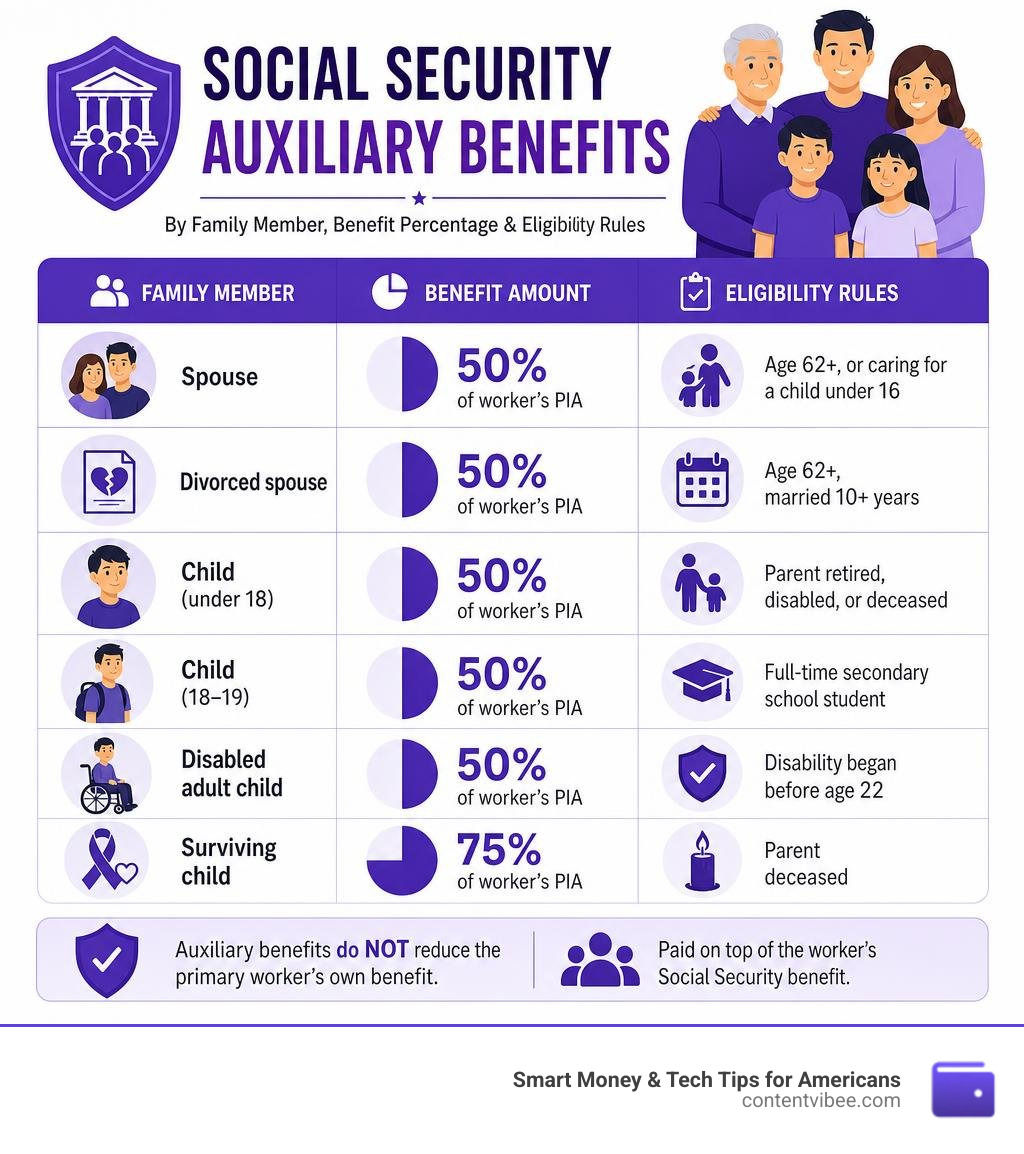
Here’s a quick snapshot of who can receive them and how much:
| Family Member | Qualifying Condition | Benefit Amount |
|---|---|---|
| Spouse | Age 62+, or caring for a child under 16 | Up to 50% of worker’s PIA |
| Divorced spouse | Age 62+, married 10+ years | Up to 50% of worker’s PIA |
| Child (under 18) | Parent retired, disabled, or deceased | Up to 50% of worker’s PIA |
| Child (18-19) | Full-time secondary school student | Up to 50% of worker’s PIA |
| Disabled adult child | Disability began before age 22 | Up to 50% of worker’s PIA |
| Surviving child | Parent deceased | Up to 75% of worker’s PIA |
Key facts to know upfront:
- Auxiliary benefits do not reduce the primary worker’s own benefit — they are paid on top of it
- Over 3.7 million dependents of retired and disabled workers received these benefits as of March 2024
- The total amount a family can receive is capped by the family maximum, typically 150%–180% of the worker’s benefit for retirement cases
- Families of disabled workers face a tighter cap — usually 100%–150% of the worker’s benefit
If you’re a working spouse nearing retirement, understanding these rules can make a real difference in your household income. The right timing and filing strategy could add hundreds of dollars a month to your family’s budget — money you’re already entitled to.
This guide walks through every major rule: who qualifies, how benefits are calculated, what documents you need, and how tricky situations like dual entitlement or divorce are handled.
What Are Social Security Auxiliary Benefits?
To put it in the simplest terms, social security auxiliary benefits—often referred to simply as “family benefits”—are additional monthly cash payments designed to support the dependents of a worker who is entitled to Social Security retirement or disability benefits.
These benefits fall under Title II of the Social Security Act. The “primary beneficiary” (the worker who paid into the system through payroll taxes) establishes the earnings record. When that worker becomes eligible for benefits, their immediate family members can ride on their coattails to receive their own monthly checks.
According to the official SSA Handbook § 501, auxiliary benefits are designed to keep families financially stable when a breadwinner retires or becomes disabled.
An interesting and lesser-known rule from the SSA Handbook is that these auxiliary payments can actually continue to be paid to your family members even if you, the primary worker, are not receiving your own benefits due to imprisonment. The system recognizes that your family’s financial needs do not disappear, even under extreme personal circumstances.
Whether you are retired or disabled, your family’s access to these benefits is a fundamental right of the Social Security system. As outlined in the general Family benefits | SSA page, the SSA considers age, marital status, and specific family relationships to determine who qualifies for these extra monthly payments.
Eligibility Rules for Spouses and Divorced Spouses
When it comes to adult dependents, the SSA has clear rules separating current spouses from ex-spouses. The absolute baseline for any spousal benefit is the duration of the marriage.
For a current spouse, you must generally be married for at least one continuous year before you can claim auxiliary benefits on your partner’s record. However, if you are the natural parent of your spouse’s child, this one-year waiting period is waived.
For divorced spouses, the rules are much stricter. The marriage must have lasted for at least 10 consecutive years before the divorce was finalized. If you meet this 10-year threshold, you may be eligible to claim benefits on your ex-spouse’s record without affecting their current household benefits in any way.
To explore these rules in deeper detail, check out our comprehensive resources on The Ultimate Guide to Spousal Social Security Eligibility and find answers to common legal questions in Can Divorced Spouse Get Social Security Benefits.
Spousal Qualifications for Social Security Auxiliary Benefits
To qualify for spousal social security auxiliary benefits, a current spouse must meet one of two primary conditions:
- Age-Based Qualification: The spouse must be at least 62 years old. If claimed before reaching Full Retirement Age (FRA), which is age 67 for anyone born in 1960 or later, the monthly benefit will be permanently reduced.
- “Child-in-Care” Qualification: A spouse can receive auxiliary benefits at any age if they are actively caring for a child of the worker who is under the age of 16, or a child who was disabled before the age of 22.
According to the SSA’s internal guidelines in SSA – POMS: NL 00711.025 – Wife’s Benefits Paragraphs – 12/22/2003 , once the youngest child in your care turns 16, the caregiver’s auxiliary benefits will stop, unless that child has a qualifying disability and you continue to provide personal services or parental control.
If you are ready to take the next step and file your claim, you can read our practical guide on Applying for Spousal Benefits.
Divorced Spousal Rules and the 10-Year Requirement
If you are divorced, you can still claim auxiliary benefits on your ex-spouse’s record if:
- Your marriage lasted 10 years or longer.
- You are currently unmarried (if you remarry, you generally lose eligibility on your ex-spouse’s record, unless the subsequent marriage also ended by death, divorce, or annulment).
- You are at least 62 years old.
- Your ex-spouse is at least 62 and eligible for retirement or disability benefits (even if they haven’t actually applied for them yet!).
If your ex-spouse has not yet applied for benefits, you must have been divorced for at least two consecutive years before you can file a claim on their record.
To see how these rules translate into real dollar amounts, you can use the resources in Ex-Files: A Guide to Using the Divorced Spouse Social Security Benefits Calculator.
Child Auxiliary Benefits and Childhood Disability Benefits (CDB)
Children are highly protected under the Social Security umbrella. If a parent qualifies for retirement or disability benefits, or passes away, their children may receive monthly auxiliary payments.
These benefits are available to:
- Biological children
- Adopted children
- Stepchildren (provided the step-relationship has existed for at least one year, or 9 months in survivor cases)
- Dependent grandchildren or step-grandchildren (under very specific circumstances where the parents are deceased or disabled)
As highlighted in the resource on Understanding Auxiliary Benefits, these payments are designed to stabilize family finances and ensure that children have basic financial support, regardless of whether they live in the same household as the primary beneficiary.
Age and School Attendance Rules for Children
Generally, a child’s auxiliary benefits will automatically terminate when they turn 18. However, there are two primary exceptions to this rule:
- High School Students: If a child is still a full-time student at an elementary or secondary school (high school), benefits can continue until they graduate, or until two months after they turn 19, whichever comes first. To prevent a gap in payments, parents should submit a certified statement of school attendance to the SSA three months before the child’s 18th birthday using Form SSA-4.
- Disabled Children: If a child has a qualifying disability, benefits can continue indefinitely into adulthood, as discussed below.
Childhood Disability Benefits (CDB) and Adult Children
If a child becomes disabled before reaching age 22, they may qualify for Childhood Disability Benefits (CDB), also known as Disabled Adult Child (DAC) benefits.
This is an incredibly valuable benefit because it allows an adult child to receive monthly payments based on their parent’s work record, which is often much higher than what they would receive on their own limited work history.
To apply for CDB, you will need to submit:
- Form SSA-4 (Application for Child’s Benefits)
- Form SSA-3368 (Disability Report – Adult)
- Form SSA-827 (Authorization to Disclose Information to the Social Security Administration)
This process requires extensive medical documentation showing that the adult child’s disabling condition met the SSA’s strict definition of disability before they turned 22.
How Auxiliary Benefits Are Calculated and the Family Maximum
The amount of money your family members can receive is directly tied to your Primary Insurance Amount (PIA). The PIA is the monthly benefit amount you are entitled to receive if you claim benefits at your exact Full Retirement Age.
Here is how those percentages break down across different types of auxiliary and survivor benefits:
| Beneficiary Type | Auxiliary Benefit Percentage | Survivor Benefit Percentage |
|---|---|---|
| Spouse (at FRA) | 50% of worker’s PIA | 100% of deceased worker’s PIA |
| Divorced Spouse (at FRA) | 50% of worker’s PIA | 100% of deceased worker’s PIA |
| Child (under 18 / Student) | 50% of worker’s PIA | 75% of deceased worker’s PIA |
| Disabled Adult Child | 50% of worker’s PIA | 75% of deceased worker’s PIA |
To quickly estimate your family’s potential monthly payments, you can use our interactive Social Security Spousal Benefit Calculator. If you are planning for the long term and want to understand how these numbers shift after a passing, read our guide on How Survivor Benefits Work When a Spouse Passes Away.
The Impact of the Family Maximum Limit
While calculating individual percentages is simple, the SSA does not write unlimited checks. The total amount of money a single family can receive on one worker’s record is strictly capped by the Family Maximum.
- Retirement and Survivor Cases: The family maximum typically ranges from 150% to 180% of the worker’s PIA.
- Disability Cases: The family maximum is much tighter, capped at either 85% of the worker’s Average Indexed Monthly Earnings (AIME) or 150% of the worker’s PIA, whichever is lower. Often, this results in a cap between 100% and 150% of the disabled worker’s benefit.
If the combined sum of the primary worker’s benefit and their dependents’ auxiliary benefits exceeds this family maximum cap, the worker’s benefit remains untouched, but every dependent’s auxiliary benefit is reduced proportionately until the total fits under the cap.
As detailed in the legal brief Title II Auxiliary Benefits: Social Security Benefits You’ve Never Heard of, and Who is Eligible for Them , divorced spouses are a notable exception to this rule. A divorced spouse’s auxiliary benefit is not included in the family maximum calculation, meaning their claim will never reduce the benefits paid to a current spouse or children.
Dual Entitlement and Delayed Retirement Credits (DRCs)
Many spouses work and pay their own Social Security taxes, meaning they are entitled to their own retirement benefit and a spousal auxiliary benefit. This is known as dual entitlement.
Under SSA rules, you cannot collect both benefits in full. Instead, the SSA will pay your own retirement benefit first. If your spousal benefit is larger than your own retirement benefit, they will pay you an “excess” amount to make up the difference, bringing your total payment up to the higher spousal rate.
We explain this delicate balancing act in His, Hers, and Ours: The Ultimate Guide to Dual Social Security Benefits.
Additionally, Delayed Retirement Credits (DRCs)—which increase your retirement benefit by 8% per year for every year you delay claiming past your FRA up to age 70—do not increase your living spouse’s auxiliary benefits. The spousal benefit is strictly capped at 50% of your PIA at FRA.
According to SSA – POMS: RS 00615.694 – DRCs in Dual-Entitlement Cases – 12/06/2023 , in dual-entitlement cases, the SSA calculates the combined payment without DRCs first, adds the DRCs to your retirement benefit, and then subtracts that adjusted amount to find the final payable auxiliary amount.
Special Rules: Back Pay, Medicare, and Benefit Continuation
Navigating the intersection of Social Security disability, retirement, and healthcare can get complicated. Fortunately, auxiliary beneficiaries have access to several key protections.
If a primary worker is awarded retroactive disability benefits (back pay), their eligible auxiliary dependents are generally entitled to retroactive auxiliary payments for those same months.
Furthermore, auxiliary beneficiaries can establish eligibility for Medicare based on the primary worker’s earnings history. This is particularly valuable for individuals who do not have enough work credits of their own to qualify for premium-free Medicare Part A.
Under SSA – POMS: HI 00801.405 – HI Entitlement for Auxiliaries and Survivors Based on MQGE – 02/08/2023 , certain government employees who paid Medicare taxes but not Social Security taxes (Medicare Qualified Government Employment, or MQGE) can pass Medicare eligibility to their auxiliary dependents and survivors, including disabled adult children and divorced spouses.
Medicare Entitlement for Social Security Auxiliary Benefits Recipients
To qualify for Medicare based on a spouse or parent’s work record, the auxiliary beneficiary must generally:
- Be at least 65 years old.
- Have End-Stage Renal Disease (ESRD) requiring dialysis or a kidney transplant.
- Be a disabled adult child who has been receiving Childhood Disability Benefits for at least 24 months.
This ensures that even if you spent your life working in the home or caring for a disabled family member, you will still have access to critical healthcare coverage when you turn 65.
Benefit Continuation Periods (BCP) During Disability Reviews
If the SSA conducts a Continuing Disability Review (CDR) and determines that a primary worker is no longer disabled, the worker has the right to appeal. Under Section 2 of Public Law 98-460, both the worker and their dependents can elect to continue receiving monthly payments during this appeal process, known as a Benefit Continuation Period (BCP).
However, processing subsequent claims during a BCP requires strict administrative oversight. As outlined in SSA – POMS: DI 10105.902 – Taking and Processing Auxiliary or Survivor Applications Filed During the Benefit Continuation Period (BCP) – Disability Benefit Equals or Exceeds Auxiliary or Survivor Benefit – 06/15/2015 , if a disabled worker files for an auxiliary or survivor claim on another record during a BCP, and their own disability benefit equals or exceeds that new claim, the new auxiliary claim cannot be paid out during the continuation period.
Additionally, SSA – POMS: DI 10105.904 – General – Auxiliary(s) – 07/14/2009 dictates that the primary worker must elect benefit continuation for themselves in order for auxiliaries living in their household to receive continued payments. If a disabled adult child (CDB) declines to continue benefits during an appeal, any parent receiving caregiver benefits based on having that child in their care will also have their continuation payments stopped.
How to Apply for Auxiliary Benefits

Applying for auxiliary benefits is relatively straightforward, but you must gather the correct documentation to avoid processing delays. You can apply online, over the phone at 1-800-772-1213, or by scheduling an in-person appointment at your local SSA office.
When you are ready to file, you will need to submit:
- The primary worker’s Social Security Number (SSN) and proof of their entitlement.
- Your own SSN and birth certificate.
- Proof of marriage (for current spouses) or divorce decrees (for ex-spouses).
- Form SSA-2 (for spousal claims).
- W-2 forms or self-employment tax returns for the previous year.
- Bank account routing and account numbers for direct deposit.
For a seamless digital filing experience, read Your Digital Guide to Form SSA-2 and Online Spousal Claims. If you are missing certain official documents, do not delay your application! The SSA will work with you to help obtain certified copies.
Frequently Asked Questions about Auxiliary Benefits
Navigating the SSA’s rulebook can feel like reading a foreign language. Here are simple answers to the most common questions we receive.
Do auxiliary benefits reduce the primary worker’s monthly payment?
No! This is one of the most common myths about Social Security. Any auxiliary benefits paid to your spouse, ex-spouse, or children are paid in addition to your monthly benefit. Your own retirement or disability check will remain exactly the same.
What happens to auxiliary benefits if the primary worker dies?
If the primary worker passes away, auxiliary benefits will automatically transition into survivor benefits. For a surviving spouse at Full Retirement Age, this means their monthly check will bump up from 50% of the worker’s PIA to 100% of the worker’s benefit.
To understand how this transition works, read What You Need to Know About Spousal Survivor Benefits.
How does the Government Pension Offset (GPO) affect spousal auxiliary benefits?
If you receive a pension from a federal, state, or local government job where you did not pay Social Security taxes, your spousal auxiliary benefits may be reduced by two-thirds of your government pension amount under the Government Pension Offset (GPO).
To learn how to calculate this reduction and plan around it, read our guide on Navigating the Government Pension Offset for Spouses.
Conclusion
Understanding social security auxiliary benefits is one of the most effective ways to maximize your household’s lifetime wealth. Whether you are coordinating benefits with a spouse, securing support for a disabled child, or claiming on an ex-spouse’s record, these rules exist to provide your family with a robust financial safety net.
At ContentVibee, we are dedicated to providing clear, actionable financial advice to help you navigate retirement with confidence. For a complete look at how all of these pieces fit together, explore A Comprehensive Guide to Social Security Benefits.