


What You Need to Know About Delayed Social Security Benefits
Delayed Social Security benefits are one of the most powerful tools available to Americans planning for retirement — but the rules around them are often misunderstood, especially for those still working past age 70.
Here’s the quick answer:
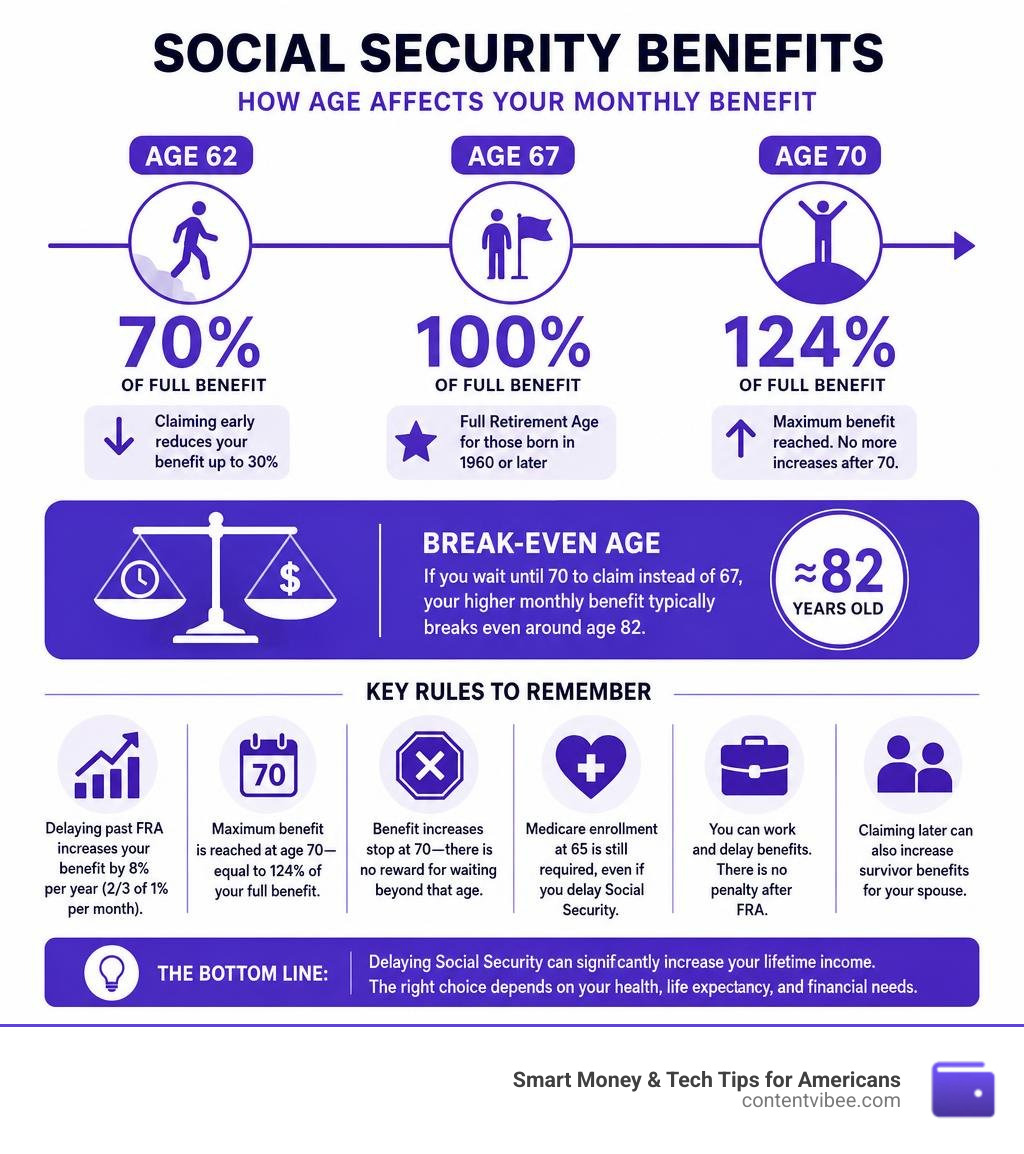
- Full retirement age (FRA) is 67 for anyone born in 1960 or later
- Delaying past FRA increases your monthly benefit by 8% per year (2/3 of 1% per month)
- Maximum benefit is reached at age 70 — equal to 124% of your full benefit
- Claiming early at 62 permanently reduces your benefit by up to 30%
- Benefit increases stop at 70 — there is no reward for waiting beyond that age
- Medicare enrollment at 65 is still required, even if you delay Social Security
Despite these potential gains, the data tells a surprising story. About 64% of retired workers claimed Social Security before their full retirement age as of December 2022. And only 10% of new claimants in 2022 waited until age 70 to start benefits.
So why does the “delay as long as possible” advice not play out in reality? Because the decision is more nuanced than most people realize — especially if you’re still working, have a spouse, or are weighing what your money could earn elsewhere.
This guide breaks down exactly how delayed retirement credits work, who benefits most from waiting, and what working past 70 means for your benefits and your spouse’s.
Relevant articles related to delayed social security benefits:
- can you collect a pension and still work full-time
- retirement passive income ideas
- retirement health insurance options
Understanding Delayed Social Security Benefits and Full Retirement Age
To understand how delayed social security benefits work, we first have to look at the baseline established by the Social Security Administration (SSA): your Full Retirement Age (FRA). Your FRA is the age at which you are eligible to receive 100% of your Primary Insurance Amount (PIA). Your PIA is the basic benefit amount calculated from your highest 35 years of inflation-adjusted earnings.
If you were born in 1960 or later, your full retirement age is exactly 67. You can verify your specific age requirements directly through the Delayed Retirement | Born in 1960 | SSA planning page.
For decades, the standard advice from financial planners has been to wait as long as possible to claim. Yet, historical data reveals a massive disconnect between this advice and real-world behavior. In December 2022, approximately 64% of retired workers receiving Social Security benefits had already begun receiving payments before they reached their FRA. Many retirees choose to claim early due to immediate income needs, health concerns, or simply the desire to enjoy their money while they are young.
Choosing when to file is one of the most consequential decisions you will make for your retirement security. To explore how your birth year dictates your baseline options, take a look at The Definitive Guide To Social Security Claiming Age.
How Delayed Retirement Credits Work Past Your Full Retirement Age
If you decide to wait past your full retirement age to claim your benefits, the SSA rewards your patience through delayed retirement credits (DRCs). These credits act as a permanent boost to your monthly check. For anyone born in 1943 or later, the benefit increases by 8% per year for each year you delay past your FRA.
Broken down monthly, this equates to an increase of 2/3 of 1% for each month you delay. For example, if your FRA is 67 and you delay claiming for a full 36 months until you reach age 70, your monthly benefit will permanently increase by 24%, meaning you will receive 124% of your Primary Insurance Amount.
However, these credits do not accumulate indefinitely. The benefit increases stop completely once you reach age 70. There is absolutely no financial incentive to delay claiming your Social Security benefits past your 70th birthday. If you are currently past 70 and have not claimed, you are leaving money on the table!
Despite the mathematical appeal of a guaranteed 24% boost, very few future retirees actually wait this long. Only 10% of individuals who initiated their Social Security benefits in 2022 chose to wait until age 70.

Understanding the timing of how these credits are applied is crucial. The SSA automatically calculates and applies your delayed retirement credits. However, if you claim in the middle of a calendar year before reaching age 70, the credits earned during that year may not be added to your monthly check until the following January.
To learn more about the exact government rules governing these increases, visit the Benefits Planner: Retirement | Delayed Retirement Credits | SSA page. Additionally, we dive deep into the pros and cons of this strategy in our article, Why Waiting For Social Security Age 70 Benefits Might Be Your Best Move.
Calculating Your Delayed Social Security Benefits Increase
The exact percentage increase you receive depends heavily on your year of birth and your specific FRA. The rules have shifted over time as Congress gradually raised the retirement age to keep the program solvent.
For example, if you were born in 1956, your full retirement age is 66 and 4 months. If you chose to delay claiming until age 70, you would have delayed for a total of 44 months. At a rate of 2/3 of 1% per month, this delay yields a massive 29.3% increase, meaning you would receive 129.3% of your PIA. You can review the exact tables for this transition group on the Delayed Retirement | Born in 1956 | SSA page.
For those born in 1960 or later, the maximum delay is 36 months (from age 67 to 70), resulting in a maximum 124% benefit. Knowing your birth year’s exact rules ensures you do not miscalculate your projected retirement income.
The Impact of Early Claiming vs. Delayed Social Security Benefits
On the opposite end of the spectrum is early claiming. You can claim Social Security retirement benefits as early as age 62, but doing so comes with a heavy financial penalty. In 2022, 27% of individuals chose to claim at age 62, making it the most common early-claiming age.
If your FRA is 67 and you claim at age 62, your monthly benefit is permanently reduced by 30%. The SSA calculates this reduction using a multi-step formula:
- Your benefit is reduced by 5/9 of 1% for each of the first 36 months before your normal retirement age.
- Your benefit is reduced by 5/12 of 1% for each additional month beyond 36 months (up to 24 additional months if claiming at 62).
This permanent reduction is designed to keep lifetime payouts roughly equal regardless of when you claim, assuming average life expectancies. However, for those who live long lives, claiming early can mean leaving hundreds of thousands of dollars on the table.
For a complete breakdown of how early reductions compare to delayed credits, you can read the official explanation on the Early or Late Retirement page. To run your own numbers and see how these percentages impact your household budget, check out our Timing Is Everything The Best Age To Take Social Security Calculator Guide.
The Math of Delaying: Break-Even Ages and Present Value Analysis
To truly evaluate whether delaying your benefits is the right move, we have to look at the “break-even” age. This is the age at which the total cumulative lifetime benefits of a delayed claiming strategy surpass the cumulative benefits of claiming early.
If we assume a 0% real discount rate (meaning we do not account for the potential investment return you could have earned by claiming early and investing the money), the break-even point when comparing claiming at age 67 versus age 70 is typically around 82.5 years of age.
If you claim at 67, you get a three-year head start on receiving checks. If you wait until 70, your monthly check is 24% larger, but you received $0 for those three years. It takes until age 82.5 for the larger checks from age 70 to catch up to and overtake the head start you got at age 67.
Actuarial data shows that living to 82.5 is far from a guarantee:
- 49% of 67-year-old males do not survive to age 82.5.
- 36% of 67-year-old females do not survive to age 82.5.
- 77% of 67-year-old males and 65% of 67-year-old females die before reaching age 89.
This actuarial reality becomes even more stark when we apply a personal discount rate (the rate of return you expect to earn on your investments). If you can claim early and earn a 4% real return on that money, you must live to age 89 for delaying from age 67 to 70 to be financially beneficial.
Let’s look at the present value and expected value of these choices:
| Claiming Age | Monthly Benefit (Base: $2,000 at FRA) | Cumulative Benefits by Age 80 (0% Return) | Cumulative Benefits by Age 85 (0% Return) | Cumulative Benefits by Age 90 (0% Return) |
|---|---|---|---|---|
| Age 62 | $1,400 | $302,400 | $386,400 | $470,400 |
| Age 67 | $2,000 | $312,000 | $432,000 | $552,000 |
| Age 70 | $2,480 | $297,600 | $446,400 | $595,200 |
Expected-value calculations using standard US life tables show that:
- For males, starting benefits at age 70 is mathematically inferior to starting at age 67 unless your personal real discount rate is less than 0.47%.
- A starting age of 62 actually yields the highest expected lifetime value for males if your personal discount rate/investment return is above 2.05%.
In other words, if you are a disciplined investor who can earn a modest return on your money, or if you have health factors that make reaching average life expectancy unlikely, delaying past 67 might not be the wealth-maximizing choice. For a balanced view of this math, read our guide on Patience Is A Virtue But Is It A Payoff The Cons Of Late Social Security Claiming.
Key Factors to Consider Before Delaying Your Benefits
Because retirement is about more than just mathematical formulas, we must look at several personal and macroeconomic factors before deciding when to file.
First and foremost is your health status and family history. If you are in excellent health and your parents lived into their 90s, you have a higher probability of beating the break-even odds, making a delayed claim highly profitable. Conversely, if you have chronic health issues, claiming earlier ensures you actually get to use the money you paid into the system.
Second is your immediate need for income. If you need Social Security to pay your mortgage or buy groceries, delaying is a luxury you cannot afford. However, if you have robust retirement accounts (like a 401(k) or IRA) or a pension, you can choose to draw down those assets first while letting your Social Security benefit grow at a guaranteed 8% annual rate.
Third are solvency concerns regarding the Social Security Trust Funds. Current board of trustees projections indicate that the trust fund reserves could be depleted by 2034. If Congress does not act before then, incoming tax revenues would still cover about 81% of scheduled benefits. While we do not recommend making claiming decisions entirely out of fear, some retirees prefer to claim earlier to secure their benefits under the current rules.
Lastly, consider the investment opportunity cost. If you delay Social Security, you are effectively using your other retirement assets to fund your living expenses in the meantime. This means those assets are no longer growing in the stock market.

Weighing these variables is the key to optimizing your retirement income. To build a comprehensive strategy, check out The Ultimate Guide To Social Security Benefit Optimization.
Working Past 70, Spousal Benefits, and Medicare Coordination
If you plan to continue working past age 70, there are several unique rules you must navigate.
First, the good news: once you reach your Full Retirement Age, the Social Security Earnings Test no longer applies. You can earn as much money as you want from a job or self-employment, and your Social Security benefits will not be reduced by even a single penny.
However, your working status and claiming timeline have significant implications for your family:
- Spousal Benefits: A husband or wife can claim a spousal benefit worth up to 50% of your Primary Insurance Amount (PIA). However, delayed retirement credits do not increase spousal benefits. If your PIA is $2,000, your spouse’s maximum spousal benefit is $1,000, regardless of whether you claim at age 67 or delay until age 70.
- Survivor Benefits: Unlike spousal benefits, survivor benefits do benefit from delayed retirement credits. If you delay claiming until age 70 and then pass away, your surviving spouse is eligible to receive 100% of your increased monthly benefit (including the 24% boost). This makes delaying a highly effective life insurance strategy for the higher-earning spouse in a marriage.
To see the exact tables on how claiming ages impact family benefits, refer to the Early or delayed retirement data sheet.
Another critical piece of the puzzle is Medicare coordination. Many people mistakenly believe they can delay signing up for Medicare if they delay their Social Security benefits. This is a costly mistake.
You must sign up for Medicare at age 65, even if you are delaying your Social Security retirement benefits. If you do not have qualifying employer-sponsored health coverage and fail to sign up for Medicare Part B during your Initial Enrollment Period, you could face permanent late-enrollment penalties (an extra 10% on your Part B premium for every 12-month period you delayed).
Frequently Asked Questions about Delayed Social Security
Do delayed retirement credits increase spousal benefits?
No. Spousal benefits are strictly capped at a maximum of 50% of the worker’s Primary Insurance Amount (PIA) at their full retirement age. Delaying your claim past your FRA to earn credits will boost your personal check, but it will not increase the amount your spouse can claim on your record.
What happens to my delayed credits if I die before claiming?
If you pass away before claiming your benefits, you will not personally receive the payments. However, any delayed retirement credits you earned up to the month of your death will be factored into the survivor benefits paid to your eligible surviving spouse, providing them with a permanently higher monthly income.
Do I need to sign up for Medicare at 65 if I delay Social Security?
Yes. Medicare enrollment is completely separate from Social Security retirement benefits. Unless you have qualifying health insurance through a current employer (yours or your spouse’s), you must sign up for Medicare Part A and Part B at age 65 to avoid permanent late-enrollment premiums and coverage gaps.
Conclusion
At ContentVibee, we believe that navigating retirement should not feel like trying to solve a Rubik’s cube in the dark. Deciding how to handle your delayed social security benefits is a deeply personal choice that requires balancing hard math with your health, your family’s needs, and your long-term financial security.
Whether you decide to claim at 62, wait until your full retirement age of 67, or maximize your monthly check by delaying until age 70, the key is to make an informed choice based on clear, actionable advice.
If you are planning to keep earning a paycheck while transitioning into retirement, make sure you understand how your income affects your household. Learn more about working in retirement and spousal benefits to ensure you keep more of your hard-earned money!


