What Every Divorced American Needs to Know About Claiming an Ex’s Social Security
Are ex spouses entitled to Social Security benefits? Yes — and millions of divorced Americans don’t realize it.
If your marriage lasted at least 10 years, you may be able to collect Social Security based on your ex-spouse’s work record. Here’s the quick answer:
Key eligibility requirements at a glance:
- Your marriage lasted at least 10 years
- You are age 62 or older
- You are currently unmarried
- You have been divorced for at least 2 years (or your ex is already collecting benefits)
- Your own Social Security benefit is less than what you’d receive on their record
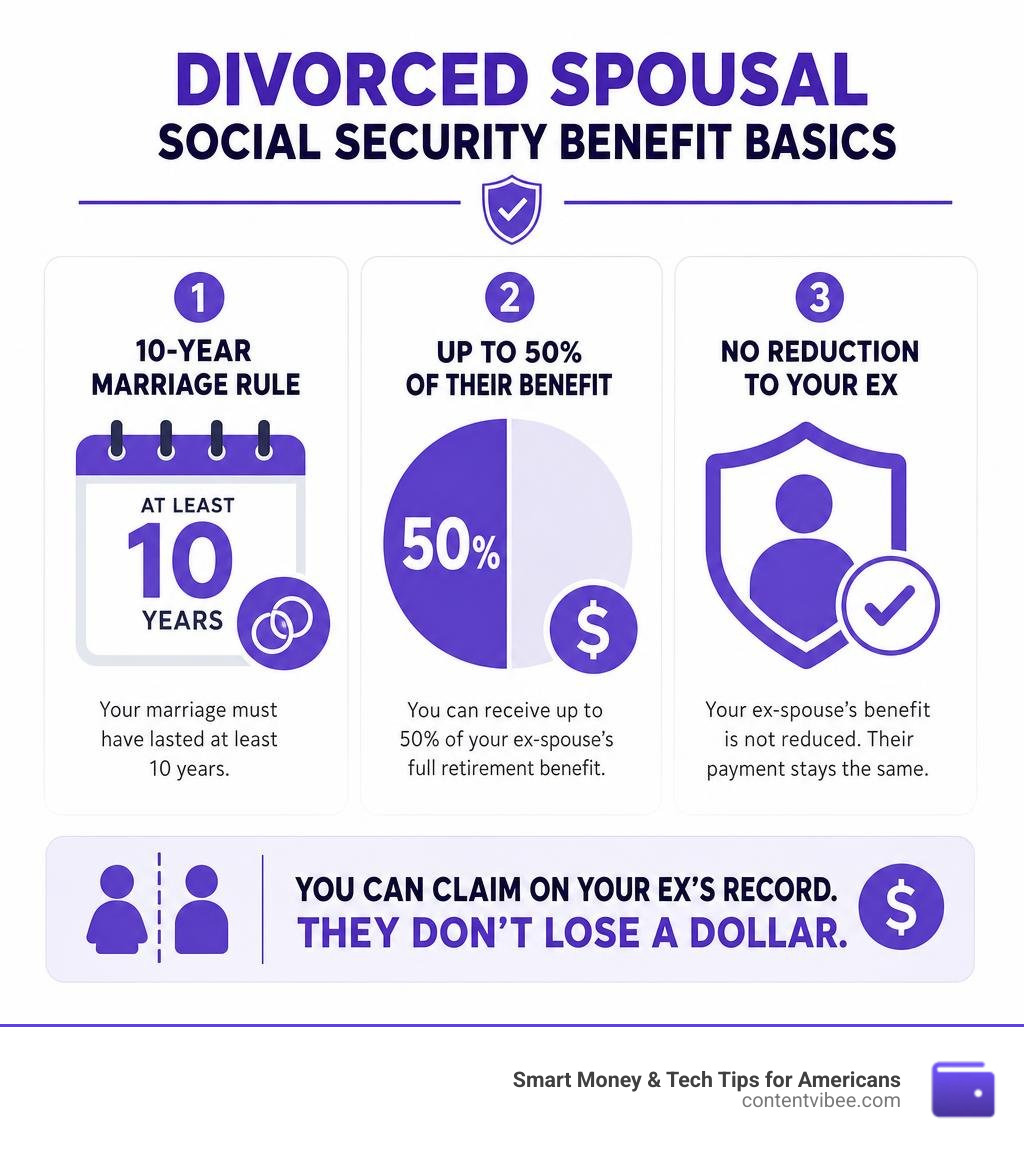
If you check all those boxes, you could receive up to 50% of your ex-spouse’s full retirement benefit — and it won’t reduce their payment by a single dollar.
That last part surprises most people. Your ex doesn’t lose anything. Their monthly check stays exactly the same whether you claim on their record or not. They won’t even be notified that you filed.
As the Social Security Administration has confirmed, any benefits paid to a divorced spouse do not reduce payments made to the ex or to any current spouse. It’s essentially free money that many divorced Americans simply leave unclaimed.
This guide walks you through everything — eligibility rules, how much you can get, what happens if you remarry, and how to apply.
Are Ex Spouses Entitled to Social Security Benefits? Core Eligibility Rules
Navigating the bureaucratic maze of the Social Security Administration (SSA) can sometimes feel like trying to assemble flat-pack furniture without the instruction manual. But when it comes to understanding whether are ex spouses entitled to social security benefits, the rules are actually quite clear-cut.
To determine if you qualify to claim benefits on your former partner’s work record, we have to look at four non-negotiable criteria established by federal law.
1. The 10-Year Marriage Rule
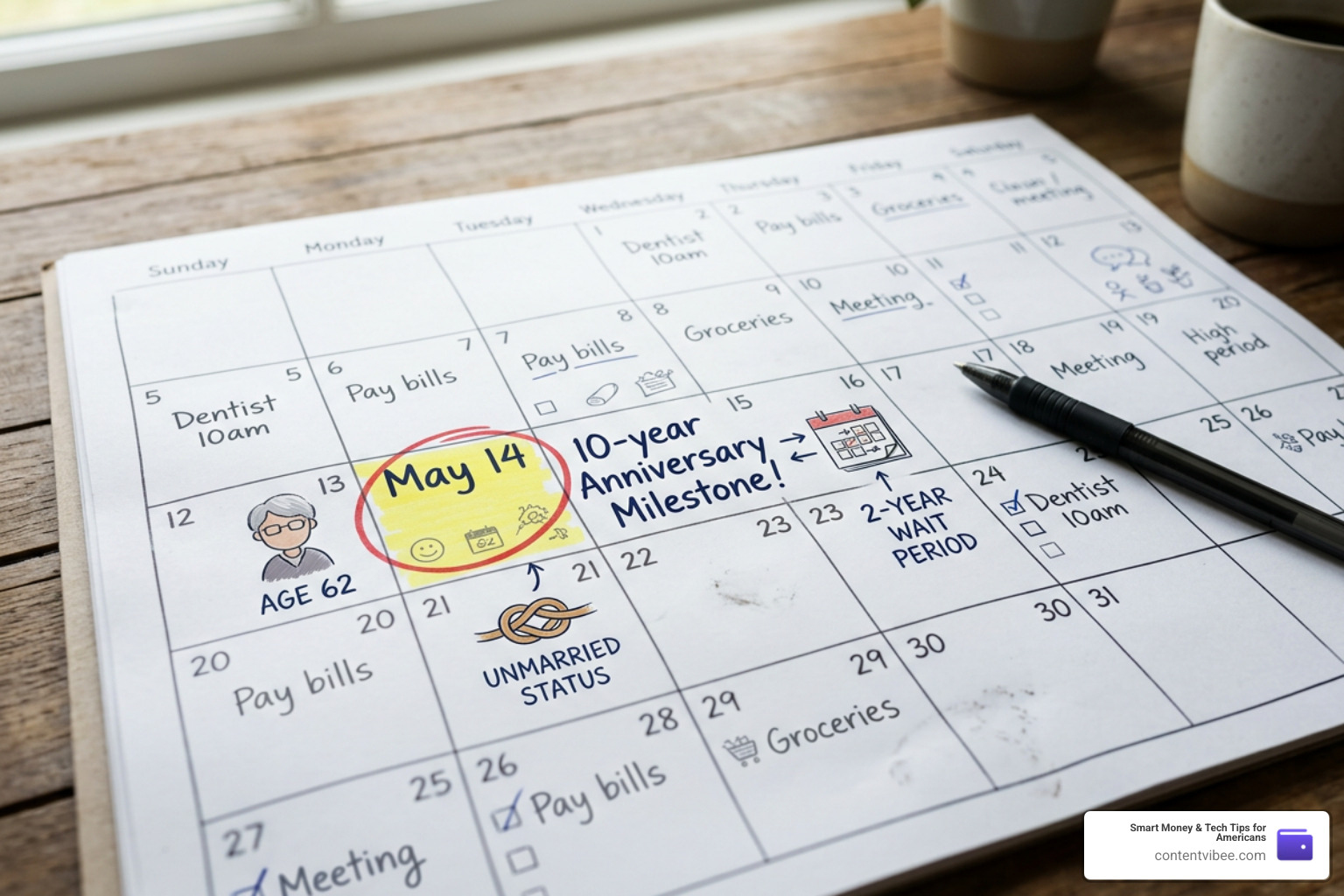
Your marriage must have lasted for at least 10 continuous years before the divorce was finalized. If you divorced at 9 years and 11 months, the SSA is strict—you will not qualify.
However, there is an interesting quirk: if you divorced someone, remarried them shortly after, and then divorced again, the SSA may combine those years to help you meet the 10-year threshold, provided the gap between the marriages was very brief. For the vast majority of people, though, a single, continuous decade of marriage is the standard.
2. The Age 62 Requirement
You must be at least 62 years old to collect any form of spousal or divorced spousal benefit. That claiming at age 62 will result in a permanently reduced monthly payout compared to waiting until your Full Retirement Age (FRA).
3. Your Current Marital Status
To claim on an ex-spouse’s record, you must currently be unmarried. If you have remarried, you generally lose the right to claim on your ex’s record (unless that subsequent marriage has also ended by death, divorce, or annulment). We will dive deeper into the nuances of remarriage later in this guide.
4. The 2-Year Divorce Waiting Period
This is a rule that trips many people up. If your ex-spouse has already started collecting their own Social Security retirement or disability benefits, you can apply for your divorced spousal benefit immediately upon your divorce.
However, if your ex is eligible for benefits but has not yet applied for them, you can still claim on their record—but only if you have been officially divorced for at least two continuous years. This is known as being an “independently entitled divorced spouse.”
If you meet all of these criteria, you are legally entitled to file a claim. To dig deeper into how these rules apply to unique personal situations, you can Learn more about whether a divorced spouse can get benefits or consult the Official SSA FAQ on former spouse records for exact regulatory language.
How Divorced Spousal Benefits Are Calculated and Affected by Offsets
Now that we have established eligibility, let’s talk about the fun part: the math. How much money are we actually talking about, and how does the SSA calculate your check?
The starting point for all calculations is your ex-spouse’s Primary Insurance Amount (PIA). The PIA is the monthly benefit your ex-spouse is entitled to receive at their Full Retirement Age (FRA). Currently, in June 2026, the FRA is 67 for anyone born in 1960 or later.
If you wait until your own Full Retirement Age to claim, your maximum divorced spousal benefit is exactly 50% of your ex-spouse’s PIA. For example, if your ex-spouse’s PIA is $3,000 per month, your maximum benefit at your FRA is $1,500 per month.
The Penalty for Claiming Early
If you decide to claim your benefits before reaching your FRA, the SSA will permanently reduce your monthly payout. The earlier you claim, the steeper the reduction. If your FRA is 67 and you choose to file at the absolute earliest age of 62, your benefit will be reduced to roughly 32.5% of your ex’s PIA.
Unlike your own retirement record, divorced spousal benefits do not earn delayed retirement credits. If you delay claiming your own work benefit past your FRA, your check grows by 8% each year until age 70. This rule does not apply to spousal or ex-spousal benefits. Once you reach your FRA, your divorced spousal benefit maxes out at 50%. There is absolutely no financial benefit to waiting past your FRA to claim on an ex’s record.
Understanding Dual Entitlement
What happens if you have your own work history and qualify for your own Social Security benefit? The SSA does not allow “double dipping.” You cannot combine your own retirement benefit and your divorced spousal benefit to get a massive double check.
Instead, the SSA applies the rule of “deemed filing.” When you apply, they will calculate both your own benefit and your ex-spousal benefit. You will receive whichever amount is higher. If your own benefit is $1,200 and your divorced spousal benefit is $1,500, you will receive your $1,200 plus a $300 “top-off” to bring your total check to $1,500.
| Claiming Age | Percentage of Ex-Spouse’s PIA | Example Payout (Based on $3,000 PIA) |
|---|---|---|
| 62 | 32.5% | $975 |
| 63 | 35.0% | $1,050 |
| 64 | 37.5% | $1,125 |
| 65 | 41.7% | $1,251 |
| 66 | 45.8% | $1,374 |
| 67 (Full Retirement Age) | 50.0% | $1,500 |
Government Pensions and Offsets (GPO & WEP)
If you worked in a government job (like a public school teacher, police officer, or civil servant) where you did not pay Social Security taxes, any government pension you receive can severely impact your divorced spousal benefit.
The Government Pension Offset (GPO) reduces your spousal or ex-spousal benefit by two-thirds of the amount of your government pension. For many, this offset completely wipes out their potential Social Security benefit.
Additionally, the Windfall Elimination Provision (WEP) can affect how your own retirement benefit is calculated if you have a pension from non-covered work.
To make sure you don’t make a costly timing mistake, Read our comprehensive divorced spouse guide for 2026 and review the official SSA POMS RS 00202.001 spouse definitions to understand the strict legal definitions of entitlement.
Special Rules: Remarriage, Multiple Exes, and Survivor Benefits
Life is rarely a straight line, and relationships can get complicated. Fortunately, the Social Security system has built-in rules to handle almost any modern family dynamic.
One of the most common concerns is whether a former spouse can “block” you from claiming, or if having multiple ex-spouses will dilute the money pool. Let’s set the record straight: no one can block your claim, and multiple ex-spouses do not reduce anyone’s benefits.
Consider the famous example of late-night host Johnny Carson, who was married four times. Because three of his marriages lasted at least 10 years, all three of his eligible ex-wives could theoretically claim benefits on his record at the same time. None of them had to share the benefit, none of them reduced Johnny’s own check, and none of them reduced the benefits of his widow.
Furthermore, federal law dictates that Social Security benefits are a statutory right. This means even if your divorce attorney inserted a clause in your divorce decree stating you waive your right to claim Social Security on your ex’s record, that clause is completely void and unenforceable. The SSA ignores private legal agreements that attempt to override federal benefits.
To see how these rules compare to couples who remain married, check out our Guide to spousal benefits for couples and review the SSA POMS RS 00202.040 termination events to see exactly what causes a benefit to stop.
How Remarriage Affects Whether Are Ex Spouses Entitled to Social Security Benefits
If you are currently collecting a divorced spousal benefit and you decide to walk down the aisle again, your benefit on your ex-spouse’s record will terminate the month before your new marriage takes place.
Once remarried, you must look to your new spouse’s work record for potential spousal benefits (which usually requires being married for at least one year before claiming).
However, if your subsequent marriage ends in divorce, annulment, or death, your eligibility to claim on your first ex-spouse’s record is restored. The SSA allows you to slide back onto your previous ex’s record as long as you meet the standard 10-year marriage requirement for that specific relationship.
Survivor Benefits: What Happens If Your Ex-Spouse Passes Away?
The rules change dramatically—and in your favor—if your ex-spouse passes away. If you are divorced but your marriage lasted at least 10 years, you become eligible for surviving divorced spouse benefits.
While a living ex-spouse’s record only grants you up to 50% of their PIA, a deceased ex-spouse’s record allows you to claim up to 100% of their actual benefit amount.
The rules for survivor benefits are also much more flexible:
- Earlier Claiming Age: You can claim survivor benefits as early as age 60 (or age 50 if you are disabled).
- Remarriage Flexibility: If you remarry after age 60 (or age 50 if disabled), your remarriage will not disqualify you from collecting survivor benefits on your deceased ex-spouse’s record.
This means you could potentially marry a new partner at age 61 and still collect a full survivor’s check based on your first husband or wife’s earnings history. For a detailed roadmap on navigating this transition, read our Claiming deceased spouse benefits guide and review What you need to know about spousal survivor benefits.
Step-by-Step Guide: Are Ex Spouses Entitled to Social Security Benefits Without the Ex’s Knowledge?
One of the greatest features of the divorced spousal benefit is absolute privacy. Because of strict federal privacy laws, the SSA will never contact your ex-spouse to tell them you have filed on their record. Your ex will have no idea, and they have no legal path to find out.
To apply smoothly, follow these steps:
- Gather Your Information: You will need your own Social Security number, birth certificate, and bank routing information for direct deposit.
- Collect Marriage and Divorce Proof: You must provide your original marriage certificate and the final divorce decree to prove the marriage lasted at least 10 years.
- Provide Ex-Spouse Details: You will need your ex’s name, date of birth, and ideally, their Social Security number. If you do not know their SSN, don’t panic—the SSA can search for and identify their record using their name, parents’ names, and birth date.
- Submit Your Application: You can apply online at the SSA website, call their toll-free number at 1-800-772-1213, or schedule an appointment at your local SSA office.
For a comprehensive checklist of local legal protections, you can also consult the Peoples Law Library guide on divorced spouse benefits.
Frequently Asked Questions about Divorced Spousal Benefits
We hear many myths and misconceptions about how divorce affects retirement planning. Below are the answers to the most common questions we receive.
Can my ex-spouse block me from claiming benefits on their record?
No. Your ex-spouse has absolutely zero say in the matter. The SSA handles your application independently. Your ex is not required to sign any paperwork, they will not be notified, and they cannot block your claim through any legal or personal means.
Does claiming on my ex-spouse’s record reduce their own monthly payment?
No. This is a common fear, but the “no-reduction rule” is absolute. Any benefits you receive as a divorced spouse are paid out of a general federal trust fund. They do not come out of your ex’s pocket, they do not reduce their monthly check, and they do not affect the benefits of your ex’s current spouse if they have remarried.
Can a divorce decree waive my right to claim these federal benefits?
No. Social Security is a federal statutory right established by Congress. Private contracts, including divorce decrees and prenuptial agreements, cannot waive or override federal law. Even if you signed a document during your divorce mediation agreeing not to claim on their record, that agreement is legally unenforceable at the Social Security office.
Conclusion
At ContentVibee, our mission is to provide clear, actionable advice to help you maximize your retirement and money-management strategy. Understanding whether are ex spouses entitled to social security benefits is a critical piece of the puzzle for millions of Americans planning their financial futures in 2026.
Leaving these benefits on the table is simply giving up money you are legally owed. Take a moment to evaluate your options, gather your documents, and Calculate your potential payout with our Social Security Spousal Benefit Calculator to secure the financial future you deserve.