


Why Retirement Benefits Matter More Than Most People Realize
Retirement benefits are the foundation of financial security for millions of Americans — and understanding how they work could mean thousands of dollars more (or less) in your pocket every year.
Here is a quick overview of the most important things to know:
| Topic | Key Fact |
|---|---|
| When you can claim Social Security | As early as age 62 with 10+ years of work |
| Full Retirement Age (FRA) | Between 66 and 67, depending on birth year |
| Early claiming penalty | Up to 30% less per month if you claim at 62 |
| Delayed claiming bonus | +8% per year for every year past FRA, up to age 70 |
| Spousal benefit | Up to 50% of your spouse’s full benefit |
| Income replacement goal | Most advisers recommend replacing 80% of pre-retirement income |
| Social Security alone covers | 28% to 78% of pre-retirement income, depending on earnings |
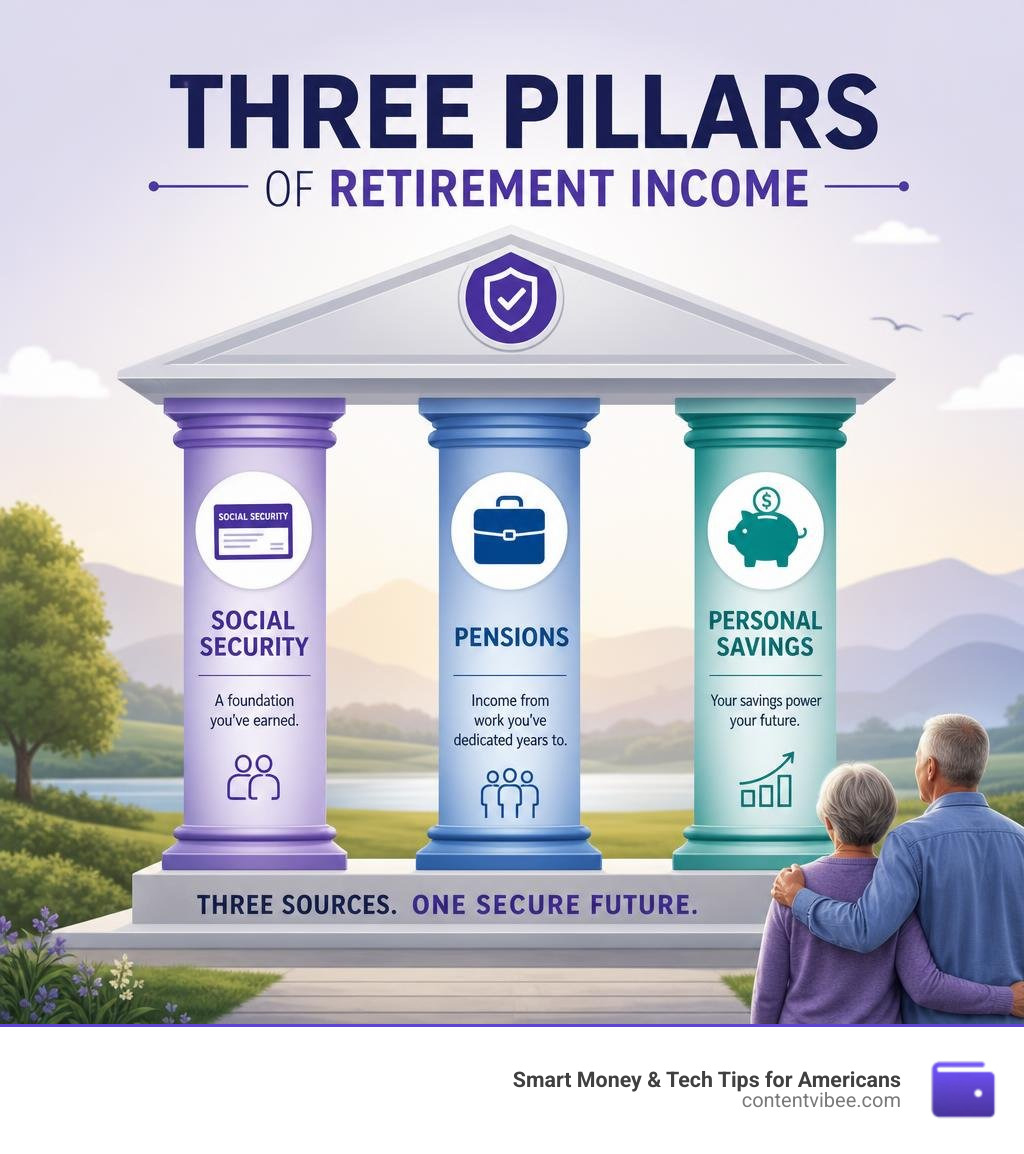
Most people think of retirement income as just a Social Security check. But in reality, a secure retirement usually rests on three sources working together: Social Security, a workplace pension or retirement plan, and personal savings.
The challenge? Each source has its own rules, timelines, and trade-offs. Miss a deadline, claim too early, or overlook a spousal benefit, and you could leave significant money on the table.
This guide breaks it all down — clearly and without jargon — so you can make confident decisions about when and how to claim what you’ve earned.
The Three Pillars of Retirement Income
When you visualize a comfortable retirement, you probably imagine sleeping in, traveling, or finally mastering the art of sourdough bread. You probably do not picture a three-legged stool. Yet, that stool is the classic financial model for retirement planning.
To achieve true financial peace of mind, your retirement income should ideally rely on three sturdy pillars:
- Social Security: The guaranteed, inflation-adjusted safety net provided by the federal government.
- Workplace Retirement Plans: Pensions (defined benefit plans) or employer-sponsored savings accounts like 401(k)s and 403(b)s.
- Personal Savings and Investments: Your personal IRAs, taxable brokerage accounts, real estate, and emergency funds.
Most financial advisers point out that you will need about 80% of your pre-retirement income to maintain your current lifestyle once you stop working.
How much of that does Social Security cover? It depends on your lifetime earnings. For very low earners, Social Security replaces up to 78% of pre-retirement income if starting benefits at age 67. For medium earners, it replaces about 42%, and for high earners, it drops to roughly 28%.
This means that if you want to avoid a sudden diet of instant noodles, your personal savings and workplace plans must bridge the gap. You can get a clear picture of how much extra you need to build by using a Retirement Calculator Estimate Savings Needed.
For many people, retirement income also comes from multiple distinct benefit programs. If you are eligible for benefits from more than one source — such as your own work record and a spousal record — the Social Security Administration (SSA) applies a “highest payment rule.” You cannot “double dip” and receive the full amount of both; instead, the SSA will coordinate the benefits to ensure you receive the highest single payment amount for which you qualify.
To understand the core rules governing these federal payouts, you can read the official guidelines on Retirement benefits | SSA .
Maximizing Your Social Security Retirement Benefits
Deciding when to claim your Social Security retirement benefits is one of the most critical financial decisions you will ever make. It is a permanent choice that dictates your monthly cash flow for the rest of your life.
The system is designed to be mathematically neutral over an average lifespan, but your personal health, financial needs, and employment status should dictate your strategy.
The baseline of this system is your Full Retirement Age (FRA). If you are turning 62 in June 2026, your FRA is exactly 67 years old.
- Claiming Early (Age 62): You can start receiving monthly checks as early as age 62, provided you have worked and paid Social Security taxes for at least 10 years. However, claiming at 62 means your monthly benefit will be permanently reduced by about 30% compared to what you would receive at age 67.
- Claiming at Full Retirement Age (Age 66–67): At this milestone, you receive 100% of your primary insurance amount (PIA), which is the benefit calculated from your 35 highest-earning years.
- Delaying Benefits (Up to Age 70): If you choose to delay your benefits past your FRA, your monthly payout will increase by 8% for each full year you wait. Once you hit age 70, the increases stop, so there is no financial benefit to waiting past your 70th birthday.
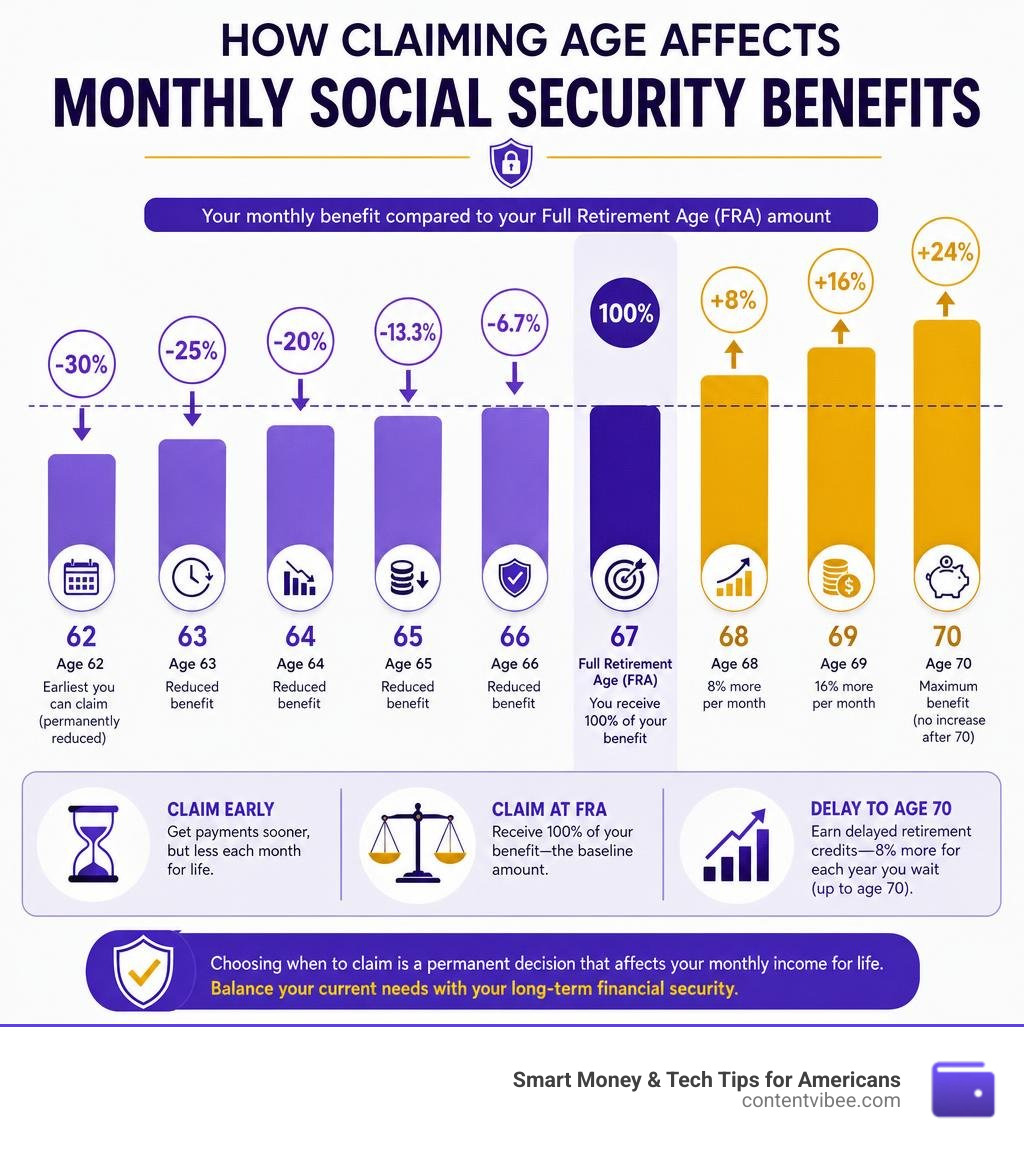
Choosing the optimal moment to file requires balancing immediate financial needs against long-term security. For a deep dive into how to time this transition perfectly, read The Definitive Guide to Social Security Claiming Age and explore Why Waiting for Social Security Age 70 Benefits Might Be Your Best Move.
Eligibility and Work Credits for Retirement Benefits
How do you qualify for these lifetime monthly payments? It is not enough to simply reach retirement age; you have to earn your way in by paying into the system over time.
As you work and pay Federal Insurance Contributions Act (FICA) taxes, you earn “work credits.” The amount of earnings required to secure a credit increases slightly each year. You can earn a maximum of four credits per calendar year.
For anyone born in 1929 or later, you must accumulate at least 40 credits (which equates to 10 years of work) to be eligible for retirement benefits. If you do not reach this threshold, you cannot claim benefits on your own record. For a comprehensive overview of how these credits translate into monthly checks, check out our A Comprehensive Guide to Social Security Benefits.
Spousal and Survivor Social Security Options
Social Security is not just an individual benefit; it is also a family protection plan. Spouses, ex-spouses, and survivors may be eligible to receive benefits based on a worker’s earnings record.
If you are married, you might be eligible for spousal benefits. Spouses who have never worked outside the home, or who have historically earned much less than their partners, can receive up to 50% of the retired worker’s full benefit amount when claiming at their own FRA.
If you decide to claim spousal benefits early (as early as age 62), the payout is permanently reduced. For example, if your FRA is 67, claiming spousal benefits at age 62 reduces the payout to just 32.5% of the worker’s unreduced benefit.
Ex-spouses are also protected. If you were married for at least 10 years, are currently unmarried, and are age 62 or older, you may be eligible to claim benefits based on your ex-spouse’s work history without affecting their current household benefits in any way.
To see how these rules apply to your household, check out The Ultimate Guide to Spousal Social Security Eligibility and learn how to Calculate Your Spousal Benefits the Easy Way.
How to Estimate Your Future Retirement Benefits
You do not have to guess what your future financial situation will look like. The easiest way to get an accurate, personalized projection of your retirement benefits is to create a “my Social Security” account on the official SSA website.
This portal provides a detailed estimate of your monthly payments at ages 62, FRA, and 70 based on your actual, verified earnings history. It also allows you to check for errors in your reported earnings history — which is vital, as an incorrect record can permanently lower your future payouts.
For step-by-step guidance on navigating these projections, read our guide on How to Calculate Your Social Security Benefit in 5 Simple Steps and compare your options using the resources found in Best Free Social Security Calculator Options Your No Cost Retirement Roadmap.
Workplace Retirement Plans: Pensions vs. Defined Contribution Plans
Workplace retirement plans generally fall into one of two categories: defined benefit plans (traditional pensions) and defined contribution plans (such as 401(k) or 403(b) accounts). Understanding how these plans function is crucial for coordinating your total retirement income.
| Feature | Defined Benefit Plan (Pension) | Defined Contribution Plan (401k/403b) |
|---|---|---|
| Who Funds It? | Primarily the employer | Primarily the employee (often with an employer match) |
| Who Manages Investment Risk? | The employer | The employee |
| Payout Structure | Guaranteed monthly annuity for life | Based on account balance and investment performance |
| Portability | Often lost or frozen if you switch jobs early | Highly portable; can be rolled over into an IRA |
| Federal Protections | Insured by the Pension Benefit Guaranty Corporation (PBGC) | Regulated by ERISA, but balances are not guaranteed against market loss |
Traditional pensions are increasingly rare in the private sector, but they remain common for government, education, and public service employees. For instance, public employees can explore specific state-level plan structures like the State of Texas Retirement | ERS .
Similarly, specialized federal programs exist for specific industries, such as those outlined in the Railroad Retirement and Survivor Benefits (IB-2) .
If you participate in a private-sector retirement plan, your rights are protected by the Employee Retirement Income Security Act (ERISA). This federal law sets minimum standards for plan participation, vesting, and fiduciary responsibility.
If you are preparing to transition out of your job and want to know how to claim your workplace funds safely, refer to the official resource on Claiming Benefits | U.S. Department of Labor .
Additionally, if you have worked in a state system or public sector job that uses specialized pension calculations, you can learn how these formulas are structured by reviewing Calculating Your Retirement Benefits .
Essential Coordination: Medicare, Taxes, and Special Rules
Retirement planning is not just about bringing money in; it is also about keeping as much of it as possible. This requires navigating Medicare enrollment, tax brackets, and specialized rules that govern working during retirement.

Medicare Enrollment Timing
Even if you plan to delay claiming Social Security until age 70, you should generally sign up for Medicare three months before your 65th birthday. Failing to register during your Initial Enrollment Period can result in permanent premium penalties for Medicare Part B and Part D.
Furthermore, if you are actively contributing to a Health Savings Account (HSA), you must stop all contributions at least six months before applying for Medicare to avoid tax penalties.
Taxability of Social Security Benefits
Many retirees are surprised to learn that their Social Security benefits may be subject to federal income tax. In fact, about 40% of people who receive Social Security must pay income taxes on their benefits.
Whether your benefits are taxed depends on your “combined income” (adjusted gross income + nontaxable interest + half of your Social Security benefits):
- Individual Filers: If your combined income is between $25,000 and $34,000, you may pay income tax on up to 50% of your benefits. If it is over $34,000, up to 85% of your benefits may be taxable.
- Joint Filers: If you and your spouse have a combined income between $32,000 and $44,000, you may pay tax on up to 50% of your benefits. If your joint combined income is over $44,000, up to 85% of your benefits may be taxable.
The Social Security Earnings Test
If you claim Social Security benefits before reaching your Full Retirement Age and choose to keep working, your earnings will be subject to an annual limit.
If your earnings exceed this threshold, the SSA will temporarily withhold a portion of your benefits. However, this is not a permanent loss; once you reach your FRA, the SSA recalculates your monthly payment upward to account for the withheld amounts.
Non-Social Security Covered Work
If you receive a pension from an employer that did not withhold Social Security taxes (such as certain government agencies or school districts), your Social Security benefits may be modified by the Windfall Elimination Provision (WEP) or the Government Pension Offset (GPO).
However, legislations such as the Social Security Fairness Act have introduced measures to reform these offsets, ensuring that workers who have split their careers between covered and non-covered employment receive fairer calculations.
Frequently Asked Questions About Claiming Your Income
What documents do I need to apply for Social Security retirement benefits?
When you are ready to apply, you can complete the process online, over the phone, or in person at a local Social Security office. To prevent any processing delays, gather these documents ahead of time:
- Your Social Security card or record of your number.
- Your original birth certificate or other proof of age.
- Your W-2 forms or self-employment tax returns from the previous year.
- U.S. military discharge papers (DD-214) if you served.
- Your bank account routing and account numbers for direct deposit.
For more detailed application instructions, you can consult the official guide on Social Security benefits and how to apply – USAGov .
How does working after claiming early affect my monthly payments?
If you claim benefits at age 62 and continue working, your monthly payouts will be subject to the annual earnings test. If your earnings exceed the limit set for that calendar year, the SSA will withhold $1 in benefits for every $2 you earn above the threshold.
In the year you reach your Full Retirement Age, a higher limit applies, and the penalty drops to $1 for every $3 earned. The moment you hit your exact FRA, the earnings test disappears entirely, and you can earn an unlimited amount of money without any benefit reductions.
To read more about the fundamentals of these calculations, check out The Basics of Social Security Retirement Benefits – AARP .
What protections exist if my employer’s pension plan fails?
If your employer sponsors a traditional defined benefit pension plan and runs into severe financial trouble, your earned pension is protected by a federal agency called the Pension Benefit Guaranty Corporation (PBGC).
The PBGC acts as an insurance program, stepping in to pay guaranteed basic pension benefits up to legal limits if a plan is terminated without enough funds to pay promised benefits. However, that defined contribution plans like 401(k)s are not insured by the PBGC; their value is determined by market performance and your individual investment choices.
Conclusion
Securing your financial future is all about taking proactive, informed steps today. By understanding how your Social Security, workplace pension, and personal savings accounts coordinate, you can design a retirement strategy that maximizes your lifetime income.
Do not leave your hard-earned money to chance. Use our How Much Social Security Will I Get Calculator to run your personal numbers, explore different claiming ages, and build a reliable roadmap for your golden years.


