


What the Earnings Test Means for Your Social Security Benefits
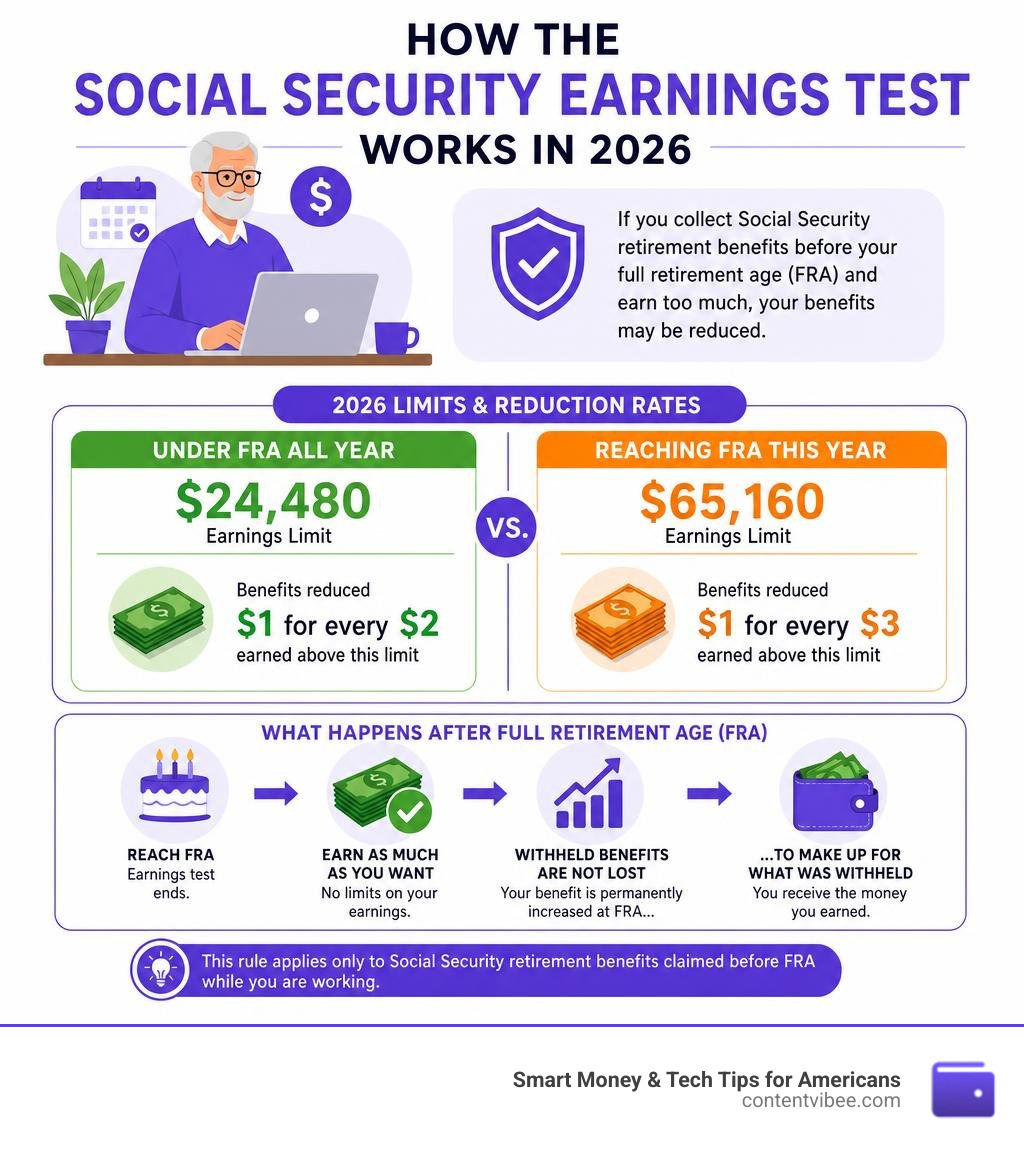
The Social Security earnings test is a rule that reduces your monthly benefits if you work and earn above a set limit before reaching your full retirement age (FRA).
Here’s the quick version of how it works:
- Who it affects: Anyone collecting Social Security retirement benefits before their full retirement age who is still working
- 2026 lower limit (under FRA all year): $24,480/year — benefits reduced $1 for every $2 earned above this
- 2026 higher limit (reaching FRA this year): $65,160/year — benefits reduced $1 for every $3 earned above this
- After FRA: The earnings test disappears completely — you can earn as much as you want
- Are withheld benefits gone forever? No — your benefit is permanently increased at FRA to make up for what was withheld
If you’re a working spouse nearing retirement, this rule matters a lot. Claiming spousal Social Security benefits while still pulling a paycheck could mean hundreds of dollars withheld from your monthly check — at least temporarily.
The good news: the rules are more manageable than they look once you understand them. And there are smart ways to time your claim to avoid unnecessary reductions.
What is the Social Security Earnings Test and How Does It Work?
At its core, the Social Security Retirement Earnings Test (RET)—commonly referred to as the earnings test—is a mechanism used by the Social Security Administration (SSA) to determine whether an individual is fully “retired.”
Social Security was originally designed to replace earnings lost due to retirement, disability, or death. If you are still working and earning a substantial income, the SSA assumes you have not fully retired and will temporarily withhold some of your benefits. You can read more about the history and statutory definitions on the Retirement earnings test (US)) Wikipedia page.
The earnings test only applies to beneficiaries who claim their benefits before reaching their Full Retirement Age (FRA). Your FRA depends on your birth year, but for everyone reaching retirement age now, it is between 66 and 67. If you claim early and continue working, the SSA tracks your earnings. If those earnings cross a specific annual threshold, your benefits are reduced.
It is crucial to understand that early claiming drastically reduces your baseline benefit forever. When you combine early claiming with the earnings test, you run the risk of receiving much smaller checks or even having your benefits suspended entirely for several months. For a deeper look into selecting the right claiming age, check out The Definitive Guide to Social Security Claiming Age.
What Counts as Earnings?
A common point of confusion is what actually counts as “earnings” under this test. The SSA only counts earned income, which includes:
- Wages from an employer (gross wages)
- Net earnings from self-employment (NESE)
The earnings test does not count:
- Pension payments
- Government or military retirement benefits
- Investment income, dividends, or capital gains
- Interest income
- IRA or 401(k) withdrawals
- Inheritances or gifts
If your post-retirement income comes entirely from investments and a pension, you do not have to worry about the earnings test at all, no matter how much you bring in!
Annual and Monthly Exempt Amounts for 2026
The SSA adjusts the exempt amounts (the limits you are allowed to earn without penalty) every year based on national average wage index changes. Since we are in July 2026, the current limits reflect the updated cost-of-living adjustments for this year.
There are two distinct limits to keep in mind, depending on how close you are to your Full Retirement Age:
- The Lower Exempt Amount: This applies to individuals who will be under their FRA for the entire calendar year. For 2026, this limit is $24,480 per year (or $2,040 per month).
- The Higher Exempt Amount: This applies to individuals in the specific calendar year they reach their FRA, but only for the months prior to reaching that age. For 2026, this limit is $65,160 per year (or $5,430 per month).
To see how these limits have increased over time, here is a quick comparison between last year and this year:
| Category | 2025 Limits | 2026 Limits |
|---|---|---|
| Under FRA (All Year) – Annual | $23,400 | $24,480 |
| Under FRA (All Year) – Monthly | $1,950 | $2,040 |
| Year of FRA Attainment – Annual | $62,160 | $65,160 |
| Year of FRA Attainment – Monthly | $5,180 | $5,430 |
You can verify these official figures directly via the SSA’s page on Exempt Amounts Under the Earnings Test.
How the Monthly Earnings Test Applies in Your Grace Year
But what happens if you retire in the middle of the year? Let’s say you retire in June 2026 at age 62, having already earned $50,000 from January to May. Under the annual test, you would already be far over the $24,480 limit, meaning you wouldn’t get any benefits for the rest of the year.
To prevent this unfair scenario, the SSA offers a special “grace year” rule. In your first year of retirement (the year you first become entitled to benefits), the SSA can apply a monthly earnings test instead of the annual one.
Under the monthly test, you can receive your full Social Security check for any month you are considered retired, regardless of how much you earned earlier in the year. To qualify as retired in a month, your monthly earnings must be at or below the monthly limit ($2,040 in 2026), and you must not perform “substantial services” in self-employment (generally defined as working more than 45 hours a month in your business).
During your application process, you simply report to the SSA that your employment has ended or your earnings have dropped, indicating zero (or low) earnings for the remaining months. For complete technical rules on how these exempt amounts are determined, you can reference the official SSA – POMS: RS 02501.025 – Determining Annual and Monthly Exempt Amounts guidelines.
Calculating Excess Earnings and Benefit Reductions

If your earned income exceeds the limits, the SSA calculates your “excess earnings” and reduces your benefits accordingly. The reduction rate depends on your age:
- Under FRA all year: Your benefits are reduced by $1 for every $2 you earn over the limit ($24,480 in 2026).
- In the year you reach FRA: Your benefits are reduced by $1 for every $3 you earn over the limit ($65,160 in 2026), but only counting earnings in the months before you reach FRA.
Once you reach the exact month of your FRA, the earnings test no longer applies, and your earnings will never cause a benefit reduction again.
To see how these rules are implemented procedurally, you can look at SSA – POMS: RS 02501.080 – Calculating Excess Earnings. If you want to run your own custom scenarios, you can also use the official Retirement Earnings Test Calculator.
Step-by-Step Guide to the Earnings Test Calculation
Let’s walk through a real-world example to see how the math plays out.
Scenario A: Under FRA All Year (2026)
- The Worker: Sarah, age 63.
- Sarah’s 2026 Earned Income: $34,480 (from a part-time job).
- Sarah’s Monthly Benefit: $1,500 ($18,000 annually).
- Find the excess earnings: Subtract the 2026 lower exempt amount from Sarah’s total earnings.
$$34,480 – 24,480 = 10,000 \text{ in excess earnings}$$ - Apply the reduction rate ($1 for every $2): Divide the excess earnings by 2.
$$10,000 \div 2 = 5,000 \text{ in benefit reductions}$$ - Withholding process: The SSA does not shave off a small percentage of each monthly check. Instead, they withhold entire monthly checks until the reduction amount is met. Because Sarah’s monthly benefit is $1,500, the SSA will withhold 4 full checks ($6,000 total withheld) to cover the $5,000 reduction. The $1,000 over-withholding will be refunded to Sarah in 2027.
Scenario B: Reaching FRA in 2026
- The Worker: David, turning FRA in October 2026.
- David’s Earnings (January – September): $71,160.
- David’s Monthly Benefit: $2,500.
- Find the excess earnings: Subtract the 2026 higher exempt amount from David’s pre-FRA earnings.
$$71,160 – 65,160 = 6,000 \text{ in excess earnings}$$ - Apply the reduction rate ($1 for every $3): Divide the excess earnings by 3.
$$6,000 \div 3 = 2,000 \text{ in benefit reductions}$$ - Withholding process: The SSA will withhold David’s first monthly check of $2,500 to cover the $2,000 reduction, refunding the extra $500 later.
For an overall estimate of your baseline benefits before reductions, you can play with our Social Security Calculator: Estimate Your Benefit Amount.
How the Earnings Test Affects Spousal and Family Benefits
It is a common misconception that the earnings test only impacts the individual worker. In reality, if you are a primary worker and your benefits are withheld due to excess earnings, any auxiliary benefits paid on your record (such as spousal or child benefits) are also withheld.
For example, if you claim early retirement and your spouse receives a spousal benefit based on your record, your excess earnings will reduce both your check and your spouse’s check.
However, if your spouse is the one working and earning over the limit, their excess earnings will only reduce their own spousal benefit—it will not affect your worker benefit. For a detailed breakdown of this dynamic, read Working After Retirement: Are Spousal Benefits Reduced by Working?.
What Happens to Withheld Benefits at Full Retirement Age?
Many people believe that the money withheld by the earnings test is gone forever, acting as a “tax” or a penalty. This is false.
When you reach your Full Retirement Age, the SSA performs a calculation called the Adjustment of Reduction Factor (ARF). They look back at all the months your benefits were withheld, and they recalculate your monthly benefit upward.
When you claim Social Security early, your benefit is permanently reduced by a certain percentage for every month you claim before FRA (roughly 6.7% per year for the first three years, and 5% per year thereafter).
If the SSA withheld 12 months of benefits from you because of the earnings test, they will recalculate your benefit at FRA as if you had claimed 12 months later than you actually did. This permanently increases your monthly check for the rest of your life.
This adjustment process is detailed in the official operating manual SSA – POMS: RS 02501.021 – The Earnings Test (ET). While delaying your claim initially is often the best financial move, the ARF ensures that working and having benefits withheld is not a total loss. To weigh the pros and cons of claiming ages, see Patience Is a Virtue, But Is It a Payoff? The Cons of Late Social Security Claiming.
Strategies to Minimize Benefit Reductions
If you want to keep working but hate the idea of having your hard-earned benefits withheld, you can use several strategies to minimize or completely avoid the earnings test penalty:
- Leverage the Grace Year: If you are retiring mid-year, make sure you take advantage of the monthly earnings test. Keep your monthly earnings below $2,040 for the rest of the year.
- Defer Compensation: If you are a business owner or have control over your pay, you can defer bonuses or salary payments to a year when you have reached FRA.
- Structure as a Corporation: For self-employed individuals, keeping earnings inside a corporation as retained earnings (rather than taking them as wages or self-employment income) can keep your “earned income” below the limit.
- Suspend Your Benefits: If you’ve already claimed early but found a high-paying job, you can contact the SSA and ask them to suspend your benefits to avoid building up overpayment debts.
For more comprehensive strategies on keeping your money in your pocket, read How to Avoid the Dreaded Social Security Earnings Limit Penalty and understand your limits with SGA Demystified: Your Guide to Social Security’s Work Limits.
Frequently Asked Questions about the RET
Does the RET apply to pensions or investment income?
No. The earnings test only applies to “earned income” (wages and self-employment net earnings). It does not apply to pensions, passive investments, dividends, interest, or capital gains. However, if you are receiving a government pension from work where you did not pay Social Security taxes, you might be subject to the Windfall Elimination Provision (WEP) or Government Pension Offset (GPO). Learn more about this in Double Dipping or Double Trouble with Social Security and Your Government Pension.
Are withheld benefits gone forever?
No. Your benefits are not lost. Once you reach FRA, the SSA will recalculate your monthly benefit amount to credit you for the months benefits were withheld. This results in a higher monthly payout for the rest of your life. If you want to see why maximizing your monthly amount is so powerful, check out Why Waiting for Social Security Age 70 Benefits Might Be Your Best Move.
How does the RET impact employment rates for older Americans?
Research shows that the earnings test acts as a significant work disincentive. In fact, studies show that the annual earnings test reduces the employment rate of Americans aged 63–64 by at least 1.2 percentage points. Many older workers intentionally limit their hours or retire fully to avoid crossing the exempt threshold.
From a policy standpoint, some economists advocate for eliminating the RET entirely. However, doing so would have a substantial short-term cost. For instance, past trust fund analyses indicated that eliminating the RET for everyone age 62 or older would have a negative front-loaded effect on the Social Security trust fund, costing roughly $81 billion over a six-year period, even though the long-range actuarial balance would remain relatively unchanged.
Conclusion
Navigating the Social Security earnings test doesn’t have to be a headache. While the rules can feel restrictive, they are ultimately designed to return your withheld funds to you in the long run. By understanding the 2026 limits—$24,480 if you are under FRA all year, and $65,160 if you reach FRA this year—you can map out a working and retirement strategy that maximizes your lifetime income.
At ContentVibee, we are dedicated to bringing you clear, actionable advice to take the guesswork out of retirement planning. Before you make your next move, use our How Much Social Security Will I Get Calculator to model your benefits and build a retirement strategy that works for you!


