

Why the Average Management Fee for Mutual Funds Matters More Than You Think
The average management fee for mutual funds can quietly drain thousands of dollars from your retirement savings over time — and most investors never notice until it’s too late.
Here’s a quick benchmark so you can see where funds stand:
| Fund Type | Average Expense Ratio |
|---|---|
| Equity mutual funds (asset-weighted) | 0.40% |
| Bond mutual funds (asset-weighted) | 0.38% |
| Actively managed mutual funds | 0.87% |
| Index mutual funds | 0.58% |
| Equity mutual funds (gross, all sizes) | ~1.10% |
| Vanguard mutual funds (average) | 0.08% |
| Industry average (all mutual funds) | 0.50% |
These numbers vary a lot depending on what type of fund you own. An international equity fund can charge as much as 1.68% per year. A simple index fund might charge as little as 0.08%.
That gap matters enormously when you’re living on a fixed income and every dollar counts.
Over the past two decades, fees have dropped significantly — the average investor paid 0.87% in 2004 and just 0.36% in 2023, according to Morningstar research. That’s real progress. But plenty of funds still charge far more than they should.
Knowing what’s normal — and what’s too high — is the first step to protecting your retirement income.
Understanding the Average Management Fee for Mutual Funds and Expense Ratios
When we talk about the cost of a fund, we usually look at the “expense ratio.” This is the total percentage of your investment that goes toward running the fund every year. It’s not a bill you pay directly; instead, the fund takes it out of the assets, which lowers your overall return.
As of May 2026, the data shows a clear trend: fees are falling, but they aren’t uniform. According to the Investment Company Institute (ICI), the asset-weighted average for equity mutual funds dropped to 0.40% in 2024, a massive 62% decline since 1996. Bond funds have seen a similar trajectory, sitting at roughly 0.38%.
However, these “asset-weighted” averages can be a bit misleading. They reflect what the average dollar is paying, and because most people are smart enough to pile into low-cost funds, the average looks low. If you look at the “gross” or simple average—which treats a tiny, expensive fund the same as a massive, cheap one—the average management fee for mutual funds in the equity space is closer to 1.10%.
The category of the fund makes a huge difference in what you’ll pay. Generally, the more “work” a fund manager has to do, the more they charge.
| Fund Category | Average Gross Expense Ratio |
|---|---|
| International Equity | 1.68% |
| Small-Cap Equity | 1.61% |
| Large-Cap Equity | 1.45% |
| High-Yield Bond | 1.35% |
| International Bond | 1.35% |
| Intermediate Bond | 1.07% |
Smaller fund companies often have higher costs because they lack the “economies of scale” that the giants have. For instance, actively managed domestic equity funds at small complexes can average 0.99%, compared to an industry-wide average of 0.64%. For more on how these ratios work, you can check out the [PDF] Trends in the Expenses and Fees of Funds, 2023.

Mutual Funds vs. ETFs: A Cost Comparison
If you’re looking for the absolute lowest price tag, Exchange-Traded Funds (ETFs) usually win the race. Why? Because ETFs are structured differently. They don’t have to deal with individual shareholder record-keeping in the same way mutual funds do, and they almost never charge 12b-1 “marketing” fees.
In 2025, the average ETF expense ratio was 0.48% for index-based versions and 0.74% for active versions. Compare that to mutual funds, where index versions averaged 0.58% and active versions hit 0.87%.
However, it’s not just about the expense ratio. ETFs are traded like stocks, which means you might pay a brokerage commission (though many brokers have moved to $0 commissions). Mutual funds, on the other hand, might have “loads”—which are essentially sales commissions.
One major advantage of ETFs is tax efficiency. Because of how they create and redeem shares, they trigger fewer capital gains distributions than mutual funds. This means you keep more of your money working for you. For a deeper dive into these structural differences, Fidelity Investments provides a great comparison.
Breaking Down the Components of Mutual Fund Fees
To truly master the average management fee for mutual funds, we need to peek under the hood. A fund’s total cost is usually made up of three main parts:
1. Management/Advisory Fees
This is the money paid to the “brains” of the operation—the portfolio managers and analysts who decide which stocks to buy and sell. These typically range between 0.25% and 1.00% of your investment annually. If you’re curious about how these are structured at specific firms, you can read about Why Fidelity Investments Advisory Fees are structured the way they are.
2. 12b-1 Fees
Named after a section of the Investment Company Act of 1940, these fees cover marketing and distribution costs. Many investor advocates dislike these because they feel like a “disguised” commission. By law, 12b-1 fees are capped at 1.00% total (0.75% for distribution and 0.25% for service). The good news? 92% of new mutual fund sales now go into “no-load” shares that don’t charge these fees at all.
3. Other Operating Expenses
This includes the “boring” but necessary stuff: legal fees, auditing, and custodial services. While they seem small, they can add up in smaller funds. You can learn How to Master Management Expense Ratio Mutual Funds Without a Math Degree to see how these pieces fit together.

The Real Cost of Investing: Performance and Impact
We often hear that “you get what you pay for.” In mutual funds, the opposite is often true. High fees don’t guarantee high performance; in fact, they are one of the most reliable predictors of lower future returns.
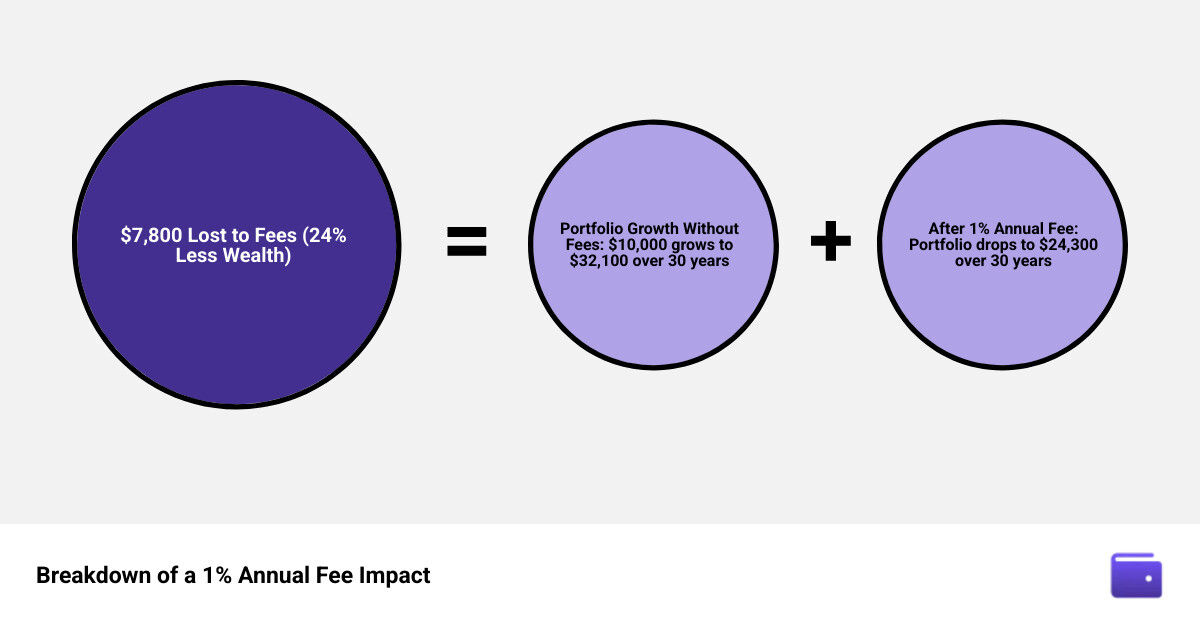
Think of it this way: if two funds both earn 5% in the market, but Fund A charges 0.50% and Fund B charges 1.50%, Fund A puts 4.5% in your pocket while Fund B only gives you 3.5%. Over 30 years, that 1% difference can cost you hundreds of thousands of dollars due to the loss of compounding.
The SEC has frequently warned that even small differences in fees can lead to massive gaps in your nest egg. To see the math for yourself, check out this Expense Ratio Impact Guide or use an Expense Ratio Impact Calculator.
How the Average Management Fee for Mutual Funds Impacts Long-Term Returns
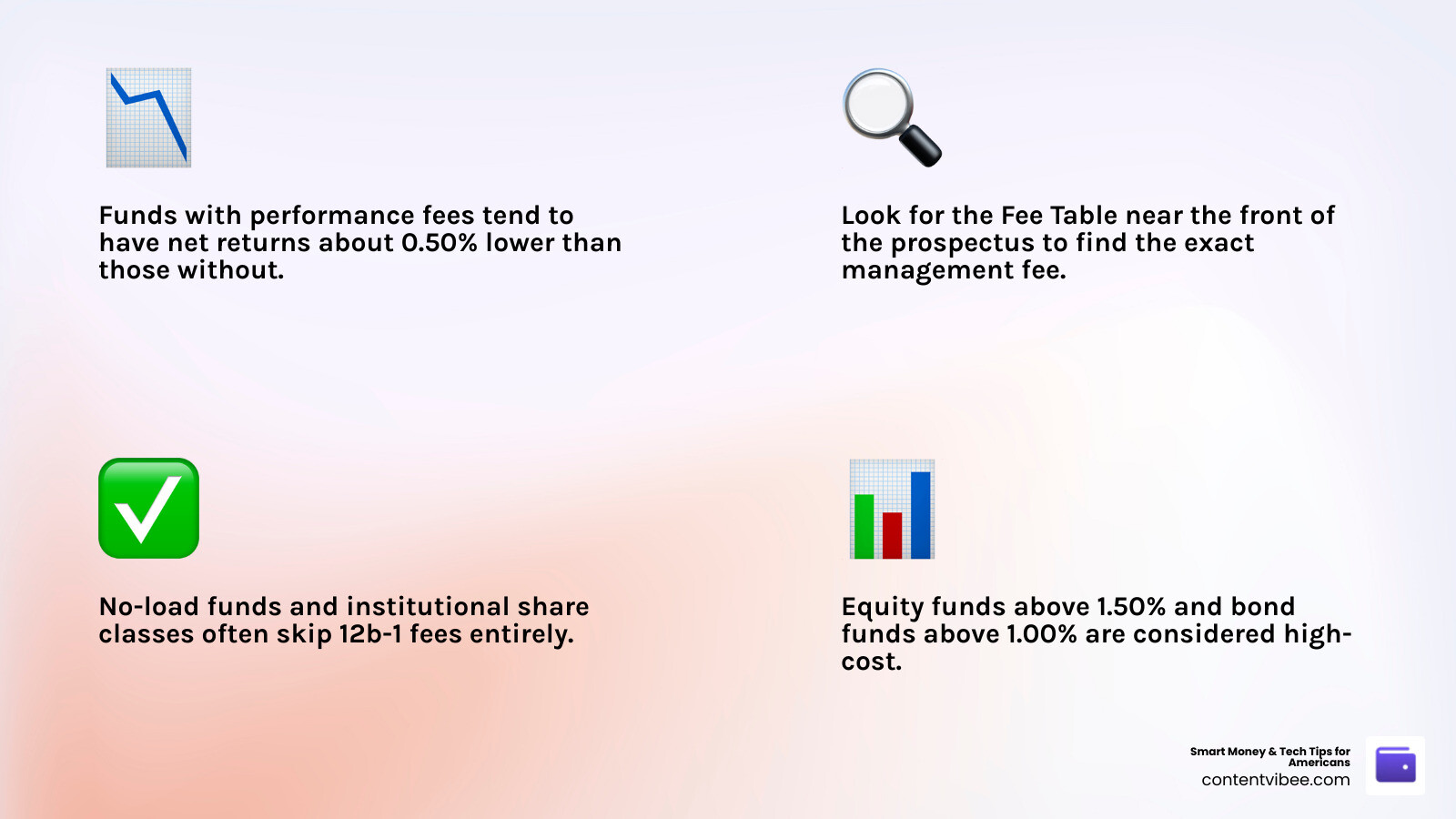
Research shows that funds charging “performance fees” (where the manager gets a bonus for beating a benchmark) actually tend to underperform. On average, funds with performance fees have net returns about 0.50% lower than those without. This is often because the fees are structured to be “asymmetric”—the manager wins big when things go well, but the investor eats the loss when they don’t.
Furthermore, “fee extraction” is a real concern. Some funds use complex structures to hide the total cost of ownership. This is why we always recommend looking for funds with transparent, low-cost structures. For instance, understanding Why MFS Investment Management Expense Ratio varies can help you spot these patterns.
Factors Influencing the Average Management Fee for Mutual Funds
Why does one fund cost 0.10% and another 1.50%? It usually comes down to three things:
- Active vs. Passive: Index funds (passive) just track a list of stocks, so they are cheap. Active funds require expensive research teams.
- Asset Class: International funds require global staffing and currency hedging, which pushes the average management fee for mutual funds higher.
- Fund Size: Large funds can spread their fixed costs (like legal fees) over more investors, lowering the cost for everyone. This is why a giant like Vanguard can offer an average expense ratio of just 0.08%.
Frequently Asked Questions
What is a high expense ratio for a mutual fund?
Generally, anything over 1.50% for an equity fund is considered high. For a basic bond fund, anything over 1.00% should raise a red flag. In index funds, you shouldn’t really be paying more than 0.20%.
Do all mutual funds charge 12b-1 fees?
No! In fact, the industry is moving away from them. Most “no-load” funds and institutional share classes do not charge 12b-1 fees. In 2024, 92% of sales went into funds without these charges.
How do I find the management fee in a prospectus?
Look for the “Fee Table” near the front of the prospectus. It will have a section titled “Annual Fund Operating Expenses.” This table breaks down the management fee, 12b-1 fees, and “other expenses” to give you the total expense ratio.
Conclusion
At Smart Money & Tech Tips for Americans, we believe that “following the fees” is the single best strategy for most investors. The average management fee for mutual funds has been falling for decades, and there is no reason for you to pay more than necessary for a quality investment.
By choosing low-cost, no-load funds and keeping an eye on your total expense ratio, you can ensure that more of your hard-earned money stays in your pocket. Whether you are comparing Asset Management vs Investment Management or just picking your first index fund, remember: every penny saved in fees is a penny earned in retirement.