


Why Your Full Retirement Age Matters for Spousal Social Security Benefits
Using a full retirement age calculator is the fastest way to find the exact age at which you qualify for 100% of your Social Security benefits — and it’s the starting point for any smart spousal claiming strategy.
Your Full Retirement Age (FRA) by Birth Year:
| Birth Year | Full Retirement Age |
|---|---|
| 1943 – 1954 | 66 |
| 1955 | 66 years, 2 months |
| 1956 | 66 years, 4 months |
| 1957 | 66 years, 6 months |
| 1958 | 66 years, 8 months |
| 1959 | 66 years, 10 months |
| 1960 or later | 67 |
For most people reading this, FRA is age 67.
Here’s why this matters so much for couples: the age both you and your spouse choose to claim Social Security can permanently raise or lower your household income for the rest of your lives.
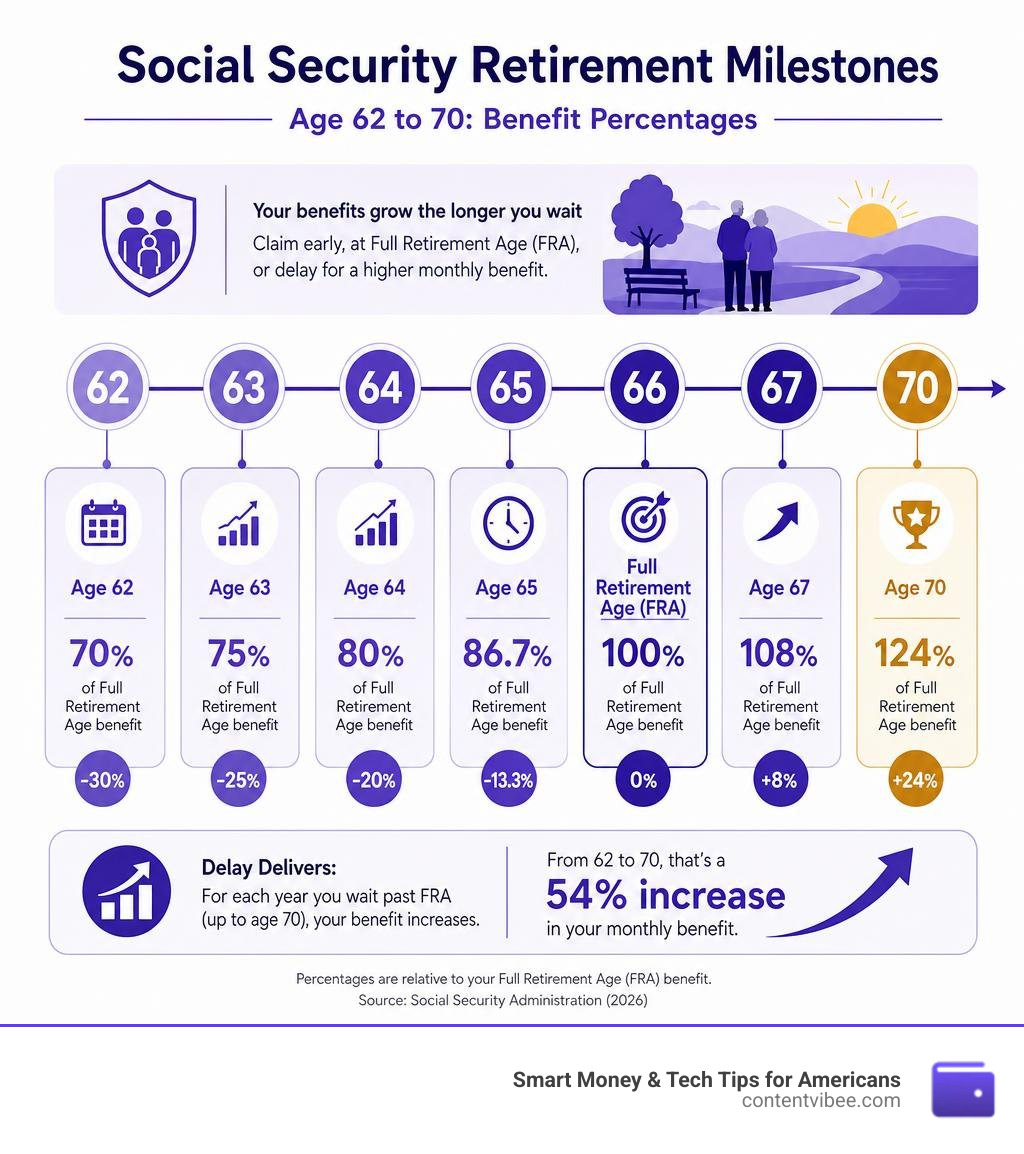
- Claim at 62 and you lock in a permanent 30% reduction
- Claim at FRA and you get 100% of your earned benefit
- Claim at 70 and you earn 24% more per month than at FRA
For spouses, the stakes are even higher. A lower-earning spouse’s benefit is tied directly to the higher earner’s record. One wrong timing decision can mean tens of thousands of dollars in lost lifetime income.
This guide walks you through exactly how to use a full retirement age calculator, understand spousal benefit rules, and make the claiming decision that fits your household.
Quick full retirement age calculator definitions:
What is Full Retirement Age (FRA) and How is it Determined?
Full Retirement Age (FRA) is the specific age set by federal law at which you become eligible to receive your unreduced, 100% primary insurance amount (PIA) from the Social Security Administration (SSA). Your PIA is the base monthly benefit calculated from your 35 highest-earning years of work.
The concept of FRA has evolved significantly over the years. For decades, the standard retirement age in the United States was 65. However, in 1983, Congress passed a landmark bipartisan law to address the long-term financial solvency of the Social Security system. Recognizing that Americans were living longer, healthier lives than previous generations, the 1983 amendments established a gradual increase in the FRA from 65 to 67.
Under this law, the transition was phased in slowly based on birth year. For anyone born in 1960 or later, the transition is fully complete, setting the standard FRA at exactly 67.
Determining your exact FRA is essential because it serves as the baseline for every single calculation involving your retirement check. If you want to dive deeper into the historical context and find the absolute best age to collect SS based on your lifestyle goals, it helps to look at how the government calculates these milestones. You can also utilize the official government tools like the Benefits Planner: Retirement | Retirement Age Calculator | SSA to verify your timeline.
Using a Full Retirement Age Calculator to Find Your Milestone
While a simple birth year chart is helpful, a dedicated full retirement age calculator provides the pinpoint accuracy required for true financial planning. These tools calculate your exact milestone down to the month, which is incredibly important because the SSA does not round your age up or down; they calculate your eligibility based on exact calendar dates.
One critical nuance that many people overlook is the “January 1st Rule.” If your birthday falls on January 1st of any given year, the Social Security Administration calculates your benefits as if you were born in the previous calendar year. For example, if you were born on January 1, 1960, the SSA treats your birth year as 1959. This means your FRA would be 66 years and 10 months, rather than 67.
By using an interactive tool like the Social Security Quick Calculator, you can input your date of birth and current earnings to instantly see your milestone dates, including:
- Your exact early retirement eligibility date (at age 62)
- Your precise Full Retirement Age date (between 66 and 67)
- Your maximum benefit date (at age 70)
Having these calendar dates in hand allows you and your spouse to align your retirement timeline with other financial milestones, such as paying off a mortgage, transitioning to part-time work, or enrolling in Medicare.
How Claiming Age Affects Spousal and Individual Benefits
Deciding when to click “apply” on the Social Security website is one of the most consequential financial decisions you will ever make. The difference between claiming as early as possible and waiting until age 70 can alter your monthly check by up to 76%.
To understand the math, let’s look at how the SSA penalizes early claimers and rewards those who delay. If your FRA is 67, claiming at age 62 results in a permanent 30% reduction in your monthly benefit. This reduction is calculated month-by-month: the SSA reduces your benefit by 5/9 of 1% for each of the first 36 months before FRA, and 5/12 of 1% for each additional month.
Conversely, if you delay claiming past your FRA, you earn Delayed Retirement Credits. These credits accrue at a rate of 8% per year (or 2/3 of 1% per month) for every year you wait, up to age 70. For someone with an FRA of 67, waiting until 70 yields a permanent 24% increase on top of their base benefit.

This decision is often framed as a “break-even” analysis. The break-even age is the point in time where the total cumulative benefits of waiting to claim a larger check surpass the total cumulative benefits of claiming a smaller check early. For most individuals, the break-even age between claiming at 62 versus waiting until FRA lies between 78 and 82. If you expect to live past this age range, waiting is mathematically the superior choice.
To model these numbers for your own household, you can use our dedicated guide to calculate spouse retirement benefits to compare different scenarios alongside your estimated Social Security check.
The Impact of Early vs. Delayed Claiming on Your Household
When you are married, the claiming decision should never be made in a vacuum. It is a joint “longevity bet” that requires looking at your combined life expectancies.
For a married couple, the higher earner’s claiming age is of paramount importance. Why? Because the higher earner’s monthly benefit determines the survivor benefit that the remaining spouse will inherit. If the higher earner claims early at 62, they permanently reduce not only their own retirement check but also the survivor benefit for their spouse.
If the higher earner delays claiming until age 70, they maximize both their monthly income and the safety net for the surviving spouse. Because women statistically outlive men on average, this strategy often serves as an invaluable insurance policy for wives, ensuring they receive the largest possible monthly check if their husband passes away first.
Furthermore, any delayed retirement credits you earn compound alongside the annual Cost-of-Living Adjustments (COLA). Because COLA is a percentage-based increase, a larger base benefit means that each year’s inflation adjustment translates to a larger dollar increase, widening the gap between early and delayed claimers over time.
How a Full Retirement Age Calculator Helps Estimate Spousal Benefits
A spousal benefit allows a lower-earning or non-working spouse to receive a monthly payment based on their partner’s work record. The maximum spousal benefit is exactly 50% of the primary earner’s primary insurance amount (PIA) at their Full Retirement Age.
However, to get that full 50%, the spouse claiming the benefit must have reached their own FRA. If the spouse claims early at age 62, the spousal benefit is permanently reduced to as little as 32.5% of the primary earner’s PIA.
It is also important to note that delayed retirement credits do not apply to spousal benefits. A spouse cannot receive more than 50% of the primary earner’s PIA, meaning there is no financial incentive to delay claiming a spousal benefit past your own FRA.
To see how these rules apply to your specific numbers, you can use a how much Social Security will I get calculator to run different scenarios and find the optimal combination of ages for both partners.
Navigating Spousal, Divorced, and Survivor Benefits
Social Security is designed to protect families, which is why the system includes robust provisions for current spouses, divorced spouses, and surviving spouses. However, navigating these programs requires meeting strict legal criteria.
To help you stay organized, we have compiled the core requirements and strategies for each benefit type:
- Current Spousal Benefits: To qualify, you must be at least 62 years old, and your spouse must already be actively receiving their own retirement benefits. Additionally, you must have been married for at least one continuous year before filing.
- Divorced Spousal Benefits: If you are divorced, you can still claim benefits based on your ex-spouse’s work record. To qualify, your marriage must have lasted for at least 10 consecutive years, you must currently be unmarried, and both you and your ex-spouse must be at least 62. Crucially, if you have been divorced for at least two years, you can claim benefits even if your ex-spouse has not yet filed for theirs. Best of all, claiming on an ex-spouse has absolutely zero impact on their benefits or the benefits of their current spouse.
- Survivor Benefits: If your spouse passes away, you can inherit up to 100% of their monthly benefit, including any delayed retirement credits they earned. You can claim survivor benefits as early as age 60 (or age 50 if you are disabled), though claiming before your FRA will result in a reduced monthly amount.
To ensure you don’t miss any critical steps when applying, review our comprehensive resources:
- Learn at what age can I claim my spouses Social Security to time your application perfectly.
- Review the golden rules can a spouse collect SS spousal benefits to avoid common filing traps.
- Download the ultimate checklist for your application for spousal benefits to gather all necessary documentation before you apply.
- Read our step-by-step guide on how to claim spousal benefits online or over the phone.
Working While Receiving Benefits and Using a Full Retirement Age Calculator
Can you work and collect Social Security at the same time? Yes, but if you do so before reaching your Full Retirement Age, you must navigate the Social Security Earnings Test.
If you claim benefits early and continue to earn income from a job, the SSA imposes strict limits on your earnings. In 2026, the maximum taxable earnings limit for Social Security is $184,500, which determines the maximum amount of wages subject to the payroll tax. However, the limit for the earnings test is much lower:
- If you are under FRA for the entire year: The SSA will withhold $1 in benefits for every $2 you earn above the annual limit (which is adjusted annually for inflation; in 2025, this limit was $23,400).
- In the year you reach FRA: The limit is significantly higher, and the penalty drops. The SSA will withhold $1 in benefits for every $3 you earn above the limit, but they only count earnings made in the months prior to your birthday month.
- Once you reach FRA: The earnings test disappears entirely. You can earn an unlimited amount of money from a job, and your Social Security benefits will not be reduced by a single penny.
It is vital to understand that any benefits withheld under the earnings test are not lost forever. When you reach your FRA, the SSA will automatically recalculate your monthly benefit upward to account for the months they withheld payments.
To model how your wages might impact your monthly checks, you can use the Benefits Planner: Retirement | Online Benefits Calculator | SSA or check out our interactive tools/finance calculator to map out your post-retirement work strategy.
Frequently Asked Questions about Spousal Retirement Age
Managing Social Security rules can feel like learning a completely new language. Here are clear, straightforward answers to the questions we hear most often from American couples.
At what age can I claim my spouse’s Social Security?
The earliest age you can claim a spousal benefit is 62. However, claiming at 62 means your monthly check will be permanently reduced. To receive the maximum possible spousal benefit (50% of your partner’s primary insurance amount), you must wait until you reach your own Full Retirement Age (which is age 67 for anyone born in 1960 or later). Additionally, you must have been married for at least one year, and your spouse must already be receiving their own retirement benefits.
How does my spouse’s claiming age affect my spousal benefit?
Your spousal benefit is calculated based on your partner’s Primary Insurance Amount (PIA) at their Full Retirement Age. Even if your spouse delays their own retirement until age 70 to earn delayed retirement credits, your spousal benefit will not increase past the 50% FRA cap. However, if your spouse claims their own retirement early (for example, at 62), it does not reduce your spousal benefit percentage, provided you wait until your own FRA to claim it.
Can I work while receiving spousal benefits?
Yes, you can work while receiving spousal benefits, but you are subject to the same Social Security Earnings Test rules. If you are under your Full Retirement Age and earn more than the annual limit, the SSA will temporarily withhold a portion of your spousal benefits. Once you reach your FRA, the earnings limit is lifted, and your monthly benefit will be adjusted upward to credit you for any withheld payments.
Conclusion
At Smart Money & Tech Tips for Americans, we believe that retirement planning shouldn’t feel like a guessing game. By taking the time to understand how a full retirement age calculator works and coordinating your claiming strategy with your spouse, you can secure your household’s financial future and maximize every dollar you’ve earned.
Whether you decide to claim early to enjoy your active years, wait until FRA for a balanced approach, or delay until 70 to maximize your lifetime safety net, the key is making an informed, joint decision.
Ready to run the numbers for your own household? Use our free, interactive Social Security Spousal Benefit Calculator to instantly compare claiming ages and find the optimal path to financial freedom.


