


What the Fidelity Activity Assessment Fee Really Means for Your Trades
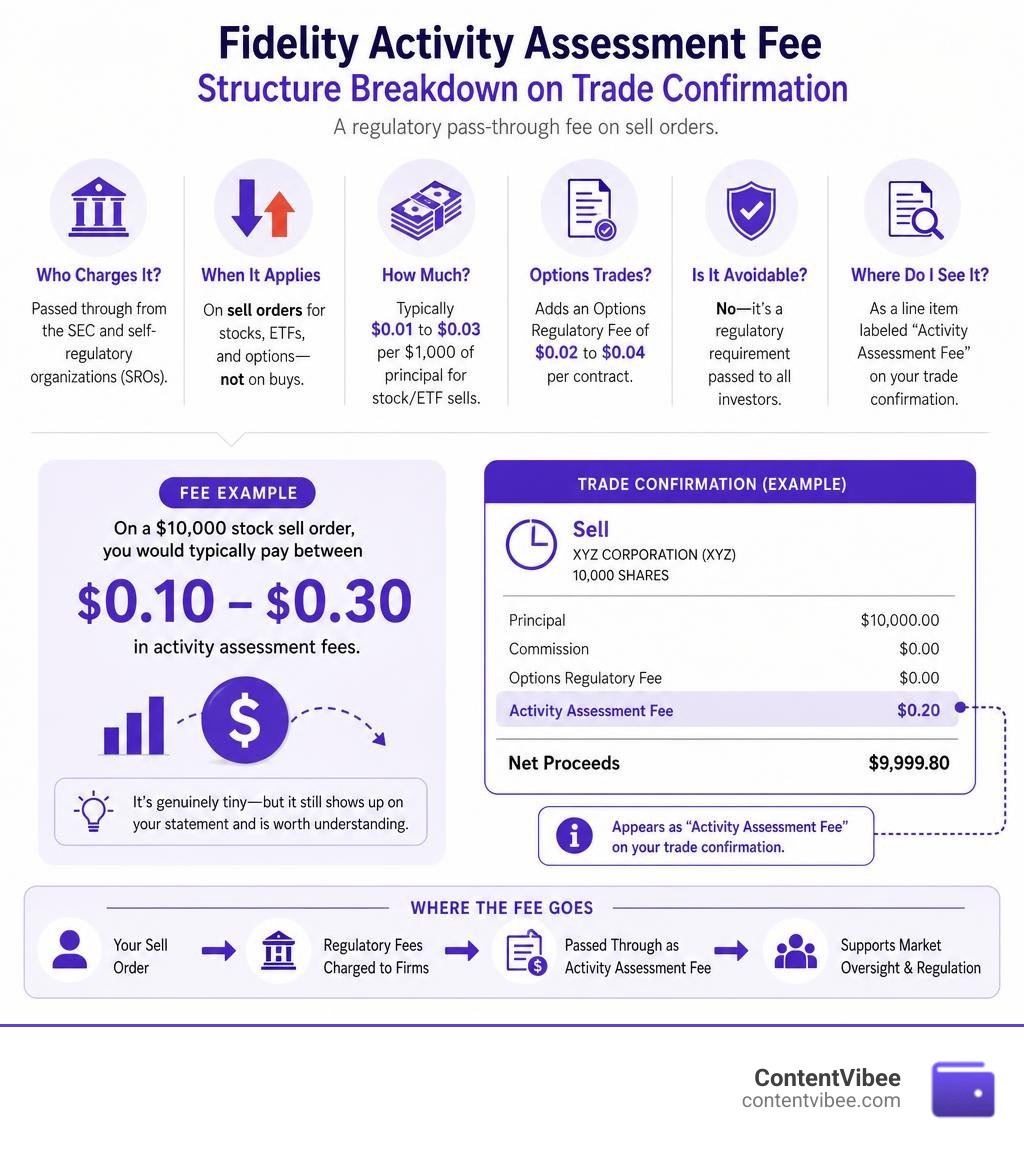
The Fidelity activity assessment fee is a small regulatory pass-through charge that appears on your trade confirmation whenever you sell stocks, ETFs, or options. It is not a Fidelity profit center — it exists to offset costs that regulators charge Fidelity for overseeing securities markets.
Here is a quick snapshot of what you need to know:
| What You Want to Know | Quick Answer |
|---|---|
| Who charges it? | Fidelity passes through costs from the SEC and self-regulatory organizations (SROs) |
| When does it apply? | On sell orders for stocks, ETFs, and options — not buy orders |
| How much is it? | Typically $0.01 to $0.03 per $1,000 of principal for stock/ETF sells |
| Options trades? | Adds an Options Regulatory Fee of $0.02 to $0.04 per contract |
| Is it avoidable? | No — it is a regulatory requirement passed to all investors |
| Where do I see it? | As a line item labeled “Activity Assessment Fee” on your trade confirmation |
So on a $10,000 stock sell order, you would typically pay between $0.10 and $0.30 in activity assessment fees. It is genuinely tiny — but it still shows up on your statement, and it is worth understanding exactly what you are paying and why.
What Is the Fidelity Activity Assessment Fee and Why Is It Charged?
When we look at our monthly account statements or trade confirmation sheets, seeing an unexpected line item can feel confusing — especially when online equity commissions are listed at $0.00. The Fidelity activity assessment fee is an operational mechanism used by brokerage firms to recover regulatory costs incurred from clearing transactions across public exchanges.

Under Section 31 of the Securities Exchange Act of 1934, federal law mandates that self-regulatory organizations (SROs) such as the Financial Industry Regulatory Authority (FINRA) and national securities exchanges pay government fees based on the total dollar volume of securities sold. To recover these fees, broker-dealers assess an offset charge directly on client sell orders. As detailed in the official Fidelity Brokerage Fee Schedule PDF, this charge—often referred to as an “Additional Assessment”—is determined at Fidelity’s sole discretion and designed to match or approximate regulatory charges imposed by SROs and the Securities and Exchange Commission (SEC).
For a deeper look into baseline broker structures, explore our overview on Are Fidelity Trades Really Free Demystifying the Fees.
Difference Between the Activity Assessment Fee and the FINRA Trading Activity Fee
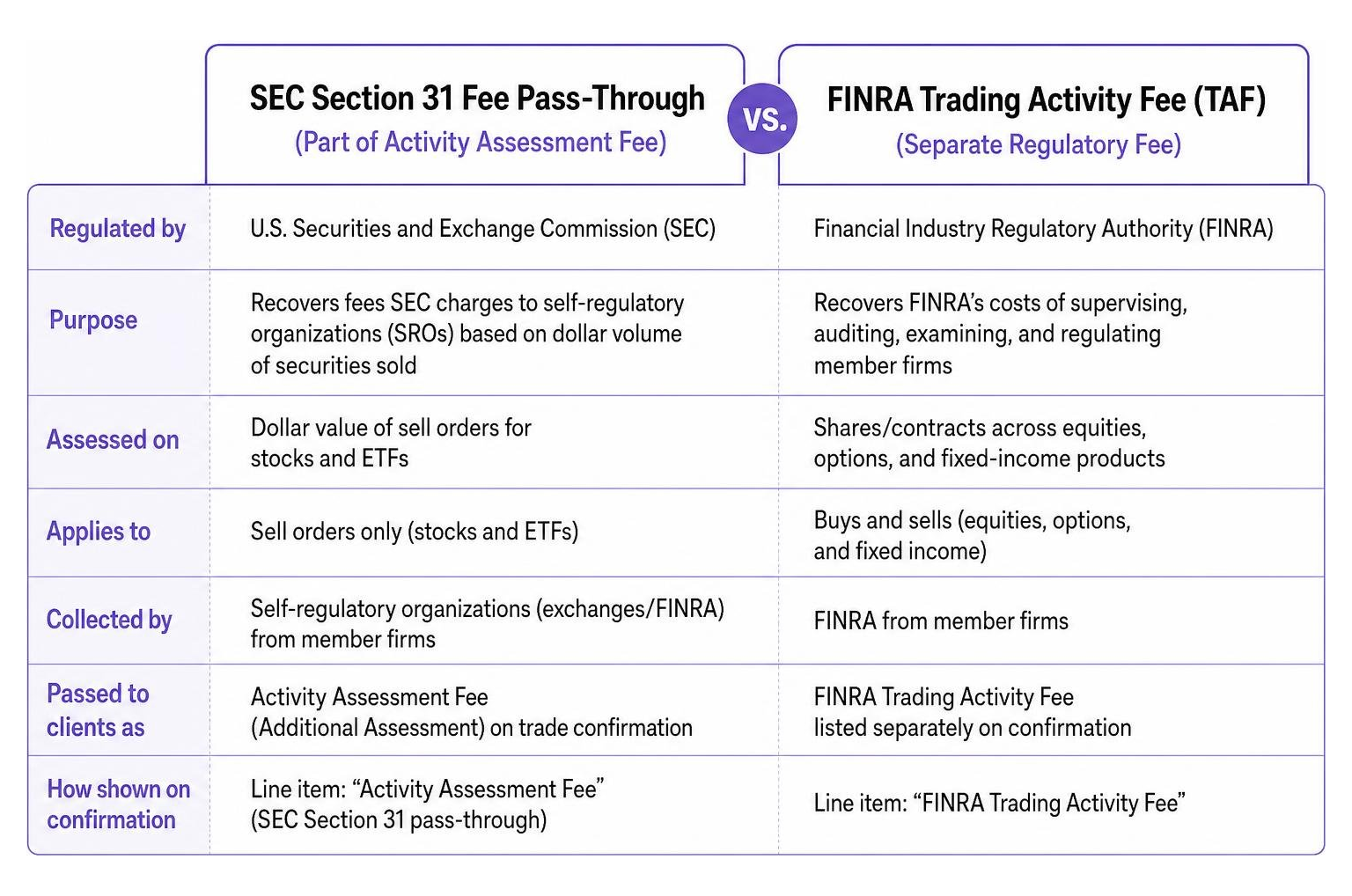
It is easy to conflate the broader Fidelity activity assessment fee with specific regulatory line items like the FINRA Trading Activity Fee (TAF). However, they serve distinct regulatory functions and fund different regulatory bodies.
The primary distinctions include:
- SEC Section 31 Regulatory Transaction Fee: Passed through as part of the activity assessment fee on stock and ETF sell orders to recover the costs imposed on exchanges by the SEC to regulate national securities markets.
- FINRA Trading Activity Fee (TAF): Assessed directly by FINRA on member broker-dealers to recover the explicit costs of supervising, auditing, examining, and regulating financial institutions.
While the TAF is assessed on aggregate trading volume across equities, options, and fixed-income products on a per-share or per-contract basis, the Activity Assessment Fee line item on client trade confirmations frequently bundles regulatory pass-throughs together. To learn more about overall transaction expenses, check out our guide on What Does It Really Cost to Trade on Fidelity.
How the Fidelity Activity Assessment Fee Is Calculated
Calculating the Fidelity activity assessment fee depends directly on the security type, total principal value, and contract volume involved in a sell trade. While buy orders carry a $0 assessment fee, sell orders trigger specific mathematical formulas applied directly on the trade date.
| Security Type | Primary Regulatory Fee Basis | Typical Rate Range | Applicable Transactions |
|---|---|---|---|
| Equities & ETFs | Total Principal Sales Value | $0.01 to $0.03 per $1,000 principal | Sell orders only |
| Options Contracts | Per Contract + Principal Assessment | $0.02 to $0.04 per contract + Equity rate | Closing / Sell transactions |
| Fixed Income / Debt | Excluded or trace-based | Exempt (U.S. Treasuries) or custom fixed rate | Secondary market sells |
To review more pricing rules, check our detailed breakdown on Fidelity Fee Per Trade.
How the Fidelity Activity Assessment Fee Is Calculated on Stocks and ETFs
For stock and ETF sell orders, the calculation relies primarily on the total dollar amount (principal) realized from the sale.
The mathematical formula applied to equity sales is:
$$\text{Activity Assessment Fee} = \left(\frac{\text{Total Principal Value}}{\$1,000}\right) \times \text{Assessment Rate}$$
Historically, this assessment rate generally ranges between $0.01 and $0.03 per $1,000 of principal.
For example, if we place a sell order for 500 shares of a stock at $50 per share, our total principal value is:
$$\text{Principal} = 500 \times \$50 = \$25,000$$
Assuming an assessment rate of $0.0278 per $1,000 of principal:
$$\text{Fee} = \left(\frac{\$25,000}{\$1,000}\right) \times 0.0278 = 25 \times 0.0278 = \$0.695 \rightarrow \$0.70$$
Because clearing systems round fractional cents up to the nearest whole cent, small sell orders under $1,000 generally incur a minimum rounded fee of $0.01. For additional insights on stock trading charges, read our article on How Much Does Fidelity Actually Charge to Trade Stocks.
Calculation Methods for Options Trades
Options trades involve a two-part fee mechanism under the Fidelity activity assessment fee header:
- The Equity Additional Assessment: Calculated on the underlying principal value generated when options positions are sold or exercised for physical stock delivery.
- The Options Regulatory Fee (ORF): Assessed directly on option contract transactions to recover exchange-level clearing costs imposed by the Options Clearing Corporation (OCC) and option exchanges.
The Options Regulatory Fee typically ranges from $0.02 to $0.04 per contract.
If we sell to close 10 option contracts at a premium price of $2.00 ($200 per contract, totaling $2,000 in principal):
- ORF Component: $10 \text{ contracts} \times \$0.03 = \$0.30$
- Principal Assessment Component: $(\$2,000 / \$1,000) \times \$0.0278 = \$0.0556 \rightarrow \$0.06$
- Total Activity Assessment Fee: $\$0.30 + \$0.06 = \$0.36$
To better understand standard vs. hidden trading costs, explore Fidelity Fees for Buying Stocks What’s the Catch.
Covered Securities, Exemptions, and Statement Line Items
Understanding where the Fidelity activity assessment fee applies helps investors plan execution strategies effectively across different account types and asset classes.
Exemptions from the Fidelity Activity Assessment Fee
Not all investment trades trigger an activity assessment fee. Regulatory statutes specifically exempt numerous transaction categories:
- Buy Orders: Purchasing stocks, ETFs, or options never triggers an activity assessment fee.
- U.S. Treasury Securities: Government debt securities (Treasury bills, notes, and bonds) traded in primary or secondary markets are fully exempt from SEC Section 31 fees and FINRA TAF.
- Mutual Fund Primary Transactions: Buying or redeeming shares of traditional open-end mutual funds directly through the fund family does not incur exchange regulatory fees, though short-term redemption fees or transaction fees may apply separately.
- Primary Market Offerings: Purchasing shares directly in an Initial Public Offering (IPO) or secondary municipal bond offering.
- ETF Creation and Redemption: Direct creation or redemption transactions between Authorized Participants (APs) and ETF sponsors.
For a comprehensive breakdown of mutual fund cost schedules, refer to The Complete Guide to Fidelity Mutual Fund Fees.
How the Fee Appears on Statements and Comparing Across Brokerages
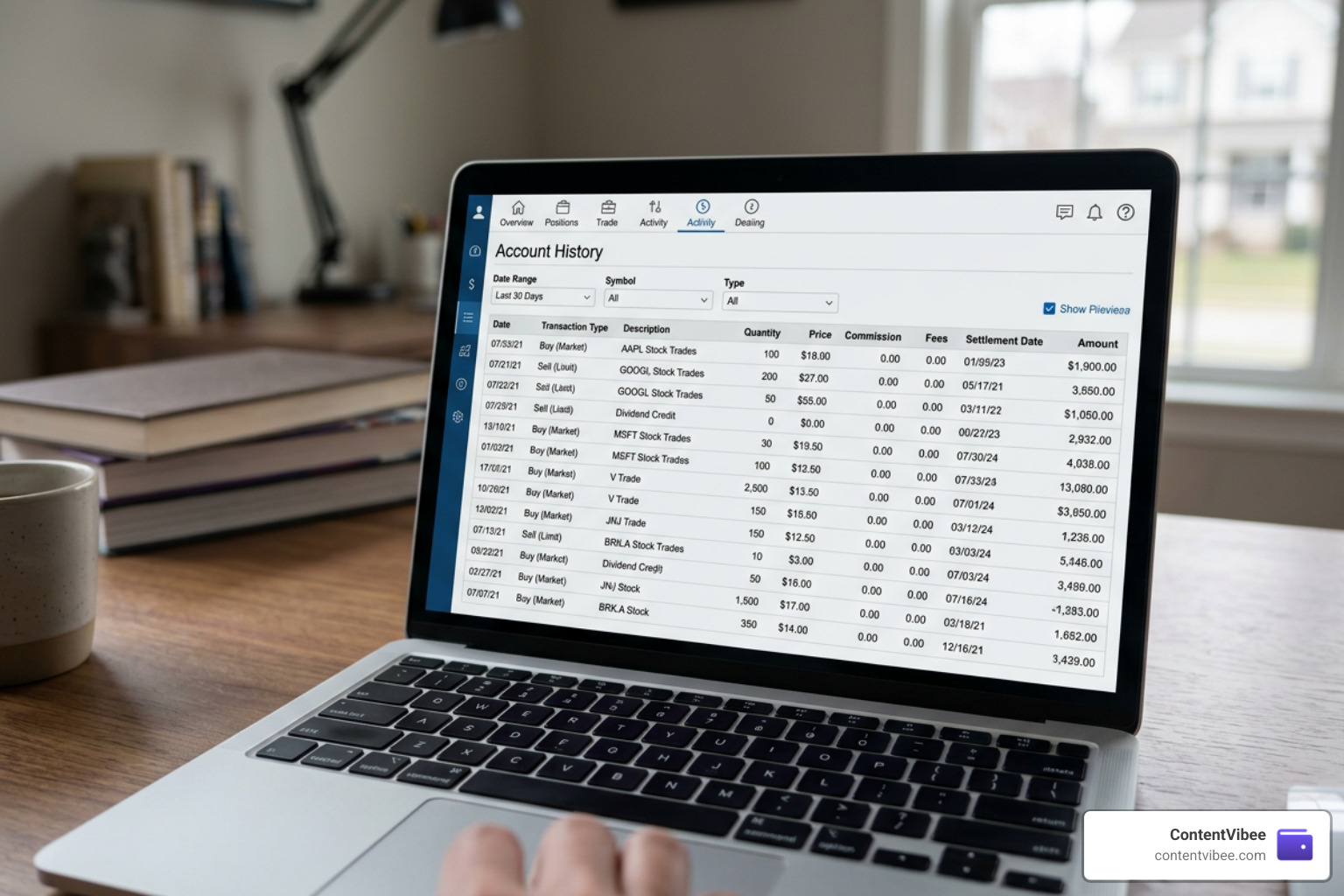
When reviewing transaction history, the Fidelity activity assessment fee appears as a separate line item on individual trade confirmation receipts and monthly account statements.
Because clearing houses consolidate regulatory fees using automated clearing systems, minor discrepancies between estimated fees and final cleared amounts can occur due to internal rounding rules, trade allocation account adjustments, or mid-year regulatory rate shifts. For information on system tracking and accounting adjustments, you can review technical specifications like the Fee Code Activity Documentation.
Overall, pass-through regulatory fee rates are uniform across major retail brokerages because the underlying SEC and FINRA assessments are mandated by federal oversight bodies. To compare overall account charges, read our Fidelity Brokerage Account Fees Review What You Need to Know.
Disclosures, Fee Changes, and Dispute Resolution
Regulatory assessment rates are updated periodically by the SEC, FINRA, and the OCC to adapt to overall market volume changes. For example, when market trading volumes spike sharply, regulatory bodies often reduce per-dollar assessment rates to prevent over-collecting regulatory revenue.
When these rate changes occur:
- Fidelity updates its online disclosures and brokerage fee schedules without requiring individual client consent.
- Changes take effect on designated federal effective dates for all subsequent trade confirmations.
If you suspect a fee was calculated incorrectly on a specific trade confirmation, follow this simple resolution process:
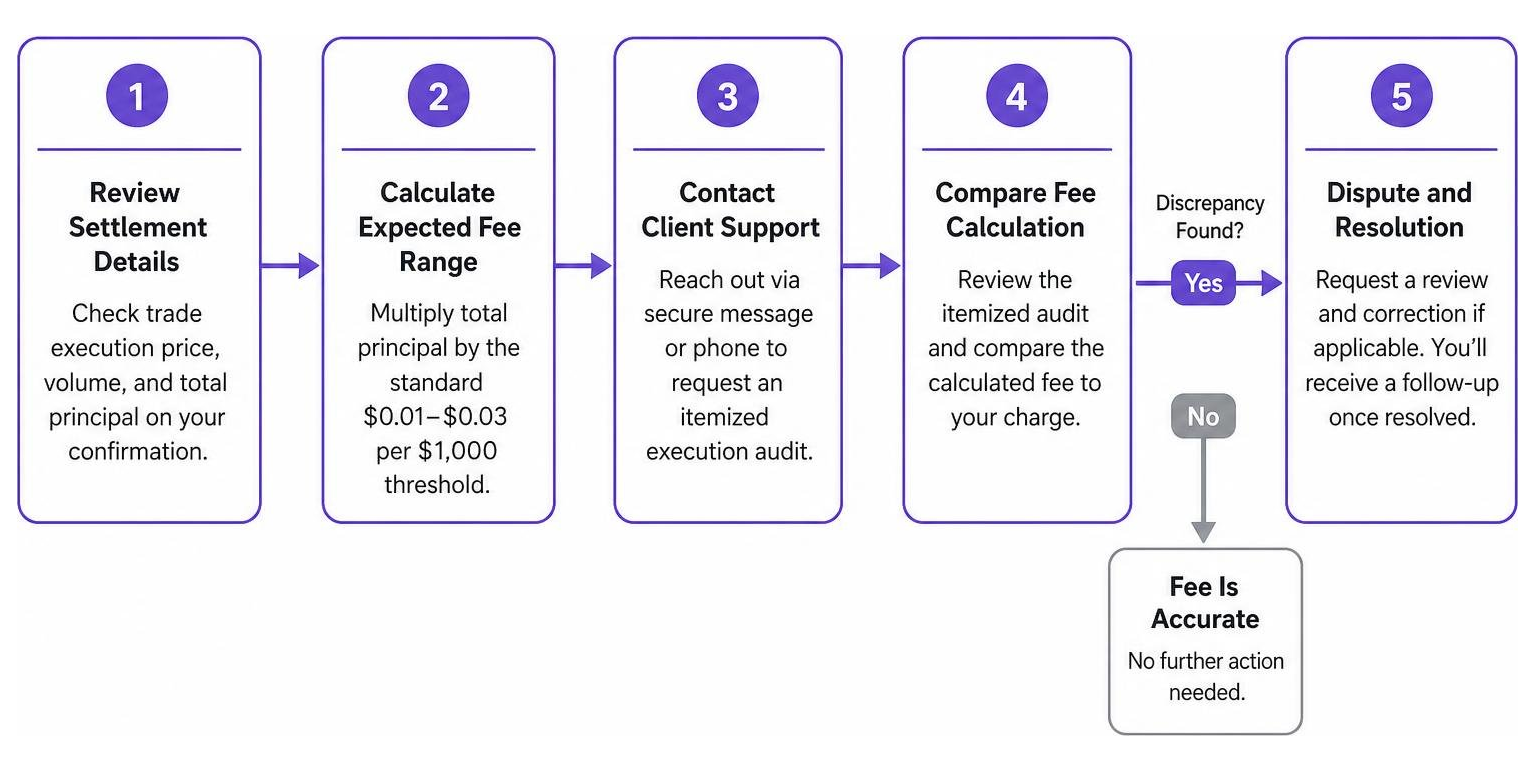
- Review Settlement Details: Check the trade execution price, volume, and total principal on your trade confirmation sheet.
- Calculate Expected Fee Range: Multiply your total principal by the standard $0.01 to $0.03 per $1,000 threshold (adding contract charges for options).
- Contact Client Support: Reach out to a customer service representative via secure message or phone to request an itemized execution audit.
To review complete brokerage cost breakdowns, read Fidelity Fees and Commissions Explained Without the Fine Print.
Frequently Asked Questions About Fidelity Activity Assessment Fees
Why was an activity assessment fee charged on my trade?
An activity assessment fee is charged whenever you execute a sell order for equities, ETFs, or options. It is a pass-through charge used by brokerages to pay regulatory oversight fees required by the SEC and self-regulatory organizations under federal law.
Does the activity assessment fee apply to stock buy orders?
No. The Fidelity activity assessment fee applies strictly to sell transactions. Buy orders on standard U.S. stocks and ETFs carry $0 in commissions and zero regulatory assessment fees.
What should I do if I think the activity assessment fee was calculated wrong?
If you suspect an error on your trade confirmation, contact customer service directly to request a line-item breakdown. Representatives can review trade allocation logs and issue adjustments if clearing rounding rules caused an overcharge.
Conclusion
The Fidelity activity assessment fee is an unavoidable regulatory pass-through cost associated with selling stocks, ETFs, and options in U.S. financial markets. Averaging between $0.01 and $0.03 per $1,000 in sold principal, it accounts for a tiny fraction of total proceeds while directly supporting the oversight of secure, liquid trading markets.
By staying informed about how these fees work across different order types and securities, we can better decode our trade confirmations and manage investment portfolios with complete clarity. For additional trading guides, fee breakdowns, and personal finance tools, check out The Ultimate Guide to Fidelity Trading Fees and Savings.


