


The Retirement Savings Gap That Affects Millions of Single-Income Households
A spousal retirement account — more commonly called a spousal IRA — is one of the most overlooked tools in the American tax code. It lets a working spouse contribute to a separate IRA in a non-working partner’s name, even if that partner has little or no earned income of their own.
Here’s the quick answer:
- A spousal IRA is a standard traditional or Roth IRA opened in the non-working spouse’s name
- The working spouse’s income funds the account, but the non-working spouse owns it outright
- You must file a joint federal tax return to qualify
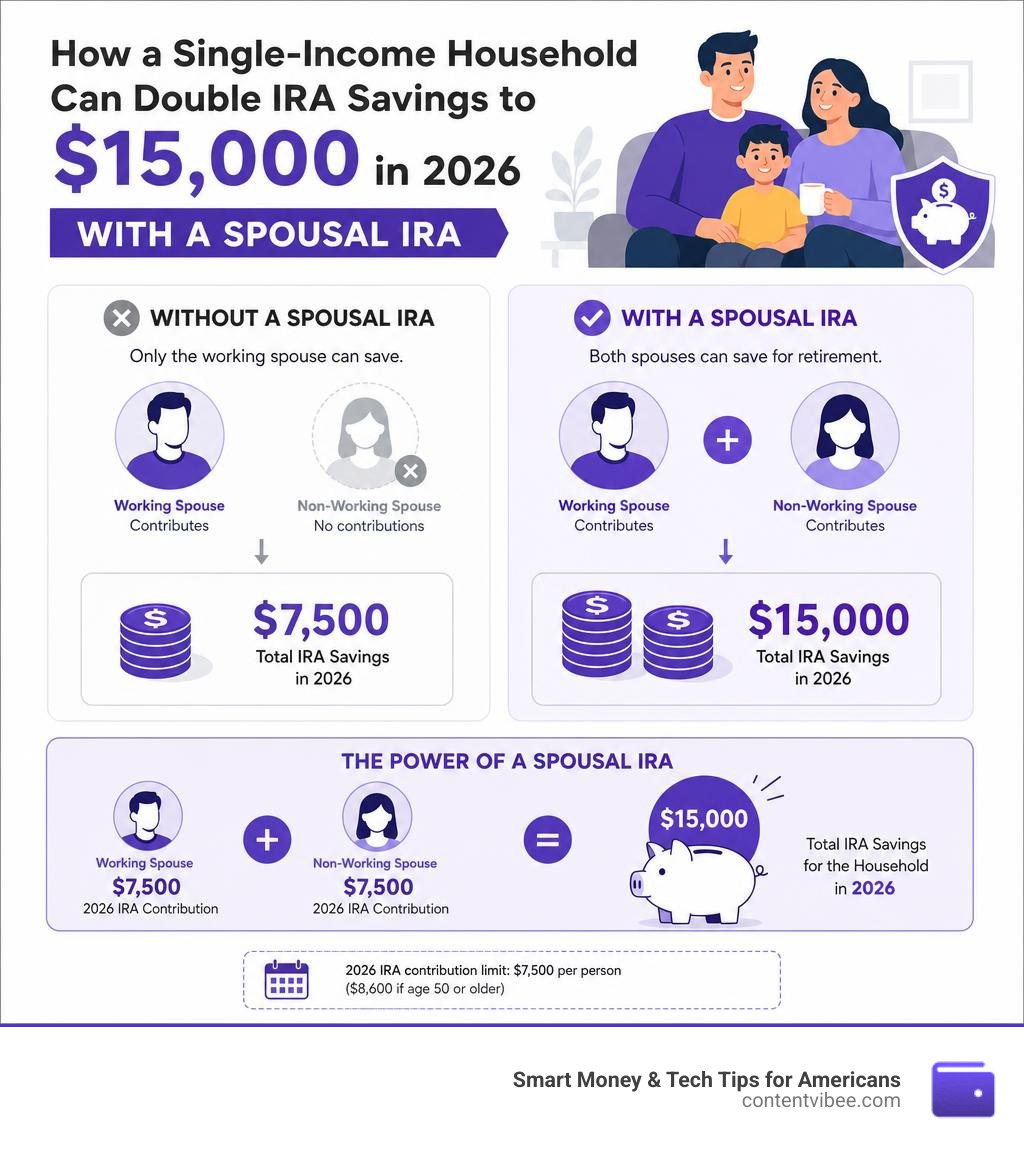
- In 2026, each spouse can contribute up to $7,500 (or $8,600 if age 50 or older)
- A single-income household can shelter up to $15,000 per year across both IRAs combined
- Income limits apply for Roth contributions (full contribution allowed below $242,000 MAGI for joint filers in 2026)
This matters more than most people realize. Stay-at-home parents, caregivers, and spouses between jobs have no access to an employer’s 401(k). Without a spousal IRA, they could spend years — sometimes decades — building zero retirement savings of their own.
That creates a real financial risk, especially if a divorce or unexpected death disrupts the household. The spousal IRA directly solves this problem.
What is a Spousal Retirement Account and How Does It Work?
To understand how a spousal retirement account works, we have to look at the foundational rules of individual retirement accounts. Normally, the IRS mandates that you must have “taxable compensation” (earned income) to contribute to an IRA. If you do not work, you cannot save.
However, Section 219(c) of the Internal Revenue Code provides a brilliant exception. It allows a married couple to treat their combined income as a shared pool for retirement savings. Under this rule, the working spouse can use their earned income to fund an IRA for the non-working or lower-earning spouse.
It is important to clear up a common misconception: there is no such thing as a “joint” IRA. The “I” in IRA stands for Individual. A spousal IRA is not a special, co-owned account type. It is simply a standard traditional or Roth IRA that is set up in the non-working spouse’s name and linked to their Social Security number, but funded by the working spouse’s paycheck.
The non-working spouse maintains 100% individual ownership of the account. Even though the working partner makes the contributions, the money belongs entirely to the account holder. This structure is a fantastic way to ensure both partners build independent nest eggs. If you are looking for other creative methods to diversify your household savings, check out our guide on Alternative Ways To Save For Retirement That Actually Work.
Traditional vs. Roth Spousal Retirement Account Options
When establishing a spousal retirement account, you must choose between two primary tax structures: a Traditional IRA or a Roth IRA. The right choice depends on your household’s current tax bracket and where you expect to be in the future.
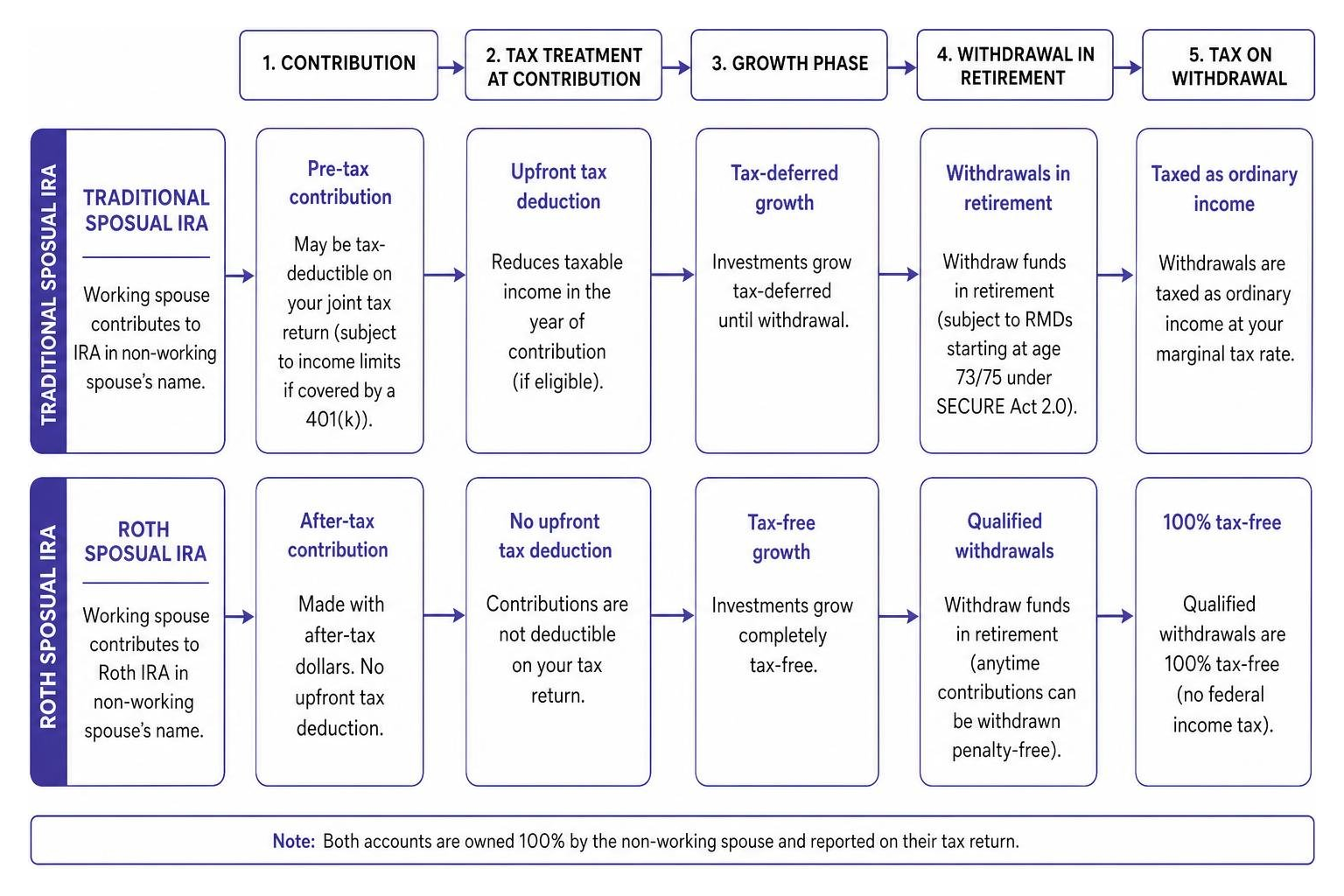
- Traditional Spousal IRA: Contributions are made with pre-tax dollars. This means you may be able to deduct the contribution on your joint tax return, reducing your taxable income today. The money grows tax-deferred, and your spouse will pay ordinary income tax on the withdrawals during retirement.
- Roth Spousal IRA: Contributions are made with after-tax dollars, meaning there is no upfront tax deduction. However, the funds grow completely tax-free, and qualified withdrawals in retirement are also 100% tax-free.
To help you calculate which structure will save you the most money over the long haul, we recommend using The Great Retirement Debate Roth Vs Traditional 401K Calculator Guide.
Here is a quick look at how these two options stack up in 2026:
| Feature | Traditional Spousal IRA | Roth Spousal IRA |
|---|---|---|
| Upfront Tax Deduction | Yes (subject to income limits if working spouse has a 401k) | No |
| Growth Type | Tax-deferred | Tax-free |
| Retirement Withdrawals | Taxed as ordinary income | 100% tax-free |
| Required Minimum Distributions (RMDs) | Yes (starts at age 73/75 under SECURE Act 2.0) | None during the original owner’s lifetime |
| Contribution Source | After-tax or pre-tax equivalent | After-tax dollars only |
Eligibility and Rules for a Spousal IRA
While a spousal retirement account is incredibly flexible, the IRS does enforce strict guardrails to prevent abuse. To qualify for this tax-sheltering strategy, you must satisfy three core criteria:
- Legal Marriage: You must be legally married. Cohabitating partners or common-law arrangements that are not legally recognized do not qualify.
- Joint Tax Filing: You must file a joint federal income tax return for the tax year in which the contribution is made.
- Sufficient Earned Income: The working spouse must have enough taxable compensation to cover the total contributions made to both IRAs.
Earned income includes wages, salaries, tips, bonuses, commissions, and net self-employment income. It does not include passive income such as interest, dividends, rental income, pension payouts, or Social Security benefits. If you want to dive deeper into how different income streams affect your tax liability, check out our insights on Smart Strategies To Defer Taxes And Boost Your Retirement Savings.

Filing Status and Income Requirements
The joint filing requirement is non-negotiable. If you and your spouse decide to file as Married Filing Separately, you lose the ability to make spousal IRA contributions. In that scenario, the non-working spouse would be limited to contributing $0, as they have no individual earned income.
Additionally, your combined household income must support your savings goals. For example, if both you and your spouse are under age 50 and want to fully fund your respective IRAs in 2026, you will need to contribute $7,500 to your account and $7,500 to your partner’s account. To do this, the working spouse’s total earned income for the year must be at least $15,000. If the working spouse only earns $12,000, your combined IRA contributions across both accounts cannot exceed $12,000.
2026 Contribution Limits and Tax Implications
For the 2026 tax year, the IRS has adjusted IRA contribution limits upward to account for inflation. This gives families a larger tax-sheltered runway than in previous years.
- Under Age 50: The maximum annual contribution limit is $7,500 per person.
- Age 50 and Older: If the account owner is 50 or older, they qualify for an additional catch-up contribution of $1,100, bringing their individual limit to $8,600.
This means a single-income couple under age 50 can contribute a combined total of $15,000 to their IRAs in 2026. If the non-working spouse is over 50 but the working spouse is 45, they can contribute $8,600 to the non-working spouse’s account and $7,500 to the working spouse’s account, for a total of $16,100. If both are 50 or older, the maximum household limit reaches $17,200.
You can review the official parameters on the IRS IRA Contribution Limits page. To understand how catch-up provisions can dramatically accelerate your savings as you approach retirement, read The Ultimate Guide To Retirement Contribution Catch Up Limits. If you are planning to focus purely on the tax-free growth of a Roth account, don’t miss The Ultimate Guide To Your 2026 Max Roth Ira Contribution.
MAGI Limits and Phase-Outs for 2026
Your ability to claim a tax deduction (for a Traditional IRA) or make direct contributions (for a Roth IRA) depends on your Modified Adjusted Gross Income (MAGI) and whether the working spouse is covered by an employer-sponsored retirement plan, such as a 401(k).
Roth Spousal IRA Income Limits (2026)
For married couples filing jointly, the ability to contribute directly to a Roth spousal IRA phases out as income rises:
- Full Contribution: Allowed if your joint MAGI is under $242,000.
- Partial Contribution: Allowed if your joint MAGI is between $242,000 and $252,000.
- No Contribution: If your joint MAGI is $252,000 or more, you cannot contribute directly to a Roth IRA (though you can still look into a “backdoor” Roth strategy).
Traditional Spousal IRA Deduction Phase-Outs (2026)
If the working spouse is covered by an active workplace retirement plan, the tax deductibility of the working spouse’s Traditional IRA contribution phases out between $129,000 and $149,000 MAGI.
However, the deduction rules are much more generous for the non-working spouse. If the working spouse has a workplace retirement plan but the non-working spouse does not, the non-working spouse can claim a full deduction on their Traditional IRA contribution as long as the couple’s joint MAGI is under $240,000 (phasing out completely at $250,000).
How to Maximize Your Spousal Retirement Account in 2026
The secret weapon of the spousal retirement account is compounding interest. If a couple starts contributing $15,000 annually at age 30, assuming a conservative 7% annual return, that double-IRA strategy could compound to over $1.42 million by age 60.
To make the most of this strategy:
- Contribute Early: Don’t wait until the tax deadline (which is April 15, 2027, for the 2026 tax year) to make your contributions. Contributing early in the year gives your money more time to compound.
- Use the Split Strategy: You do not have to put all your eggs in one basket. You can divide your contributions between Traditional and Roth accounts to build “tax diversification” for your retirement years.
- Layer with After-Tax Options: If you max out your IRAs and still have cash to save, look into other options. Learn more about this in our guide on After Tax Contributions How To Maximize Your Retirement Nest Egg.
Step-by-Step: How to Open a Spousal IRA
Setting up a spousal retirement account is a straightforward process, but it requires careful attention to detail to ensure the account is registered correctly with the IRS.

Here is the exact step-by-step process:
- Choose a Brokerage Firm: Compare major financial institutions. Look for brokerages that offer zero account-maintenance fees, low-cost investment options, and robust customer service.
- Gather Personal Information: You will need the non-working spouse’s Social Security number, birthdate, employment status (listed as homemaker, student, or unemployed), and bank routing information.
- Open the Account in the Non-Working Spouse’s Name: When filling out the application, ensure the non-working spouse is listed as the primary account owner. This is an individual account, not a joint one.
- Select the Account Type: Choose either a Traditional IRA or a Roth IRA based on your tax planning goals.
- Link Your Funding Source: Link your shared household checking or savings account (or the working spouse’s individual account) to the newly opened IRA.
- Set Up Beneficiaries: This is a vital step. Ensure your partner designates primary and contingent beneficiaries to protect the assets.
- Make the Contribution: Transfer the funds. If you are making contributions between January 1 and April 15, make sure to explicitly designate whether the funds are for the current tax year or the prior tax year.
For a comprehensive look at coordinating these steps within your broader household budget, read The Ultimate Guide To Retirement Money Management.
Managing and Investing the Funds
Opening the account and transferring the money is only half the battle. The cash must actually be invested. A common mistake is letting the money sit in a settlement fund earning virtually zero interest.
Once the funds clear, log in to the account and allocate the money. For most couples, a simple, low-cost portfolio works best. This can be built using:
- Target-Date Funds: These automatically adjust their asset allocation to become more conservative as your spouse nears retirement age.
- Broad-Market Index Funds or ETFs: These track major indexes like the S&P 500 or the total stock market, offering instant diversification at a very low cost.
Frequently Asked Questions about Spousal IRAs
What happens to a spousal IRA in the event of divorce or death?
Because the account is owned individually by the non-working spouse, it remains in their name if the couple divorces. However, during divorce negotiations, the assets within the IRA may be treated as marital property and subject to division. To avoid triggering immediate income taxes and a 10% early withdrawal penalty, any division of IRA assets must be executed via a court-approved “transfer incident to divorce.”
If the non-working spouse passes away, the funds will go to the designated beneficiaries. If the working spouse passes away, the non-working spouse (as the beneficiary of the working spouse’s accounts) can take advantage of special spousal rollover rules, allowing them to treat the inherited IRA as their own.
Can a non-working spouse contribute to both a traditional and Roth IRA?
Yes. A non-working spouse is allowed to hold and contribute to both a Traditional and a Roth IRA in the same year. However, the combined total of all contributions across both accounts cannot exceed the annual limit ($7,500 in 2026, or $8,600 if age 50 or older).
What are the consequences of excess contributions?
If you accidentally contribute more than the allowable limit—or if your joint earned income falls short of your total contributions—the IRS will impose a 6% annual excise tax on the excess amount. To avoid this penalty, you must withdraw the excess contribution, along with any net earnings generated by those funds, before your tax filing deadline (including extensions).
Conclusion
A spousal retirement account is a highly effective way for single-income families to double their retirement savings capacity, protect the financial independence of stay-at-home partners, and optimize their household tax strategy.
At ContentVibee, we understand how overwhelming it can be to navigate complex, ever-shifting financial landscapes. With major updates like the SECURE Act 2.0 changing Required Minimum Distribution (RMD) ages to 73 (and eventually 75 starting in 2033), staying informed is your best defense against unnecessary penalties. Taking action today by setting up a spousal IRA ensures that both you and your partner can look forward to long-term financial security.
Ready to optimize your family’s retirement strategy? Learn more about maximizing your household safety net by reading our guide on How Social Security Spousal Benefits Work for Married Couples.