


Why Understanding How to Claim Spousal Benefits Could Be Worth Thousands in Retirement
When you claim spousal benefits through Social Security, you may be entitled to up to 50% of your spouse’s full retirement benefit — even if you have little or no work history of your own. For millions of Americans, this is one of the most valuable and least understood parts of retirement planning.
Here’s a quick summary of how spousal benefits work:
| Key Factor | What You Need to Know |
|---|---|
| Who qualifies | Married spouses age 62+, or any age if caring for a qualifying child |
| Maximum benefit | Up to 50% of your spouse’s full retirement benefit (Primary Insurance Amount) |
| Earliest you can claim | Age 62 (with a permanent reduction) |
| Full benefit age | Your own Full Retirement Age (FRA), between 66 and 67 |
| Divorced spouses | May qualify if the marriage lasted at least 10 years |
| Survivor benefits | Up to 100% of deceased spouse’s benefit, available from age 60 |
| Can you get both? | No — you receive whichever benefit is higher, not both |
Social Security is a vital source of retirement income for tens of millions of Americans. Yet many couples leave significant money on the table simply because they don’t understand how spousal benefits work — or when and how to claim them.
The rules around timing, eligibility, and benefit calculation are not always simple. Claiming too early can permanently reduce your monthly payment. Waiting too long past your Full Retirement Age won’t increase spousal benefits the way it does personal retirement benefits. And recent policy changes have closed some once-popular claiming strategies for good.
This guide breaks it all down in plain language — so you can make confident, informed decisions about your retirement income.
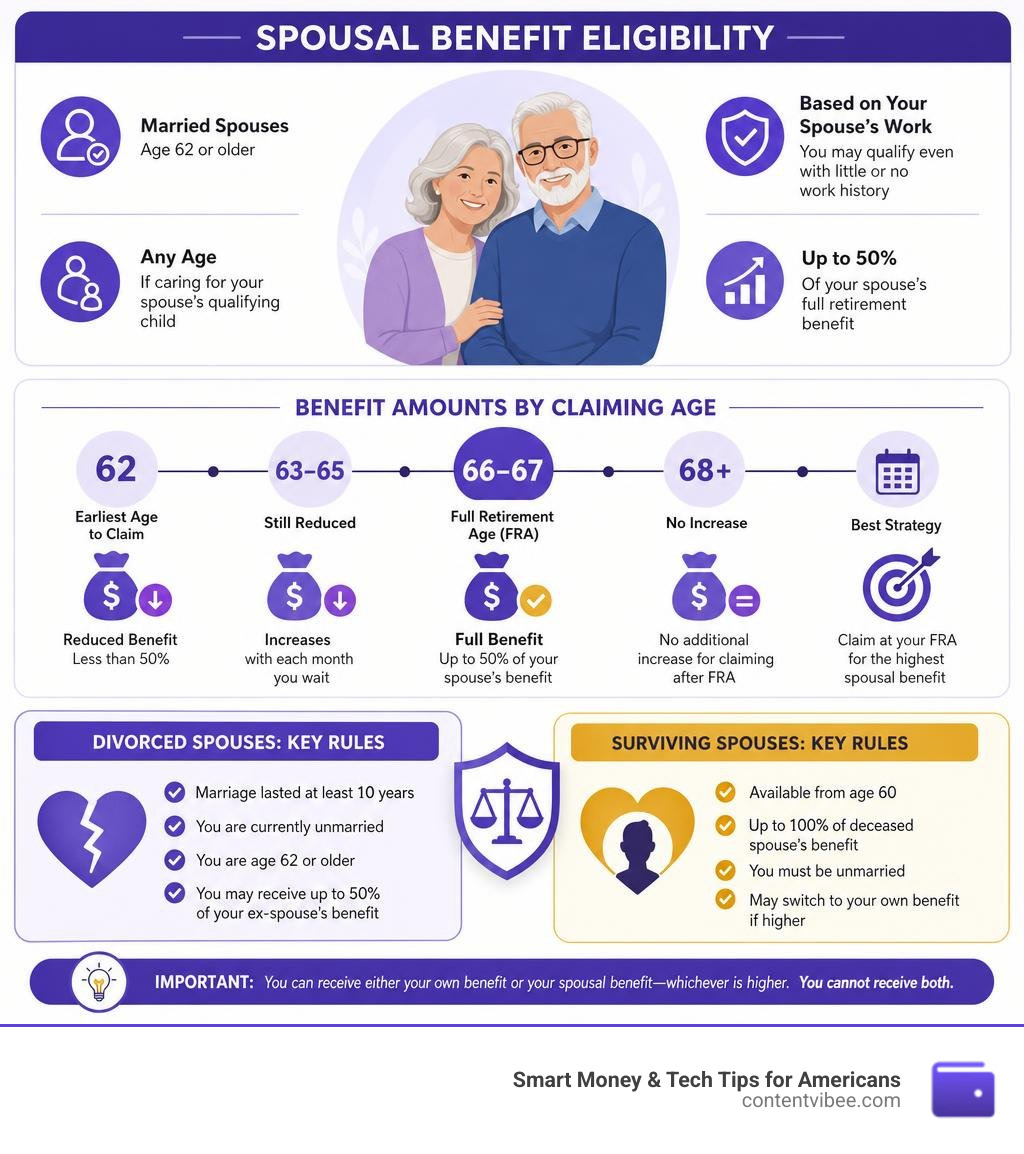
Who is Eligible to Claim Spousal Benefits?
At Smart Money & Tech Tips for Americans, we talk to many retirees who assume that if they didn’t work outside the home, they are completely shut out of Social Security. Thankfully, that is a myth. The system is designed to protect both earners and homemakers within a household. To understand if you qualify, we need to look closely at the foundational rules of eligibility.
To claim spousal benefits, you must first be legally married. Under the Social Security Administration’s guidelines, a valid marriage is typically defined by the laws of the state where you live (such as California). However, the SSA also recognizes “deemed spouses” in cases where a marriage ceremony was entered in good faith but was technically invalid due to a legal impediment.
Beyond marital status, the primary eligibility requirements include:
- The Age Requirement: You must be at least 62 years old to claim.
- The “In-Care” Exception: If you are under age 62, you can still qualify if you are caring for a child of the worker who is under age 16 or disabled.
- The Worker’s Status: Your spouse must already be receiving their own retirement or disability benefits for you to claim on their record.
- The Marriage Duration: Generally, you must have been married for at least one continuous year before you can file for spousal benefits.
These rules are outlined in detail in the SSA Handbook § 305. Additionally, the official Program Operations Manual System (POMS) under SSA – POMS: RS 00202.001 – Definitions and Requirements for Spouse Benefits – 07/24/2017 provides the precise legal definitions of who qualifies as a legal or deemed spouse. To make sure you meet every criteria, you can read The Ultimate Guide to Spousal Social Security Eligibility.
Age Requirements to Claim Spousal Benefits
While age 62 is the earliest milestone, timing is everything. If you choose to claim spousal benefits at age 62, your monthly check will be permanently reduced. To get the maximum possible amount — which is 50% of your spouse’s primary insurance amount (PIA) — you must wait until you reach your own Full Retirement Age (FRA).
For anyone born in 1960 or later, the FRA is 67. If you were born before 1960, your FRA is somewhere between 66 and 67, depending on your exact birth year.
We highly recommend reviewing Do You Qualify for Social Security Spouse’s Benefits? | Social Security Matters | SSA to see how the SSA views age-related eligibility. To figure out the ideal timing for your specific situation, check out At What Age Can I Claim My Spouses Social Security.
Marriage Duration and Deemed Spouse Rules
As mentioned, the standard rule is that you must be married for at least one full year before filing. However, there are exceptions. The one-year requirement can be waived if:
- You are the natural parent of the worker’s child.
- You were entitled (or potentially entitled) to certain other Social Security benefits (such as survivor, parent’s, or disability benefits) in the month before you married.
If you aren’t sure whether your marital history meets these guidelines, you can learn How to Check Your Eligibility for Spousal Social Security Benefits. The SSA uses these rules to prevent people from entering short-term marriages solely to capture federal benefits.
How Spousal Benefits are Calculated and the Impact of Early Claiming
How much can you actually expect to receive? The calculation is based on your spouse’s Primary Insurance Amount (PIA). The PIA is the monthly amount your spouse is entitled to receive if they wait until their own Full Retirement Age to claim.
The maximum spousal benefit you can ever receive is 50% of your spouse’s PIA.
It is crucial to note that your spousal benefit is capped at this 50% mark. Even if your spouse delays claiming their own benefit past their FRA to earn delayed retirement credits (which grow by 8% per year up to age 70), your spousal benefit will not increase. It remains anchored to their PIA at FRA.

If you want to run the numbers for your household, you can use the Tools/Finance Calculator/Social Security Spousal Benefit Calculator. You can also review the official math guidelines on the Benefits for Spouses page.
To help visualize how claiming early impacts your monthly check, here is a breakdown of the percentage of your spouse’s PIA you will receive based on how early you claim (assuming an FRA of 67):
| Age at Claiming | Months Before FRA (67) | Percentage of Spouse’s PIA Received |
|---|---|---|
| 67 (Full Retirement Age) | 0 | 50.0% |
| 66 | 12 | 45.8% |
| 65 | 24 | 41.7% |
| 64 | 36 | 37.5% |
| 63 | 48 | 35.0% |
| 62 | 60 | 32.5% |
The Cost of Claiming Before Full Retirement Age
If you claim before your Full Retirement Age, the SSA applies a strict monthly reduction formula.
- For the first 36 months before your FRA, your spousal benefit is reduced by 25/36 of 1% for each month.
- For any additional months beyond 36 (up to a maximum of 60 months if you claim at age 62), the benefit is reduced by an additional 5/12 of 1% per month.
When you do the math, claiming at age 62 when your FRA is 67 means your spousal benefit is reduced by a whopping 35%. Instead of receiving 50% of your spouse’s PIA, you will only receive 32.5%. This is a permanent reduction that remains in place for the rest of your life.
Additionally, if you plan to continue working in retirement, claiming early can trigger the SSA earnings test, which might temporarily reduce your benefits further. You can read about how this works in Working in Retirement Are Spousal Benefits Reduced by Working.
How Your Own Retirement Benefits Interact
What happens if you have worked and earned your own Social Security retirement benefits? You cannot “double dip” and collect both your full retirement benefit and a full spousal benefit.
Instead, the SSA uses a rule called deemed filing. When you apply for benefits, you are deemed to be filing for both your own retirement benefits and spousal benefits simultaneously. The SSA will calculate both amounts and pay you your own benefit first. If your spousal benefit is higher than your own, they will add a “spousal boost” to make up the difference.
Let’s look at the classic Sandy example to see how this works:
- Sandy has her own retirement benefit (PIA) of $1,000.
- Her husband, John, has a PIA of $2,500.
- Sandy’s maximum spousal benefit is 50% of John’s PIA, which is $1,250.
- Because Sandy’s spousal benefit ($1,250) is higher than her own retirement benefit ($1,000), she is entitled to the higher amount.
- The SSA will pay Sandy her own $1,000 first, and then add a spousal boost of $250. Her total monthly payment is $1,250.
If Sandy’s own retirement benefit had been $1,300, she would simply receive her own $1,300, and no spousal benefit would be paid because her own record yields the higher check.
To explore this interaction further, you can read What Is a Social Security Spousal Benefit or find out if Can a Married Couple Both Collect Social Security.
Special Rules for Divorced Spouses and Survivor Benefits
Life doesn’t always follow a straight line, and the SSA recognizes this by offering protection for divorced individuals and surviving spouses. These rules can be incredibly generous, but they come with strict parameters.
For a comprehensive overview of how these secondary benefits fit into your retirement picture, we suggest reviewing the guide on Collecting Social Security Benefits as a Spouse – AARP.
Rules for Divorced Spouses to Claim Spousal Benefits
If you are divorced, you can still claim spousal benefits on your ex-spouse’s record. The beauty of this rule is that your claim has absolutely zero impact on your ex-spouse’s personal benefit, nor does it impact their current spouse’s ability to claim. It is completely confidential.
To qualify on an ex-spouse’s record, you must meet the following criteria:
- The 10-Year Rule: Your marriage must have lasted for at least 10 consecutive years.
- Marital Status: You must currently be unmarried. If you remarry, you lose eligibility to claim on your ex’s record (unless your subsequent marriage also ends).
- Age: You must be at least 62 years old.
- The Two-Year Rule: If your ex-spouse has not yet filed for their own benefits but is eligible to do so, you can still claim on their record as long as you have been divorced for at least two continuous years.
These guidelines are often referred to as the golden rules of divorced claims. You can read a complete breakdown of these strategies in The Golden Rules Can a Spouse Collect SS Spousal Benefits.
Survivor Benefits vs. Spousal Benefits
It is common to confuse spousal benefits with survivor benefits, but they are entirely different.
- Spousal benefits are paid while your spouse is still living and top out at 50% of their PIA.
- Survivor benefits are paid after your spouse passes away and can be up to 100% of their actual benefit amount.
If you are a surviving spouse, you can claim survivor benefits as early as age 60 (or age 50 if you are disabled). If you wait until your own Full Retirement Age to claim survivor benefits, you will receive 100% of the monthly amount your deceased spouse was receiving (or was entitled to receive) at the time of their death.
Furthermore, survivor benefits do not trigger deemed filing in the same way. A surviving spouse can choose to claim survivor benefits early while letting their own retirement benefit grow up to age 70, and then switch to their own higher benefit later. To understand how to navigate this difficult transition, we have a compassionate guide: Claiming Whats Yours a Guide to Deceased Spouse Social Security.
Strategic Claiming and Recent Policy Changes
Coordinating your claiming strategies as a couple is one of the most powerful tools you have to maximize your lifetime household income.
The most common and effective strategy is often referred to as the split strategy. Because survivor benefits can reach up to 100% of the deceased worker’s benefit, it is usually in the couple’s best interest to have the higher-earning spouse delay claiming their benefit as long as possible (up to age 70). This maximizes both their own monthly check and the future survivor benefit for the remaining spouse.
Meanwhile, the lower-earning spouse might claim their own benefit early to bring some income into the household, and then transition to a spousal benefit once the higher earner files. For a deeper look at these dynamics, check out Spousal Benefits: An Often Overlooked Key to Maximizing Social … and Do Both Spouses Collect Social Security.
Maximizing Combined Benefits for Couples
When both spouses have work histories, you have multiple pathways to explore. You might both claim based on your own records, or one of you might rely on spousal benefits.
To see how couples coordinate their timing to keep their tax brackets low and their lifetime payouts high, read Both Spouses Collect Social Security.
The End of the Restricted Application Loophole
If you have researched Social Security strategies online, you may have run across articles discussing the “restricted application” or “file and suspend” loopholes. These strategies allowed a high-earning spouse to file for benefits and immediately suspend them, allowing the lower-earning spouse to claim spousal benefits while the high earner’s benefit continued to grow.
We must emphasize that these loopholes have completely closed.
The Bipartisan Budget Act of 2015 set a strict sunset timeline for these options. The very last group of retirees eligible to file a restricted application (those who turned 66 before January 2, 2024) have now aged past the limit. As of June 2026, deemed filing applies to everyone across the board. You can no longer choose to claim only a spousal benefit while letting your own retirement benefit grow past your FRA.
How to Apply and Required Documentation
Applying to claim spousal benefits is a straightforward process, but you will need to have your documentation organized to avoid delays.
You can apply in three ways:
- Online: This is the fastest and most convenient method. You can apply online if you are within three months of turning 62 or older.
- By Phone: You can call the SSA toll-free at 1-800-772-1213.
- In Person: You can visit your local Social Security office (we suggest calling ahead to make an appointment).
To make sure you don’t miss a step, we have put together The Ultimate Checklist for Your Application for Spousal Benefits.
Checklist of Documents Needed for Your Application
The SSA is highly strict about verifying your identity and your relationship to the worker. Under the guidelines of SSA – POMS: RS 00202.050 – Spouse’s Benefits – Evidence and Forms Requirements – 02/16/2006, you must provide original documents or copies certified by the issuing agency (photocopies are generally not accepted, except for W-2 forms).
Be prepared to provide:
- Your birth certificate or other proof of age.
- Proof of U.S. citizenship or lawful alien status.
- Your marriage certificate.
- If you are divorced, your final divorce decree (proving the marriage lasted 10+ years).
- Your most recent W-2 forms or self-employment tax returns.
- Your bank routing and account numbers for direct deposit.
Note: Do not delay filing your application even if you are missing some of these documents. The SSA will work with you to help obtain the necessary proofs.
Frequently Asked Questions about Spousal Benefits
Navigating federal retirement guidelines often brings up specific, highly technical questions. Here are the answers to some of the most common concerns we hear from our readers.
Can I receive both my own retirement benefit and a spousal benefit?
No. Under the “deemed filing” rules, you cannot combine both full benefits. You will receive an amount equal to the higher of the two. The SSA achieves this by paying your own retirement benefit first, and then adding a spousal supplement if the spousal benefit is larger.
Does my spousal benefit increase if I delay claiming past my Full Retirement Age?
No. Unlike personal retirement benefits — which earn delayed retirement credits of 8% per year up to age 70 — spousal benefits do not grow past your Full Retirement Age. Once you reach your FRA, your spousal benefit is capped at 50% of your spouse’s PIA. There is no financial advantage to waiting past your FRA to claim a spousal benefit.
What happens to my spousal benefit if my spouse is still working?
If your spouse is still working and has not yet filed for retirement benefits, you cannot claim a spousal benefit on their record (unless you are divorced and meet the two-year divorce rule).
Additionally, if you are receiving spousal benefits and continue to work before reaching your FRA, your benefits may be reduced if your earnings exceed the annual limit. For those facing complex health situations, you can also explore how these rules interact with disability pay by reading Applying for Spousal Disability Benefits a Complete Guide to VA and SSA Options.
Conclusion
Deciding when and how to claim spousal benefits is one of the most critical decisions you will make for your household’s financial security. By coordinating your claiming ages, avoiding early-retirement reductions, and understanding how your personal work history interacts with your spouse’s, you can secure thousands of dollars in extra lifetime income.
At Smart Money & Tech Tips for Americans, our mission is to help you cut through the bureaucratic red tape and make confident financial decisions. Take the next step in planning your retirement by reading The Golden Rules Can a Spouse Collect SS Spousal Benefits to ensure you are maximizing every dollar you have earned.


