


401k Investment Companies Fees and Retirement Plan Management Cost is one of the most important — and most overlooked — factors in how much money you’ll actually have when you retire.
Here’s a quick answer if you need it fast:
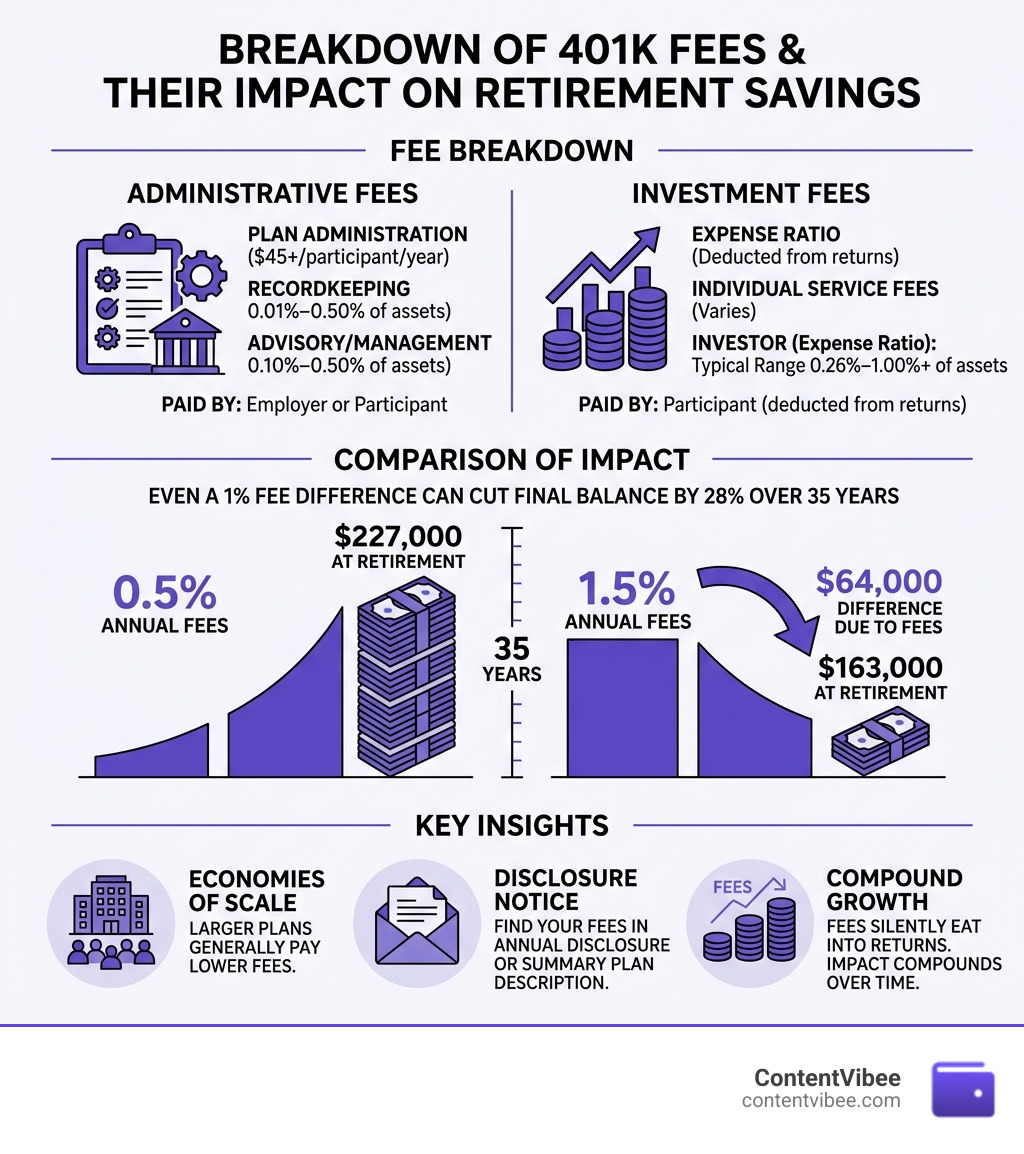
| Fee Type | Typical Range | Who Pays |
|---|---|---|
| Plan administration | $45+/participant/year | Employer or participant |
| Investment (expense ratio) | 0.26%–1.00%+ of assets | Participant (deducted from returns) |
| Individual service fees | Varies | Participant |
| Recordkeeping | 0.01%–0.50% of assets | Employer or participant |
| Advisory/management | 0.10%–0.50% of assets | Employer or participant |
The short version:
- Most 401(k) plans charge three types of fees: plan administration, investment, and individual service fees
- The average equity mutual fund expense ratio for 401(k) participants was 0.31% in 2023 — down sharply from 0.77% in 2000
- Even a 1% fee difference can cut your final balance by 28% over 35 years
- Larger plans generally pay lower fees due to economies of scale
- You can find your fees in your plan’s annual disclosure notice, Summary Plan Description, or by asking HR
Now here’s why this matters so much.
Imagine you’re 30 years old with $25,000 in your 401(k). You’ve got 35 years until retirement, and your investments earn 7% per year on average. Sounds great, right?
But here’s the catch: if your plan charges 0.5% in annual fees, you’ll end up with around $227,000 at retirement. Bump those fees up to just 1.5%, and that number drops to $163,000 — a difference of over $64,000, simply because of fees.
That’s not a rounding error. That’s decades of lost compound growth.
Most people focus almost entirely on how much they contribute or which funds to pick. Fees? Those feel like fine print. But they’re silently eating into your returns every single year — and the damage compounds just like your investments do, only in reverse.
This guide breaks down exactly what you’re paying, why it matters, and how to make smarter choices — whether you’re an employee trying to protect your savings or an employee trying to run a competitive, cost-effective plan.
Understanding 401k Investment Companies Fees and Retirement Plan Management Cost
When we talk about 401k Investment Companies Fees and Retirement Plan Management Cost, we are looking at a complex ecosystem governed by federal law. In the United States, the Employee Retirement Income Security Act (ERISA) sets the gold standard for how these plans must be managed.
Under ERISA, employers who sponsor 401(k) plans are considered “fiduciaries.” This isn’t just a fancy title; it means they have a legal obligation to act solely in the interest of the participants. Part of this duty involves ensuring that the fees paid to investment companies are “reasonable” relative to the services provided. You can find deep dives into these regulations through the A Look At 401(k) Plan Fees | U.S. Department of Labor resources.
Plan administration is the “engine room” of your retirement account. It covers the day-to-day operations like recordkeeping, legal compliance, and customer service. While some employers cover these costs as a benefit, many pass them on to employees. If you’ve ever wondered Why Brokerage Firm Investment Fees and Account structures vary so much, it often comes down to how these administrative tasks are bundled.

Breaking Down 401k Investment Companies Fees
The most significant cost for most participants is the investment fee, primarily expressed as an expense ratio. This is the percentage of your total assets that the mutual fund or investment company takes every year to cover its own management costs.
- Expense Ratios: These are deducted directly from your investment returns. In 2023, the average 401(k) participant in equity mutual funds paid 0.31%.
- No-Load Shares: Most modern 401(k) plans (about 96% of mutual fund assets) use “no-load” share classes, meaning you don’t pay a commission to buy or sell the fund. This is a massive improvement from the year 2000, when only 66% of assets were in no-load classes.
- Asset-Based Fees: Some providers charge a percentage of your total balance (e.g., 0.25%) just to maintain the account. As your balance grows, this fee grows—even if the work required to manage your account stays the same.
Understanding these nuances is key to Analyzing Investment Management Expense Ratios and Understanding Advisory Fees which can vary wildly between providers.
Managing Retirement Plan Management Cost for Long-Term Growth
We cannot overstate the “snowball effect” of fees. When a fee is taken out of your account, you aren’t just losing that dollar today; you’re losing every cent that dollar would have earned through compounding over the next 20 or 30 years.
Consider a 50-year-old worker with a $500,000 balance, contributing $15,000 annually. With a 7% return over 15 years, a 1% annual fee would cost them approximately $230,000 in lost potential compared to a zero-fee scenario. This is why some experts refer to high fees as the 401(k) Fees: The Hidden Retirement Killer You Can Stop Today.
Whether you are looking at big names or boutique firms, Understanding Fees at Various Investment Firms is the first step toward stopping that “killer” in its tracks.
Evaluating the Top 401k Provider Models and Fee Structures
In 401k Investment Companies Fees and Retirement Plan Management Cost, there are two main ways services are sold: bundled and unbundled.
- Bundled Arrangements: This is a “one-stop-shop” where a single provider (like a large mutual fund company or insurance firm) handles everything—recordkeeping, investments, and administration. These are often cheaper for the employer to set up but can hide costs through “revenue sharing.”
- Unbundled Arrangements: Here, the employer picks different providers for different tasks. One company handles the recordkeeping, while another acts as the investment advisor. This offers more transparency but requires more oversight.
A common practice in bundled plans is revenue sharing, where the mutual fund pays the recordkeeper a portion of its expense ratio. While this can offset the direct cost of the plan, it often means participants are stuck in higher-cost funds. This is a dynamic we often see when Understanding Robo-Advisor Investment Fees, where technology is used to lower these overhead costs.

How Plan Size and Management Style Influence Total Expenses
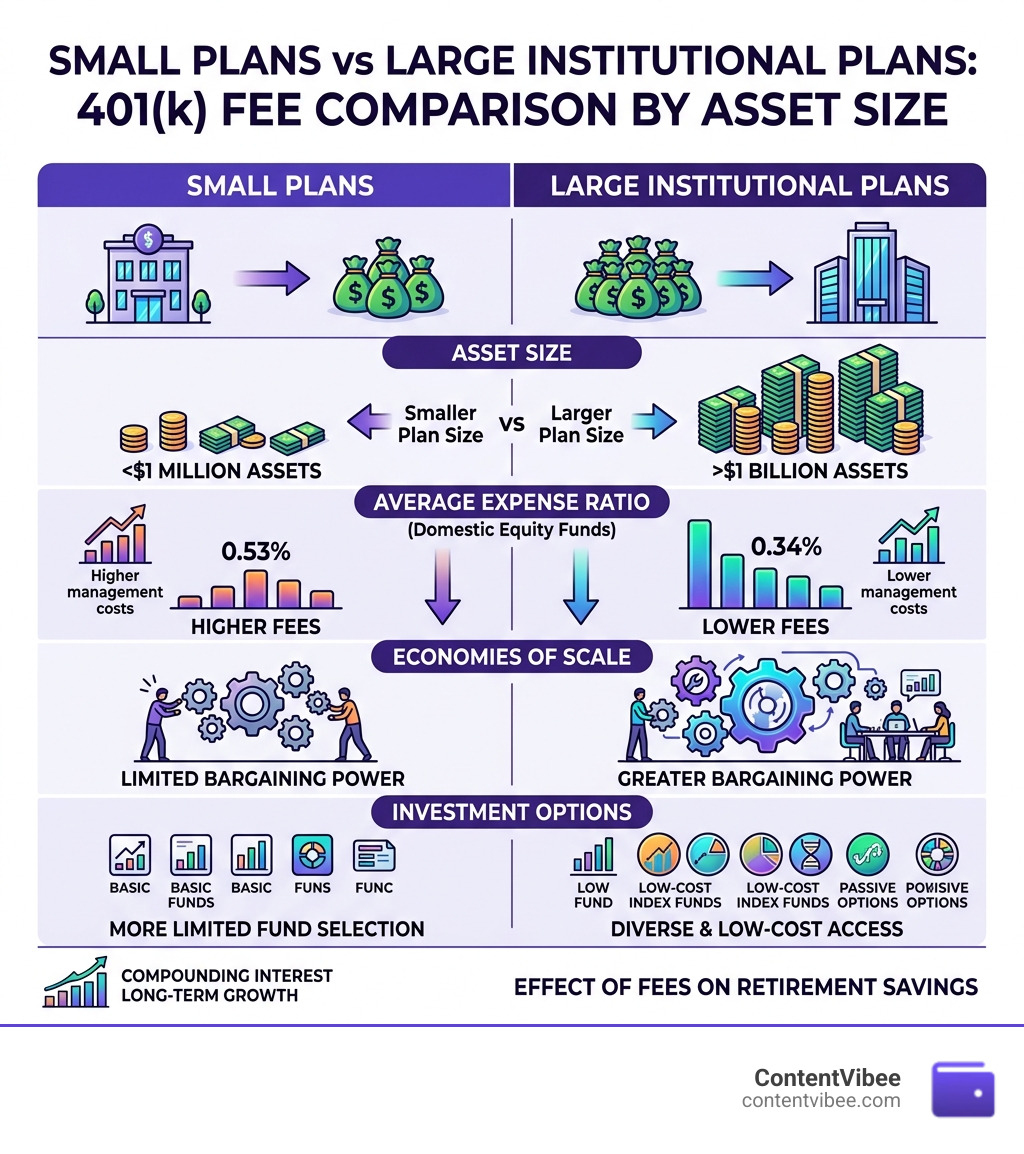
Size matters. Just like buying in bulk at a warehouse club, larger 401(k) plans get a better deal. According to research from the Investment Company Institute, the average expense ratio for domestic equity funds in small plans (under $1 million in assets) was 0.53%, while large plans (over $1 billion) enjoyed rates as low as 0.34%.
Management style also plays a massive role:
- Active Management: Professional stock-pickers try to beat the market. These funds are more expensive because you’re paying for their expertise and research.
- Passive Index Funds: These simply track a market index (like the S&P 500). They are significantly cheaper and have become the standard for cost-conscious plans.
By leveraging economies of scale and passive options, many organizations can significantly lower their 401(k) Plan Services, Fees, and Expenses | Investment Company Institute data. Even if you are Understanding Credit Union Investment Services Fees, you’ll find that the same principles of scale apply.
Strategies to Minimize Fees and Protect Your Retirement Assets
As an employee, you might feel like you have no control over your plan’s fees, but that isn’t true. You have the power of choice within your investment menu.
- Read the Disclosures: Every year, your plan must send you a “404(a)-5” participant fee disclosure. It lists every fund and its exact expense ratio. Read it.
- Hunt for Index Funds: Look for funds with words like “Index,” “S&P 500,” or “Total Market” in the name. These usually have the lowest fees.
- Review the SPD: Your Summary Plan Description (SPD) explains how administrative fees are charged—whether they are flat fees or based on your balance.
- Check Form 5500: If you’re really curious, you can look up your company’s Form 5500 on the Department of Labor website to see exactly what the company is paying its providers.
This level of scrutiny is especially important when comparing private plans to government options. You can learn more by looking at What You Need to Know About Government Investment Plans and Understanding Government Investment Plan Withdrawal Rules and Tax implications.
Employer Fiduciary Responsibilities and Tax Incentives in 2026
For employers, the landscape in April 2026 is more supportive than ever, thanks to the SECURE Act 2.0. Running a high-quality 401(k) is no longer just a “big company” perk.
- Startup Tax Credits: Small businesses (up to 100 employees) can now claim tax credits of up to $5,000 per year for three years to cover the cost of starting a plan. There’s also an additional credit for employer contributions.
- Safe Harbor Plans: These plans allow employers to skip complex annual “nondiscrimination” testing if they provide a certain level of matching or non-elective contributions. This reduces administrative headaches and costs.
- Auto-Enrollment: New plans created after the SECURE Act 2.0 are generally required to include auto-enrollment, which helps boost participation and helps the plan reach economies of scale faster.
By using these incentives, employers can provide a robust benefit while keeping the 401k Investment Companies Fees and Retirement Plan Management Cost low for everyone involved.
Frequently Asked Questions about 401k Investment Companies Fees
Who typically pays for 401(k) administrative fees?
It’s a mix. Some employers pay 100% of the administrative costs as a business expense (which is tax-deductible for them). In other plans, the cost is shared. For example, the employer might pay the base monthly fee, while participants pay a per-head fee (like $5–$14 per month) or an asset-based fee (like 0.25% of their balance).
How do I find the specific fees for my 401(k) investment choices?
The most direct way is your Annual Participant Fee Disclosure. This document is legally required to be sent to you. It will show a table comparing every investment option, its historical returns, and its “gross expense ratio.” You can also find this info in the fund’s prospectus or on your quarterly account statement.
What is considered a “reasonable” 401(k) fee in 2026?
“Reasonable” is subjective, but benchmarks help. For a mid-to-large plan, an all-in cost (investment + admin) under 1.00% is generally considered good. For very large plans, that number should be closer to 0.50% or lower. In 2023, the average equity fund expense ratio was 0.31%, so if your funds are all over 1.00%, it might be time to ask your HR department why.
Conclusion
Navigating 401k Investment Companies Fees and Retirement Plan Management Cost doesn’t have to be a headache. By understanding the difference between administrative and investment costs, you can make choices that keep more of your money working for you instead of your provider.
At ContentVibee, we believe in empowering investors with the data they need to succeed. Much like the Zacks Rank system helps self-directed investors find value in the stock market, understanding your 401(k) fees helps you find value in your retirement plan. Fee transparency isn’t just a regulatory requirement—it’s your best tool for a secure future.
Whether you are dealing with an unauthorized bank transaction or trying to fix credit report fraud, being proactive is the only way to protect your assets. The same applies to your retirement. Don’t let high fees be the “hidden killer” of your dreams. Protect your retirement future today by reviewing your statements and choosing low-cost, high-value investments.


