


Bitcoin Investment Risk Analysis and Long Term Profit Strategy is one of the most searched — and most misunderstood — topics in personal finance today.
Here is a quick snapshot of what you need to know:
| Key Question | Short Answer |
|---|---|
| What is Bitcoin’s average annual return? | 72% over the past decade, but just ~29.6% post-2018 |
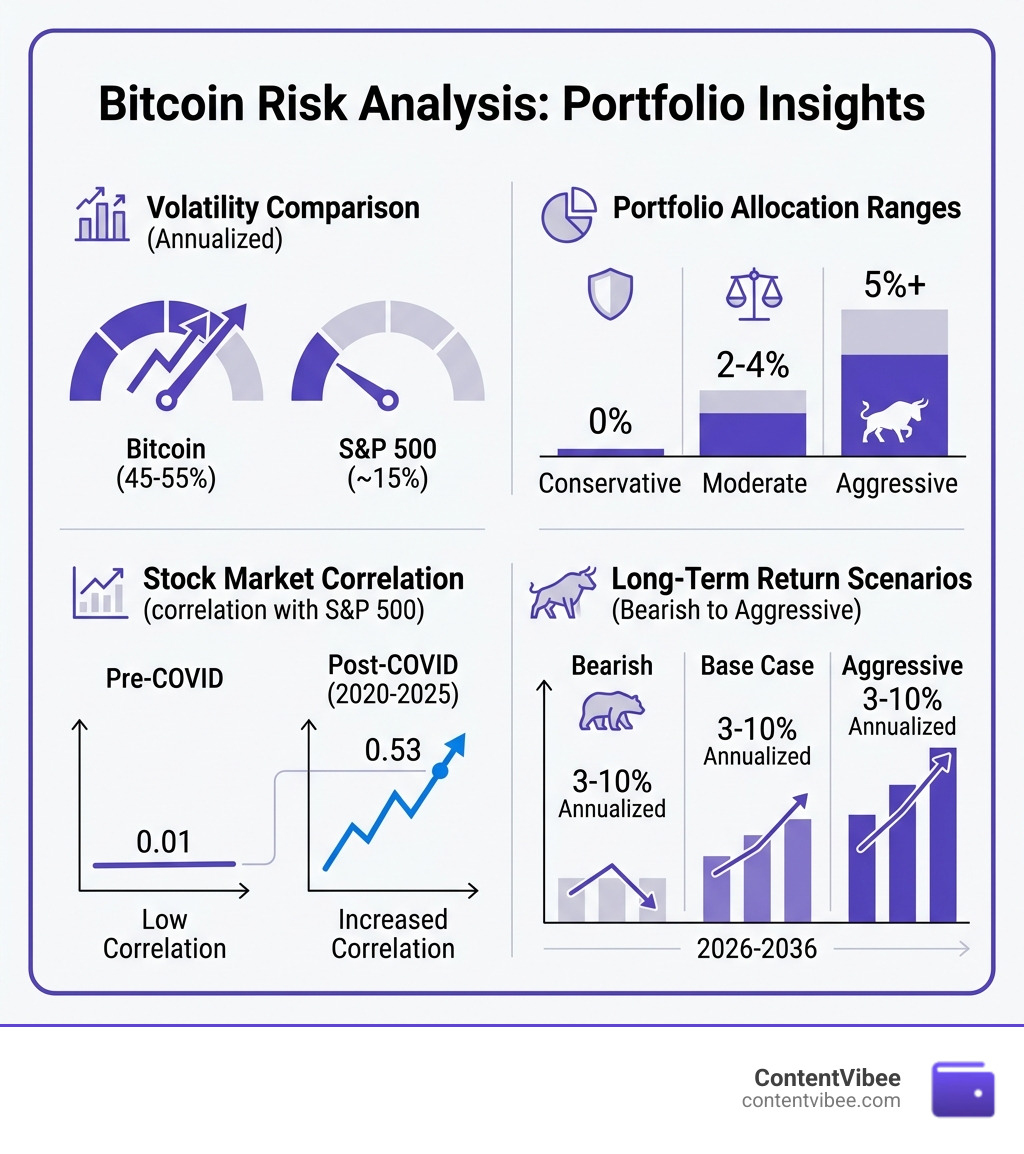
| How volatile is Bitcoin? | ~45-55% annualized volatility — 4x the S&P 500 |
| What allocation do institutions recommend? | 2%-4% (moderate/aggressive); 0% (conservative) |
| Does Bitcoin diversify a portfolio? | Less so now — correlation with stocks hit 0.53 post-COVID |
| What is the optimal weight per Markowitz analysis? | Possibly negative: -1.6% (2014-2025), -7.3% (2020-2025) |
| What are the biggest risks? | Volatility, regulatory uncertainty, behavioral traps, custody loss |
| What long-term return is realistic? | 3%-10% annualized (bearish to aggressive supply/demand models) |
Bitcoin crossed $100,000 for the first time in December 2024. By October 2025, it hit an all-time high of $126,198. Today, in April 2026, it sits at a 52% drawdown from those highs — and the Fear & Greed Index is deep in “extreme fear” territory.
Sound familiar? This is Bitcoin’s pattern. Explosive runs. Brutal crashes. Repeat.
For self-directed investors, that cycle creates a real dilemma. The potential upside is hard to ignore. But so are the risks — not just market risks, but behavioral risks, security risks, and portfolio construction risks that most guides gloss over.
This guide cuts through the noise. No hype. No doom. Just the data you need to make a clear-eyed decision about whether — and how — Bitcoin belongs in your portfolio.
Bitcoin Investment Risk Analysis and Long Term Profit Strategy: The 2026 Outlook

As we navigate the second quarter of 2026, the landscape for digital assets has matured, but the core challenges remain. When we perform a Bitcoin Investment Risk Analysis and Long Term Profit Strategy review, we have to look at the hard empirical evidence rather than just the “to the moon” social media threads.
One of the most sobering pieces of research comes from the Markowitz mean-variance framework. Traditionally, investors believed that adding any asset with high returns would improve the “efficient frontier” of a portfolio. However, recent academic analysis covering the period from 2014 to 2025 suggests that the optimal long-term portfolio share of Bitcoin is actually negative (-1.6%). If we look only at the “institutional era” (2020–2025), that optimal weight drops further to -7.3%.
Why is the math so bearish? It comes down to two factors: uncompensated volatility and a massive correlation shift. Every Investor Faces Risk, but Bitcoin’s risks are unique. Before the COVID-19 pandemic, Bitcoin often moved independently of the stock market. Today, that diversification benefit has largely evaporated. The correlation between Bitcoin and U.S. equities has shifted from weakly negative to persistently positive, currently sitting around 0.53.
When the S&P 500 drops, Bitcoin often drops harder. In fact, in the worst-performing months for stocks, Bitcoin’s median returns have historically been worse than bonds or gold. With an annualized volatility of 55%—roughly four times that of the S&P 500—investors must ask if the potential reward justifies the wild ride. You can explore deeper metrics on this in the Measuring Bitcoin’s Risk And Reward – Ark Invest report.
Optimal Allocation: Why the Long Term Profit Strategy Might Require Small Weights
If the mathematical “optimum” is negative, why are institutions like Fidelity and Morgan Stanley still talking about it? The answer lies in “satellite” allocations. We believe that while Bitcoin shouldn’t be the core of your retirement plan, it can serve as a high-risk growth engine if sized correctly.
Investment Asset Allocation Strategy Risk Management is about understanding the “tail wagging the dog” effect. Even a tiny 1% allocation to Bitcoin can contribute 2.7% to your overall portfolio volatility. If you increase that to 5%, Bitcoin starts contributing a staggering 17.8% to total portfolio risk.
Here is what the major players currently recommend for 2026:
- Fidelity: Suggests 1% to 5% for most diversified portfolios, depending on risk tolerance.
- Morgan Stanley: Recommends a 2% to 4% threshold for growth-oriented portfolios, with a strict 0% for conservative investors.
- J.P. Morgan: Remains cautious, noting that a 3.5% Bitcoin allocation carries the same risk weight as an entire 40% bond allocation in a traditional 60/40 split.
Managing Volatility for a Sustainable Bitcoin Investment Risk Analysis and Long Term Profit Strategy
To survive as a long-term investor, you have to be “crash-proof” mentally. Since 2010, Bitcoin has seen a 10% drawdown in every single rolling six-month period. Half of those periods saw 30% drops, and 30% of the time, the asset crashed by 50% or more.
As of April 2026, we are seeing the aftermath of the 2025 peak. According to the Bitcoin (BTC) – Investment Analysis April 2026 | CoinStats AI report, the current 52% drawdown is standard for the asset’s history. To manage this, we recommend:
- Strict Rebalancing: Set a “drift” limit (e.g., 20%). If your 5% allocation grows to 7% due to a price surge, sell the excess and move it into safer assets.
- Liquidity Buffers: Never invest money you might need within the next four years.
- Sharpe Ratio Awareness: While Bitcoin’s returns are high, its risk-adjusted returns (Sharpe ratio) have often collapsed during periods of high equity correlation.
Behavioral Pitfalls: When Crypto Invades Your Financial Security

The most dangerous risk isn’t the price chart—it’s your own brain. Behavioral Portfolio Theory suggests that humans divide their money into “mental accounts” (e.g., a “safety” bucket for the mortgage and a “lottery” bucket for speculation).
Recent data from the National Financial Capability Study (NFCS) shows a phenomenon called “mental account invasion.” Investors, caught up in the FOMO (Fear Of Missing Out) of a Bitcoin bull run, often start pulling money from their safety buckets to fund their crypto accounts. This leads to undesirable financial behaviors such as:
- Late mortgage payments: Diverting housing funds to “buy the dip.”
- Credit card misuse: Using high-interest debt to leverage crypto positions.
- Retirement borrowing: Taking loans against a 401(k) to chase the next all-time high.
Why The Investment Time Horizon Impact matters here: if your horizon is 20 years, a 50% drop is a blip. If your horizon is “I need to pay the electric bill next Tuesday,” a 50% drop is a catastrophe. Social media amplifies these biases, creating an echo chamber where “HODLing” is treated as a religion rather than a financial decision.
Unauthorized Transactions and Identity Theft Risks
Beyond market movements, the digital nature of Bitcoin exposes you to significant fraud risks. In 2026, we are seeing a rise in sophisticated “unauthorized bank transaction” schemes where scammers use stolen SSNs to access traditional bank accounts and wire funds to unrecoverable crypto wallets.
| Security Layer | Exchange (Custodial) | Self-Custody (Hardware Wallet) |
|---|---|---|
| Control | Third-party holds keys | You hold keys |
| Risk | Exchange bankruptcy/hack | Loss of seed phrase |
| Recovery | Customer support (slow) | Impossible if keys are lost |
| Fraud Protection | Some insurance (rarely FDIC) | None |
If you are a victim of wire transfer fraud recovery options USA 2026, time is of the essence. While crypto transactions are irreversible, the “on-ramps” (your bank) have dispute mechanisms. If you spot an unauthorized bank transaction how to dispute and recover money USA 2026, contact your institution within 24 hours to trigger a Regulation E dispute.
Strategic Execution: DCA, Halvings, and the Monday Effect
If you decide that a Bitcoin Investment Risk Analysis and Long Term Profit Strategy fits your goals, the how is just as important as the how much.
The most effective strategy remains Dollar-Cost Averaging (DCA). By investing a fixed amount every week or month, you mathematically buy more Bitcoin when prices are low and less when they are high. Interestingly, historical data from 2018–2025 suggests a “Monday Effect.” Investors who scheduled their DCA for Monday mornings accumulated roughly 14.36% more Bitcoin than those buying on other weekdays, likely due to weekend sell pressure and lower institutional activity.
We also have to look at the “halving” cycles. Every four years, the amount of new Bitcoin created is cut in half. The 2024 halving was muted, but the upcoming 2028 halving is already being priced into long-term supply-demand frameworks. Why Energyx Investment Risk Analysis Long Term projects show that as supply tightens, the “floor” price tends to rise, provided demand remains steady.
Long-Term Profit Strategy and Inflation Hedging
Is Bitcoin really “digital gold”? The narrative is that because Bitcoin has a fixed supply of 21 million, it should protect you when the M2 money supply expands.
In reality, Bitcoin’s performance during the high-inflation years of 2022–2024 was mixed. It behaved more like a “high-beta” tech stock than a stable store of value. However, when we look at Why Schd Dividend Etf Yield Analysis And Long Term trends, we see that investors are increasingly using Bitcoin as a hedge against currency debasement rather than just a rise in the Consumer Price Index (CPI). If global liquidity cycles turn upward, Bitcoin has historically captured that expansion more aggressively than traditional assets.
Security and Self-Custody: Protecting Your Digital Wealth
The phrase “Not your keys, not your coins” is the golden rule of 2026. After the high-profile exchange collapses of the early 2020s (and the recent 2025 Bybit hack that saw $1.4 billion stolen), we cannot stress enough the importance of cold storage.
A hardware wallet keeps your private keys offline, away from hackers. However, this introduces “personal responsibility risk.” If you lose your 12-to-24-word seed phrase, your money is gone forever.
- Best Practice: Use a hardware wallet (like Ledger or Trezor) but store the seed phrase on a physical, fireproof metal plate.
- Advanced: Consider a Multi-signature (Multisig) setup where two out of three keys are required to move funds. This prevents a single point of failure.
Googl Lly Long Term Investment Risk profiles often highlight the danger of “counterparty risk”—the risk that the company holding your money goes broke. With self-custody, you eliminate counterparty risk but increase “operator error” risk.
Recovery Options for Wire Transfer and Crypto Fraud
What happens if the worst occurs? If you are dealing with identity theft credit report fraud how to fix and protect your score USA, you must act immediately:
- Freeze your credit: Contact Equifax, Experian, and TransUnion.
- File an FTC report: Use IdentityTheft.gov.
- Audit your accounts: Look for unauthorized Zelle or wire transfers.
For zelle fraud transaction recovery steps and bank protection options USA, many banks now offer enhanced verification, but once a transfer is authorized, recovery is difficult. If you were scammed into sending Bitcoin, you might have a “theft loss” claim for tax purposes, though the IRS rules on this have tightened significantly in 2026. For more on the legal side of digital asset legitimacy, see Why Rep Sheri Biggs Bitcoin Investment Legitimacy.
Frequently Asked Questions about Bitcoin Risk
Is the optimal long-term portfolio share of Bitcoin negative?
According to a Markowitz mean-variance analysis using data from 2014 to 2025, the optimal weight was -1.6%. In the more recent 2020–2025 window, it dropped to -7.3%. This suggests that for a purely risk-averse investor looking at historical risk-adjusted returns, Bitcoin may not belong in a traditional “efficient” portfolio. However, this doesn’t account for its potential as a speculative satellite holding.
Can Bitcoin serve as an effective hedge against inflation in 2026?
Bitcoin’s role as an inflation hedge is still being debated. While it has a fixed supply, its high correlation with stocks means it often falls during the same “risk-off” periods when inflation fears cause interest rates to rise. It is better viewed as a hedge against long-term monetary debasement rather than short-term price spikes in consumer goods.
What are the behavioral risks of investing in cryptocurrency?
The primary risk is “mental account invasion,” where investors prioritize high-risk crypto “aspirational” goals over “protection layer” needs like mortgages or retirement. This is often fueled by social media influence, leading to panic selling during 50% drawdowns or over-leveraging during bull markets.
Conclusion
At ContentVibee, we want you to be an empowered investor, not a gambler. Navigating a Bitcoin Investment Risk Analysis and Long Term Profit Strategy requires a balance of technological optimism and cold, hard data.
If managing these volatility swings and rebalancing acts feels overwhelming, you aren’t alone. That’s why we built Autopilot. Our investment app offers automated portfolio management for self-directed investors who want the growth of digital assets without the 24/7 stress. We provide comprehensive fee, risk, and management reviews to ensure your strategy is truly cost-worthy and aligned with your long-term goals.
Ready to take the next step in your investment journey? More info about investment services is available on our blog, where we break down everything from dividend yields to the latest in financial security. Stay disciplined, stay secure, and keep your eyes on the long horizon.


