


Why Benefit Rules Matter for Your Financial Security in 2026
Understanding benefit rules can mean the difference between maximizing your retirement income and leaving thousands of dollars on the table.
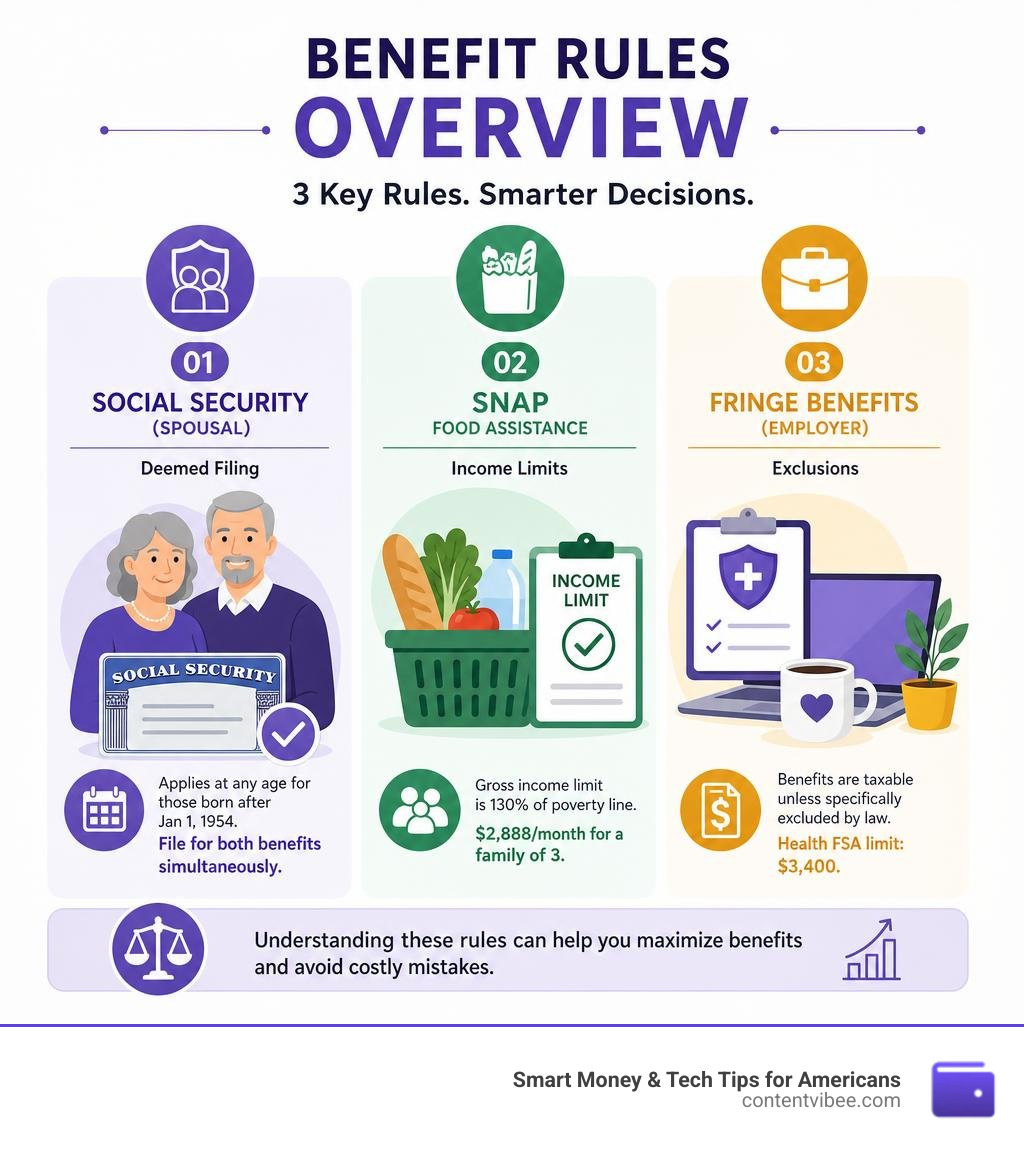
Here is a quick overview of the main benefit rule categories covered in this guide:
| Benefit Type | Key Rule | 2026 Key Figure |
|---|---|---|
| Social Security (Spousal) | Deemed filing applies at any age for those born after Jan 1, 1954 | File for both benefits simultaneously |
| SNAP Food Assistance | Gross income limit is 130% of poverty line | $2,888/month for a family of 3 |
| Fringe Benefits (Employer) | Benefits are taxable unless specifically excluded by law | Health FSA limit: $3,400 |
| Widow(er) Benefits | Full benefit at FRA; reduced by up to 28.5% if claimed earlier | Age 60 minimum to claim |
Whether you are nearing retirement, applying for food assistance, or managing workplace benefits as an employer or employee, the rules governing each program are specific — and the stakes are high.
For example, many working spouses approaching retirement don’t realize that filing for a spousal Social Security benefit automatically triggers a claim on their own retirement benefit too. That single rule, introduced by the Bipartisan Budget Act of 2015, has reshaped how couples plan for retirement income.
This guide breaks down the most important benefit rules across three major areas — Social Security, SNAP, and employer fringe benefits — so you can make smarter, more confident decisions in 2026.
Understanding Social Security Benefit Rules
Navigating the Social Security Administration (SSA) system can feel like learning a complex foreign language. However, mastering these benefit rules is essential to secure your financial future. The landscape changed dramatically with the passage of the Bipartisan Budget Act of 2015, which closed several popular loopholes that married couples previously used to maximize their lifetime payouts.
To understand how these changes affect you in 2026, we first need to look at how spousal and survivor benefits are structured. Under the law, if you are married, you may be eligible for spousal benefits based on your partner’s work record. To learn the basics of who qualifies, check out our guide on The Golden Rules Can a Spouse Collect SS Spousal Benefits?.
Generally, a spousal benefit can be worth up to 50% of your spouse’s Primary Insurance Amount (PIA) if claimed at your Full Retirement Age (FRA). However, if you claim before reaching your FRA, the SSA will permanently reduce your monthly check. These exact mathematical reductions are governed by federal law under CFR § 404.410, which outlines the exact fractions used to discount early retirement and spousal claims. For a detailed breakdown of this coordination, read our article on How Social Security Spousal Benefits Work for Married Couples.
Divorce and Survivor Rules
What happens if you are divorced? The benefit rules state that if your marriage lasted at least 10 years, you are unmarried, and you are at least 62 years old, you can claim spousal benefits based on your ex-spouse’s record—even if they have remarried. Best of all, your claim has absolutely no impact on your ex-spouse’s benefits or the benefits of their new spouse.
Survivor benefits operate under a completely different set of rules. If your spouse passes away, you can claim widow(er) benefits as early as age 60 (or age 50 if you are disabled). According to the official policy in SSA – POMS: RS 00207.001, you must generally have been married for at least 9 months before your spouse’s death to qualify, unless a specific exception (such as parenthood of the deceased’s child) applies.
When it comes to payments, SSA – POMS: RS 00207.002 establishes that a widow(er) claiming at FRA is entitled to 100% of the deceased worker’s benefit. If you claim early, however, your benefit is reduced. As detailed in SSA – POMS: RS 00615.301, the maximum reduction for early widow(er) benefits is capped at 28.5%, meaning you will receive at least 71.5% of the unreduced benefit even if you claim at age 60.
Finally, do not forget about your children. Under SSA – POMS: RS 00203.001, minor children, high school students under 19, or adult disabled children may also qualify for dependent benefits on your record, providing an extra layer of financial security for your family.
Deemed Filing and Spousal Benefit Rules

One of the most critical concepts to understand in 2026 is deemed filing. Before the 2015 law change, retirees could file for a spousal benefit at full retirement age while letting their own retirement benefit grow by 8% per year until age 70.
Today, that strategy is history for almost everyone. Under the current benefit rules, when you file for either your own retirement benefit or a spousal benefit, you are “deemed” to have filed for both. The SSA will automatically calculate both amounts and pay you the higher of the two. You cannot choose to receive only the spousal benefit while delaying your own.
This rule applies to anyone who turned 62 on or after January 2, 2016. In 2026, since anyone turning 62 this year was born in 1964, deemed filing applies to everyone currently reaching retirement age. For a complete strategy on navigating this, see The Ultimate Guide to Social Security Benefit Optimization.
There are, however, a few important exceptions to deemed filing:
- Child-in-Care: If you are receiving spousal benefits and caring for a child who is under age 16 or disabled, deemed filing does not apply.
- Disability Benefits: If you receive Social Security Disability Insurance (SSDI), you are exempt from deemed filing rules.
- Survivor Benefits: Deemed filing does not apply to survivor benefits. A surviving spouse can choose to start survivor benefits early and let their own retirement benefit grow until age 70, or vice versa.
Understanding how these dual entitlements interact is vital. To see how this plays out in real life, check out our guide, His Hers and Ours The Ultimate Guide to Dual Social Security Benefits, as well as our article on The Definitive Guide to Social Security Claiming Age.
Voluntary Suspension and Maximizing Couples Benefit Rules
If you want to maximize your household benefits by delaying your retirement claim, you need to understand the rules surrounding voluntary suspension (often called “file and suspend”).
Once you reach Full Retirement Age, you can instruct the SSA to suspend your retirement benefit payments. This allows you to earn delayed retirement credits of 8% per year up to age 70, which will increase your future monthly check by up to 32%.
However, under the post-2016 rules, if you suspend your own retirement benefits:
- All dependent and spousal benefits payable on your work record are also suspended.
- You cannot receive spousal benefits on anyone else’s record during the suspension period.
This means couples must carefully coordinate their claiming timeline. You can no longer suspend your own benefit to build credits while your spouse happily collects a spousal benefit on your record.
To map out a successful strategy, read The Smart Couples Guide to Social Security Strategies and learn how to coordinate your timelines in Social Security Spousal Benefits Timing is Everything.
Additionally, if you plan to work while receiving benefits before your FRA, you must watch out for the Earnings Test. According to SSA – POMS: RS 02501.021, if your earned income exceeds the annual limit, the SSA will withhold $1 in benefits for every $2 you earn over the limit. Fortunately, once you reach FRA, the earnings test no longer applies, and the SSA will recalculate your benefit upward to account for the months your benefits were withheld.
For deeper insights into simultaneous claiming strategies, read Timing is Everything How Married Couples Can Claim Social Security Simultaneously, find out if Can a Married Couple Both Collect Social Security, or explore our comprehensive guide, Double the Fun A Guide to Social Security Spousal Benefits for Couples.
SNAP Eligibility and Calculation Rules for FY 2026
The Supplemental Nutrition Assistance Program (SNAP) provides crucial food support to millions of low-income Americans. However, eligibility and benefit levels are strictly regulated by federal and state benefit rules, which have undergone major changes recently.
For fiscal year 2026, SNAP eligibility is determined by three main national tests:
- Gross Income: Your household’s total monthly income must be at or below 130% of the federal poverty line. For a household of three, this limit is $2,888 per month (or $34,656 annually).
- Net Income: Your income after allowable deductions must be at or below 100% of the poverty line.
- Assets: Households without an elderly or disabled member are limited to $3,000 in countable assets (such as bank accounts). For households with an elderly or disabled member, the asset limit is $4,500.
The Impact of Recent Legislation
SNAP rules were significantly altered by the implementation of a major legislative package (often referred to as the 2025 Republican megabill), which took full effect heading into 2026. This law restricted utility deductions and expanded work-related time limits, resulting in a steep drop in program participation nationwide.
Despite these cuts, SNAP remains a vital resource. In fiscal year 2026, the maximum monthly SNAP benefit for a household of three is $785, with an estimated average monthly benefit of $588. Across the entire program, the average benefit per person is estimated at $188 per month (approximately $6.17 per day).
Income Limits and Deductions for SNAP
To determine your actual monthly SNAP allotment, the government assumes that a household will spend 30% of its net income on food. The actual benefit is calculated by subtracting 30% of your net income from the maximum monthly allotment for your household size.
To lower your net income and qualify for a higher benefit, you can claim several deductions:
| Deduction Type | Description | Key 2026 Statistic |
|---|---|---|
| Standard Deduction | A flat deduction allowed for all households. | $209 per month (for households of 1-3) |
| Earnings Deduction | Deducts 20% of any earned income to reward work. | Claimed by 28% of SNAP households |
| Shelter Deduction | Deducts housing and utility costs that exceed half of net income (capped at $744 unless a member is elderly or disabled). | Claimed by 68% of SNAP households |
| Medical Expenses | Out-of-pocket medical expenses over $35/month for elderly or disabled members. | Varies by actual cost |
| Dependent Care | Deducts costs for childcare or eldercare necessary for work or training. | Varies by actual cost |
Using these deductions effectively is the key to maximizing your family’s monthly food assistance.
Work Requirements and Recent Law Changes
Work requirements for SNAP have tightened significantly in 2026 due to the recent legislative changes. Under the rules for Able-Bodied Adults Without Dependents (ABAWDs):
- The Rule: Adults aged 18 to 64 who do not have children under 14 or a disability must work or participate in a work training program for at least 20 hours per week.
- The Time Limit: If you do not meet this requirement, you are limited to receiving SNAP benefits for only three months within a 36-month period.
- The Megabill Impact: The 2025 legislative package expanded this age bracket up to age 64 (previously age 54) and restricted states from issuing individual waivers in high-unemployment areas.
Exemptions still apply for pregnant individuals, those who are physically or mentally unfit for work, and veterans. However, for most able-bodied adults, meeting the 20-hour weekly work or training threshold is now mandatory to maintain benefits.
Tax Rules for Employer-Provided Fringe Benefits in 2026
For both employers and employees, workplace perks are a fantastic way to boost compensation. However, the Internal Revenue Service (IRS) has strict benefit rules regarding what is tax-free and what must be counted as taxable wages.
According to the IRS Employee Benefits Guide, any fringe benefit provided to an employee is taxable and must be included in their total wages unless the tax code specifically excludes it. Employers can review these statutory frameworks through the Laws | U.S. Department of Labor portal or general summaries of Employee Benefits in the USA.
For 2026, several exclusion limits have been adjusted for inflation:
- Health FSA: An employee’s pre-tax salary reduction contribution to a health Flexible Spending Account (FSA) is capped at $3,400.
- Qualified Parking: The monthly tax-free exclusion for parking is $340.
- Transit Passes: The monthly exclusion for commuter highway vehicle transportation and transit passes is $340.
- Dependent Care FSA: The maximum pre-tax contribution is $7,500 (or $3,750 for married individuals filing separately).
Taxable vs. Excludable Fringe Benefits
Understanding which benefits are excludable can save you thousands of dollars in payroll and income taxes.
- Group-Term Life Insurance: The cost of up to $50,000 of coverage provided by your employer is entirely tax-free. Any coverage above $50,000 is taxable based on IRS premium tables.
- Educational Assistance: Employers can provide up to $5,250 per year in tax-free educational assistance, which can be used for tuition, books, or even direct student loan payments.
- AI Training and Literacy Programs: In 2026, employer-provided artificial intelligence (AI) training programs qualify as tax-free working condition benefits if the training helps employees perform their current job duties.
- De Minimis Benefits: Small, occasional perks (like coffee, holiday turkeys, or low-value gift items) are excludable because they are too small to make accounting for them practical.
- Permanently Taxable/Eliminated: Moving expense reimbursements remain permanently taxable (except for active-duty military), and bicycle commuting reimbursements are no longer excludable. Additionally, employer deductions for convenience meals on business premises have been eliminated.
Nondiscrimination Rules and Reporting Requirements
To qualify for tax-free status, many benefits must comply with strict nondiscrimination rules under Section 125 (for cafeteria plans), Section 105(h) (for self-funded medical plans), Section 129 (for dependent care), and Section 79 (for group-term life insurance).
These benefit rules prevent employers from favoring Highly Compensated Employees (HCEs) or “key employees” (defined in 2026 as officers earning over $235,000 or 5% owners). If a plan is found to be discriminatory:
- Non-highly compensated employees keep their tax-free benefits.
- HCEs and key employees must include the entire value of the benefits in their taxable income.
Special S Corporation Rules
S corporation shareholders who own more than 2% of the company’s stock are treated as partners rather than employees. Consequently, they cannot participate in tax-favored cafeteria plans, and any fringe benefits they receive are generally treated as taxable distributions.
Employers must report all taxable fringe benefits on the employee’s Form W-2, withholding federal income tax, Social Security, and Medicare taxes based on the fair market value of the benefit.
Frequently Asked Questions about Benefit Rules
Can I receive spousal benefits while delaying my own retirement?
Under the deemed filing rules established by the Bipartisan Budget Act of 2015, you cannot receive spousal benefits while delaying your own retirement benefit to earn delayed retirement credits. When you apply for one, you are deemed to have applied for both, and the SSA will pay you the higher amount. The only exceptions are if you qualify for survivor benefits or are receiving spousal benefits while caring for a child under 16 or disabled.
What are the SNAP asset limits for 2026?
For fiscal year 2026, the standard SNAP asset limit is $3,000 for households without an elderly or disabled member, and $4,500 for households with an elderly or disabled member. However, many states use “broad-based categorical eligibility” to raise or entirely eliminate these asset limits for families who qualify for other low-income assistance programs.
Are employer-provided AI training programs taxable?
No, in 2026, employer-provided AI training and literacy programs are generally excludable from your taxable wages. They qualify as tax-free working condition benefits because they improve the skills necessary to perform your current job duties, or they fall under the annual $5,250 tax-free educational assistance exclusion.
Conclusion
Mastering the various benefit rules in 2026 is essential for securing your household’s financial well-being. Whether you are timing your Social Security spousal claim to maximize lifetime income, navigating the new SNAP work requirements, or structuring tax-free employee perks at your business, staying informed is your best strategy.
At ContentVibee, we are dedicated to providing clear, actionable advice to help you manage your money and maximize your benefits. If you are currently managing a disability claim or want to know how working affects your assistance, explore our comprehensive guide on disability pension earnings limits to ensure you stay compliant while earning extra income. By planning strategically and staying on top of the latest 2026 regulations, you can protect your financial security and build a brighter future.