When Your Government Pension and Social Security Collide
If you’re trying to understand how a Social Security government pension affects your retirement income, here’s the short answer:
Key facts at a glance:
- If you worked a government job not covered by Social Security, two federal rules — the Windfall Elimination Provision (WEP) and the Government Pension Offset (GPO) — used to reduce or eliminate your Social Security benefits.
- The Social Security Fairness Act, signed into law on January 5, 2025, repealed both WEP and GPO.
- The repeal applies retroactively to January 2024, meaning many people are owed back payments.
- Over 2.8 million people had their benefits reduced under these rules — including teachers, firefighters, police officers, and federal employees under the Civil Service Retirement System (CSRS).
- As of July 2025, the SSA has already sent 3.1 million payments totaling $17 billion to eligible beneficiaries.
- If you never applied for benefits because of WEP or GPO, you may need to file a new application now.
You spent decades in public service. Maybe you taught school, worked for a city government, or served as a first responder. You knew you’d get a pension — but you may have been told your Social Security spousal benefits would be slashed, or your own Social Security check would be smaller than expected. For millions of Americans, that wasn’t just a surprise. It was a gut punch.
The rules behind that reduction — the Government Pension Offset and the Windfall Elimination Provision — were in place for decades. They were complicated, often misunderstood, and deeply frustrating for people who felt they were being penalized for their public service.
But the rules have changed. And if you’re nearing retirement or already receiving benefits, understanding what happened — and what it means for your money — is more important than ever.
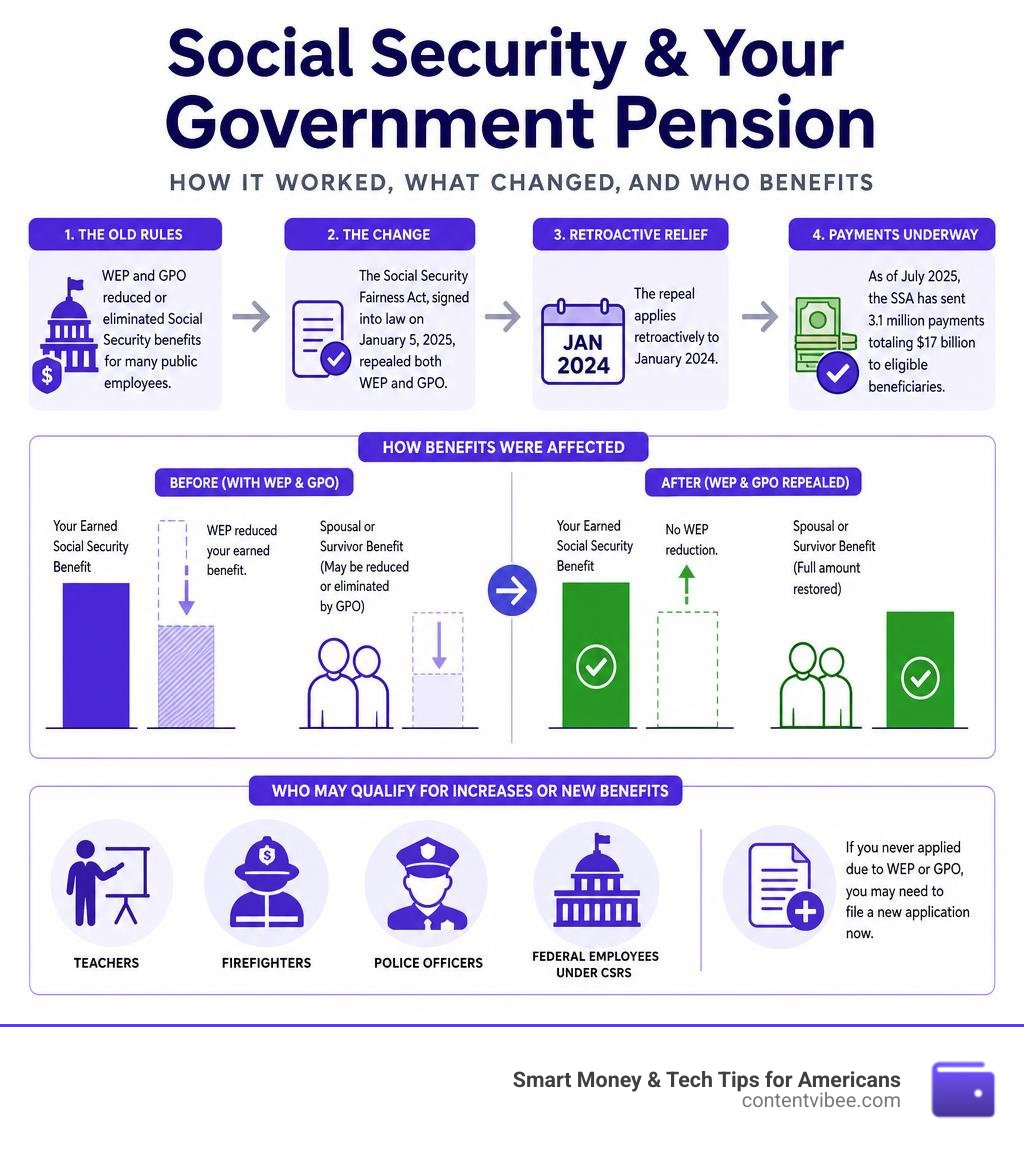
How Your Social Security Government Pension Interacts with Federal Benefits
To understand how your Social Security government pension works, we first have to look at how we got here. For a long time, the relationship between public pensions and Social Security was a source of massive confusion.
If you work in the private sector, you pay Social Security taxes (FICA) on your earnings. When you retire, you collect your benefit. Simple, right? But public employees have a different landscape. Roughly 72 percent of state and local public employees work in “covered” employment, meaning they pay Social Security taxes just like private-sector workers. These employees are not affected by special pension offsets.
However, the remaining 28 percent work in “non-covered” employment. In these jobs, workers do not pay Social Security taxes. Instead, they contribute to a state, local, or federal pension plan. In 2018, this accounted for about one-quarter of all state and local government employees—approximately 6.5 million workers. In some professions, the numbers are even more stark: nearly 90 percent of teachers in 13 sampled states were excluded from the Social Security system.
If you spent part of your career in non-covered public service and another part in the private sector, you earned both a government pension and Social Security credits. Under the old rules, the government stepped in to prevent what it deemed “double dipping” through two major adjustments.

For a deep dive into how these rules used to chip away at your hard-earned money, check out our More info about WEP rules.
The History of the Social Security Government Pension Reductions
The history of these offsets dates back to the late 1970s and early 1980s. Congress introduced these provisions to ensure that workers who received pensions from non-covered work were treated similarly to those who worked in covered employment their entire careers.
The first of these rules was the Government Pension Offset (GPO), enacted as part of the Social Security Amendments of 1977. Its goal was to align spousal and survivor benefits for government workers with those of private-sector workers. You can read the detailed historical context in the Official GPO Policy Guidelines. Under the GPO, if you received a non-covered government pension, your spousal or survivor benefits were subjected to a severe two-thirds reduction.
A few years later, Congress enacted the Windfall Elimination Provision (WEP) as part of the Social Security Amendments of 1983. WEP targeted a worker’s own retirement or disability benefits, altering the formula used to calculate their Primary Insurance Amount (PIA) to prevent what was viewed as an unfair “windfall” for workers with short careers in covered employment.
The Windfall Elimination Provision (WEP) and Your Retirement Wealth
To understand how WEP impacted retirement wealth, we have to look at how Social Security calculates benefits. The system is progressive, meaning lower-wage earners get a higher percentage of their pre-retirement earnings replaced than higher-wage earners.
When a non-covered government employee also worked in the private sector for a short period, their Social Security record showed low lifetime earnings. The Social Security formula mistook them for a low-wage worker and applied the highly generous replacement rate. WEP was designed to eliminate this effect by reducing the first bracket of the benefit formula by up to 50 percent of the monthly non-covered pension amount.
However, the reduction was capped and phased out for workers with a long history of “substantial earnings” in covered employment. If you had 30 or more years of substantial covered earnings, you were entirely exempt from WEP. But for those with fewer years, WEP stripped away hundreds of dollars from their monthly retirement and disability checks. For more details on how non-covered work interacts with disability benefits, see our guide on More info about disability pension earnings.
The Government Pension Offset (GPO) and Spousal Benefits
While WEP targeted your own retirement record, the Government Pension Offset (GPO) targeted benefits you might claim based on your spouse’s work record. Spousal and survivor benefits were originally designed in the 1930s to support dependent spouses who did not work outside the home.
Under the old GPO rules, if you received a non-covered government pension, your spousal or surviving spouse benefits were reduced by two-thirds of your monthly pension amount.
For instance, if you received a monthly civil service pension of $3,000, two-thirds of that ($2,000) was used as an offset. If you were eligible for a $2,100 survivor benefit on your deceased spouse’s record, the GPO reduced your actual payout to just $100. If your offset amount was larger than the spousal benefit, your Social Security payment was reduced to zero.
The SSA calculated this using your gross monthly pension before deductions for taxes, health insurance, or allotments, as detailed in the Official GPO Pension Applicability Rules. Even if you took your pension as a lump sum, the SSA would use actuarial tables to calculate a monthly proration equivalent to determine the offset.
The Social Security Fairness Act of 2025: A Historic Repeal
For decades, advocates, public sector unions, and affected retirees campaigned to eliminate WEP and GPO, calling them an unfair penalty on public service. That fight culminated in a historic legislative victory.

The Social Security Fairness Act (H.R. 82) was signed into law on January 5, 2025. This landmark legislation completely repealed both the Windfall Elimination Provision and the Government Pension Offset.
This means that your pension no longer has any impact on your Social Security eligibility or monthly benefit amounts. The change was retroactively applied to benefits paid after December 2023, triggering a massive wave of retroactive back payments for millions of retirees. If you are considering working during retirement now that these penalties are gone, explore More info about working after retirement.
Who Qualifies for Increased Benefits Under the New Law?
The repeal of WEP and GPO represents a massive financial shift for roughly 3 million pension recipients. The workers who stand to benefit most include:
- Teachers: Especially in states like California, Texas, and Illinois, where the vast majority of educators do not participate in Social Security.
- First Responders: Firefighters and police officers who often have split careers or qualify for spousal benefits.
- Federal Employees: Specifically those hired before 1984 who remain under the Civil Service Retirement System (CSRS).
Federal employees who transitioned to the Federal Employees Retirement System (FERS) or were hired after December 31, 1983, have mandatory Social Security coverage and were already exempt from GPO, but those still carrying CSRS pensions are seeing substantial increases. You can review the exact historical guidelines for federal employees in the Official Federal Employment GPO Exemptions.
Timeline for Benefit Increases and Retroactive Back Payments
Implementing a change of this scale was a massive undertaking for the Social Security Administration. The law dictated that the repeal was effective retroactively to January 2024.
The SSA began adjusting monthly benefit payments on February 25, 2025. By July 7, 2025, the agency completed sending out over 3.1 million retroactive payments, totaling an astonishing $17 billion to eligible beneficiaries—completing the project five months ahead of schedule.
Most affected beneficiaries saw their regular monthly checks adjust to the new, unreduced amounts starting in April 2025. The monthly increases have varied widely depending on individual work histories, ranging from nominal amounts to more than $1,000 per month.
Navigating Your Social Security Government Pension After the Repeal
If you were already receiving a reduced Social Security benefit, your payments should have adjusted automatically. However, there are two groups of people who need to take active steps:
- Those who never applied: Many public servants never filed for spousal or retirement benefits because they knew the WEP or GPO would reduce their payment to zero. If this is you, you must file a new application immediately to claim your benefits.
- Those with pending applications: Since the law passed, the SSA has taken in 289,715 new applications (completing 92% of them by mid-2025).
To ensure you receive your payments smoothly, we highly recommend logging into your my Social Security account to verify your mailing address and direct deposit information. For general retirement planning assistance, you can also utilize the Official SSA Retirement Planner.
Public Pensions vs. Social Security: Wealth, Safe Harbor, and Trust Fund Solvency
Now that the WEP and GPO are gone, it is helpful to compare how public pensions stack up against Social Security as wealth-building tools. They are structured very differently, and these differences can dramatically impact your lifetime retirement wealth.
| Feature | Public Pension (Defined Benefit) | Social Security |
|---|---|---|
| Vesting Period | Typically 5 to 10 years | 10 years (40 credits) |
| COLA | Varies widely by state/plan | Annual, tied to CPI-W |
| Normal Retirement Age | Often lower (median age 62) | Age 66 to 67 |
| Spousal/Survivor Benefits | Often requires joint-and-survivor election (reduces pension) | Built-in, no reduction to worker’s benefit |
These structural differences mean that a public pension and Social Security generate different levels of lifetime wealth. For California public employees, understanding these adjustments is crucial. You can read more in our guide, More info about CalPERS COLA.
Do Public Pensions Meet IRS Safe Harbor Standards?
Under Internal Revenue Code (IRC) Section 3121, state and local government employers are exempt from paying Social Security taxes only if they provide a retirement plan that meets “Safe Harbor” requirements. These rules mandate that the public pension must provide a benefit equivalent to the basic retirement benefit of Social Security.
However, research shows a gap between the letter of the law and actual lifetime resources. According to the Research on Public Pension Standards, while virtually all public pensions pass the annual benefit test at age 67, they often fall short when analyzed under a wealth-based generosity test.
In fact, 43 percent of public pensions fall short of Social Security’s lifetime wealth equivalent for a significant minority of non-covered new hires. This is because public pensions often have longer vesting periods, and many do not offer cost-of-living adjustments (COLAs) that keep pace with inflation. Furthermore, about 45 percent of new pension members leave their public jobs within 5 years, forfeiting their employer’s pension contributions entirely.
Trust Fund Exhaustion: Public Pensions vs. Social Security OASI
Both public pensions and the federal Social Security system face long-term financial sustainability questions.
Social Security’s Old-Age and Survivors Insurance (OASI) trust fund has long been projected to deplete its reserves—with older reports, such as the 2019 Trustees Report, pointing to 2034 as a critical window. If Congress does not act before depletion, the system would transition to a pay-as-you-go structure, which could trigger automatic benefit reductions.
However, some local public pensions are in far worse shape. For example, certain municipal pension plans (such as those in Chicago) have faced severe funding crises, with some projected to exhaust their trust fund assets much sooner. Unlike the federal government, local municipal plans cannot print money, meaning trust fund exhaustion could lead to drastic benefit cuts, tax hikes, or legal battles over state constitutional protections.
Frequently Asked Questions about WEP, GPO, and the Repeal
With such a massive change to federal law, we know you have questions. Here are the answers to the most common queries we receive.
How do I avoid scams related to the WEP and GPO repeal?
Sadly, scammers love big news. Whenever a major benefit change occurs, bad actors try to exploit retirees.
Be on high alert for anyone calling, emailing, or texting you claiming they can “expedite” your retroactive WEP/GPO payments for a fee. The SSA will never ask you to pay a fee to receive your benefits, nor will they threaten to suspend your accounts. Always verify your account status directly through the Official SSA Retirement Benefits Portal or call the SSA directly at 1-800-772-1213.
What if my Medicare premiums are deducted from my pension or Social Security?
If your Social Security benefit was previously reduced to zero by the GPO, you had to pay your Medicare Part B premiums directly to the Centers for Medicare & Medicaid Services (CMS) or have them deducted from your Office of Personnel Management (OPM) annuity.
Now that your Social Security benefits are restored, the SSA will automatically transition your Medicare Part B deductions to your Social Security check. You should continue to pay your CMS bills until you receive official notice that the deduction has switched. If premiums were accidentally deducted from both accounts during the transition, the SSA and OPM will coordinate to issue you a refund.
How does the 60-month rule apply to historical GPO exemptions?
Before the 2025 repeal, the “60-month rule” was a primary way government workers could avoid the GPO. Under this rule, if a worker’s last 60 months of government service were covered by both Social Security and their public pension plan, they were exempt from GPO spousal reductions.
While the Social Security Fairness Act has made this rule obsolete for all benefits payable from January 2024 onward, it remains a critical reference point for analyzing retroactive claims or disputes dating before 2024. You can review how this was historically administered in the Official 60-Month Exemption Policy.
Conclusion
Navigating the intersection of a Social Security government pension used to feel like walking through a financial minefield. For decades, WEP and GPO drained the retirement savings of those who dedicated their lives to public service.
But with the passage of the Social Security Fairness Act, the landscape has completely changed. Public servants can finally access the full retirement wealth they earned in both the public and private sectors.
At ContentVibee, we are committed to helping you make sense of these major financial shifts. To make sure you are getting every dollar you deserve from the federal government, check out our comprehensive guide to Maximize Your Retirement Benefits.