Why You Should Use a 401k Withdrawal Calculator Before Touching Your Retirement Funds
A 401k withdrawal calculator can show you exactly how much of your money you’ll actually keep — and how much you’ll permanently lose — before you make a costly, irreversible decision.
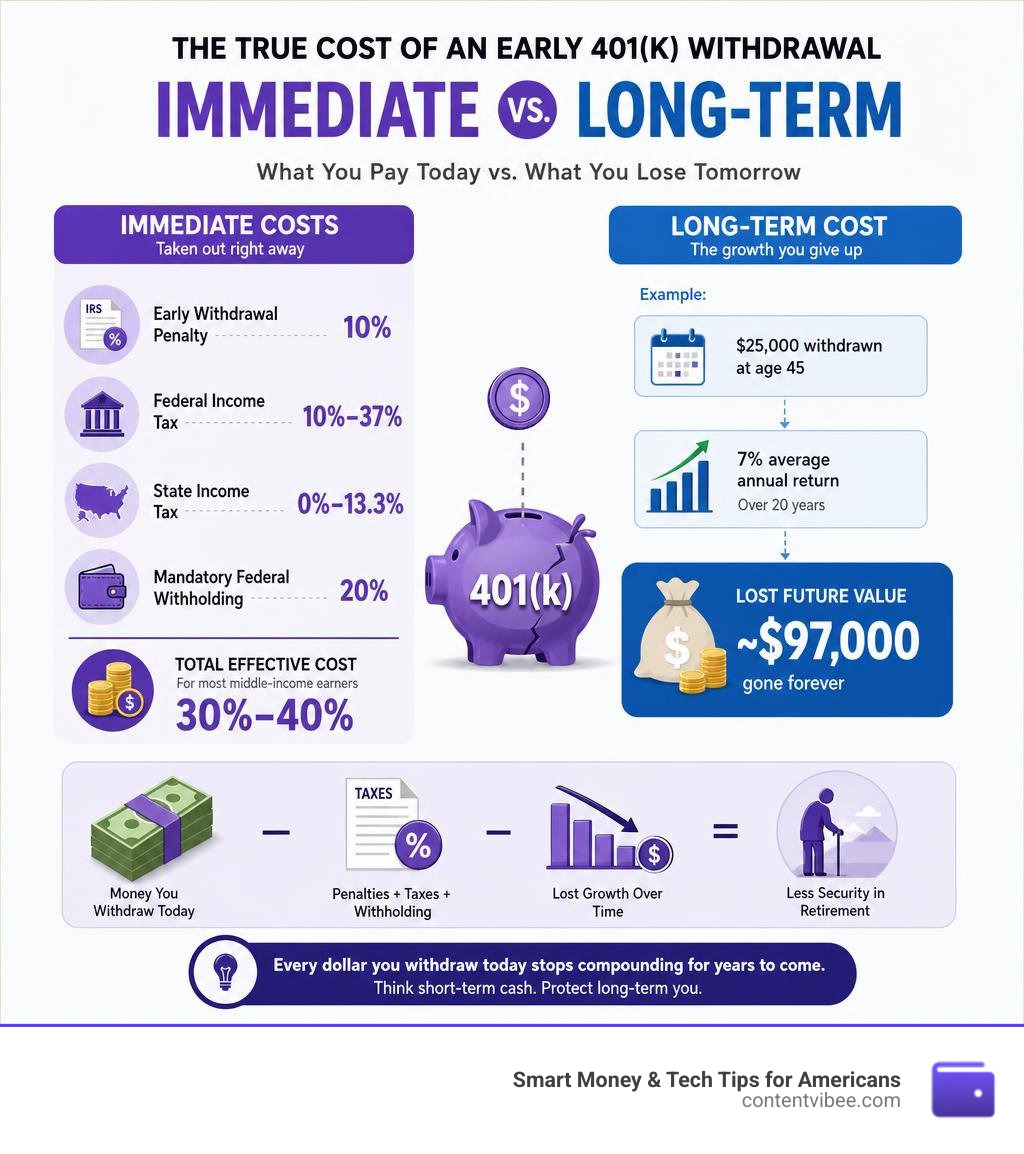
Quick answer: What does an early 401k withdrawal actually cost?
| Cost Layer | Typical Amount |
|---|---|
| 10% IRS early withdrawal penalty (before age 59½) | 10% of withdrawal |
| Federal income tax (ordinary income rates) | 10% – 37% depending on your bracket |
| State income tax | 0% – 13.3% depending on your state |
| Mandatory federal withholding upfront | 20% withheld at distribution |
| Total effective cost for most middle-income earners | 30% – 40% |
| Lost future retirement value ($25K withdrawn at age 45) | ~$97,000 at 7% return over 20 years |
That last row is the one most people miss.
Right now, a record 6% of 401(k) participants took a hardship withdrawal in 2025 — the highest rate ever recorded, up from just 2% before the pandemic. The median amount withdrawn was $1,900. For many people, that small sum of cash cost tens of thousands of dollars in lost retirement growth.
The immediate financial pressure is real. But so is the long-term damage.
Every dollar you pull out today isn’t just gone — it stops compounding for the next 10, 20, or 30 years.
Before you cash out, you need to see the full picture: the penalty, the taxes, the withholding, and the future value you’re giving up. That’s exactly what a withdrawal calculator is built to show you.
Easy 401k withdrawal calculator glossary:
What is a 401k withdrawal calculator and how does it work?
A 401k withdrawal calculator is a digital planning tool designed to estimate the net cash you will receive after taxes and penalties are subtracted from your retirement distribution. When you look at your 401(k) account balance, the number you see is “pre-tax” (unless you have a Roth 401k). It’s easy to look at a $50,000 balance and think, “Great, I have $50,000 to buy a house or pay off debt.”
In reality, a large portion of that balance belongs to Uncle Sam. A withdrawal calculator acts as a reality check, translating your gross account balance into actual, spendable net cash.

To deliver an accurate estimate, the calculator processes several key pieces of financial data:
- Your Age: This determines whether you are subject to the IRS 10% early withdrawal penalty (which generally applies if you are under age 59½).
- Withdrawal Amount: The gross amount you want to pull from your plan.
- Federal and State Tax Brackets: Since traditional 401(k) distributions are taxed as ordinary income, your current marginal tax rate heavily influences the final math.
- Penalty Exemptions: The calculator checks if you qualify for specific IRS exceptions that waive the 10% penalty.
One of the most valuable features of an advanced calculator is the gross-up calculation. Let’s say you need exactly $20,000 in cash to cover an emergency. If you withdraw exactly $20,000 from your 401(k), you won’t get $20,000. After taxes and penalties are deducted, you might only walk away with $13,000.
A gross-up calculation works backward: it determines the exact gross amount you must withdraw so that your net payout matches your target. For example, to get $20,000 in hand at a 22% federal tax rate, a 5% state tax rate, and a 10% penalty, the calculator will show you that you actually need to request a gross withdrawal of approximately $27,000.
To run these numbers for your own situation, you can use interactive tools like the 401k Early Withdrawal Calculator or the 401(k) Cash Out Withdrawal Calculator . If you are still in the saving phase and want to see how contributions build up your balance over time, check out our guide on The Ultimate Guide to Calculating Your 401k Contributions.
The Real Cost of Cashing Out Before Age 59½
Pulling money out of a traditional 401(k) before you reach age 59½ is one of the most expensive ways to get cash. For most middle-income earners in the United States, the effective combined cost rate (taxes plus penalties) sits between 30% and 40%. In high-tax states, that rate can easily surpass 50%.
When you cash out early, your money is hit by three distinct financial drains:

- The 10% IRS Early Withdrawal Penalty: Under IRS Section 72(t), any distribution taken before age 59½ triggers an immediate 10% excise tax. This is a flat penalty that goes straight to the federal government on top of your regular income taxes.
- Federal Income Taxes: Traditional 401(k) contributions are made with pre-tax dollars. When you withdraw that money, the IRS treats every dollar as ordinary income. If you are in the 22% federal tax bracket, you will owe 22% on the withdrawal. Even worse, a large lump-sum withdrawal can push you into a higher marginal tax bracket, increasing the tax rate on your regular career earnings.
- State and Local Income Taxes: Except for states with no income tax, your state government will also want its cut. State tax rates on retirement distributions range from 0% to over 13% depending on where you live.
A common point of confusion is the mandatory 20% federal withholding. By law, when you take an eligible rollover distribution directly from a 401(k) plan, the plan sponsor is required to withhold 20% and send it directly to the IRS.
It is vital to understand that withholding is not the same as your actual tax liability. The 20% is merely a prepayment. If your actual tax bracket is 22% and you owe a 10% early withdrawal penalty, your actual tax liability is 32%. The 20% withheld upfront will not cover what you owe, and you will have to pay the remaining 12% difference when you file your tax return the following spring.
To get a broader picture of how different retirement accounts grow and are taxed, you can run projections using a general 401K Calculator .
Calculating the Long-Term Opportunity Cost with a 401k Withdrawal Calculator
While the immediate taxes and penalties are painful, they pale in comparison to the opportunity cost of lost future growth. When you remove money from your 401(k), you aren’t just losing the cash you spend today; you are permanently removing those dollars from the engine of compounding interest.
Let’s look at a real-world scenario. Suppose you are 45 years old and decide to withdraw $25,000 from your 401(k) to cover an expense. Assuming a historically reasonable 7% average annual return (which is a standard inflation-adjusted benchmark for the S&P 500), that $25,000 would have grown to $96,742 by the time you reach age 65.
By cashing out that $25,000 today, your future self is giving up nearly $97,000 in retirement wealth.
A helpful mental shortcut is the 3x to 4x rule: every dollar you withdraw at age 40 will be worth roughly $3.87 by age 60, and over $7.60 by age 65 if left invested.
If you want to see how much you need to keep in your accounts to secure a comfortable lifestyle, you can use our Retirement Calculator: Estimate Savings Needed to map out your long-term goals.
Penalty Exceptions and the SECURE 2.0 Act Rules
Fortunately, the IRS does not apply the 10% early withdrawal penalty to every single pre-59½ distribution. There are several legal paths to waive the penalty using Form 5329 waivers. However, keep in mind that a penalty exception does not waive your ordinary income taxes — you will still owe federal and state income taxes on the distribution.
Under IRS rules, some of the traditional exceptions to the 10% penalty include:
- Total and Permanent Disability: If you can prove you are unable to engage in any substantial gainful activity due to a physical or mental impairment.
- Substantially Equal Periodic Payments (SEPP / Section 72(t)): A method where you take annual distributions based on your life expectancy for at least five years or until you turn 59½, whichever is longer.
- Unreimbursed Medical Expenses: If your medical expenses exceed 7.5% of your Adjusted Gross Income (AGI).
- Qualified Domestic Relations Orders (QDRO): If you are withdrawing funds to pay a former spouse under a court-approved divorce decree.
The tax landscape has also evolved thanks to the SECURE 2.0 Act. This legislation introduced several new penalty-free withdrawal exceptions designed to help workers access emergency cash without the 10% sting:
- Emergency Personal Expenses: You can withdraw up to $1,000 once per calendar year for personal or family emergency expenses. You have the option to repay this withdrawal within three years to rebuild your account.
- Domestic Abuse Victims: Victims of domestic abuse can withdraw up to $10,000 (or 50% of their account balance, whichever is less) within one year of the abuse.
- Terminal Illness: Participants with a certified terminal illness expected to result in death within 84 months can take penalty-free distributions.
Understanding these rules is essential. For instance, did you know that one of the most common reasons for early withdrawals is home buying? However, while the IRS allows a penalty-free first-time homebuyer withdrawal of up to $10,000 from an IRA, this exception does not apply to active 401(k) plans. To learn more about how different plans treat taxes, check out The Great Retirement Debate: Roth vs Traditional 401k Calculator Guide.
How the Age 55 Rule Works for Early Retirees
If you are planning an early retirement, one of the most powerful tax loopholes available is the Age 55 Rule (often called the separation from service rule).
Normally, if you retire at age 55, you would have to wait until age 59½ to touch your 401(k) penalty-free. However, the Age 55 Rule states that if you leave or lose your job during or after the calendar year in which you turn 55, you can take penalty-free distributions from that specific employer’s 401(k) plan.
Key details to remember about the Age 55 Rule:
- It only applies to your current plan: You cannot use this rule to withdraw penalty-free from previous 401(k) plans or IRAs. If you have old 401(k) accounts, you must consolidate them into your current employer’s plan before you separate from service.
- Public Safety Workers get an extra break: Qualified public safety employees (such as police officers, firefighters, and EMTs) qualify for this rule starting at age 50 instead of 55.
- No rolling over: If you roll your 401(k) into an IRA after leaving your job, you instantly lose your Age 55 Rule eligibility, as IRAs strictly enforce the 59½ age limit for standard penalty-free access.
Smarter Alternatives to Taking an Early 401(k) Distribution
Before you sign the paperwork to cash out your retirement, it is highly recommended to explore alternatives that protect your compound interest.
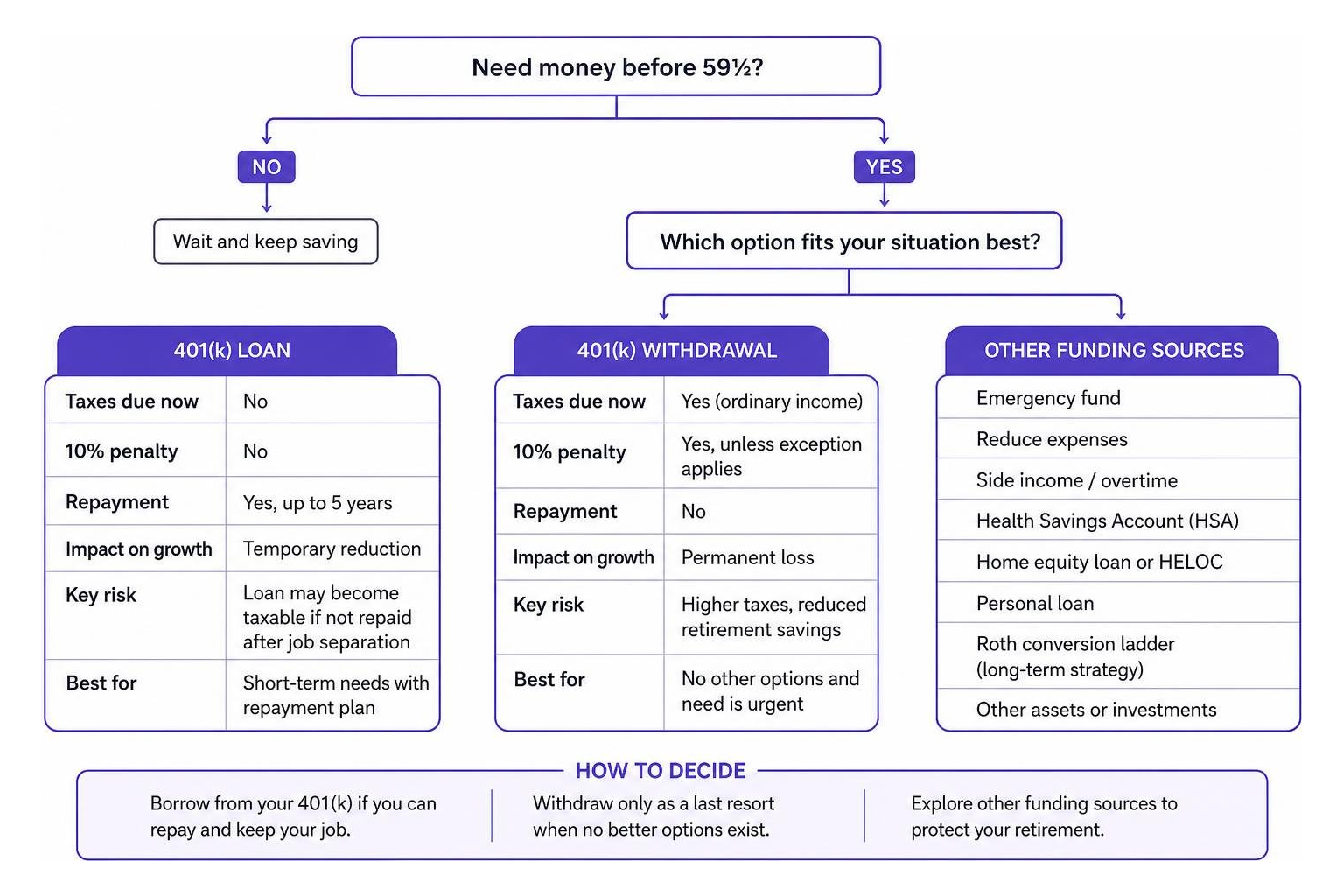
For many, a 401(k) loan is a far superior option to a straight withdrawal. With a loan, you borrow money from your own account and pay it back over time (usually up to 60 months). Best of all, the interest you pay on the loan goes right back into your own account — meaning you are paying interest to yourself, not a bank.
Here is a direct comparison of how these two options stack up:
| Feature | 401(k) Early Withdrawal | 401(k) Loan |
|---|---|---|
| Immediate 10% Penalty | Yes (unless an exception applies) | No |
| Income Taxes Owed | Yes (ordinary rates) | No |
| Upfront Withholding | Yes (mandatory 20%) | No |
| Impact on Compound Growth | Permanent loss of growth | Temporary reduction in growth |
| Repayment Required | No (cannot easily put it back) | Yes (usually within 5 years) |
| Job Separation Risk | None | High (loan may become taxable if unpaid after leaving job) |
While a 401(k) loan is generally much safer, it does carry job loss default risk. If you leave or are laid off from your employer, the remaining balance of your loan must typically be repaid by the due date of your federal tax return for that year. If you cannot repay it, the IRS treats the outstanding loan balance as a taxable distribution, hit with both income taxes and the 10% early withdrawal penalty.
Another advanced strategy for long-term planning is a Roth conversion ladder. This involves rolling traditional pre-tax retirement accounts into a Roth account, paying the taxes upfront, and then withdrawing the converted contributions penalty-free after a mandatory five-year waiting period.
If you are exploring ways to maximize your retirement accounts using after-tax funds, take a look at our guide on After-Tax Contributions: How to Maximize Your Retirement Nest Egg.
We can map out this decision-making process visually to help you choose the best path forward:
How to Minimize Taxes If You Must Use a 401k Withdrawal Calculator
If you have exhausted all alternatives and an early withdrawal is your only option, you can still take strategic steps to minimize the tax damage:
- Avoid Marginal Tax Bracket Creep: Because 401(k) withdrawals are taxed as ordinary income, taking a large lump sum can push you into a higher tax bracket. If possible, split your withdrawal across two tax years (e.g., taking half in December and half in January) to keep your income in a lower tax bracket.
- Know Your State Laws: State income tax treatment of 401(k) withdrawals varies wildly across the country. In 2026, there are 14 states that do not tax 401(k) distributions at all (either because they have no state income tax or they specifically exempt retirement income). These states include Alaska, Florida, Hawaii, Illinois, Iowa, Mississippi, Nevada, New Hampshire, Pennsylvania, South Dakota, Tennessee, Texas, Washington, and Wyoming. If you live in a high-tax state like California (up to 13.3%), timing your move or managing your residency can save you thousands.
- Use a Gross-Up Calculation Wisely: Work with a tax professional to calculate the exact minimum amount you need to withdraw. Do not pull out extra “just in case,” as every additional dollar is taxed at your highest marginal rate.
To make sure you are optimizing your contributions and getting every dollar of employer matching before you consider taking funds out, read our guide on Don’t Leave Money on the Table: The Ultimate 401k Max Calculator Guide.
Frequently Asked Questions About 401(k) Withdrawals
What is the difference between mandatory 20% withholding and my actual tax liability?
When you take an early distribution from a 401(k), the IRS requires the plan administrator to withhold 20% upfront as a prepayment of your federal income taxes. This withholding is reported on your IRS Form 1099-R.
However, this 20% is rarely enough to cover your total bill. If you are in the 22% federal tax bracket and owe a 10% early withdrawal penalty, your actual tax liability is 32%. In this scenario, the 20% withholding leaves you with a 12% underpayment, which you will have to pay as a tax bill when you file your annual tax return.
Conversely, if your actual tax bracket is low and you qualify for a penalty waiver, the 20% withholding might be more than you owe, resulting in a tax refund.
Does a hardship withdrawal automatically waive the 10% early withdrawal penalty?
No. This is one of the most common and costly mistakes retirement savers make.
A “hardship distribution” is a plan-level rule that allows you to access your 401(k) funds while still employed due to an “immediate and heavy financial need” (such as preventing foreclosure/eviction, medical expenses, or tuition).
While qualifying for a hardship withdrawal allows your employer to release the funds, it does not automatically waive the IRS 10% early withdrawal penalty. Unless you also meet one of the specific IRS penalty exceptions (such as unreimbursed medical expenses exceeding 7.5% of your AGI), you will still owe the 10% penalty on top of ordinary income taxes.
Can I use the Rule of 55 if I roll my 401(k) over into an IRA?
No. The Age 55 Rule is an exclusive feature of employer-sponsored 401(k) and 403(b) plans.
If you separate from service at age 55 and immediately roll your 401(k) balance into an Individual Retirement Account (IRA), you lose your penalty-free status. IRAs do not recognize the Age 55 Rule. Once your money is in an IRA, you must wait until age 59½ to take penalty-free distributions (unless you use a different exception like a SEPP plan).
If you plan to retire early using the Age 55 Rule, keep your funds in your employer’s plan.
Conclusion
Cashing out your 401(k) early is a major financial decision that can cost you 30% to 40% of your savings in immediate taxes and penalties, while quietly erasing nearly four times that amount in lost future retirement growth.
At ContentVibee, we believe that making smart money decisions starts with having the right data. Before you make an irreversible move, take the time to run your numbers, consult with a tax professional, and explore smarter funding options like 401(k) loans or penalty-free hardship exceptions.
Ready to see how your retirement strategy holds up? Explore our suite of financial tools to optimize your savings and take control of your financial future today.