


What Is the 2026 Max Roth IRA Contribution?
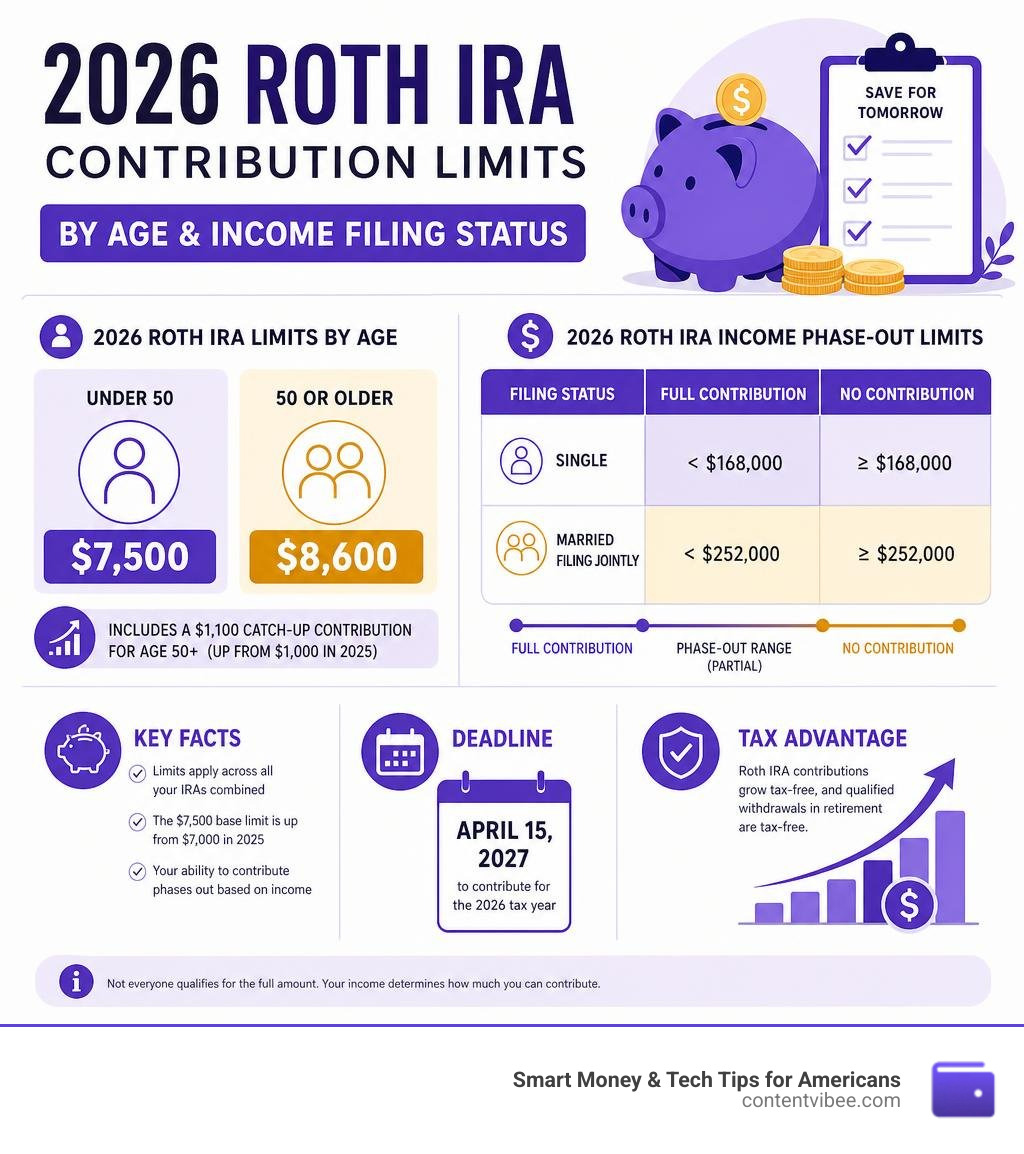
The 2026 max Roth IRA contribution is $7,500 for most people — and $8,600 if you’re age 50 or older.
Here’s a quick snapshot so you have the answer right away:
| Age | 2026 Roth IRA Limit |
|---|---|
| Under 50 | $7,500 |
| 50 or older | $8,600 |
Key facts to know upfront:
- The $7,500 base limit is up from $7,000 in 2025
- The $1,100 catch-up contribution (for age 50+) is up from $1,000 in 2025
- These limits apply across all your IRAs combined — not per account
- Your ability to contribute phases out based on your income
- The deadline to contribute for the 2026 tax year is April 15, 2027
But here’s the catch — not everyone qualifies for the full amount.
Your income determines how much you can actually put in. Single filers earning $168,000 or more in 2026 can’t contribute directly to a Roth IRA at all. Married couples filing jointly hit that same wall at $252,000.
That’s why knowing the full picture matters — especially if you’re in or near retirement and trying to build tax-free income without the headaches of stock swings or rental properties.
This guide walks you through everything: the exact limits, income phase-outs, spousal IRA rules, backdoor strategies, and how to avoid costly mistakes.
2026 max roth ira contribution glossary:
Understanding the 2026 Max Roth IRA Contribution Limits
When planning our retirement, understanding the exact rules governing our accounts is the key to maximizing long-term wealth. For the 2026 tax year, the IRS has introduced several important cost-of-living adjustments (COLA) that directly impact how much we can save in tax-advantaged accounts.
The standard 2026 max Roth IRA contribution has officially increased to $7,500. This is a welcome $500 boost from the $7,000 limit that was in place for both 2024 and 2025. This annual limit is a combined cap across all your individual retirement accounts. This means if you have both a Traditional IRA and a Roth IRA, your total combined contributions across both accounts cannot exceed $7,500 (or $8,600 if you are 50 or older) for the year.
This change coincides with broader adjustments across workplace retirement plans. For instance, the IRS announced that the employee elective deferral limit for 401(k), 403(b), and most 457 plans has increased to $24,500 for 2026, up from $23,500 in 2025. To read the official IRS announcement regarding these changes, you can view the 401(k) limit increases to $24,500 for 2026, IRA limit increases to $7,500 | Internal Revenue Service.
How Age Affects Your 2026 Max Roth IRA Contribution
Age plays a significant role in how much the tax code allows us to shelter in a Roth IRA. The IRS provides “catch-up” provisions to help older workers accelerate their retirement savings as they approach their golden years.
- If you are under age 50: Your maximum contribution limit for 2026 is $7,500.
- If you are age 50 or older: Your maximum contribution limit for 2026 is $8,600.
This $8,600 total is made up of the $7,500 base limit plus a $1,100 catch-up contribution. This catch-up amount is a notable change for 2026. Historically, the IRA catch-up contribution limit was fixed at a flat $1,000 and was not indexed for inflation. However, thanks to the SECURE 2.0 Act, the IRA catch-up limit is now subject to annual cost-of-living adjustments (COLA). The 2026 tax year marks the first time this catch-up limit has risen to $1,100, providing an extra boost for savers.
To explore how these age-based limits interact with your broader retirement planning, you can review the guide on Traditional and Roth IRA Contribution Limits – Fidelity Investments.
Comparing the 2025 and 2026 Max Roth IRA Contribution Limits
Keeping track of how limits change year-over-year helps us adjust our automatic monthly contributions and avoid underfunding or overfunding our accounts. The table below outlines the key differences between the 2025 and 2026 tax years:
| Contribution Category | 2025 Tax Year | 2026 Tax Year | Change |
|---|---|---|---|
| Base Contribution Limit (Under 50) | $7,000 | $7,500 | +$500 |
| Catch-Up Contribution Limit (50+) | $1,000 | $1,100 | +$100 |
| Total Limit for Age 50 and Older | $8,000 | $8,600 | +$600 |
| Single Filer MAGI Phase-Out Range | $146,000 – $161,000 | $153,000 – $168,000 | +$7,000 shifts |
| Married Joint (MFJ) Phase-Out Range | $230,000 – $240,000 | $242,000 – $252,000 | +$12,000 shifts |
These upward shifts reflect the persistent inflation adjustments calculated by the IRS. If you set up automatic contributions in 2025, now is the perfect time to log into your brokerage account and adjust your monthly transfers to align with the new 2026 limits.
Income Limits and MAGI Phase-Out Mechanics
While Roth IRAs offer incredible benefits—namely tax-free growth and tax-free withdrawals in retirement—they come with strict income eligibility rules. The government restricts high earners from contributing directly to a Roth IRA.
Your eligibility to make a direct 2026 max Roth IRA contribution depends entirely on your Modified Adjusted Gross Income (MAGI) and your tax filing status. If your MAGI falls below the designated threshold, you can contribute the full amount. If it falls within the “phase-out” range, your maximum allowable contribution is reduced. If your income exceeds the phase-out range entirely, your direct contribution limit drops to zero.
To check how these phase-out ranges are structured and how they might limit your direct contributions, you can read more on Roth IRA Contribution Limits for 2025-2026 – Charles Schwab.
MAGI Calculation and Add-Backs
To determine your eligibility, you cannot simply look at your gross salary or even your Adjusted Gross Income (AGI) on your tax return. You must calculate your Modified Adjusted Gross Income (MAGI) specifically for Roth IRA purposes.
To calculate your MAGI, you start with your AGI (which is your total income minus “above-the-line” deductions like pre-tax 401(k) contributions or HSA contributions) and add back certain deductions. Common add-backs include:
- Student loan interest deductions
- The foreign earned income exclusion
- Foreign housing exclusions or deductions
- Deductions taken for traditional IRA contributions
- Exclusions for savings bond interest or employer-provided adoption benefits
Notably, if you completed a Traditional-to-Roth conversion (a Roth conversion) during the year, the income from that conversion is not included in your MAGI for the purposes of determining your eligibility to make a regular annual Roth IRA contribution.
Maximizing your pre-tax workplace contributions is one of the most effective ways to lower your AGI, which in turn lowers your MAGI and can keep you under the Roth IRA phase-out threshold. For a detailed breakdown of how workplace retirement contributions lower your taxable income, check out The Ultimate Guide to Calculating Your 401k Contributions.
Phase-Out Ranges by Filing Status
The IRS adjusts the MAGI phase-out ranges annually. For 2026, the thresholds have increased significantly, allowing more Americans to qualify for direct Roth contributions.

Here are the official 2026 MAGI phase-out ranges:
- Single Filers and Heads of Household: The phase-out range is $153,000 to $168,000.
- If your MAGI is under $153,000, you can contribute the full 100% of the limit ($7,500 or $8,600).
- If your MAGI is between $153,000 and $168,000, your allowable contribution is proportionally reduced.
- If your MAGI is $168,000 or more, you cannot make a direct contribution.
- Married Filing Jointly (MFJ): The phase-out range is $242,000 to $252,000.
- If your joint MAGI is under $242,000, both you and your spouse can contribute the full individual limits.
- If your joint MAGI is between $242,000 and $252,000, your contributions are reduced.
- If your joint MAGI is $252,000 or more, direct contributions are prohibited.
- Married Filing Separately (MFS) (and you lived with your spouse at any time during the year): The phase-out range is $0 to $10,000. This is a statutory cliff that does not adjust for inflation. If you file separately and live together, even a small amount of income will disqualify you from direct Roth contributions.
Advanced Roth IRA Strategies: Spousal IRAs and Backdoor Conversions
If your income is too high to contribute directly, or if you or your spouse doesn’t have traditional earned income, you aren’t necessarily locked out of the benefits of a Roth IRA. The tax code provides advanced strategies to help savers maximize their tax-free growth potential.
To understand the power of adding after-tax funds to your broader portfolio, you can read our detailed guide on After-Tax Contributions: How to Maximize Your Retirement Nest Egg.
Maximizing Savings with a Spousal Roth IRA
Under normal IRS rules, you must have “earned income” (such as wages, salaries, tips, or self-employment net earnings) to contribute to an IRA. If you do not work, your contribution limit is typically $0.
However, the Spousal IRA rule (under IRC Section 219(c)) provides a major exception for married couples. If you file a joint tax return, the working spouse can fund a separate Roth IRA for the non-working (or low-earning) spouse using the working spouse’s eligible compensation.
To utilize this strategy:
- You must file a joint federal tax return.
- The working spouse must have enough earned income to cover the combined contributions for both accounts. For example, if both spouses are under 50, the working spouse needs at least $15,000 in earned income to fully fund both Roth IRAs ($7,500 each) in 2026.
- The contributions must be made into two separate accounts—there is no such thing as a “joint” IRA account.
This rule is an exceptional way for single-income households to double their annual tax-free savings rate. For official guidance on spousal contributions, check out the Retirement topics – IRA contribution limits | Internal Revenue Service.
Navigating the Backdoor Roth IRA and the Pro-Rata Trap
For high-earning individuals whose MAGI exceeds the 2026 limits ($168,000 for singles; $252,000 for married couples), the Backdoor Roth IRA strategy is a highly effective workaround. This strategy allows you to bypass the income limits entirely by taking a multi-step approach.
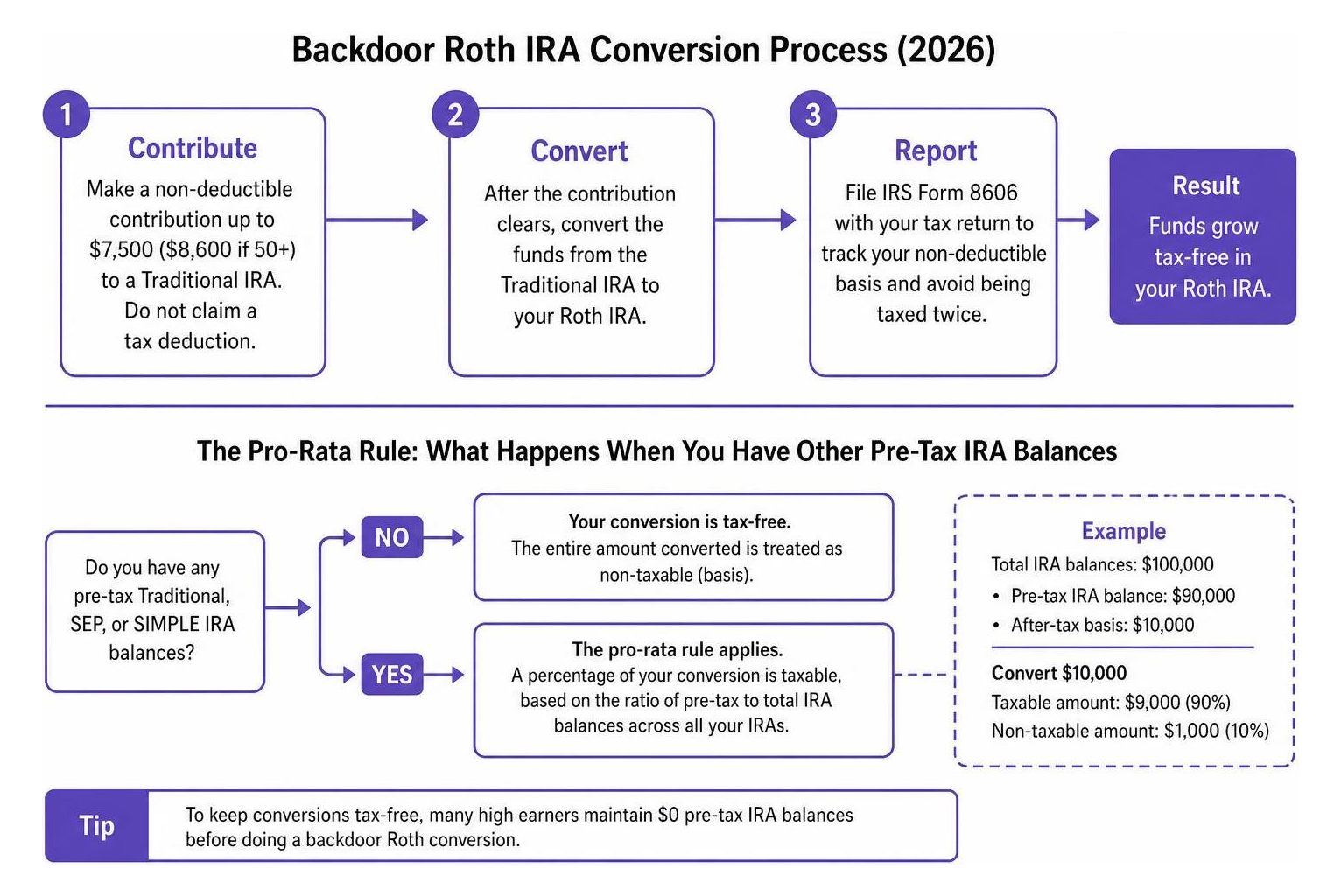
Here is how the backdoor process works:
- Contribute: You make a non-deductible contribution of up to $7,500 ($8,600 if 50+) to a traditional IRA. Because your income is high, you do not claim a tax deduction for this contribution.
- Convert: Shortly after the contribution clears, you instruct your brokerage firm to convert those funds from the Traditional IRA into your Roth IRA.
- Report: You file IRS Form 8606 with your annual tax return to track this non-deductible basis, ensuring you aren’t taxed twice on the same money.
Beware of the Pro-Rata Trap
The backdoor strategy works beautifully only if you do not own any other pre-tax IRAs (such as a Rollover IRA, traditional IRA, SEP IRA, or SIMPLE IRA).
Under the IRS pro-rata aggregation rule, when you convert funds from a Traditional IRA to a Roth IRA, the IRS views all of your traditional IRAs as a single, combined account. If you have a mixture of pre-tax and after-tax money across your accounts, you cannot choose to convert only the after-tax money. The conversion will be taxed proportionally.
For example, if you have $92,500 in a pre-tax Rollover IRA and you make a $7,500 non-deductible contribution to a new Traditional IRA to do a backdoor Roth, your total IRA balance is $100,000. Because 92.5% of your total IRA assets are pre-tax, 92.5% of your $7,500 conversion will be subject to ordinary income taxes, resulting in an unexpected tax bill.
How to avoid the trap: Before executing a backdoor Roth, consider rolling over any pre-tax IRA balances into your current employer’s active 401(k) plan. Workplace 401(k) plans do not count toward the pro-rata calculation, leaving your Traditional IRA balance at $0 and allowing for a tax-free backdoor conversion.
To explore more ways to keep your tax liability low while building your retirement nest egg, take a look at our Smart Strategies to Defer Taxes and Boost Your Retirement Savings.
Rules, Penalties, and Withdrawal Mechanics
Failing to follow IRS regulations can result in penalties that quickly erode your investment returns. Understanding how to handle mistakes and how the withdrawal rules function is vital for long-term success.
If you are looking for alternative ways to build wealth outside of traditional and Roth IRAs, you can explore Alternative Ways to Save for Retirement That Actually Work.
Correcting Excess Roth IRA Contributions
An excess contribution occurs if you contribute more than the 2026 max Roth IRA contribution limit, or if you make a direct contribution when your MAGI is too high.
If you leave an excess contribution in your Roth IRA, the IRS imposes a 6% annual excise tax penalty on the excess amount for every year it remains in the account. Fortunately, you can avoid this penalty by correcting the mistake before your tax filing deadline (including extensions, typically October 15 of the following year).
You have two primary ways to correct an excess contribution:
- Withdraw the Excess: You can withdraw the excess contribution along with any net income attributable (earnings) to that contribution. While the withdrawn contribution is tax-free, the earnings are subject to ordinary income tax in the year they were earned.
- Recharacterize the Contribution: You can instruct your brokerage firm to “recharacterize” your Roth contribution (plus its earnings) as a Traditional IRA contribution. This treats the contribution as if it had been made to the Traditional IRA from day one, allowing you to later perform a backdoor conversion if desired.
The 5-Year Rule and Tax-Free Withdrawals
One of the greatest benefits of a Roth IRA is that you can withdraw your original contributions at any time, for any reason, completely tax- and penalty-free. However, withdrawing the earnings generated by those contributions is a different story.
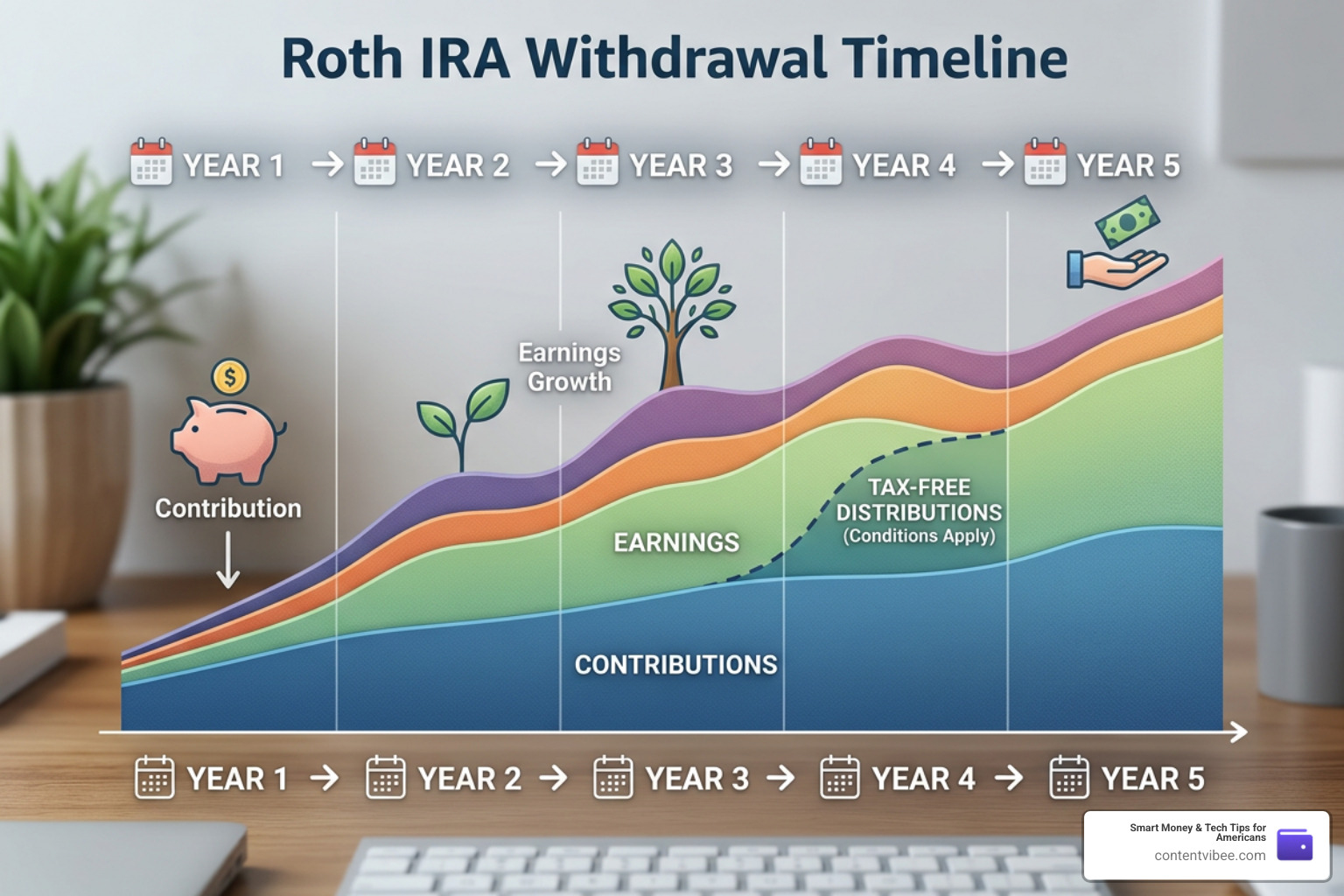
To withdraw earnings tax- and penalty-free, the distribution must be a qualified distribution. This requires meeting two criteria:
- The Age Requirement: You must be at least age 59½ (or qualify for a specific exemption, such as disability or up to $10,000 for a first-time home purchase).
- The 5-Year Rule: At least five tax years must have passed since the beginning of the tax year for which you made your very first contribution to any Roth IRA.
The five-year clock begins on January 1 of the tax year for which you made your first contribution. For example, if you make your first-ever Roth IRA contribution for the 2026 tax year on April 15, 2027, your five-year clock is backdated to start on January 1, 2026. Your earnings will satisfy the five-year rule on January 1, 2031.
Frequently Asked Questions about 2026 Roth IRA Limits
Can I contribute to both a 401(k) and a Roth IRA in 2026?
Yes! You can absolutely contribute to both an employer-sponsored 401(k) and a personal Roth IRA in the same tax year, provided you meet the income requirements for the Roth IRA. In fact, doing so is an excellent way to diversify your tax exposure in retirement.
By contributing to a pre-tax 401(k), you lower your current year taxable income, which can help keep your MAGI below the Roth IRA phase-out thresholds. Then, by maxing out your Roth IRA, you build a pool of tax-free wealth for the future.
To weigh the pros and cons of each account type, use our comprehensive guide: The Great Retirement Debate: Roth vs Traditional 401k Calculator Guide.
What is the combined limit for traditional and Roth IRAs?
For 2026, the combined annual limit across all your traditional and Roth IRAs is $7,500 if you are under age 50, and $8,600 if you are age 50 or older.
You can split your contributions between the two types of accounts however you like—for example, putting $4,000 into a Traditional IRA and $3,500 into a Roth IRA. However, the total sum of all contributions across all accounts cannot exceed your age-based limit.
Are Roth IRA contributions tax-deductible?
No. Roth IRA contributions are made strictly with after-tax dollars. You do not receive a tax deduction in the year you make the contribution.
The trade-off for giving up the immediate tax break is that your investments grow entirely tax-free, and your qualified withdrawals in retirement are 100% tax-free.
Conclusion
Maximizing your 2026 max Roth IRA contribution is one of the most powerful steps we can take to secure our financial future. By staying on top of the updated $7,500 limit ($8,600 for those age 50 and older) and keeping a close eye on our Modified Adjusted Gross Income (MAGI), we can ensure we are saving efficiently while avoiding unnecessary IRS penalties.
Whether you are making direct contributions, leveraging a Spousal IRA, or executing a Backdoor Roth strategy, consistency and tax planning are key. At ContentVibee, we are dedicated to helping Americans make smart money decisions and build long-term wealth through simple, actionable financial strategies.
To learn more about how taxes impact your retirement income, including how your Social Security benefits are taxed, check out our guide: Learn more about taxes on retirement income.