


The Excess IRA Contribution Penalty: What It Costs You and How to Stop It
The excess IRA contribution penalty is one of those quiet, sneaky tax problems that keeps charging you every single year until you fix it.
Here’s the quick answer most people need:
The IRS penalty for excess IRA contributions:
- Rate: 6% of the excess amount per year
- When it applies: Every year the excess stays in your account
- 2026 contribution limits: $7,500 (under age 50) or $8,600 (age 50+)
- Deadline to avoid the penalty: Tax filing deadline — April 15, or October 15 with an extension
- Fix it in time? No penalty at all
- Miss the deadline? Pay 6% per year until it’s corrected
So a $1,000 over-contribution costs you $60 a year — and that adds up to $300 over five years if you do nothing.
This happens more often than you’d think. Maybe you contributed early in the year, then your income changed. Maybe you forgot you already contributed. Maybe you didn’t realize your Roth IRA eligibility was phased out based on your earnings. Whatever the reason, the good news is: you can fix it, and if you act before the deadline, you can avoid the penalty entirely.
This guide walks you through exactly how to do that — step by step.
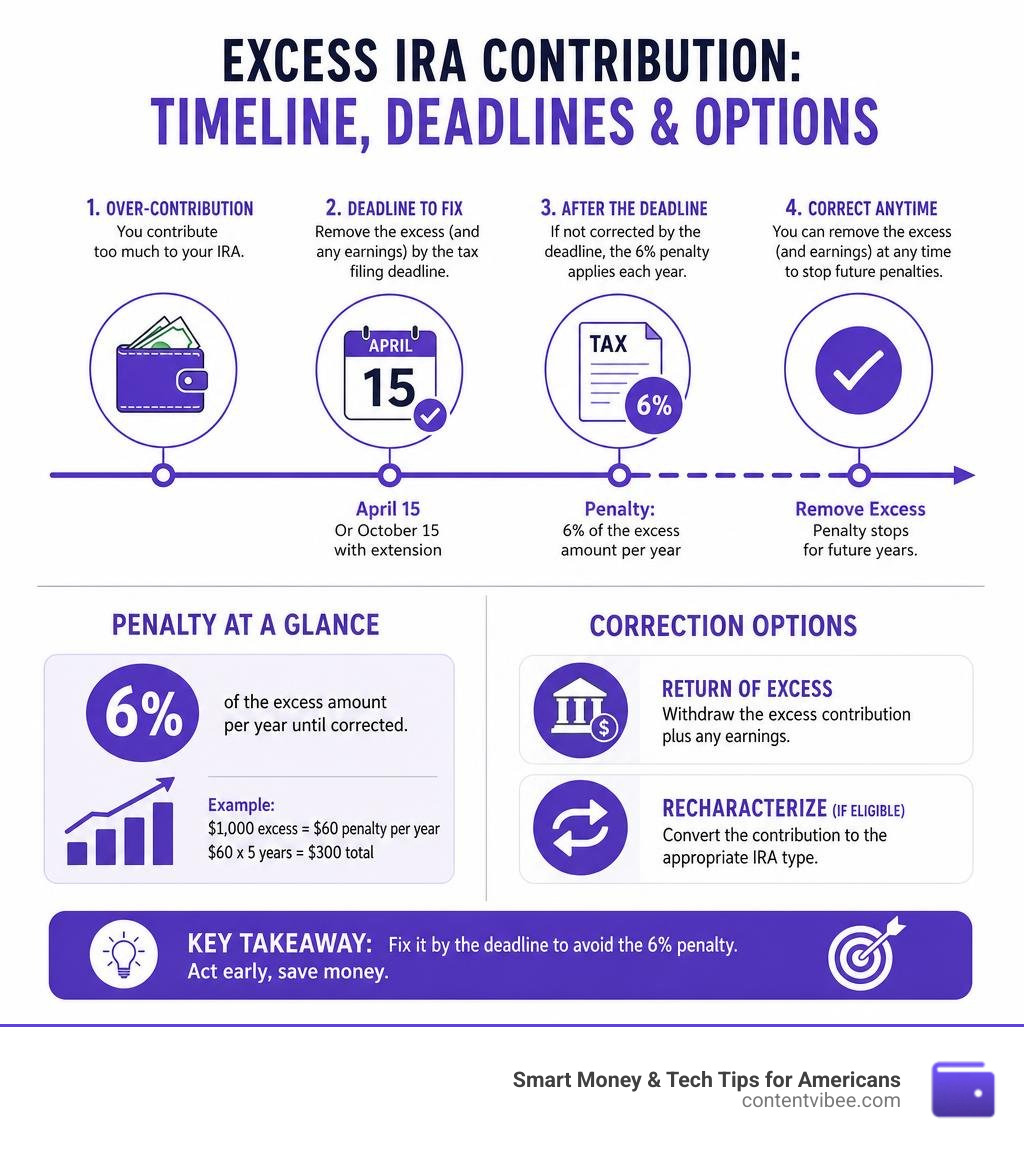
Simple excess ira contribution penalty word guide:
What is an Excess IRA Contribution and Why Does It Happen?

An excess IRA contribution occurs when you put more money into a traditional or Roth IRA than tax laws allow. While we all want to maximize our retirement savings, the IRS sets strict boundaries to prevent taxpayers from sheltering too much money from tax.
For the tax year 2026, the annual aggregate contribution limit across all of your traditional and Roth IRAs is $7,500 if you are under age 50. If you are age 50 or older, you are eligible for an additional “catch-up” contribution of $1,100, bringing your total limit to $8,600.
Exceeding these limits is surprisingly easy to do. Here are the most common reasons we see:
- Losing Track of Multiple Accounts: You might have a traditional IRA with one financial institution and a Roth IRA with another. If you contribute $5,000 to your traditional IRA and another $4,000 to your Roth IRA in 2026, you have combined to contribute $9,000. That is $1,500 over the $7,500 limit.
- Earning Less Than You Contributed: Your total IRA contributions cannot exceed your taxable earned compensation for the year. If you are a college student or a part-time worker who only earned $4,000 in taxable wages in 2026, your maximum IRA contribution is capped at exactly $4,000, even though the general limit is $7,500.
- Roth IRA Income Phase-outs: Roth IRAs have strict income limits. If your Modified Adjusted Gross Income (MAGI) exceeds the IRS thresholds, your allowable contribution limit is reduced or completely phased out. If you make your contribution in January, but receive a big promotion, a bonus, or a new job later in the year that pushes your MAGI above the threshold, your earlier contribution suddenly becomes an excess contribution.
- Backdoor Roth IRA Errors: High earners often use the “backdoor” Roth strategy. This involves contributing to a traditional IRA and then converting it to a Roth IRA. If you make a mistake during the initial non-deductible contribution phase or run into issues with the pro-rata rule, you can inadvertently trigger an excess contribution issue. To see how these accounts compare, check out our guide on The Ultimate Guide to Calculating Your 401k Contributions.
Understanding the Excess IRA Contribution Penalty and How It Accrues
If you make an excess contribution and do not correct it in a timely manner, you will face a 6% excise tax on the excess amount. This is not a one-time fee; it is an annual penalty that continues to accrue every single year the excess funds remain in your account.
According to 26 U.S. Code § 4973, the 6% excise tax is calculated as of December 31 of each tax year. However, the IRS does provide one small piece of leniency: the annual penalty cannot exceed 6% of the combined value of all your IRAs at the close of the taxable year. If your account value falls drastically, the penalty is capped at 6% of the remaining balance.
Let’s look at how these penalties compound over time if left uncorrected:
- Year 1: You contribute $2,000 over the limit. If you do not correct it, you owe a $120 penalty.
- Year 2: The $2,000 remains in the account. You owe another $120 penalty.
- Year 3: Still uncorrected. You owe another $120 penalty.
After three years, you have paid $360 in penalties on a $2,000 mistake, and you still have to remove the money to stop the bleeding!
The IRS tracks these contributions through Form 5498, which custodians send to the IRS every year to report your total contributions. If the numbers on your tax return do not match the numbers on your Form 5498, the IRS’s automated systems will eventually flag the account and issue a tax notice. For more tips on keeping your tax bill low, explore our Smart Strategies to Defer Taxes and Boost Your Retirement Savings.
Three Ways to Fix an Over-Contribution Before the Deadline

If you discover that you have over-contributed to your IRA, do not panic. You have until your tax-filing deadline, including extensions (which typically gives you until October 15 of the year following the contribution), to correct the error and avoid the 6% excise tax entirely.
Depending on your financial situation, you have three primary methods to resolve the issue. If you are weighing how these choices affect your broader retirement plan, you may also want to read The Great Retirement Debate: Roth vs Traditional 401k Calculator Guide.
Option 1: Withdraw the Excess and Earnings
The most direct way to fix the problem is a timely withdrawal. You must contact your IRA custodian and request a “Return of Excess Contribution.”
To avoid the 6% penalty, you must withdraw:
- The exact excess contribution amount.
- Any investment earnings (or losses) generated by that excess money while it was in the account.
If you complete this process before the tax deadline (plus extensions), the returned contribution itself is not taxed. However, the earnings are treated as taxable income in the year you made the original contribution.
When you request this withdrawal, custodians will usually pull the funds from your account’s core money market holdings or cash reserves. If your account is fully invested in stocks or mutual funds, you may need to sell some shares first to free up the cash.
Calculating Net Income Attributable to Avoid the Excess IRA Contribution Penalty
The earnings you must withdraw alongside your excess contribution are technically known as Net Income Attributable (NIA). You cannot simply look at how much the specific stock you bought with the excess money grew. Instead, the IRS requires you to calculate NIA based on the performance of the entire IRA account during the time the excess money was in it.
The mathematical formula for calculating NIA is:
Net Income Attributable = Excess Contribution × [ (Adjusted Closing Balance - Adjusted Opening Balance) / Adjusted Opening Balance ]
To make this easier to understand, let’s look at what these variables mean:
| Variable | Description |
|---|---|
| Excess Contribution | The dollar amount you contributed over your limit. |
| Adjusted Opening Balance | The total value of your IRA immediately before you made the excess contribution, plus the contribution itself. |
| Adjusted Closing Balance | The total value of your IRA immediately before you withdraw the excess, plus any transactions (like other contributions or distributions) made in the interim. |
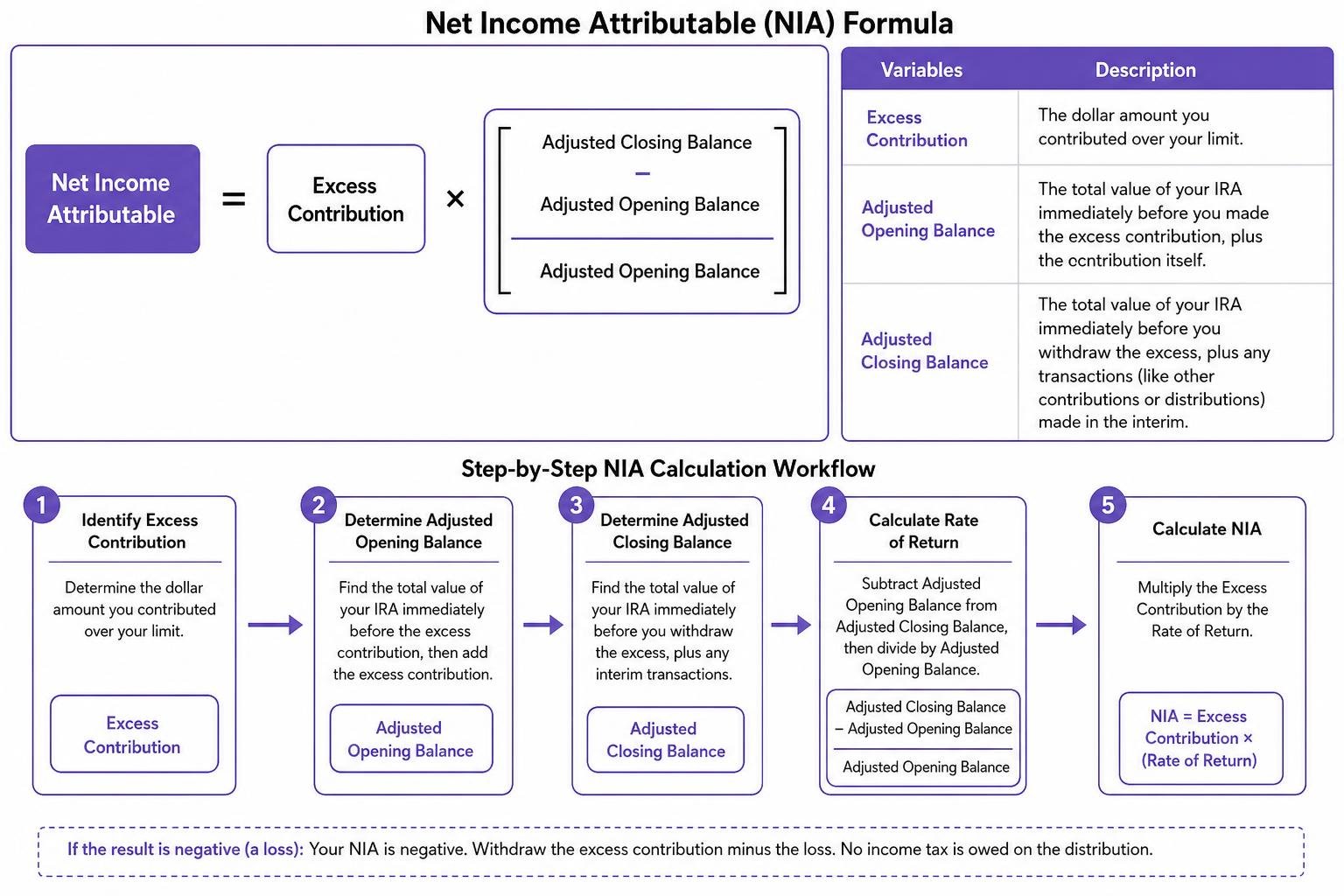
If the calculation results in a negative number (meaning your account lost value), your NIA is negative. In this case, you withdraw the excess contribution minus the loss, and you do not owe any income tax on the distribution.
Option 2: Recharacterize the Contribution
If you contributed to a Roth IRA but realized your income was too high, or you contributed to a traditional IRA but wanted the tax-free growth of a Roth, you can recharacterize the contribution.
Recharacterization treats the contribution as if it were made to the other type of IRA from the very beginning. To do this, you must instruct your custodian to perform a trustee-to-trustee transfer of the excess contribution plus its associated NIA to the second IRA.
This must be completed by your tax-filing deadline (including extensions). A properly executed recharacterization is completely tax-free and avoids the 6% excise tax, provided your total combined contributions still do not exceed the annual limit.
Option 3: Carry Forward to a Future Tax Year
If you miss the October 15 correction deadline, you can choose to apply the excess contribution to a future tax year. This is often called “absorbing” the excess.
For example, if you over-contributed by $1,000 in 2025, you can carry that $1,000 forward and count it as part of your $7,500 contribution limit for 2026.
The catch? You will still owe the 6% excise tax ($60 in this case) on your tax return for the year the excess occurred, because the money remained in the account past the deadline. However, once the new tax year begins and the excess is absorbed into your new contribution room, the penalty stops accruing.
Tax Reporting and the Impact of SECURE 2.0
Correcting your excess contributions requires careful tax reporting. Fortunately, the SECURE 2.0 Act of 2022 made this process significantly cheaper for younger savers. To make sure you understand how these distributions are reported, take a look at Demystifying Form 1099-R and Your Retirement Distributions.
Filing Form 5329 to Report the Excess IRA Contribution Penalty
If you do not correct your excess contribution before the tax deadline, you must file Form 5329, Additional Taxes on Qualified Plans (Including IRAs) and Other Tax-Favored Accounts.
You will use Part III (for traditional IRAs) or Part IV (for Roth IRAs) to calculate the 6% excise tax. The resulting penalty amount is then carried over and reported on Schedule 2 of your Form 1040. You must continue to file Form 5329 and pay the 6% penalty every year until the excess is fully withdrawn or absorbed. For official instructions, you can access the IRS Instructions for Form 5329.
Form 1099-R Codes and SECURE 2.0 Penalty Relief
When you withdraw an excess contribution, your custodian will issue a Form 1099-R in the following calendar year. The distribution codes in Box 7 of this form tell the IRS exactly how the withdrawal was handled:
- Code P: Represents an excess contribution plus earnings withdrawn in the current tax year that is taxable in the prior tax year.
- Code 8: Indicates an excess contribution plus earnings withdrawn in the same tax year the contribution was made.
- Code JP / P2: Specifically used for Roth or traditional IRA timely excess removals with NIA.
Before the passage of SECURE 2.0, if you were under age 59½ and withdrew your excess contribution before the deadline, the earnings (NIA) were subject to both ordinary income tax and a 10% early withdrawal penalty.
SECURE 2.0 eliminated the 10% early withdrawal penalty on earnings removed with timely corrected excess contributions. While you still owe ordinary income tax on the earnings, you are no longer hit with the 10% penalty. If you are a retired tax professional or looking to help others navigate these rules, check out our guide on Retirement Tax Preparer Jobs for Retired Accountants.
The New Statute of Limitations Rules
SECURE 2.0 also introduced a major change to the statute of limitations for excess contributions. Previously, if you failed to file Form 5329 to report an excess contribution, the statute of limitations never started running. The IRS could come back decades later and demand back taxes plus compounding penalties.
Under the new rules, the statute of limitations for excess contributions is capped at six years, starting from the date you filed your Form 1040 for the year the excess occurred.
However, in the landmark tax court case Couturier v. Commissioner, it was ruled that these SECURE 2.0 statute of limitations changes are not retroactive. If you have uncorrected excess contributions from tax years prior to 2023, the IRS can still assess penalties all the way back to the original contribution year.
Frequently Asked Questions about Excess IRA Contributions
What is the absolute deadline to correct an excess contribution?
The absolute deadline to correct an excess contribution to avoid the 6% penalty is the due date of your federal income tax return, including extensions. For calendar year filers, this is typically October 15 of the year following the contribution. Even if you file your taxes on April 15, Treasury Regulation Section 301.9100-2(b) grants an automatic six-month extension to complete the correction, provided you timely filed your original tax return.
Can I correct an excess contribution after I have already filed my taxes?
Yes. If you have already filed your tax return but discover the mistake before the October 15 extension deadline, you can still withdraw the excess and earnings. Once the correction is complete, you must file an amended tax return (Form 1040-X) to report the taxable earnings and adjust your retirement contribution records.
Does the 6% penalty apply to traditional IRAs and Roth IRAs differently?
The 6% penalty rate itself is identical for both traditional and Roth IRAs. However, the rules for determining what constitutes an excess contribution differ due to income limits on Roth IRAs and deduction phase-outs on traditional IRAs. Additionally, if you exceed the limit across both types of accounts simultaneously, IRS rules dictate that you must remove the excess from the Roth IRA first.
Conclusion
Over-contributing to your IRA is an easy mistake to make, but ignoring it can turn a small error into an expensive, compounding tax headache. By acting quickly, calculating your earnings correctly, and choosing the right correction method before the tax deadline, you can protect your retirement nest egg and keep the IRS at bay.
For more tools and resources to help you manage your retirement accounts and optimize your financial strategy, check out our Smart Money & Tech Tips for Americans.


