


Why Every Pre-Retiree Needs a Social Security Calculator in 2026
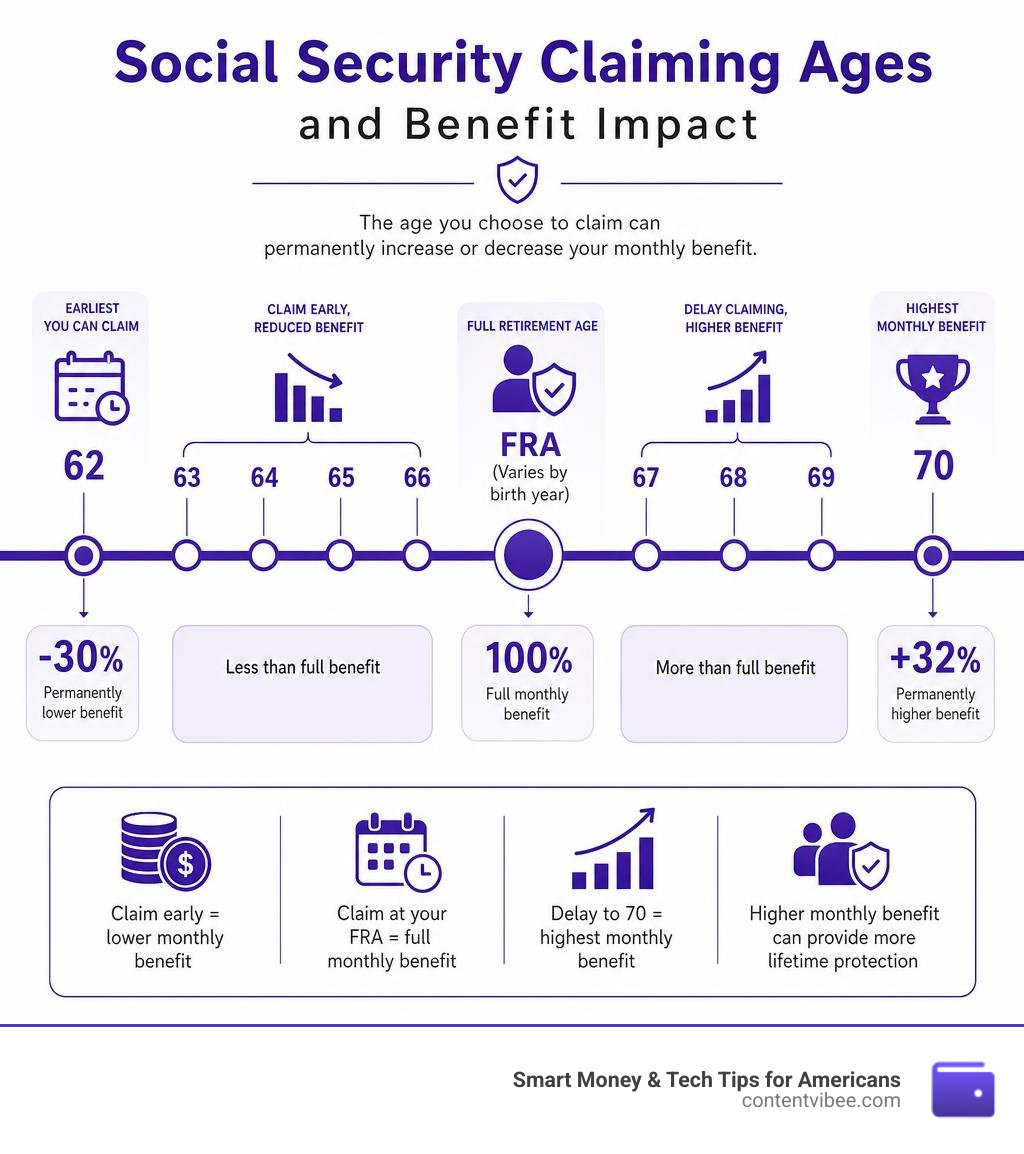
A social security calculator is a free tool that estimates your monthly retirement benefit based on your earnings history, date of birth, and the age you plan to start collecting.
Here’s a quick snapshot of what you can find out:
- Your estimated monthly benefit at age 62, your Full Retirement Age (FRA), or age 70
- How much you lose by claiming early (up to 30% permanently)
- How much you gain by waiting until 70 (up to 32% more than FRA)
- Whether spousal or survivor benefits could pay you more than your own record
- Whether your benefits could be taxed — up to 85% may be, depending on your income
The Social Security Administration offers several free calculators at ssa.gov — from a quick 2-minute estimate to a detailed downloadable tool. Third-party options from organizations like AARP add extra features like claiming-age comparisons and break-even analysis.
Why does this matter so much right now? Because the decision of when to claim is one of the biggest financial choices you’ll make in retirement. A $2,000-per-month benefit at your FRA becomes roughly $1,400 at 62 — or $2,480 at 70. That gap compounds over decades.
With the average 2026 Social Security benefit sitting at $2,071 per month, and the maximum at $4,152 per month for those with 35+ years of high earnings, knowing your number — and when to claim it — can mean tens of thousands of dollars over your lifetime.
This guide walks you through exactly how to use a Social Security calculator, what the numbers mean, and how to fit your benefit into a complete retirement plan.
How a Social Security Calculator Estimates Your Retirement Benefits
At its core, a social security calculator is a matchmaking tool. It takes your unique career profile and matches it against the Social Security Administration’s (SSA) complex formulas. But how does it turn a lifetime of hard work into a single monthly check? Let’s peel back the curtain.
The Core Inputs: Earnings History, Birth Date, and Claiming Age
To generate an estimate, any calculator worth its salt needs three primary pieces of information:
- Your Date of Birth: This determines your official Full Retirement Age (FRA). For anyone born in 1960 or later, your FRA is exactly 67. If you were born before 1960, your FRA is somewhere between 66 and 67, depending on your birth year.
- Your Earnings History: Social Security isn’t a welfare program; it’s an earned benefit. To qualify for retirement benefits, you need to accumulate 40 credits (which equates to roughly 10 years of covered work). However, the calculator doesn’t just look at those 10 years. The final benefit is calculated using your highest 35 years of earnings. If you work fewer than 35 years, the calculator will plug in $0 for the missing years, dragging your average down. Furthermore, only earnings up to the annual wage base limit ($184,500 in 2026) are taxed and counted toward your benefit.
- Your Planned Claiming Age: You can choose to start receiving checks as early as age 62, wait until your FRA, or delay all the way up to age 70.
To see how these inputs play out in real-time, you can follow our guide on how to Estimate Your Monthly Retirement Benefits In 5 Easy Steps to get a handle on your numbers.
Comparing the Official SSA Social Security Calculator with Free Online Tools
Not all calculators are built the same. Depending on how deep you want to dive, you have a few excellent options:
- The SSA Quick Calculator: This tool provides a rough, fast estimate. It’s perfect if you don’t have your historical earnings record handy. You simply enter your date of birth, current year’s earnings, and planned retirement age. The downside? Because it estimates your past earnings based on your current income, it is a rough approximation. You can access it directly via the Social Security Quick Calculator or the Quick Calculator.
- The SSA Online Calculator: A step up in accuracy, this tool requires you to manually input your actual earnings history year-by-year. You can grab these numbers from your official Social Security Statement. It is incredibly accurate but requires some manual data entry.
- The SSA Detailed Calculator: This is a comprehensive software program that you must download and install on a Windows or Mac computer. It is designed for complex scenarios, such as calculating historical benefits or incorporating non-covered pensions.
- Official Hubs: You can compare all government options on the Benefit Calculators | SSA portal.
- Third-Party Tools (e.g., AARP): The Social Security Calculator: Estimate Your Benefits – AARP is highly user-friendly. Instead of just giving you a raw number, it provides a visual breakdown of how your claiming age affects your lifestyle, how working while claiming impacts your checks, and how marital status changes your strategy.
For a complete breakdown of the best no-cost tools available, check out our guide on the Best Free Social Security Calculator Options Your No Cost Retirement Roadmap.
The Math Behind the Estimate: AIME, Bend Points, and PIA
For the math lovers out there, Social Security isn’t calculated using a simple flat rate. It uses a progressive formula designed to replace a higher percentage of income for lower-income earners than for high-income earners.
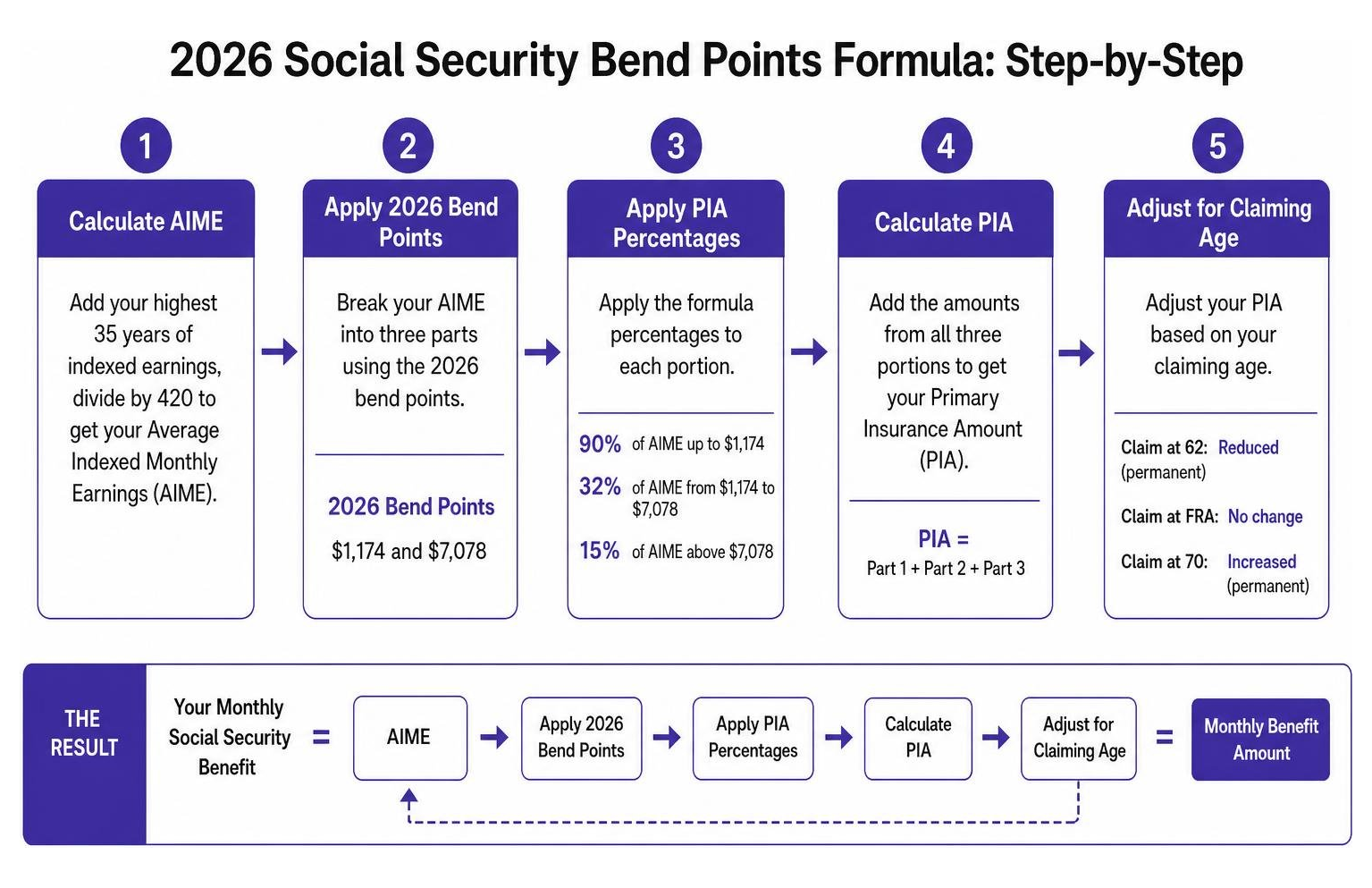
If you want to master the math yourself, our guide on How To Calculate Your Social Security Benefit In 5 Simple Steps is a great place to start. Here is how the process works in practice.
Step 1: Calculating Your Average Indexed Monthly Earnings (AIME)
First, the SSA takes your historical earnings record and adjusts (indexes) each year for wage inflation. This ensures that the $15,000 you earned back in 1985 is valued fairly against today’s economic standards.
Next, they select your highest 35 years of indexed earnings, sum them up, and divide the total by 420 (the number of months in 35 years). This resulting number is your Average Indexed Monthly Earnings (AIME).
Step 2: Applying the 2026 Bend Points to Find Your Primary Insurance Amount (PIA)
Once your AIME is established, the SSA applies three distinct percentage brackets known as “bend points” to determine your Primary Insurance Amount (PIA) — which is the monthly benefit you receive if you claim exactly at your Full Retirement Age.
The bend points lock in the year you turn 62 and are updated annually. For workers reaching age 62 in 2026, the bend points are $1,286 and $7,749.
The progressive formula replaces:
- 90% of the first $1,286 of your AIME
- 32% of your AIME between $1,286 and $7,749
- 15% of any AIME exceeding $7,749
A Real-World Example
Let’s say your 35-year career results in an AIME of $5,000 per month. Using the 2026 bend points, your PIA is calculated as follows:
- First Bracket: 90% of $1,286 = $1,157.40
- Second Bracket: 32% of ($5,000 – $1,286) = 32% of $3,714 = $1,188.48
- Third Bracket: 15% of $0 (since your AIME is below $7,749) = $0.00
Adding these together: $1,157.40 + $1,188.48 = $2,345.88. Your monthly benefit at Full Retirement Age would be $2,345.88.
To test different scenarios or use the official online calculator applets, you can visit the Benefits Planner: Retirement | Online Benefits Calculator | SSA or dive into the offline developer resources at the Benefit Calculators – Estimate Your Benefit page.
How Your Claiming Age Permanently Alters Your Monthly Payout
While your PIA represents your baseline benefit at Full Retirement Age, the age you actually file for benefits acts as a permanent multiplier.
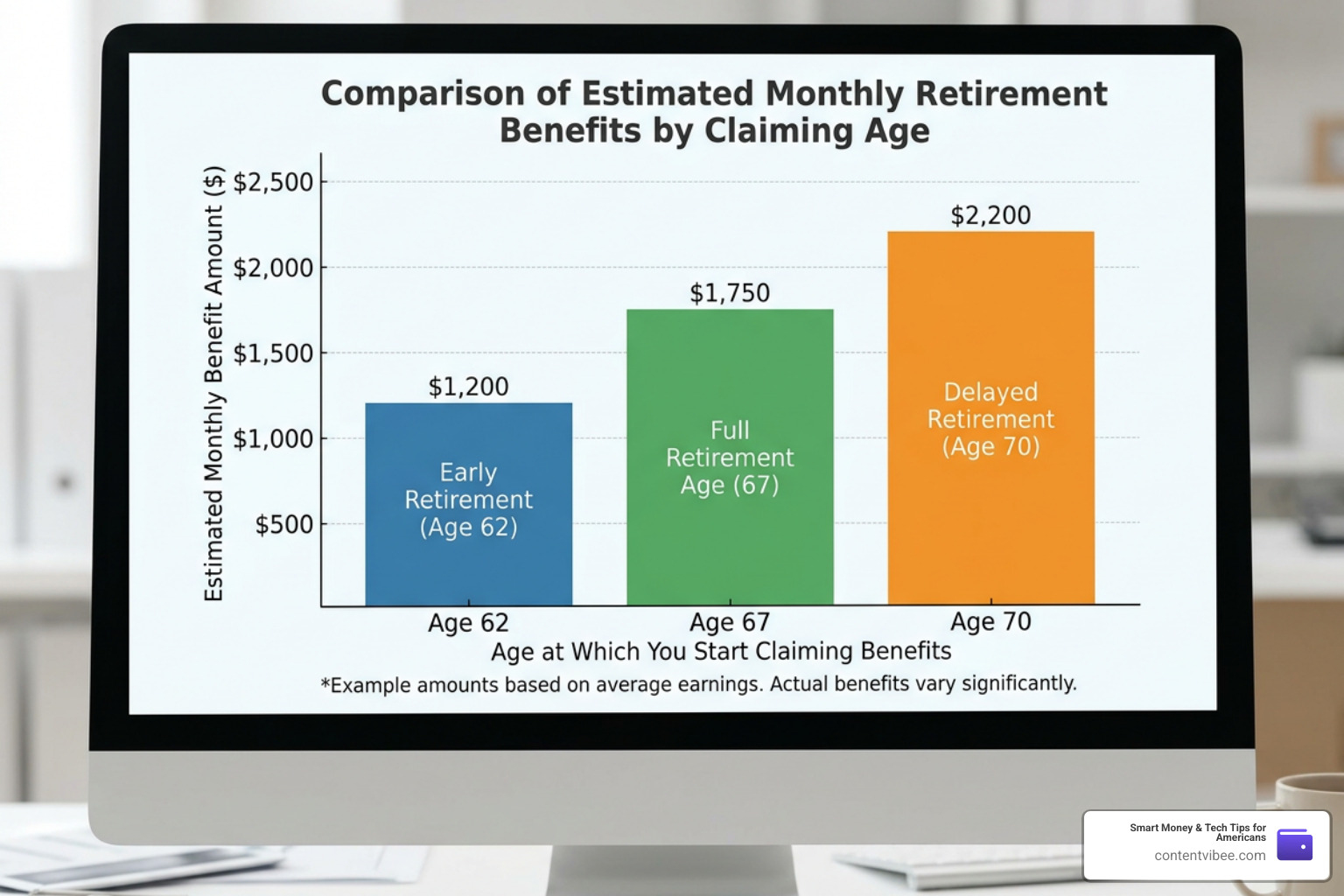
Choosing when to file is a delicate balance of health, savings, and family dynamics. For an in-depth strategy guide, check out Timing Is Everything The Best Age To Take Social Security Calculator Guide.
The Cost of Early Claiming at Age 62
You can claim as early as age 62, but doing so triggers a permanent penalty. If your FRA is 67, claiming at 62 results in a 30% reduction in your monthly check.
The mathematical reduction is calculated as:
- 5/9 of 1% for each of the first 36 months before your FRA.
- 5/12 of 1% for any additional months beyond 36 months.
For a PIA of $2,000, claiming at 62 shrinks your monthly check to $1,400. This reduction is lifelong, meaning you miss out on higher baseline payments and compound Cost-of-Living Adjustments (COLA) over your entire retirement.
Maximizing Your Check with Delayed Retirement Credits at Age 70
On the flip side, patience pays off. For every year you delay claiming past your FRA up to age 70, you earn Delayed Retirement Credits of 8% per year (or 2/3 of 1% per month).
If your FRA is 67 and you wait until age 70, you will receive a permanent 24% bonus on top of your PIA. Using our $2,000 PIA example, waiting until 70 bumps your monthly check to $2,480. When combined with compounding COLA, your age-70 check is often roughly 76% larger than your age-62 check.
Advanced Planning: Spousal Benefits, Taxes, and the Earnings Test
As you build a comprehensive retirement strategy, you must look beyond your individual earnings record. Social Security is a household asset that requires careful coordination.

To see how these benefits fit alongside your personal savings, check out our Retirement Calculator Estimate Savings Needed to map out your total income floor.
Using a Social Security Calculator for Spousal and Survivor Benefits
If you are married, divorced, or widowed, you may qualify for benefits based on your partner’s work record instead of (or in addition to) your own:
- Spousal Benefits: A lower-earning spouse can claim up to 50% of the higher earner’s PIA when claimed at their own FRA. If your spouse’s PIA is $3,000 and yours is $1,000, you can opt for a spousal benefit of $1,500 instead of your own.
- Survivor Benefits: If your spouse passes away, you can switch from your own benefit to 100% of the deceased spouse’s monthly benefit (including any delayed retirement credits they earned). This is why it is often mathematically advantageous for the higher earner to delay claiming until age 70 — it secures a larger survivor benefit for the remaining spouse.
- Divorced-Spouse Benefits: If you were married for at least 10 years, are currently unmarried, and are age 62 or older, you can claim spousal benefits based on your ex-spouse’s record without affecting their current household benefits.
For married couples looking to coordinate their strategies, we highly recommend reading Do The Math Top Social Security Calculators For Married Couples and utilizing our interactive Tools/Finance Calculator/Social Security Spousal Benefit Calculator.
How the Earnings Test and Federal Taxes Affect Your Net Payout
Many retirees are surprised to find that their Social Security checks can be reduced by work or taxed by Uncle Sam.
The Retirement Earnings Test
If you claim benefits before reaching your FRA and continue to work, the SSA will temporarily withhold benefits if your earnings exceed annual limits. In 2026, the limit is $24,480. For every $2 you earn over this limit, the SSA withholds $1 of benefits.
In the year you reach FRA, the limit rises to $65,160, with $1 withheld for every $3 earned over the limit up until the month you hit FRA. Once you reach your FRA, the earnings test disappears entirely, and your monthly benefit is permanently recalculated upward to credit you for the months benefits were withheld.
Taxation of Benefits
Whether your benefits are taxable depends on your combined income (Adjusted Gross Income + Non-Taxable Interest + 50% of your Social Security benefits):
| Combined Income (Single) | Combined Income (Married Jointly) | Taxable Portion of Benefits |
|---|---|---|
| Under $25,000 | Under $32,000 | 0% |
| $25,000 – $34,000 | $32,000 – $44,000 | Up to 50% |
| Over $34,000 | Over $44,000 | Up to 85% |
Frequently Asked Questions about Social Security Benefits
What is the maximum Social Security benefit in 2026?
The maximum monthly benefit at Full Retirement Age in 2026 is $4,152. To qualify for this amount, you must have earned at or above the maximum taxable wage base ($184,500 in 2026) for at least 35 years of your career. If you delay claiming until age 70, the maximum benefit increases to approximately $5,251 per month.
Will Social Security run out before I retire?
No. While the OASI Trust Fund is currently projected to be depleted around 2034, this does not mean benefits will drop to zero. If Congress takes no legislative action, ongoing payroll taxes will still be sufficient to fund approximately 77% of scheduled benefits.
Can I work while collecting Social Security retirement benefits?
Yes, you can work at any age while collecting benefits. However, if you are under your Full Retirement Age, your monthly checks will be subject to the Retirement Earnings Test limits ($24,480 in 2026). Once you reach your FRA, there are no earnings limits or benefit reductions.
Conclusion
Navigating retirement planning in 2026 requires balancing personal savings, tax strategies, and government benefits. At Smart Money & Tech Tips for Americans, we leverage our specialized platform, ContentVibee, to deliver clear, actionable guidance on complex financial regulations. Whether you are navigating the SECURE Act 2.0 RMD changes or mapping out your Social Security claiming strategy, utilizing a social security calculator is the first step toward building a reliable income floor.
Ready to see your personalized numbers? Head over to our Social Security Calculator Estimate Your Benefit Amount to take control of your retirement roadmap today!


