


What You Need to Know About Government Pension Offset Spousal Benefits
Government pension offset spousal benefits were reduced — or completely eliminated — for hundreds of thousands of Americans who received a pension from a government job not covered by Social Security. But that changed in 2025.
Here’s the quick answer:
- The Government Pension Offset (GPO) was a rule that cut Social Security spousal or survivor benefits by two-thirds of your non-covered government pension
- It applied to workers in jobs that did not withhold Social Security taxes — such as some teachers, police officers, and federal employees under the old Civil Service Retirement System
- The Social Security Fairness Act, signed on January 5, 2025, repealed the GPO entirely
- The repeal is retroactive to January 2024, meaning affected beneficiaries are owed back payments
- If your spousal or survivor benefits were reduced or eliminated by the GPO, you may be entitled to a lump-sum payment plus higher ongoing monthly benefits
Before the repeal, the GPO affected roughly 746,000 people — about 13% of all Social Security spousal and survivor beneficiaries. Nearly 70% of them had their entire spousal benefit wiped out.
If you’re nearing retirement or already receiving benefits, understanding how the GPO worked — and what the repeal means for your payments — could put real money back in your pocket.
Understanding Government Pension Offset Spousal Benefits
To truly understand how government pension offset spousal benefits work under the new post-repeal landscape, we have to look at why this rule existed in the first place.
Originally established by Congress in the Social Security Amendments of 1977, the GPO was designed to address what policymakers saw as an “unfair advantage.” In the traditional Social Security system, spousal and survivor benefits are considered “dependent” benefits. They were created in the 1930s and 1950s to support spouses (predominantly wives at the time) who stayed at home or had very low lifetime earnings and were financially dependent on a working spouse.
If you work a job covered by Social Security and earn your own retirement benefit, the “dual entitlement rule” prevents you from double-dipping. Under dual entitlement, your spousal benefit is reduced dollar-for-dollar by the amount of your own Social Security retirement benefit.
However, before 1977, government workers who did not pay Social Security taxes on their earnings (non-covered work) could collect their full, unreduced government pension and a full, unreduced Social Security spousal or survivor benefit based on their partner’s work history. Congress created the GPO to replicate the dual entitlement rule for these public sector employees.
To read the official history and policy logic, you can check out the Program Explainer: Government Pension Offset.

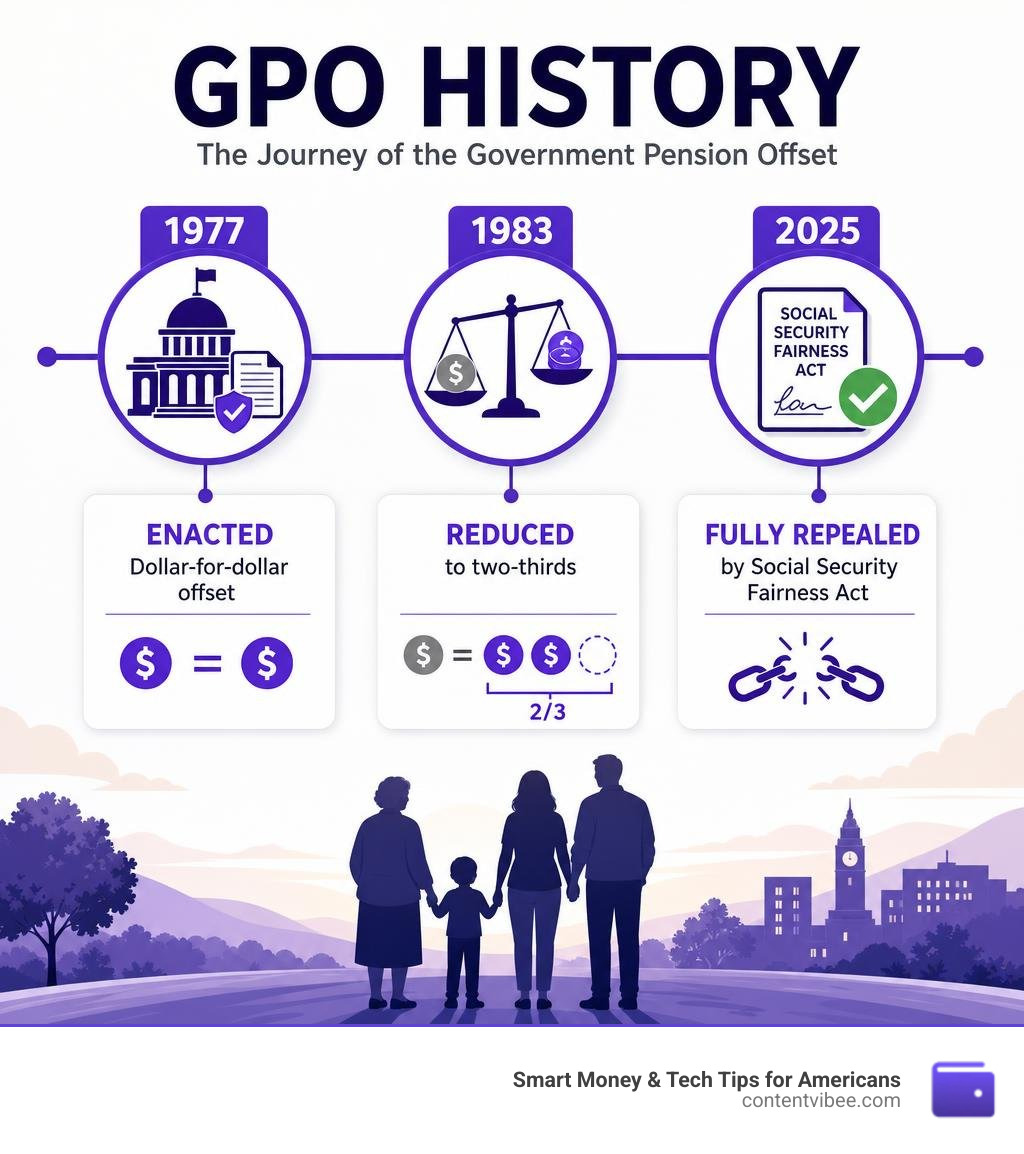
Under the original 1977 law, the GPO was a dollar-for-dollar offset. However, in 1983, Congress reduced the penalty to a two-thirds offset. Even with that reduction, the offset remained a massive financial burden for public servants. For decades, those entitled to dependent benefits found themselves facing severe cuts. If you want to understand the baseline eligibility for these benefits, read our guide on The Golden Rules Can a Spouse Collect SS Spousal Benefits?.
Who Was Affected by Government Pension Offset Spousal Benefits?
The GPO did not apply to all government workers. In fact, roughly 72% of state and local government employees are covered by Social Security and were completely unaffected by this rule. Additionally, all federal employees hired since 1984 are covered by Social Security under the Federal Employees Retirement System (FERS).
Instead, the GPO target fell on public servants who worked in non-covered positions. This primarily included:
- State and local government employees in certain states (such as teachers, firefighters, and police officers)
- Federal workers hired before 1984 who remained under the Civil Service Retirement System (CSRS)
The geographic impact of the GPO was highly uneven. For example, in New York, about 95% of state and local public employees are covered by Social Security. But in states like Ohio and Massachusetts, coverage is less than 3%. This meant public servants in those states bore the brunt of the GPO’s penalties.
According to data compiled in the Social Security: The Government Pension Offset (GPO) report, the demographics of those affected were striking:
- As of December 2019, 707,879 beneficiaries had their spousal or survivor benefits reduced or eliminated by the GPO.
- Women accounted for roughly 83% of those affected, largely because women are historically more likely to claim spousal or survivor benefits.
- 54% of affected individuals were receiving spousal benefits, while 46% were receiving widow or widower benefits.
The rule also applied to divorced spouses who were eligible for benefits based on an ex-spouse’s work history. To understand how these rules interacted with former marriages, you can read our breakdown on Surviving Divorced Spouse Benefits Explained Simply.
Historical Exemptions and Exceptions to the GPO
Before the sweeping legislative changes of 2025, the Social Security Administration (SSA) maintained a narrow list of exceptions where the GPO would not apply to a non-covered pension. According to the SSA – POMS: GN 02608.100 – Government Pension Offset (GPO) Provision – 06/23/2022 policy manual, these historical exemptions included:
- The Last-Day Rule: If you were a federal, state, or local government employee and your transition to a covered position occurred on your very last day of employment before July 1, 2004, you could escape the offset.
- The 60-Month Rule: For those retiring after July 1, 2004, you had to work in a Social Security-covered government job for at least the final 60 months of your government service to be exempt from the GPO.
- Pensions Not Based on Earnings: If your government “pension” was actually a payment that didn’t stem from earnings (such as a commercial annuity or certain survivor pensions), the GPO did not apply.
- Military Reservists: Pensions based entirely on military reserve service were exempt.
Navigating these loopholes was incredibly complex, often requiring public employees to plan their final years of work with extreme precision. For those curious about how working in retirement affects a pension, our guide on Working After Retirement Do You Have to Be Retired to Collect a Pension? offers valuable insights.
The Social Security Fairness Act of 2025 and the Repeal of GPO
For years, advocacy groups representing teachers, police officers, and firefighters lobbied Congress to eliminate what they viewed as a discriminatory penalty on public service. Their efforts culminated on January 5, 2025, when the President signed the Social Security Fairness Act into law.

This landmark legislation completely repealed both the Government Pension Offset (GPO) and the Windfall Elimination Provision (WEP). Under the act, public pensions from non-covered work no longer have any bearing on your eligibility for, or calculation of, Social Security benefits.
Here are the key details of the repeal:
- Effective Date: The law went into effect immediately upon signing in January 2025, but the repeal of the GPO was made retroactive to benefits payable after December 2023 (meaning it took effect starting January 2024).
- Implementation Timeline: The SSA began issuing retroactive lump-sum payments for the 2024 calendar year starting in February 2025. Adjusted monthly benefit payments reflecting the complete elimination of the offset began rolling out in April 2025, with major retroactive payout projects largely completed by July 2025.
- Official Clarification: The SSA updated its guidelines to confirm that non-covered pensions will no longer impact spousal rates. You can view the official confirmation on the Will Social Security reduce my spouse’s benefits if I get a government pension based on my own earnings? | Frequently Asked Questions | SSA page.
This change is a massive financial victory for retirees, injecting billions of dollars back into the pockets of public servants. To see how this fits into the broader scope of retirement planning, take a look at A Comprehensive Guide to Social Security Benefits.
Steps to Claim Retroactive Payments and Adjusted Benefits
If you were already retired and receiving a reduced spousal benefit prior to 2025, or if your spousal benefit was reduced to $0, the SSA was tasked with automatically adjusting your record. However, with millions of accounts to process, hiccups can happen.
If you believe you are owed retroactive payments or haven’t seen your monthly benefit adjust to its full, unreduced amount, here are the steps you should take:
- Verify Your SSA Account: Log into your personal “my Social Security” account online. Check your payment history to see if a lump-sum retroactive payment was deposited in early-to-mid 2025.
- Review Form SSA-1945: State and local government employers are still legally required to provide Form SSA-1945 to new employees to notify them of non-covered status, but the form was updated in March 2025 to clarify that non-covered earnings will not reduce future benefits. Ensure your employment history is correctly categorized.
- Contact the SSA: If your benefits are still showing a reduction, call the SSA at 1-800-772-1213 or visit your local field office. Be prepared to provide documentation of your non-covered pension amounts and your retirement date.
- Coordinate Survivor Benefits: If you are a surviving spouse whose widow(er) benefits were previously wiped out by the GPO, you must contact the SSA to have your survivor benefits reinstated. For help navigating this, read Claiming Whats Yours A Guide to Deceased Spouse Social Security.
How the GPO Calculation Worked: Step-by-Step
To understand the magnitude of the 2025 repeal, we have to look at how punishing the GPO calculation actually was. The GPO used a strict two-thirds reduction formula.
Before the repeal, if you received a monthly pension from a non-covered government job, the SSA would calculate two-thirds of that pension amount and subtract it from your potential Social Security spousal or survivor benefit.
According to the SSA – POMS: GN 02608.401 – Applying Government Pension Offset (GPO) – 07/29/2013 guidelines, the offset applied to the final payable spousal benefit after any reductions for early retirement were already calculated. If two-thirds of your pension was larger than your potential spousal benefit, your Social Security payment was reduced to zero.
Let’s look at the real-world numbers to see how this played out. In 2022, the average non-covered pension for someone affected by the GPO was $2,690 per month.
- Two-thirds of $2,690 is $1,793.
- Because the average Social Security retired worker benefit in 2022 was $1,825, a typical spousal benefit (which is 50% of the worker’s benefit) would be around $912.
- Since the $1,793 offset was far larger than the $912 spousal benefit, the beneficiary received $0 in spousal benefits.
Nearly 70% of all affected beneficiaries had their entire spousal or survivor benefit completely eliminated under this formula. They had an average monthly non-covered pension of $3,502.
Conversely, those who had a partial offset had smaller pensions, averaging $999 per month. Two-thirds of $999 is $666. If their potential spousal benefit was $900, they would still receive a partial payment of $234 per month ($900 – $666). For couples looking to optimize their joint retirement strategies in light of these changes, we highly recommend reading The Smart Couples Guide to Social Security Strategies.
How to Calculate Government Pension Offset Spousal Benefits
While you no longer have to worry about this offset cutting into your retirement, calculating your historical or retroactive benefits requires understanding the step-by-step math the SSA used. Here is how the “how-to” calculation worked:
- Determine the Monthly Non-Covered Pension: Find your gross monthly pension amount (before tax withholdings or health insurance deductions). If you took a lump-sum pension instead of monthly payments, the SSA prorated that lump sum as if you had received it monthly over your lifetime.
- Calculate the Two-Thirds Offset: Multiply your monthly pension by 0.667 (two-thirds). Round this number up to the nearest dime.
- Determine the Base Spousal Benefit: Calculate your potential Social Security spousal or survivor benefit (typically 50% of your living spouse’s Primary Insurance Amount, or up to 100% of a deceased spouse’s benefit).
- Subtract the Offset: Subtract the two-thirds offset from your base spousal benefit.
Let’s walk through an example:
- Step 1: Your monthly non-covered teacher’s pension is $3,000.
- Step 2: Two-thirds of your pension is $2,000 ($3,000 x 2/3).
- Step 3: Your spouse’s Social Security benefit is $2,400, making your potential spousal benefit $1,200 (50% of $2,400).
- Step 4: Subtract the offset: $1,200 (spousal benefit) – $2,000 (GPO offset) = -$800.
Because the offset is greater than the benefit, your spousal benefit was reduced to $0. Under the new post-2025 rules, however, you now receive the full $1,200 spousal benefit in addition to your $3,000 pension!
For an in-depth look at how working spouses can coordinate these benefits, check out Double Dipping The Working Spouses Guide to Social Security.
GPO vs. WEP and the Dual Entitlement Rule
It is very common to confuse the Government Pension Offset (GPO) with the Windfall Elimination Provision (WEP) and the Dual Entitlement Rule. While they all relate to benefit reductions, they target different types of benefits and use completely different formulas.
| Provision / Rule | What It Affects | How the Reduction Was Calculated | Who It Targets | Status in 2026 |
|---|---|---|---|---|
| Government Pension Offset (GPO) | Spousal and survivor benefits | Reduced by two-thirds of the non-covered pension amount | Spouses with their own non-covered government pensions | Fully Repealed (Retroactive to Jan 2024) |
| Windfall Elimination Provision (WEP) | Your own retirement or disability benefits | Adjusted “bend points” in the benefit formula, reducing payments by up to 50% | Workers with both non-covered pensions and covered work history | Fully Repealed (Retroactive to Jan 2024) |
| Dual Entitlement Rule | Spousal and survivor benefits | Reduced dollar-for-dollar (100%) by your own Social Security benefit | Workers entitled to both their own SS benefit and a spousal benefit | Active (No changes made) |
As shown in the table, the WEP affected your own retirement benefit if you had a non-covered pension but also worked enough years in the private sector to qualify for Social Security. You can read more about how the WEP used to operate in our guide: Social Security WEP Is the Government Eating Into Your Pension?.
The GPO, on the other hand, only applied to spousal and survivor benefits. For a deeper policy analysis of these differences, refer to the congressional report on the Offset (GPO).
How GPO Interacted with Medicare Premiums
One of the most confusing aspects of the GPO was its interaction with Medicare Part B. Normally, when you turn 65, your Medicare Part B premiums are automatically deducted from your monthly Social Security check.
But what happened when the GPO reduced your monthly Social Security spousal benefit to $0?
- Eligibility: Your eligibility for Medicare at age 65 based on your spouse’s work record was never affected by the GPO. You could still enroll.
- Premium Payments: Because the SSA could not deduct premiums from a $0 monthly benefit, Medicare would bill you directly. You had to pay your premiums quarterly, or set up “Medicare Easy Pay” to have them auto-drafted from a bank account.
- Post-Repeal Changes: Now that the GPO is repealed and your spousal benefits are restored, your Medicare Part B premiums can once again be automatically deducted from your monthly Social Security check.
Optimizing these deductions is a vital part of protecting your retirement nest egg. To learn more, read The Ultimate Guide to Social Security Benefit Optimization.
Frequently Asked Questions about the Government Pension Offset
What was the main purpose of the Government Pension Offset?
The GPO was created in 1977 to establish parity between public-sector employees who did not pay Social Security taxes and private-sector employees who did. Under the dual entitlement rule, a private-sector worker’s spousal benefit is reduced dollar-for-dollar by their own retirement benefit. The GPO attempted to mirror this by reducing spousal benefits by two-thirds of a public servant’s non-covered pension.
Did the GPO affect my own Social Security retirement benefits?
No. The GPO only applied to dependent benefits (spousal, divorced spousal, and survivor benefits). If you qualified for Social Security retirement benefits based on your own private-sector employment, those benefits were subject to the Windfall Elimination Provision (WEP) rather than the GPO. For a complete guide on navigating dual benefits, read His Hers and Ours The Ultimate Guide to Dual Social Security Benefits.
How does the 2025 repeal affect Medicare eligibility?
The repeal does not change your eligibility for Medicare, which remains available at age 65. However, because your spousal benefits are no longer offset to $0, you can now have your Medicare premiums deducted directly from your monthly Social Security check instead of paying quarterly bills.
Conclusion
The repeal of the Government Pension Offset through the Social Security Fairness Act has completely transformed the retirement landscape for public servants. For decades, teachers, firefighters, and police officers were penalized for their service, losing hard-earned spousal and survivor benefits. Now, those benefits are fully restored, retroactively back to January 2024.
At ContentVibee, we believe that maximizing your financial security in retirement starts with having the right information. Now is the perfect time to review your benefits, contact the SSA to claim any outstanding retroactive payments, and adjust your financial plan.
Ready to see how much you could receive under the new rules? Calculate your potential spousal benefits today using our free online tool!


